ZKsync Caught in Insider Trading Controversy: Unusual Airdrop Criteria, Witch Addresses Receive Large Airdrops
TechFlow Selected TechFlow Selected
ZKsync Caught in Insider Trading Controversy: Unusual Airdrop Criteria, Witch Addresses Receive Large Airdrops
The golden age of interactive airdrops may be coming to an end on ZKsync...
 Navigating Web3 tides with focused insights
Author: Nan Zhi, Odaily Planet Daily
Yesterday, ZKsync announced it will conduct its token airdrop next week and opened a portal for users to check their eligibility. After four years of interactions, the long journey finally reached its end. However, compared to previous Layer 2 projects such as Optimism and Arbitrum, the proportion of addresses qualifying for the ZKsync airdrop is significantly lower. Out of 6,826,968 total ZKsync chain addresses, only 695,232 are eligible—approximately 10%. According to community statistics, just 9,203 addresses received 23.9% of the total airdrop supply.
Following this, ZKsync officially released detailed airdrop criteria. While the rules aren't outright "strict," they deviate notably from conventional standards, leading to rising community accusations of insider allocations ("rat farming") within the project.
Why Are So Few Addresses Eligible?
Prior to ZKsync’s official announcement, analytics platforms like Nansen and TrustGo, as well as some crypto KOLs, had projected potential recipient numbers. In TrustGo's report, around 2.9 million addresses met their qualification threshold, while even under stricter criteria, about 2.05 million would qualify. Crypto influencer @DefiWimar analyzed code from the ZK Nation website and estimated that 1,650,351 addresses would be eligible for the ZKsync airdrop.
Yet the final number of qualified addresses fell far below expectations. Why? A major reason lies in ZKsync setting relatively unconventional requirements. Consider a benchmark address highlighted in TrustGo’s earlier report, ranked No. 500,000 under their model:
-
Interaction volume: $29,700;
-
Cross-chain volume: $3,356;
-
Active months: 11;
-
Transaction count: 182;
-
Unique contract interactions: 27;
-
Account age: 312 days.
Despite meeting these seemingly robust metrics, this benchmark address fulfilled only one of ZKsync’s seven mandatory conditions. Typically, airdrops prioritize activity level, duration, and capital scale. But ZKsync introduced seven specific thresholds: interacting with at least 10 contracts, providing liquidity, using Paymaster, trading 10 different ERC-20 tokens, and holding the Genie NFT. These criteria effectively excluded most “farming” or “lottery” accounts.
Although Odaily translated a ZKsync report back in April highlighting that “Paymaster and LIBERTAS OMNIBUS COLLECTION would become key differentiators,” that article was published after the snapshot date.
After passing the initial gate, ZKsync also implemented an innovative fund-retention requirement, which became a core parameter in calculating airdrop distribution.
Caught in a Rat Farming Scandal
If the rules were merely strict or slightly unusual, the community might have accepted them. However, ZKsync’s series of questionable actions has intensified skepticism.
Opaque Decision-Making Authority
First, ZKsync established seven mandatory conditions—one of which must be met to proceed to the next stage. Yet in their official document, ZKsync emphasized:
"Meeting one or more of the above airdrop criteria does not confer any legal right or claim to receive the airdrop; all decisions related to airdrop allocation shall be made at the sole discretion of the ZKSync Association."
This wording sparked significant backlash among users, many of whom accused ZKsync of enabling insider allocations and unfairly taking tokens away from legitimate participants.
Moreover, ZKsync stated in the document that any eligible address receiving fewer than 450 tokens would have its allocation reclaimed. As the saying goes, people don’t mind scarcity—they mind inequality. This clause further inflamed community tensions.
Nansen Distances Itself
After numerous addresses were filtered out of the airdrop, some users blamed Nansen for conducting anti-Sybil measures and wallet screening on behalf of ZKsync, resulting in lost eligibility.
In response, Nansen quickly issued a statement clarifying: "We provided Matter Labs with data on specific wallets, such as whale accounts and known scammers. However, we did not implement any anti-Sybil measures, nor did we make recommendations regarding the airdrop distribution itself."
Suspicious Addresses Emerge, But Official Silence Remains
After the airdrop checker went live, wealth-flaunting screenshots began circulating across the community. One mysterious address—0xF1802d9a70Bdc6F6EffD65d44b33226eE0E6A821—immediately drew scrutiny. The maximum airdrop for regular users was capped at 100,000 tokens, yet this single address received 5.64 million. Alongside it, various other low-activity addresses with disproportionately high allocations surfaced online.
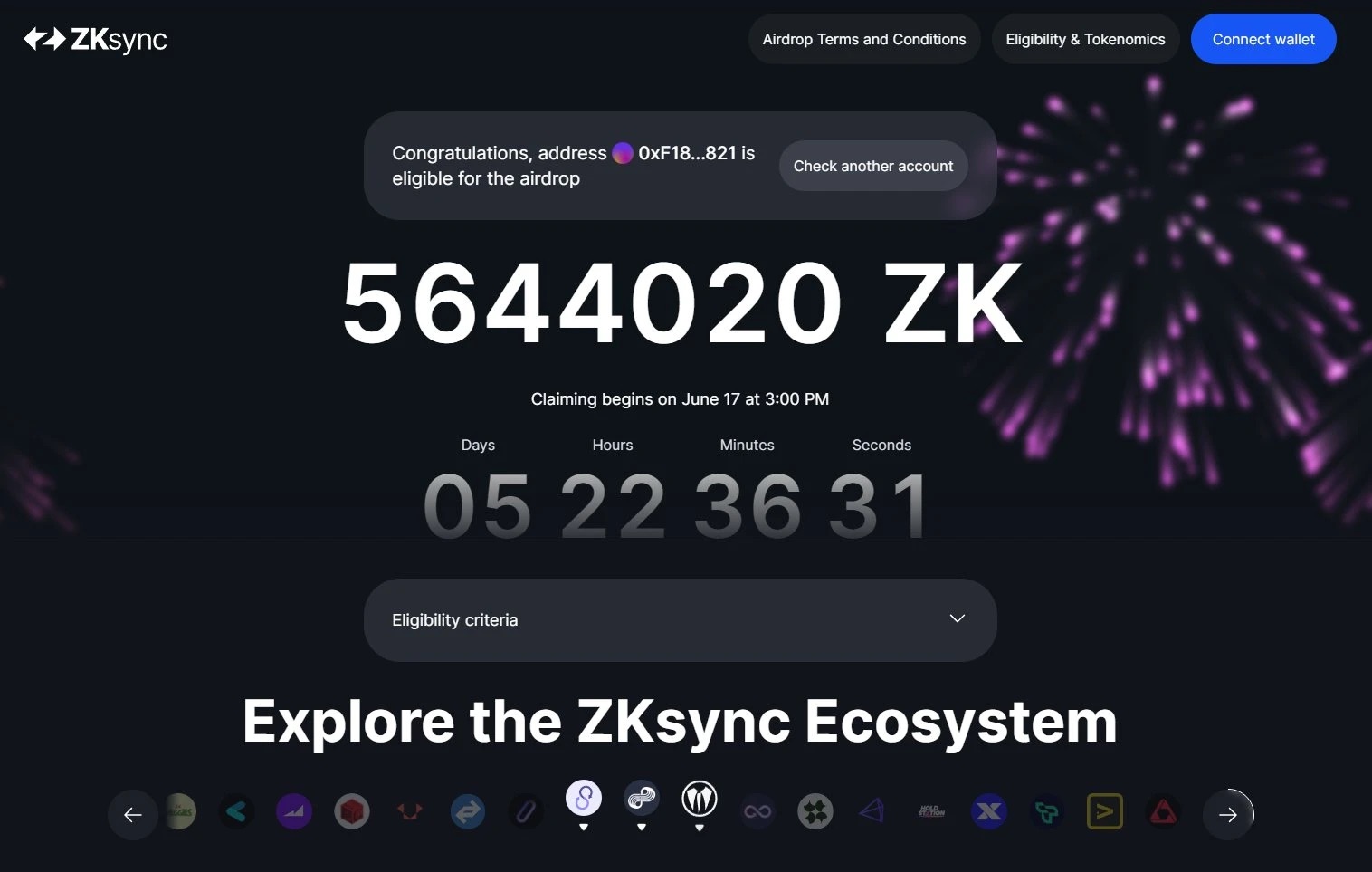
Neither the official ZKsync account nor ZKNation responded directly. 80 minutes later, zkSwap Finance—a DEX in the ZKsync ecosystem—stepped forward to clarify: the address belonged to zkSwap and the tokens were allocated for project development. zkSwap stressed that these tokens would be used to grow the protocol and benefit the community, which temporarily calmed the controversy.
However, not all concerns were addressed. Numerous known Sybil addresses previously flagged by the community still received ZKsync airdrops—including wallets identified as Sybils during Arbitrum’s airdrop over a year ago and those recently exposed in the LayerZero case.
According to Artemis, a prominent Sybil hunter who posted on X (formerly Twitter), a single Sybil operator who profited $4.2 million from Arbitrum’s airdrop remains eligible to claim nearly 1,000,000 ZK tokens through over 3,000 wallets.
Further investigation by Artemis revealed that certain rat farm clusters deposited identical amounts of ETH on the same day and collectively received over 2 million ZK tokens, averaging 15,000 ZK per wallet. Crucially, almost all these accounts appear on @LayerZero_Labs’ public Sybil list.
Once again, mirroring the earlier silence, neither official account addressed the allegations. Only ZKsync CEO Alex continued sharing positive narratives about the airdrop.
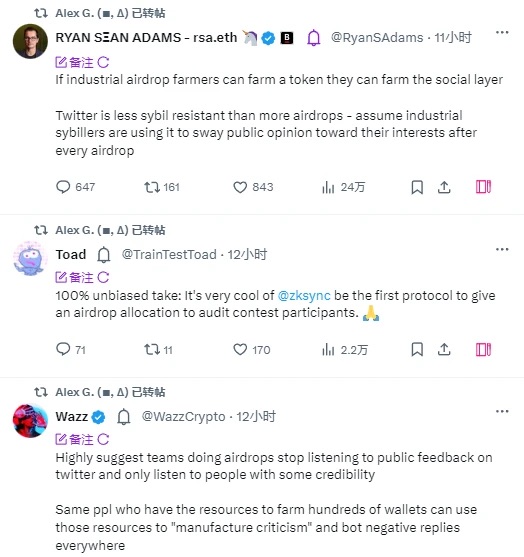
Protests Continue
ZKsync’s continued silence has fueled ongoing resistance. Calls are now spreading for major exchanges to refuse listing the ZK (ZKsync) token and to return the “ZK” name to Polyhedra. However, the likelihood of ZKsync listening to community feedback and revising its airdrop rules or scope appears nearly zero.
Looking back at the "farm-and-go" process, Starknet’s 0.005 ETH threshold and ZKsync’s fund-retention calculation rule signal a clear trend: the days of earning large airdrops simply through frequent interactions and long holding periods are fading. Increasingly, high capital thresholds dominate, making such models functionally equivalent to point-based systems. The golden era of user-driven interaction may be coming to an end—with ZKsync marking its finale.
Join TechFlow official community to stay tuned
Telegram:https://t.me/TechFlowDaily
X (Twitter):https://x.com/TechFlowPost
X (Twitter) EN:https://x.com/BlockFlow_News
 Odaily