May Blockchain Gaming Report: Market Cap Growth, Shifts in Player Engagement, and the Rise of Mini Games
TechFlow Selected TechFlow Selected
May Blockchain Gaming Report: Market Cap Growth, Shifts in Player Engagement, and the Rise of Mini Games
The total market capitalization continues to grow, player participation models are gradually evolving, and mini-games and gaming bots are emerging.
 Navigating Web3 tides with focused insights
Written by: [email protected]
In May 2024, Ethereum's performance was significantly boosted by the SEC’s approval of a preliminary application for a spot Ethereum ETF. The total market capitalization of blockchain gaming tokens reached $20.1 billion, up 6.7% month-on-month. However, despite this growth in market cap, the industry experienced an interesting shift in user engagement—transaction volume declined while daily active users hit a new high. Additionally, the rising popularity of mini-games and gaming bots is gradually reshaping the gaming landscape.
The data in this report comes from Footprint Analytics’ Blockchain Gaming Research page—an easy-to-use dashboard containing the most important statistics and metrics for understanding the blockchain gaming industry, updated in real time.
Macro Market Review
In May 2024, Bitcoin rebounded strongly from its late-April lows, climbing from $60,653 at the start of the month to $67,606 by month-end—a 11.5% increase. Meanwhile, Ethereum also demonstrated robust recovery, rising from $3,011 to $3,778 during the same period, marking a substantial gain of 25.5%.
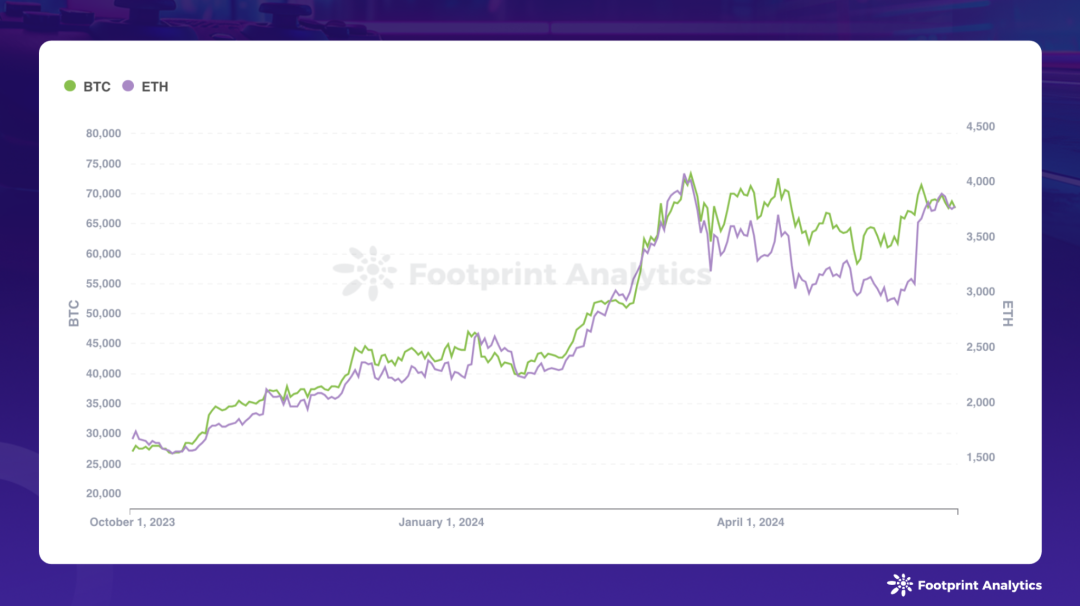
Source: Bitcoin and Ethereum Prices
In May 2024, market dynamics were notably influenced by major regulatory developments, particularly the U.S. Securities and Exchange Commission (SEC) approving the preliminary application for a spot Ethereum ETF. This landmark event not only helped Ethereum stand out within the broader cryptocurrency market but also signaled a supportive shift in regulatory attitudes toward digital assets.
Additionally, political developments impacted market sentiment. Donald Trump’s campaign team announced it would accept cryptocurrency donations, suggesting that the upcoming U.S. presidential election could have profound implications for the crypto market—potentially on par with Federal Reserve monetary policy adjustments.
Conversely, the ongoing resolution process of the Mt. Gox exchange bankruptcy exerted some downward pressure on Bitcoin’s price. The exchange, which has been bankrupt for over a decade, announced last September that creditor repayments would begin in October 2024, raising concerns about potential market impact from large-scale token sales.
Blockchain Gaming Market Overview
In May, the market capitalization of blockchain gaming tokens fluctuated but stabilized at $20.1 billion by month-end, representing a 6.7% increase from the previous period.
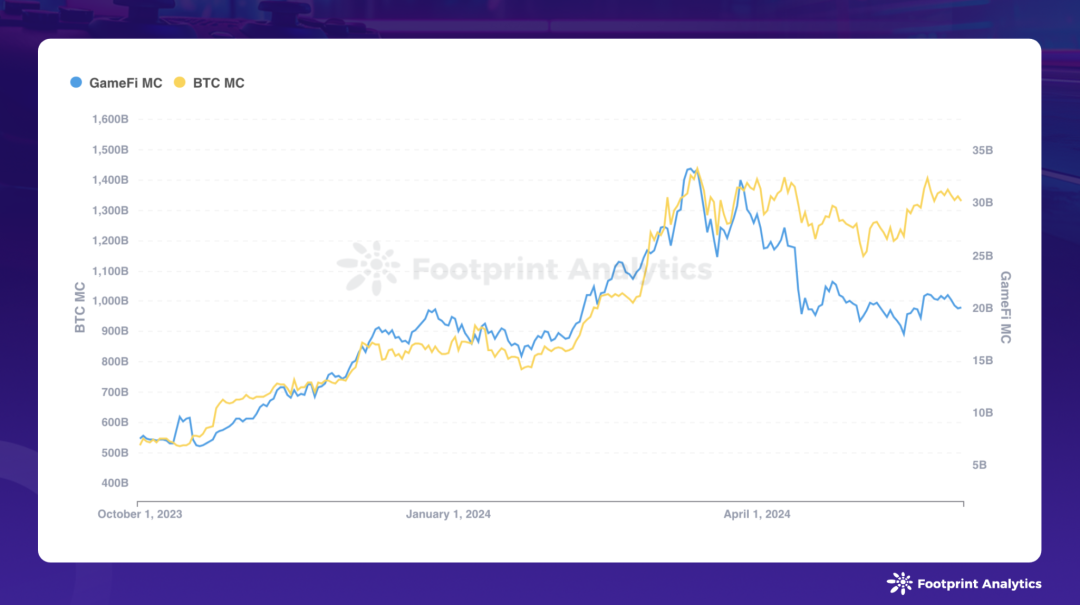
Source: Blockchain Gaming and Bitcoin Market Cap
The average daily transaction volume for blockchain games was 8 million, down 7.3% compared to April.
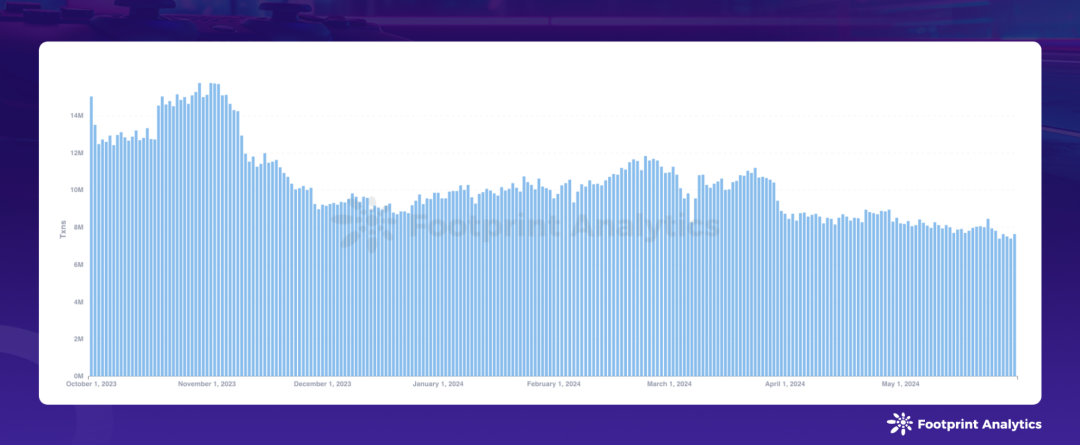
Source: Daily Transactions in Blockchain Games
At the same time, the average number of daily active users (measured by wallet count) increased to 3.3 million, up 9.6% month-on-month, setting another record high.
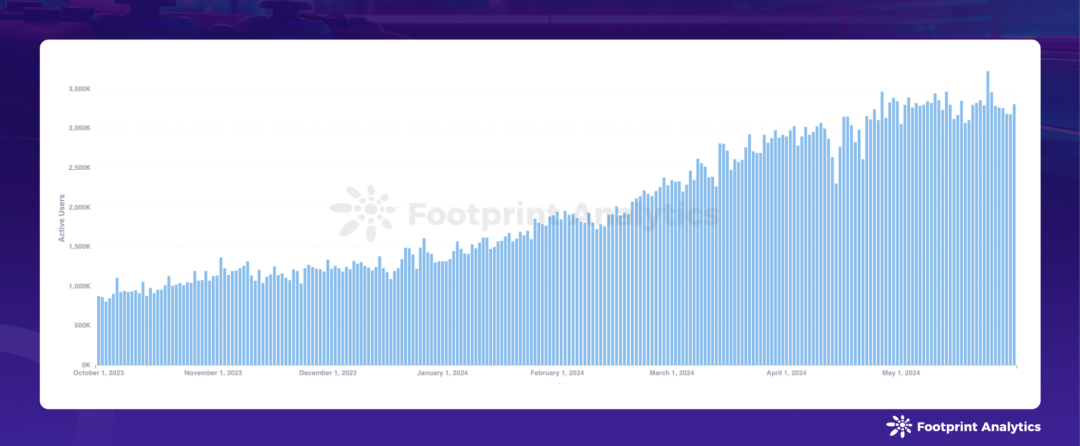
Source: Daily Active Users in Blockchain Games
After observing market trends in May, we noticed a particularly interesting phenomenon: a simultaneous decline in daily transaction volume alongside a rise in daily active users. Since October 2023, the ratio of daily transactions to daily active users has steadily dropped from 17.2 to 2.3.
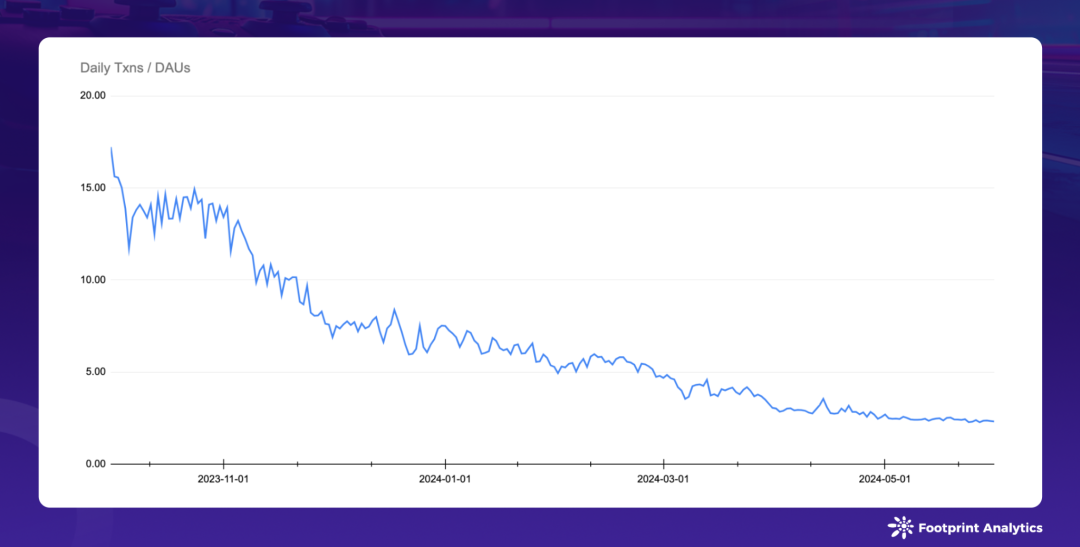
Ratio of Daily Transactions to Daily Active Users in Blockchain Games
We believe several factors may be driving this trend. First, the rise of "play-to-airdrop" strategies has led more users to participate primarily to complete tasks rather than for entertainment, reducing interaction frequency. Second, many developers are opting for partially on-chain or mini-games to balance seamless Web3 integration with engaging gameplay. These games often create user wallets or issue tokens on-chain—even if only the tokens are on-chain—while most activities occur off-chain.
Moreover, security incidents occurred in May. An unidentified hacker breached Gala Games’ internal controls and minted 5 billion new GALA tokens on May 20. The hacker then sold 600 million of these tokens on decentralized exchanges, receiving nearly 6,000 ETH. Within hours, the Gala Games team detected the attack and responded swiftly, activating their blacklist function to isolate the attacker’s address. Subsequently, the stolen funds were quickly transferred from the hacker’s wallet back into wallets controlled by Gala Games. Although the GALA token immediately dropped over 15% following the incident, it quickly recovered due to the team’s prompt response. This serves as a valuable lesson.
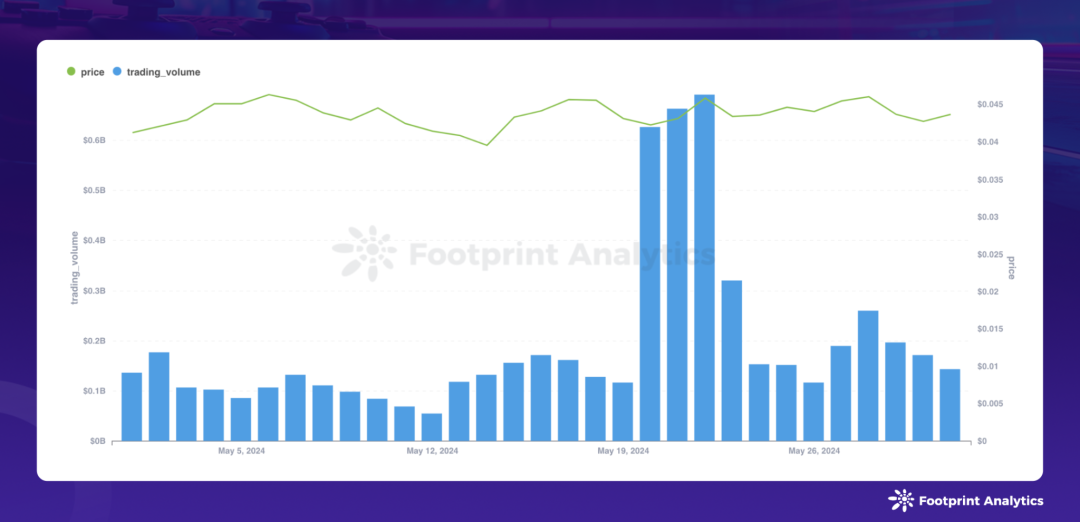
Source: GALA Token Price and Trading Volume in May 2024
Blockchain Platforms for Gaming
In May, a total of 1,525 games remained active across multiple blockchain platforms, with BNB Chain, Polygon, and Ethereum leading the market with shares of 23.3%, 19.7%, and 15.7%, respectively.
Among the 3.3 million daily active users in May, Ronin, Polygon, and NEAR continued to lead, similar to the previous month. Ronin maintained its dominance with approximately 29.0% market share. NEAR’s share grew from 12.1% at the beginning of May to 14.8% by month-end. Flow also showed growth, increasing its share from 0.7% to 3.3%. In contrast, BNB Chain’s share declined from 8.0% to 5.9%.
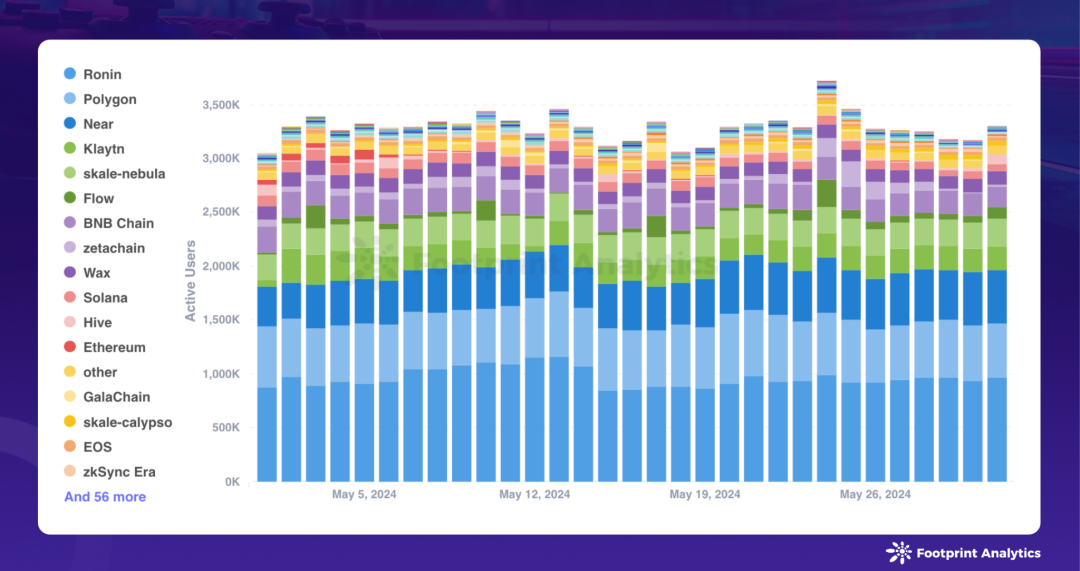
Source: Daily Active Blockchain Game Users by Chain
During May, multiple strategic initiatives aimed at enhancing gaming ecosystems were implemented across various blockchains.
On May 24, the Arbitrum community initiated a vote on a $200 million ARB Gaming Catalyst Program, with voting scheduled to conclude on June 8, aiming to strengthen the network’s gaming ecosystem. At the time of writing, the proposal had received majority support, with an approval rate of 80.6%. Meanwhile, Arbitrum is developing a Layer 3 ecosystem dedicated to gaming; Polychain Monsters, a multi-chain NFT gaming ecosystem, announced the launch of a game-specific Layer 3 chain built on Arbitrum Orbit via Altlayer.
The Starknet Foundation awarded 2 million STRK to Realms.World, an on-chain metaverse game, as part of its March-announced strategy to enhance the Starknet gaming ecosystem by allocating 50 million STRK tokens.
Captain Tsubasa, the classic football game developed by Mint Town Co., Ltd.—a subsidiary of mobile gaming giant KLab Inc.—and BLOCKSMITH&Co., officially launched on Oasys in May. Oasys is actively pursuing further collaborations with Mint Town and other developers to integrate high-quality intellectual properties (IPs) into blockchain games.
TON continues to attract significant attention. At the beginning of May, Pantera Capital, which manages over $5 billion in assets, announced its “largest investment ever” in TON. Furthermore, with the rise of Notcoin, gaming bot projects such as Tapswap and Hamster Kombat have gained increasing visibility.
Overview of Blockchain Gaming Projects
In May, the total number of blockchain games rose to 3,153, with 1,272 classified as active. Among these active games, 263 successfully attracted over 1,000 monthly users—accounting for 8.3% of all blockchain games and 20.7% of active ones.
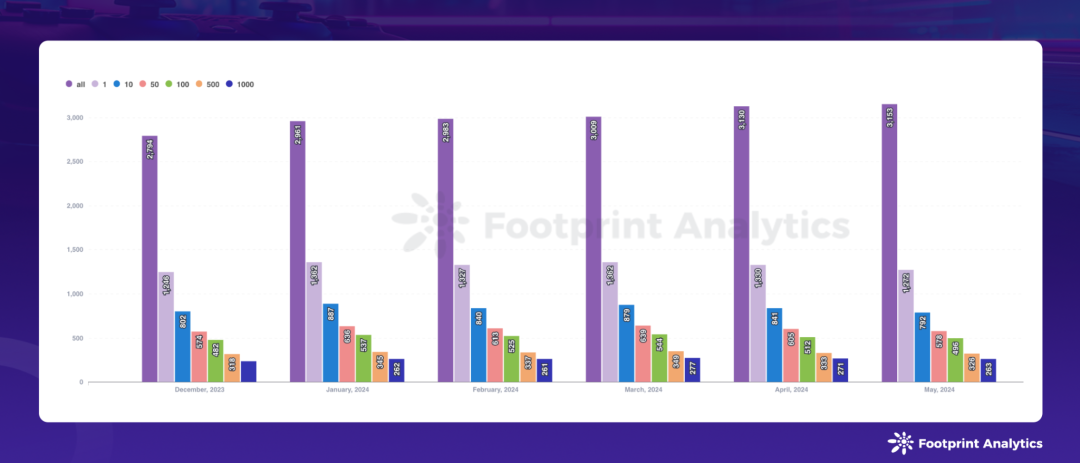
Source: Number of Monthly Active Blockchain Games
Although the blockchain gaming industry has remained highly active in recent years, it still lacks flagship titles capable of truly showcasing its potential. Popular games like Pixels, Matr1x FIRE, Sweat Economy, and Another World have drawn attention, yet many games continue to struggle to surpass 1,000 monthly on-chain users. This stagnation is partly due to the prevalence of non-full-chain games, where most data remains off-chain, despite full-chain and AAA games being long-standing narratives.
Amid these challenges, the emergence of Telegram gaming bots and mobile mini-games—exemplified by Notcoin—signals brewing changes in the industry. Binance launched the NOT token through its Launchpool on May 9 and began trading on May 16, further accelerating this trend. Today, Notcoin boasts a strong community of over 7.7 million subscribers on Telegram, while similar projects like Hamster Kombat and Tapswap have also gained significant traction, with 25.3 million and 18 million subscribers, respectively.
These developments suggest that mini-games and gaming bots may pave the way for broader Web3 adoption. Unlike full-chain or AAA games, which require long development cycles, these platforms emphasize flexibility and rapid deployment. They can act quickly and iterate rapidly. This approach may prove more effective than pursuing complex yet less accessible gaming experiences, enabling better user acquisition and retention at scale.
Blockchain Gaming Funding and Investment
In May, the blockchain gaming sector raised $44.95 million across 15 funding events, a 42.9% decrease compared to April.
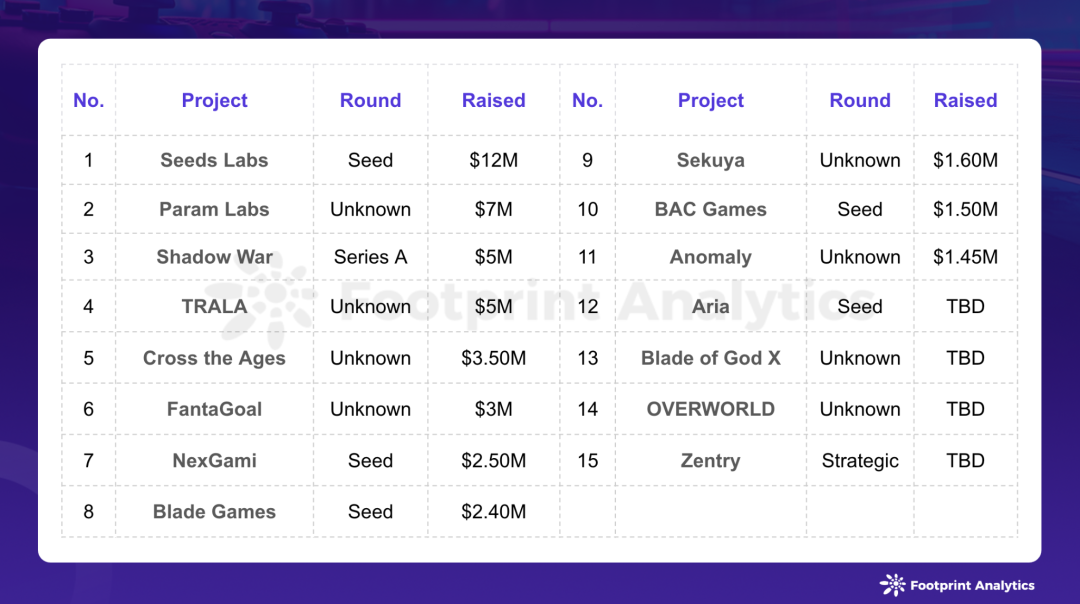
Blockchain Gaming Funding Events in May 2024 (Source: crypto-fundraising.info)
Seeds Labs raised $12 million in a seed round backed by Avalanche’s Blizzard Fund, the Solana Foundation, and Hashkey Capital. Their flagship product—Bladerite, a Web3 game—officially launched in May. The game is built on Solana.
Join TechFlow official community to stay tuned
Telegram:https://t.me/TechFlowDaily
X (Twitter):https://x.com/TechFlowPost
X (Twitter) EN:https://x.com/BlockFlow_News
 Footprint Analytics