
Extending the composability of agentive worlds with plugins
TechFlow Selected TechFlow Selected
Extending the composability of agentive worlds with plugins
Plugin developers are currently undervalued in the AW field, yet harbor tremendous potential.
 Navigating Web3 tides with focused insights
Written by: kohei.eth
Translated by: Chiny, Scissors
01. Key Issues Currently Limiting Composability
The Autonomous Worlds (AW) space is steadily growing.
Game engines like Mud and Dojo have already been developed. The number of developers and games continues to increase. Even major game studios like CCP Games are now building fully on-chain games.
Everything seems to be progressing smoothly.
But one key component is still missing.
Despite the vision of AW being that anyone can build and extend on top of games, we haven’t seen many plugins developed yet.
I was relatively unfamiliar with this field.
A year ago, when some of my friends started developing in the AW space, I thought, “Deploying an entire game on-chain makes no sense; it’s too slow and limited. Who would play this?”
However, blockchain’s core feature—allowing anyone to create and enforce new rules atop its system—is highly meaningful for gaming worlds. This led me to shift my focus from DeFi governance to the AW space.
With the entire game existing on-chain, anyone can build new rules and features on top of these worlds. There is no distinction between game studios and third-party developers.
When I realized this, it truly felt like a path toward the “metaverse.”
I also gradually recognized a huge gap between this vision and reality today.
Developing a fully on-chain game is extremely difficult and requires tight control from game studios. Yet game logic should be a playground for players.
If these on-chain worlds fail to scale successfully, I’ll find myself asking the same question as I did a year ago.
What’s the point of putting an entire game on-chain?
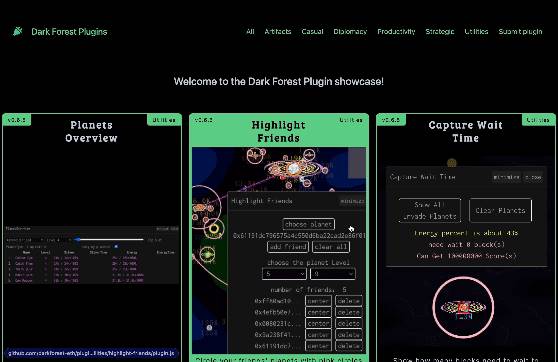
Dark Forest alone attracted more plugins than all current AWs combined
02. Why Aren’t People Building Plugins?
Many traditional games such as Fortnite and Minecraft have various mods created by their communities. So why aren’t people building plugins in the AW space? Shouldn’t fully on-chain games make plugin development easier?
The simple answer is that the AW scene is still in its infancy, with not enough games attracting players. But beyond that, two main reasons stand out.
First, plugin development is extremely challenging.
Current fully on-chain games are still in the exploratory phase. Their source code is often not fully open-sourced, documentation is incomplete, and game logic changes frequently.
As a result, every time changes are made, significant communication with the game studio and continuous maintenance are required. On top of that, there’s no guarantee the game client will support your plugin (usually it won’t), so you must develop a frontend accessible to non-technical players.
Yes, even simple plugins require substantial time and effort.
Second, funding is a major issue.
Ideally, developers would build plugins purely out of love for the game.
Yet, as noted above, this requires significant time and effort. If basic development costs cannot be covered, motivating developers to build or maintain plugins becomes very difficult.
In fact, a recent conversation with a friend—a game developer passionate about AW—highlighted these issues. He expressed interest in co-developing a plugin but emphasized the need for compensation due to the substantial time investment required.
The obvious sources of compensation would be either plugin users or the game studio itself.
However, the space is still developing, and there aren’t enough users willing to pay to offset development costs. Moreover, most AW game companies are startups without revenue, making it unrealistic to expect financial support from them.
Another option is seeking grants.
For example, Starknet recently awarded Realms $2 million in STRK grants, signaling its commitment to game development—even though not all games are built on Starknet.
Additionally, Dark Forest held a plugin competition in 2021, successfully attracting many high-quality plugins.
Yet, as mentioned earlier, not every game can offer financial backing, and there aren’t enough grants to support all games and projects across chains.
The business model for plugins remains a big challenge.
03. Solution
So how do we create an environment in this space where more plugins can be developed?
My first idea was to create a guild focused on plugin development. However, we face the same problems discussed earlier.
Given the current state of on-chain games, developing plugins demands great effort, and doing so one after another takes considerable time. Additionally, sustained plugin development requires funding. But where will this money come from?
Regardless, I plan to establish a guild, but I’m also thinking: what if we could build a mechanism enabling developers to profit from their plugins?
The idea is simple—a grant protocol that funds plugin developers.
Developers can submit proposals with their plugin ideas, player communities vote on the plugins they want, and the most community-demanded ideas receive funding.
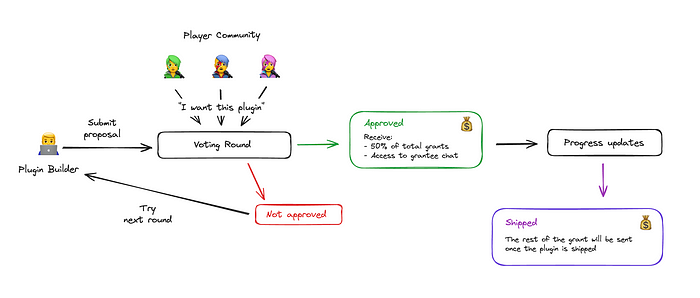
A grant protocol funds plugin developers
04. Funding the Grants
Initial grant funds will be raised from L2 grants, companies, VCs, and individuals active in the AW space.
Additionally, the first funding round will be open to any plugin idea, but to make the protocol and projects more comfortable providing grants, I’m considering future donation options that would only fund plugins built atop their specific projects.
Such grants support ecosystem growth by incentivizing plugin creation on your protocol, game engine, or game. This helps attract more users and plugin developers, creating a flywheel effect that benefits all projects and ecosystems within AW.
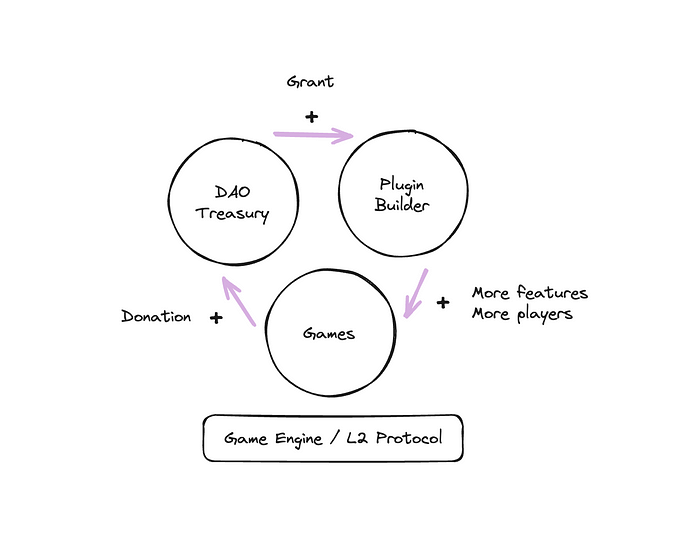 Example of a funding mechanism
As a first experiment, we plan to raise a total of $15,000. Each approved proposal will receive a fixed amount of $5,000, allowing us to ultimately support developers launching three new plugins on existing games.
In the future, I hope to support larger-scale plugin development and more developers, but since there are currently almost no plugin developers, I plan to gradually scale up while cultivating a culture and community around plugin development.
05. Voting Mechanism
To allow player communities to decide which plugin ideas get funded, I’m considering a competitive voting model.
During the submission phase, anyone with a plugin idea can submit a proposal to compete. Everyone showcases their skills and concepts to win.
When the voting phase begins, the player community votes for the plugin ideas they’d like to use. If a proposal receives enough votes to be declared a winner (in our first round, the top 3), the proposer receives funding and proceeds with plugin development.
Similar to Nouns’ Prop House mechanism ↓
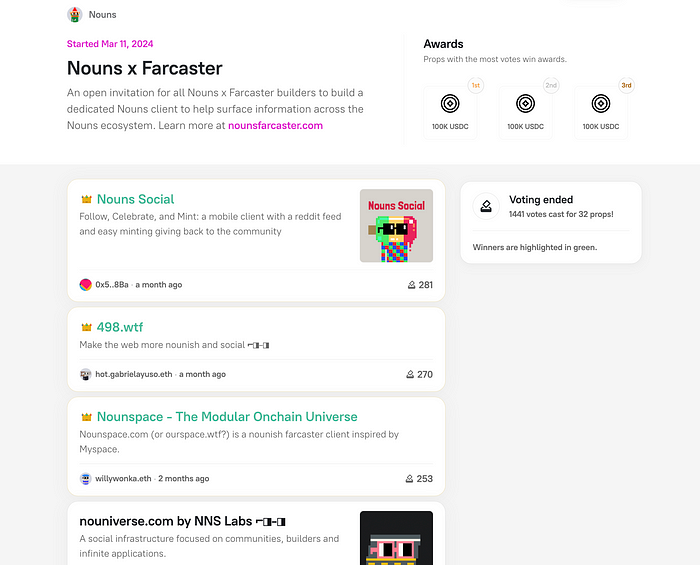 Voting mechanism
Ideally, there would be a round each month. A fixed schedule could help on-chain gamers form a habit of checking for new usable plugins on a specific date (e.g., the 10th of each month).
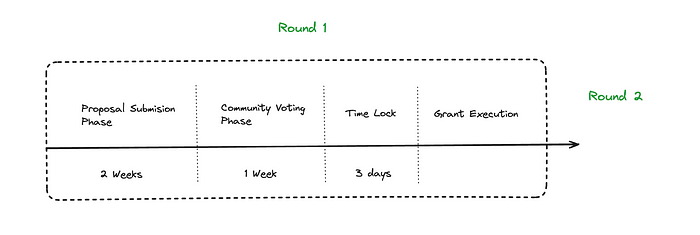
Regular check-in schedule
Determining the optimal method for allocating voting rights is highly challenging.
Currently, I lean toward a whitelist approach rather than distributing governance tokens. This allows flexible adjustment of whitelist criteria per round and avoids complexities related to tokens, such as airdrops, whale dominance, and price volatility.
One whitelist idea: select one game per round and whitelist accounts based on in-game resources (e.g., holding over 500 orbs in SS, or 2000 kimberlite in Primodium).
By the way, if you’re passionate about AW and want to contribute, feel free to DM me via Twitter or Telegram (@koheingt). Any feedback, ideas, or requests regarding the grant protocol are greatly appreciated!
06. The Rise of Plugin Developers
Currently in the AW space, there are three main groups: game studios, players, and gaming guilds.
But imagine if we could introduce a new role: the plugin developer.
I believe this grant protocol can help make that happen.
It will demonstrate how to build new features and clients. Instead of relying solely on game studios, third-party innovation can enable games to evolve continuously based on community needs and desires.
Moreover, I’ve always felt that plugin developers are currently undervalued in the AW space, yet hold tremendous potential.
Today’s teenagers aren’t just buying games; many are already creating their own indie games on platforms like Roblox. Statistics show that as of December 2023, over 5 million game developers were creating games and earning Robux.
Yet, when you try making your own game on Roblox, you quickly realize the scale and quality of what you can build are extremely limited. Until now, only large game studios typically had the capability to develop AAA games.
Autonomous Worlds will change this. Anyone will be able to expand upon AAA games without permission, and without fear that their plugin might be banned at some point in the future.
This democratization of game development can attract more people to build games at greater scale, while opening up more opportunities to earn.
We need to build products that make it easier for people to create plugins; products that help gamers discover and use plugins; products that enable developers to profit from plugins (without relying on grants)...
There’s still much to do to unlock the full potential of modding.
The AW space is still in its very early stages—now is the perfect time to shape its future.
Let’s keep experimenting boldly and exploring forward!
Join TechFlow official community to stay tuned
Telegram:https://t.me/TechFlowDaily
X (Twitter):https://x.com/TechFlowPost
X (Twitter) EN:https://x.com/BlockFlow_News