
8 Hours, 160x Gains, and a Triple Whammy to Zero: The Kardashian Family's Dramatic Foray into Crypto
TechFlow Selected TechFlow Selected
8 Hours, 160x Gains, and a Triple Whammy to Zero: The Kardashian Family's Dramatic Foray into Crypto
Three major reversals, turning the entire crypto圈 within 48 hours.
 Navigating Web3 tides with focused insights
By Tuoluo Finance
If you've paid even slight attention to American reality TV, you’ve surely heard of the Kardashian family.
Whether it's the three sisters' daily drama of flaunting wealth, plastic surgery, and mutual backstabbing, or their stepfather’s gender transition and mother’s infidelity scandals, the reality show "Keeping Up with the Kardashians" has become a quintessential guilty pleasure. The entire Kardashian clan swiftly rose to fame as household-name internet celebrities.
Recently, a member of the Kardashian family entered the crypto space, and within just two days of launching a token, gave the crypto community a firsthand taste of the uniquely chaotic and dramatic “Kardashian-style” spectacle.
In the early hours of May 27, Caitlyn Jenner—step-parent to the Kardashian sisters—suddenly posted a photo on X (formerly Twitter) shaking hands with Donald Trump, captioning it: “make america great again!!! and we love crypto!” Attached to the post was a link to the $Jenner token on the meme coin launch platform pump.fun. Unusually, Caitlyn also tagged prominent crypto meme figures like Ansem, Paul, and SolJakey to help promote the token.
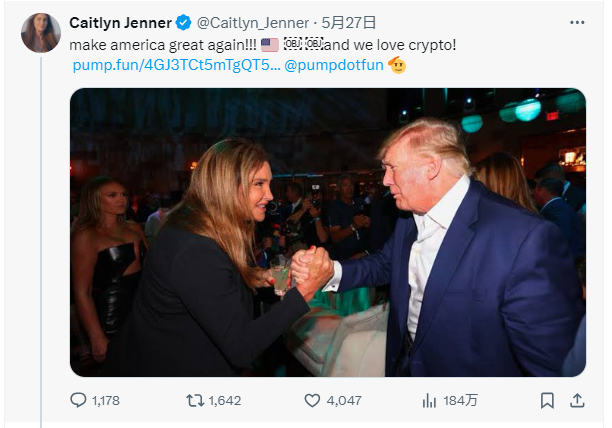
Caitlyn is no ordinary figure. Born Bruce Jenner, she was a former U.S. Olympic decathlon champion. She married Kris Jenner (mother of Kim Kardashian), raising five children together. At age 65, she underwent gender transition surgery and became Caitlyn Jenner. Today, she stands as one of the most iconic transgender public figures in American history, with 3.36 million followers on X.
Thanks to her massive influence, the crypto community immediately took notice. Within half an hour of launch, the $Jenner token surged 15-fold. One hour later, it had skyrocketed 70 times, becoming the undisputed star token on pump.fun.
However, while celebrity token launches are nothing new, given the recent GCR impersonation scam, and the fact that Caitlyn had never previously engaged with the crypto community—let alone used a tool like pump.fun—some cautious voices in the community suspected this might be another case of account hijacking, urging investors to proceed with caution.
Their fears seemed justified. Just over an hour after launch, the token developer suddenly dumped tokens worth 160 SOL from the liquidity pool. Under heavy selling pressure, $Jenner plunged sharply, halving in value almost instantly. The community erupted in anger and accusations. Just as $Jenner appeared to be racing toward zero, Caitlyn Jenner stepped in once again, delivering a powerful boost to the token.
Caitlyn updated her Instagram with a story stating: “$7 million raised in one hour for Caitlyn Jenner and Sophia Hutchins (her manager).” Sophia later reshared the post. Caitlyn then began actively engaging on X, emphasizing that her account had not been compromised.
Despite confusion over these erratic moves, the community, trusting Caitlyn, flocked back in. Fueled by profit incentives, the $Jenner token reversed course and climbed more than sixfold. Seemingly satisfied with the rebound, Caitlyn reappeared on X 30 minutes later, posting a face video confirming she personally launched the token. However, she added that she was currently on vacation playing golf and wouldn’t attend the team’s upcoming Space session.
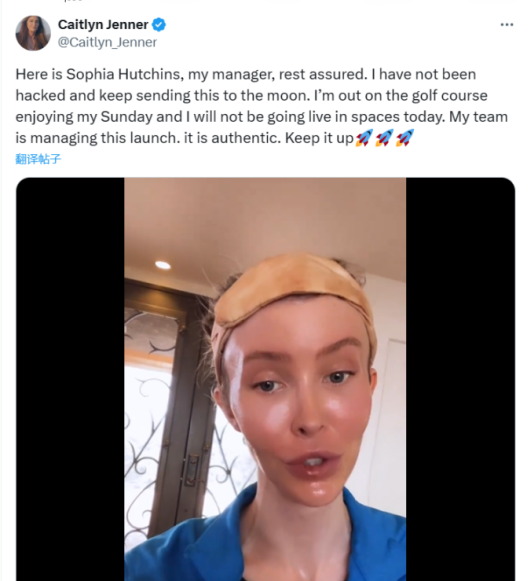
The real-face confirmation significantly boosted credibility, and the token price soared again, rising 70% within minutes. Yet skepticism resurfaced: could this video be a deepfake? After all, why would the developer dump tokens if this were legitimate?
Deepfakes are no novelty—they rely on neural network technology to analyze large datasets, using machine learning models to synthesize fake audio, facial expressions, and body movements into realistic videos. In short, AI can swap faces and mimic voices indistinguishably from real footage. Recently, deepfake incidents have surged; during India’s elections, a fake video circulated showing Prime Minister Modi dancing to Bengali pop music.
Doubts returned, and the token price crashed again, nearly halving in a short span. As chaos loomed, Caitlyn hosted a Space on X, with manager Sophia speaking on her behalf to dispel rumors. With solid evidence presented, claims of deepfake fraud began to be retracted. The token’s market cap surged from $4 million to over $20 million. Within just two hours of launch—and multiple reversals—$Jenner had appreciated 35-fold from its initial price.
Just as people thought the storm had passed, the market did a complete 180: the manager announced plans to launch another token. Since many had bought in purely for hype and visibility, a second token would dilute the first’s value. Anticipating this, panic selling ensued, and $Jenner plummeted 70% in half an hour.
Caitlyn stepped in again, clarifying that the team would focus solely on $Jenner and no further tokens would be issued. By this third reversal, barely over two hours had passed since launch. At 8:20 AM, Caitlyn posted a new video on her official account, with a moving image of herself celebrating the token reaching a $10 million market cap within four hours, affirming there was no forgery and that the crypto project was genuine.
Finally reassured, retail investors poured back in. The token rocketed upward, peaking at over 160 times its initial value. Traders began sharing profit screenshots—but then, drama struck again.
At around 2:00 AM on May 28, Caitlyn unexpectedly announced a new pump token called BBARK. News spread instantly, and $JENNER plunged from $0.027 to $0.011. Caitlyn quickly deleted the tweet, later reposting it with a clear “Ad” label, clarifying it was a promotion for another project—an apparent response to earlier promises of no additional tokens.
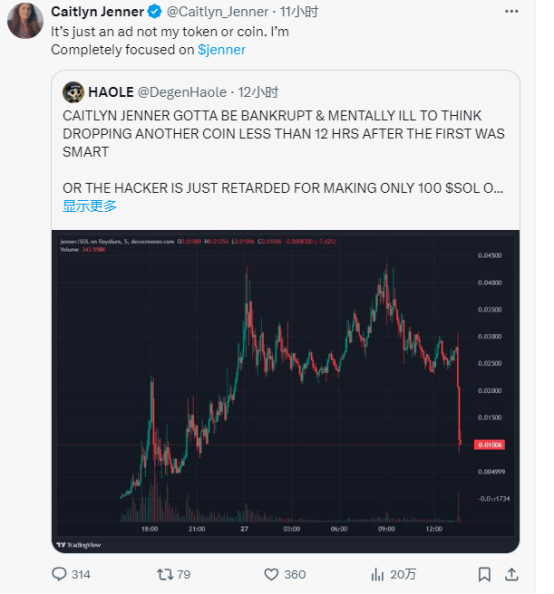
BBARK followed a similar trajectory: explosive growth followed by a brutal crash. Meanwhile, $Jenner stabilized and recovered, now trading at $0.01872 with a steady market cap of $20 million. Caitlyn continues to post updates about crypto and tokens on X. One commentator jokingly remarked, “You’ve played the entire crypto market like a fiddle in under 48 hours.”
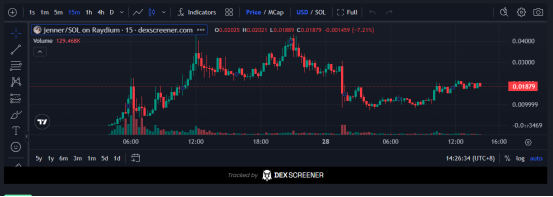
Volatility is routine in crypto, but such rapid-fire reversals are unprecedented—even for the Kardashians. The broader community remains divided on celebrity involvement. Supporters argue this drives mainstream adoption and brings well-known figures into crypto advocacy, potentially including controversial ones like Kim Kardashian. Critics say it turns the market into a stage where celebrities toy with public sentiment, manipulating prices at will. Some even joke it violates securities laws.
They’re not wrong. The U.S. Securities and Exchange Commission (SEC) has consistently cracked down on KOL marketing in crypto. In October 2022, Kim Kardashian paid a $1.3 million fine to settle charges for promoting a token without disclosing her financial ties. Floyd Mayweather, Lindsay Lohan, and others have faced similar penalties.
Although Caitlyn openly admitted to launching and promoting the token, the repeated flip-flops in messaging raise red flags under securities law—especially since many meme tokens already skirt the line of being unregistered securities. Let’s be honest: can a few casual tweets really justify creating tens of millions in market value? Is it fair—or legal—for retail investors’ hard-earned money to be so easily swayed?
On the celebrity side, beyond simply holding crypto, most early adopters started with NFTs. At the peak of the NFT craze, international stars and Chinese celebrities alike—including Edison Chen, JJ Lin, Jay Chou, Yi Nengjing, and Will Pan—launched their own NFT projects, some fetching sky-high prices due to star power. But today, nearly all celebrity NFTs have collapsed.
Recently, fans questioned Edison Chen online about whether his 2426CNFT project was still active. More recently, Stephen Chow’s NFT collection “Nobody,” which saw trading volume exceed 3,500 ETH overnight and floor price surge from 0.15 ETH to nearly 0.98 ETH (a 500% increase), has since dropped to just 0.108 ETH.
Clearly, celebrity influence is a double-edged sword: it can rapidly attract traffic, but just as easily becomes a tool for harvesting韭菜 (retail investors). Most celebrities launching tokens or NFTs lack understanding of how crypto works and have no long-term vision. A clear example: Caitlyn’s manager prematurely hinted at a second token while the first was still gaining momentum. The initial mysterious sell-off only reinforced this—though Caitlyn later implied she was deceived by token developer Sahil Arora. Ultimately, for many, launching a token may simply be a way to cash in on fame.
It’s tragic: celebrities effortlessly monetize their influence, while retail investors earnestly chase trends, hoping to board the train before it stops and walk away with life-changing gains. True, some do succeed—a lucky trader claimed over $100,000 in profits from a 3 SOL investment. But everyone knows where casino profits come from. While retail traders bounce violently along this rollercoaster, celebrities remain on their golf vacations.
Meanwhile, the rise of meme culture has reignited doubts about crypto’s core values. Freedom and decentralization increasingly feel like illusions, especially when real disruptive applications remain scarce while gambling-driven memes dominate. The community has already seen fierce debates over meme influence—A16z once publicly criticized memes for destroying crypto innovation. But opponents counter: without memes, there’s no liquidity; and without liquidity, crypto loses its main engine of growth.
With Bitcoin and Ethereum ETFs now approved, traditional finance has absorbed the two most valuable assets in crypto. For average retail investors, while bull markets cycle endlessly and opportunities never fully disappear, the golden era is fading—overnight riches are increasingly rare. Ten years ago, mining was wildly profitable; holding coins could yield hundredfold returns. Four years ago, DeFi experiments and airdrops brought solid gains. Three years ago, a single NFT could bring financial freedom. Now, Bitcoin nears $68,000, Ethereum approaches $3,800, airdrop farming is hyper-competitive, and entry barriers are higher than ever.
By comparison, memes may now represent one of the highest-risk, highest-reward narratives left. For swept-up retail investors, there’s little choice but to keep riding the waves of rapid price swings—forever suspended between hope and heartbreak.
Join TechFlow official community to stay tuned
Telegram:https://t.me/TechFlowDaily
X (Twitter):https://x.com/TechFlowPost
X (Twitter) EN:https://x.com/BlockFlow_News