
The Next Narrative Evolution in the Encrypted AI Sector: Catalysts, Development Pathways, and Related Assets
TechFlow Selected TechFlow Selected
The Next Narrative Evolution in the Encrypted AI Sector: Catalysts, Development Pathways, and Related Assets
Which AI sector will be the next to produce a single project with a market cap exceeding $1 billion?
 Navigating Web3 tides with focused insights
Author: Alex Xu
Introduction
So far, this crypto bull market cycle has been the least innovative in terms of commercial breakthroughs, lacking phenomenon-level trends like DeFi, NFTs, and GameFi from the previous cycle. This absence of industry-wide excitement has led to weak overall market momentum, with sluggish growth in users, investment, and developer activity.
This is reflected in current asset prices—throughout this cycle, most altcoins have continuously lost value against BTC, including ETH. After all, the valuation of smart contract platforms depends on the vibrancy of their application ecosystems. When app innovation stagnates, it becomes difficult to justify higher valuations for underlying blockchains.
In contrast, AI as a relatively new category within crypto benefits from the explosive external development and continuous hype in the broader tech world, potentially offering meaningful attention gains for AI-focused crypto projects.
In my April report on IO.NET, I outlined the necessity of combining AI with crypto—specifically, how cryptographic economic models, with their strengths in determinism, resource coordination, and trustlessness, may help address AI’s core challenges: randomness, resource intensity, and difficulty distinguishing human from machine.
In this article, I aim to further explore key questions about the AI sector in crypto, including:
-
Emerging or potentially breakout narratives in the crypto AI space
-
The catalysts and logic behind these narratives
-
Relevant project targets tied to these narratives
-
Risks and uncertainties associated with these narrative projections
This article represents my interim thoughts as of publication and may evolve over time. Opinions are highly subjective and may contain factual, data, or logical errors. Do not use this as investment advice. Feedback and discussion from industry peers are welcome.
Below is the main body of the article.
The Next Wave of Narratives in Crypto AI
Before reviewing the next wave of crypto AI narratives, let's first examine the current dominant narratives. By market cap, projects exceeding $1 billion include:
-
Compute: Render (RNDR, $3.85B fully diluted), Akash (fully diluted $1.2B), IO.NET (last private valuation $1B)
-
Algorithmic networks: Bittensor (TAO, $2.97B fully diluted)
-
AI agents: Fetch.ai (FET, pre-merger $2.1B fully diluted)
* Data as of: 2024.5.24, currency in USD.
Beyond these categories, which AI sub-sector might produce the next single project to surpass $1 billion in valuation?
I believe we can approach this question from two angles: “supply-side industrial narratives” and the “GPT moment” narrative.
First Perspective on AI Narrative: Energy and Data Opportunities Behind AI, From the Industrial Supply Side
From an industrial supply perspective, four key drivers power AI development:
-
Algorithms: High-quality algorithms enable more efficient training and inference
-
Compute: Both model training and inference require GPU hardware, which remains a major bottleneck. The chip shortage has driven prices for mid-to-high-end chips skyward
-
Energy: AI-driven data centers consume massive amounts of energy—not only for computation but also for cooling. Cooling systems alone account for around 40% of total energy usage in large data centers
-
Data: Improving large model performance requires expanding training parameters, which in turn demands vast volumes of high-quality data
Among these four drivers, algorithm and compute sectors already have crypto projects with market caps exceeding $1 billion. However, energy and data sectors have yet to see similarly valued projects emerge.
Yet, shortages in energy and data supply may soon materialize, becoming new industrial hotspots and driving momentum for related crypto projects.
Let’s start with energy.
On February 29, 2024, Elon Musk stated at Bosch Connected World 2024: "I predicted over a year ago that there would be a chip shortage. The next shortage will be electricity. I think next year there won’t be enough power to run all the chips."
Looking at specific data, Stanford University’s Institute for Human-Centered Artificial Intelligence, led by Fei-Fei Li, publishes an annual “AI Index Report.” In its 2022 report analyzing 2021 data, the team estimated that AI consumed only 0.9% of global electricity demand—limited pressure on energy and environment. But in 2023, the International Energy Agency (IEA) reported that global data centers consumed approximately 460 terawatt-hours (TWh) of electricity—about 2% of global demand—and projected that by 2026, data center energy consumption could range from 620 TWh to as high as 1,050 TWh.
In reality, even IEA’s estimates may be conservative, given the number of AI-intensive projects now being launched—projects whose energy needs far exceed those envisioned in 2023.
Take Microsoft and OpenAI’s planned “Stargate” project. Expected to launch in 2028 and completed around 2030, Stargate aims to build a supercomputer with millions of specialized AI chips, providing unprecedented computing power for OpenAI’s research, especially in large language models. The project is expected to cost over $100 billion—100 times more than today’s typical large data centers.
Just the Stargate project alone could consume up to 50 TWh of electricity.
It’s no surprise then that Sam Altman, OpenAI’s CEO, said at Davos in January: "Future AI will require breakthroughs in energy because the amount of electricity AI consumes will vastly exceed expectations."
After compute and energy, the next likely bottleneck in the rapidly growing AI industry is data.
More precisely, the scarcity of high-quality, usable data for AI is already a reality.
We’ve largely understood the pattern of LLM advancement—scaling model parameters and training data leads to exponential improvements in capability—and so far, no technical ceiling is in sight.
But the problem is that high-quality public data may become increasingly scarce. AI products may soon face supply-demand imbalances similar to those seen in chips and energy.
First, disputes over data ownership are rising.
On December 27, 2023, The New York Times filed a lawsuit in U.S. federal court against OpenAI and Microsoft, accusing them of using millions of its articles to train GPT models without permission. It demanded billions in statutory and actual damages and requested the destruction of all models and training data containing copyrighted content.
By late March, The New York Times issued another statement, now targeting Google and Meta as well. It alleged that OpenAI used Whisper, a speech recognition tool, to transcribe audio from YouTube videos into text for training GPT-4. The Times claimed such practices are widespread among big tech firms—Google does the same, converting YouTube video content into text for its own large models, effectively infringing on creators’ rights.
The NYT vs. OpenAI case—the so-called “first AI copyright trial”—is unlikely to reach a quick resolution due to its complexity and far-reaching implications. One possible outcome is an out-of-court settlement, with Microsoft and OpenAI paying a substantial sum. However, future data copyright disputes will likely drive up the overall cost of high-quality data.
Additionally, Google, the world’s largest search engine, is reportedly considering charging AI companies for access to its search results—not regular users.

Source: Reuters
Google’s servers store vast amounts of web content—essentially every webpage since the early 2000s. Today’s AI-powered search tools—like Perplexity abroad or Kimi and Metaso domestically—process this data through AI before delivering answers. If Google starts charging AI firms, data acquisition costs will inevitably rise.
In fact, beyond public data, AI giants are now eyeing non-public internal datasets.

Photobucket, a legacy image and video hosting site, once had 70 million users and nearly half of America’s online photo market share in the early 2000s. With the rise of social media, user numbers plummeted; today, only 2 million remain (paying $399 annually). According to user agreements, inactive accounts over a year old are reclaimed, and Photobucket retains usage rights over uploaded content. CEO Ted Leonard revealed that the company’s 1.3 billion photos and videos are highly valuable for training generative AI models. He is negotiating with multiple tech firms to sell the data, pricing between $0.05–$1 per photo and over $1 per video, estimating total value exceeds $1 billion.
EPOCH, a research group focused on AI trends, published a report titled Will we run out of data? An analysis of the limits of scaling datasets in Machine Learning. Based on 2022 ML data usage and generation trends, along with computing growth, they concluded that high-quality text data may run out between February 2023 and 2026, while image data could deplete between 2030 and 2060. Without significant efficiency gains or new data sources, the current trajectory of large-scale ML models may slow down.
Given the current trend of AI giants aggressively buying data, free, high-quality text data appears nearly exhausted—validating EPOCH’s two-year-old prediction.
Meanwhile, solutions to the “AI data shortage” are emerging—namely, AI data provisioning services.
Defined.ai is one such company, offering customized, high-quality datasets for AI firms.
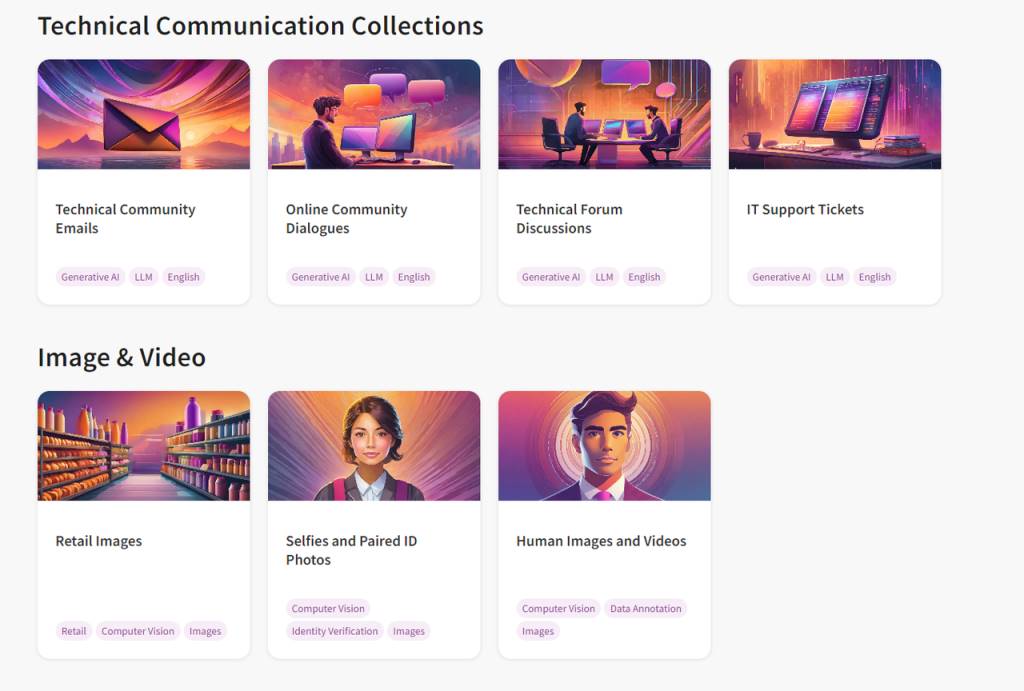
Example data types offered by Defined.ai: https://www.defined.ai/datasets
Its business model works like this: AI companies specify their data needs—e.g., images must meet certain resolution standards, avoid blur or overexposure, and reflect real-world scenes. They can request specific themes—nighttime photos, night cones, parking lots, signs—to improve AI’s nighttime recognition. Individuals complete tasks, upload content for review, and get paid per approved item—around $1–2 per high-quality image, $5–7 per short video, $100–300 per 10+ minute film, $1 per 1,000 words. Workers receive ~20% of the payout. Data provision may become the next crowdsourced industry after data labeling.
Global task distribution, economic incentives, data asset pricing and circulation, privacy protection, and open participation—this sounds exactly like a Web3-native business model.
Crypto AI Projects Under the Industrial Supply-Side Lens
Chip shortages spilled into crypto, making decentralized compute the hottest and highest-valued AI sector so far.
If energy and data bottlenecks erupt in the next 1–2 years, what crypto projects are positioned to benefit?
Let’s start with energy.
There are very few energy-related projects listed on major CEXs—only Power Ledger (token POWR).
Launched in 2017, Power Ledger is a blockchain-based energy platform enabling decentralized energy trading. It allows individuals and communities to directly trade electricity, promotes renewable energy adoption, and uses smart contracts for transparent, efficient transactions. Initially built on a private Ethereum-based chain, in late 2023 Power Ledger released a new whitepaper and launched its own general-purpose blockchain based on Solana’s framework, optimized for high-frequency microtransactions in distributed energy markets. Its main offerings include:
-
Energy trading: Peer-to-peer buying and selling of electricity, especially renewable energy
-
Environmental product trading: Carbon credits, renewable energy certificates, and financing based on environmental assets
-
Blockchain operations: Attract developers to build apps on the Power Ledger chain, with transaction fees paid in POWR
Power Ledger currently has a circulating market cap of $170M and a fully diluted market cap of $320M.
Compared to energy projects, data-focused crypto projects are more numerous.
Below I list only those I’m tracking that are already listed on at least one of Binance, OKX, or Coinbase, ordered by FDV from low to high:
1. Streamr – DATA
Streamr aims to build a decentralized real-time data network, allowing users to freely trade and share data while retaining full control. Through its data marketplace, Streamr enables data producers to sell data streams directly to interested buyers, eliminating intermediaries to reduce costs and increase efficiency.

Source: https://streamr.network/hub/projects
In practice, Streamr partnered with DIMO, a Web3 vehicle hardware project, collecting temperature, pressure, and other data via onboard sensors to create weather data feeds for institutions.
Compared to other data projects, Streamr focuses on IoT and sensor-generated data—including Helsinki’s real-time traffic data. As a result, its token DATA briefly doubled in a single day in December last year during the peak of the DePIN hype.
Streamr currently has a circulating market cap of $44M and a fully diluted market cap of $58M.
2. Covalent – CQT
Unlike other data projects, Covalent provides blockchain data. It pulls raw data from blockchain nodes via RPC, processes and structures it, and creates an efficient query database—commonly known as “blockchain data indexing.” This allows users to retrieve needed information quickly without complex direct node queries.
Covalent primarily serves B2B clients, including DApps (especially DeFi), centralized crypto firms like Consensys (MetaMask’s parent), CoinGecko, Rotki (tax tool), Rainbow (wallet), and traditional finance giants like Fidelity and EY. According to Covalent, its data service revenue already exceeds that of The Graph, a leader in the same space.
Due to the completeness, transparency, authenticity, and real-time nature of on-chain data, Web3 is poised to become a high-quality data source for niche AI applications and specialized “small AI models.” Covalent has begun supplying structured, verifiable data tailored for AI use cases.
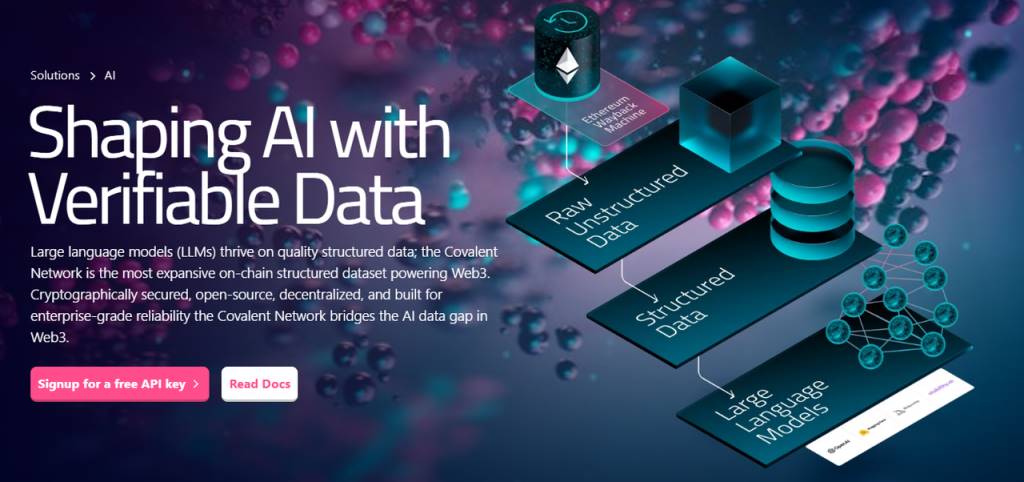
Source: https://www.covalenthq.com/solutions/decentralized-ai/
For example, it supplies data to SmartWhales, an intelligent on-chain trading platform using AI to identify profitable trading patterns and addresses. Entendre Finance uses Covalent’s structured data for real-time insights, anomaly detection, and predictive analytics.
Currently, Covalent’s use cases remain largely financial, but as Web3 products and data types diversify, so too will its applications.
Covalent currently has a circulating market cap of $150M and a fully diluted market cap of $235M—offering clear valuation advantages over peers like The Graph.
3. Hivemapper – HONEY
Among data types, video commands the highest unit price. Hivemapper provides AI companies with video and mapping data. It’s a decentralized global mapping project using blockchain and community contributions to build a detailed, dynamic, and accessible map system. Participants install dashcams to capture road data, contributing to Hivemapper’s open-source network and earning HONEY tokens. To optimize network effects and reduce costs, Hivemapper is built on Solana.
Founded in 2015, Hivemapper initially aimed to use drones for mapping but shifted to dashcams and smartphones to lower costs and scale globally.
Compared to Google Maps, Hivemapper’s incentive-driven, crowdsourced model enables faster coverage expansion, fresher map updates, and higher video quality.
Before the AI data boom, Hivemapper served autonomous driving units, navigation providers, governments, insurers, and real estate firms. Now, it offers APIs to supply AI and large models with extensive road and environmental data. Continuous input of updated imagery and road features helps AI and ML models better translate data into improved capabilities for geolocation and visual judgment tasks.

Data source: https://hivemapper.com/blog/diversify-ai-computer-vision-models-with-global-road-imagery-map-data/
Hivemapper currently has a circulating market cap of $120M and a fully diluted market cap of $496M.
Beyond these three, other data projects include The Graph – GRT (circulating $3.2B, FDV $3.7B), offering similar blockchain data indexing; and Ocean Protocol – OCEAN (circulating $670M, FDV $1.45B, soon merging with Fetch.ai and SingularityNET into ASI), an open protocol facilitating data and data-service exchange, connecting providers and consumers under conditions of trust, transparency, and traceability.
Second Perspective on AI Narrative: Recreating the GPT Moment – The Arrival of AGI
In my view, the “AI sector” in crypto began in 2023—the year GPT shocked the world. The surge in crypto AI projects was largely a spillover effect from AI’s explosive real-world progress.
Although GPT-4, Turbo, and others have continued improving, and Sora demonstrated stunning video generation capabilities, the cognitive impact of AI advancements on the public is waning. People are gradually adopting AI tools, but mass job displacement hasn’t occurred yet.
Will there be another “GPT moment”—a leap in AI capability so profound it shocks the public and changes how people perceive their lives and work?
That moment may be the arrival of Artificial General Intelligence (AGI).
AGI refers to machines possessing human-like general cognitive abilities—solving diverse complex problems, not just narrow tasks. AGI systems exhibit high-level abstract thinking, broad background knowledge, common-sense reasoning, causal understanding, and cross-domain transfer learning. Their performance matches or exceeds top humans across fields, and in overall capability, surpasses the best human collectives.
In fact, whether in sci-fi literature, games, films, or post-GPT public expectations, society has long anticipated the emergence of AGI surpassing human cognition. Or rather, GPT itself is a precursor to AGI—a prototype, a prophecy.
The reason GPT had such massive industrial and psychological impact is that its speed and performance exceeded expectations—people didn’t expect a Turing-test-passing AI to arrive so soon.
In fact, AI (AGI) may recreate the suddenness of the “GPT moment” within 1–2 years: Just as people adapt to AI assistance, they’ll realize AI is no longer just a helper—it can independently solve highly creative, challenging tasks, even ones that have stumped top human scientists for decades.
On April 8, Elon Musk appeared on an interview with Nicolai Tangen, CIO of Norway’s sovereign wealth fund, discussing AGI timing.
He said: "If AGI means smarter than the smartest humans, I think it’s likely to happen in 2025."
By his estimate, AGI could arrive in as little as 1.5 years—provided “electricity and hardware keep up.”
The benefits of AGI are obvious.
It means a giant leap in human productivity, solving scientific problems that have eluded us for decades. If we define “the smartest humans” as Nobel laureates, then with sufficient energy, compute, and data, we could have countless tireless “Nobel-level minds” working around the clock on the hardest scientific challenges.
In reality, Nobel winners aren’t one-in-millions geniuses—they’re often top university professors who, through luck and persistence, picked the right direction and succeeded. Their equally talented peers might have won in alternate timelines. But the number of top researchers remains limited, so “exploring all correct research paths” is still painfully slow.
With AGI, given sufficient energy and compute, we could deploy infinite “Nobel-level” AIs across every possible research frontier, accelerating progress by tens of times. Faster technological advancement means resources we now consider scarce and expensive—food, materials, drugs, education—could multiply hundreds of times over the next 10–20 years, with costs plummeting. We could sustain larger populations with fewer resources, dramatically increasing per capita wealth.
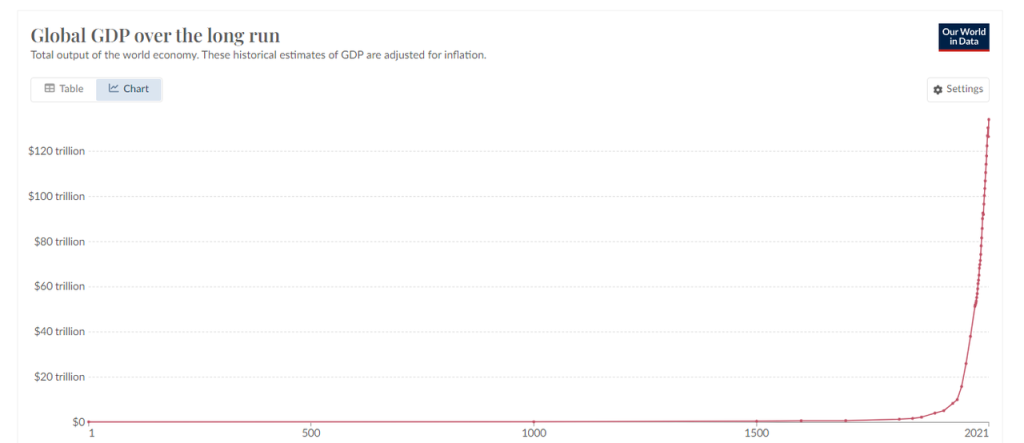
Global GDP growth chart, source: World Bank
This may sound far-fetched, so let’s look at two examples—previously used in my IO.NET report:
-
In 2018, Nobel laureate Frances Arnold said at her award ceremony: "Today we can read, write, and edit any DNA sequence, but we cannot compose it." Just five years later, in 2023, researchers from Stanford and Salesforce Research published a paper in Nature Biotechnology using a GPT-3 fine-tuned model to create 1 million entirely novel proteins from scratch, identifying two structurally distinct ones with antibacterial properties—potential alternatives to antibiotics. AI had broken the bottleneck in protein “creation.”
-
Previously, AlphaFold predicted nearly all 214 million known protein structures on Earth within 18 months—a feat hundreds of times greater than all prior human structural biology efforts combined.
Change is already underway, and AGI will accelerate it further.
On the other hand, AGI’s arrival brings enormous challenges.
AGI won’t just replace knowledge workers—“AI-resistant” service and manual labor jobs will also be disrupted as robotics mature and new materials lower production costs. The share of jobs replaced by software and machines will rise sharply.
Then, two seemingly distant issues will surface rapidly:
-
Employment and income for masses of displaced workers
-
How to distinguish AI from humans in an AI-saturated world
Worldcoin/Worldchain is attempting to solve both—using a Universal Basic Income (UBI) system to provide baseline income, and iris-based biometrics to distinguish humans from AI.
In fact, UBI isn’t a theoretical fantasy—Finland and England have conducted trials, and countries like Canada, Spain, and India have parties actively pushing for experiments.
Using biometric verification + blockchain for UBI offers global reach and broad population coverage. Plus, the resulting user network can support additional businesses—DeFi, social, task crowdsourcing—creating ecosystem synergies. This is exactly why
One key beneficiary of AGI’s societal impact is Worldcoin – WLD, with a circulating market cap of $1.03B and a fully diluted market cap of $47.2B.
Risks and Uncertainties in Narrative Projections
This article differs from many previous Mint Ventures reports on projects and sectors—its narrative projections are highly speculative. Readers should treat this as exploratory discussion, not prophecy. My assumptions face significant uncertainty, including:
Energy: GPU upgrades drastically reducing power consumption
Despite soaring AI energy demand, chipmakers like NVIDIA are continually upgrading hardware to deliver higher compute at lower power. For instance, in March, NVIDIA launched the GB200, integrating two B200 GPUs and a Grace CPU. It offers 4x the training performance and 7x the inference performance of the H100—while consuming only 1/4 the power. Still, humanity’s appetite for AI capabilities is far from satisfied. Even as per-unit efficiency improves, total energy use may still rise due to expanding AI applications and demand.
Data: OpenAI’s Q* Project achieving “self-generated data”
OpenAI is rumored to have an internal project called “Q*,” mentioned in internal employee communications. According to Reuters citing insiders, this could represent a breakthrough toward superintelligence/AGI. Q* reportedly solves unseen math problems via abstraction and can generate its own training data without relying on real-world inputs. If true, the bottleneck of high-quality data scarcity for large models would be eliminated.
AGI Timing: OpenAI’s Uncertainty
Whether AGI truly arrives in 2025, as Musk predicts, remains unknown—but it may only be a matter of time. However, Worldcoin, as a direct beneficiary of the AGI narrative, faces a major risk from OpenAI, given its reputation as the “shadow token” of OpenAI.
On May 14, OpenAI unveiled GPT-4o alongside 19 other LLM variants in a spring launch. From the leaderboard, GPT-4o scored 1310—visually much higher than others. But in percentage terms, it was only 4.5% ahead of second-place GPT-4 Turbo, 4.9% above Google’s Gemini 1.5 Pro, and 5.1% above Anthropic’s Claude 3 Opus.

Less than a year and a half after GPT-3.5 stunned the world, OpenAI’s competitors are now extremely close (despite GPT-5 not yet launching, expected later this year). Whether OpenAI can maintain its lead is becoming unclear. If its dominance fades or is overtaken, Worldcoin’s narrative value as OpenAI’s shadow token would diminish.
Moreover, beyond Worldcoin’s iris authentication, more competitors are entering—Humanity Protocol, a palm-scanning ID project, recently raised $30M at a $1B valuation. LayerZero Labs announced it will run on Humanity and join its validator network, using ZK proofs for credential verification.
Conclusion
Finally, while I’ve speculated on potential future narratives in the AI space, unlike native crypto sectors like DeFi, the AI sector largely reflects external AI hype spilling
Join TechFlow official community to stay tuned
Telegram:https://t.me/TechFlowDaily
X (Twitter):https://x.com/TechFlowPost
X (Twitter) EN:https://x.com/BlockFlow_News
 Mint Ventures