
EF has no dreams
TechFlow Selected TechFlow Selected
EF has no dreams
To become a super asset, Ethereum needs to be as unbiased as Bitcoin and gold.
 Navigating Web3 tides with focused insights
By Jack, BlockBeats
In recent days, the reversal in news around Ethereum ETFs appears to have completely reshaped market perceptions of its fundamentals. Analysts who were once fiercely bearish flipped their stance 180 degrees within a single day. With the official approval of ETFs, ETH nearly broke through the $4,000 mark this morning. Yet behind this price surge, the Ethereum Foundation (EF) finds itself at a crossroads.
Since last year’s EDCON in Montenegro, dissatisfaction with the Ethereum Foundation has been increasingly evident across the industry. The organization seems to be experiencing a midlife crisis, struggling structurally, operationally, and culturally—its weaknesses laid bare by Solana's resurgence. Now that ETH has officially become a global asset, the Ethereum Foundation risks becoming the ecosystem’s greatest burden.
Parasitic Ethereum
On May 21, prominent EF researchers Justin Drake and Dankrad Feist revealed they had both become advisors to EigenLayer, receiving compensation in EIGEN tokens potentially exceeding their current net worth. To the community, this "have your cake and eat it too" behavior looked unseemly, with some joking that EF researchers are now “re-staking” themselves.
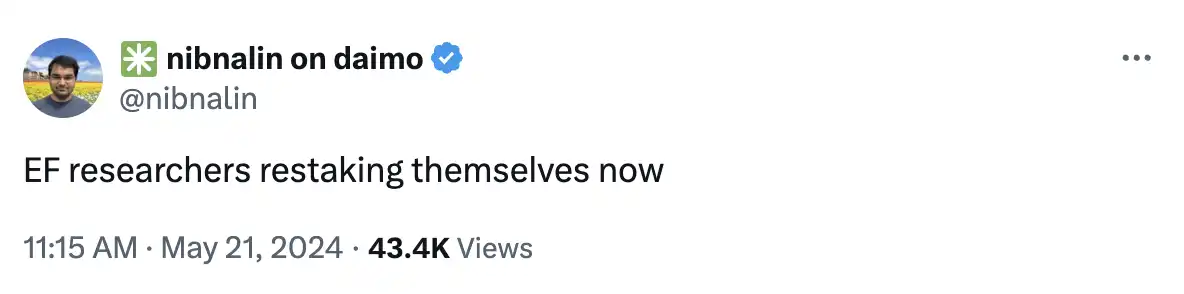
This is far from an isolated case. In today’s Ethereum ecosystem, the EF increasingly resembles a taker—leveraging its quasi-religious authority to export “ideological dollars,” while EF members reap personal fame and fortune.
EF “Congressionalization”
The debate over the EigenLayer advisory roles centered largely on whether such positions compromise EF researchers’ neutrality.
Although both researchers insisted they acted in personal capacity and would resign if EigenLayer ever conflicted with Ethereum’s interests, the community remains unconvinced. When potential earnings could surpass one’s entire net worth, it’s hard to believe anyone truly treats money as dirt.
Just one day before disclosing his advisory role, Dankrad Feist was locked in fierce debates with other EF researchers over MEV, ultimately requiring Vitalik Buterin to mediate. As the architect of Danksharding and a key visionary for Ethereum, Dankrad holds significant influence within EF. From another perspective, EigenLayer essentially paid for a lobbyist inside EF.
Today’s EF functions like Ethereum’s “Congress.” Researchers wield EIPs that can directly alter Ethereum’s trajectory and reshape billion-dollar industries. As the number and scale of ecosystem participants grow, each EIP becomes entangled in more complex利益 networks. Everyone wants special treatment during upgrades—just like L2 projects—but not all can align perfectly with Ethereum’s broader interests. Thus, EF researchers have become targets for capital seeking influence—akin to lobbying elected officials.
Whether active or former, EF researchers taking advisory roles—or otherwise engaging with projects—is now an open secret in the industry. For startups, gaining legitimacy means cultivating ties with EF at all costs. Having someone close to EF makes navigating both formal and informal channels significantly easier. For VCs, relationships with EF offer early access to high-potential investments. Projects introduced by EF researchers not only secure allocations more easily but also gain preemptive credibility.
Willingly or not, EF researchers are surrounded by capital eager to capture influence—offering advisory roles or direct sponsorship for personal research. And researchers themselves appear comfortable with this dynamic. Against the backdrop of rising modularity trends exemplified by EigenDA and Celestia, this trend will likely accelerate. More teams will install their own “lobbyists” within EF, pushing the foundation further down the path of “congressionalization.”
Ideological Victories
After FTX collapsed, Anatoly Yakovenko, CEO of Solana Labs, personally reached out to emerging ecosystem projects like Backpack, Jito, and Tensor. Many had lost critical runway; Anatoly urged them to stay and accelerate development, while Labs and the Foundation pledged technical support.
Within Solana’s ecosystem, Solana Labs and the Foundation take hands-on roles. Much of the ecosystem narrative is actively shaped and promoted by core teams. Anatoly frequently appears on social media and podcasts, even personally endorsing developer projects and meme coins. Lily Liu leads a foundation team that connects with projects big and small. The entire ecosystem revolves tightly around the foundation, projecting a strong image of unity.
For today’s Ethereum, such scenarios are nearly impossible. Unlike most blockchains, Ethereum lacks an “Ethereum Labs.” As a result, EF stands as the sole entity wielding centralized control. But as a self-proclaimed “neutral organization,” EF often refrains from direct intervention, adopting a laissez-faire posture that leaves it ill-equipped to compete with Solana’s proactive team.
Compared to Solana’s team, EF seems unwilling to get its hands dirty. After Uniswap, EF evolved into a theoretical academic body—over 300 members collecting ETH stipends, most conducting abstract research. Beyond EIPs, EF contributes little tangible value. Worse, its presence imposes ideological constraints on ecosystem development.
Over the past year, Ethereum circles haven’t discussed innovation or real-world applications. Instead, they obsess over “legitimacy.” A concept introduced by Vitalik in 2021, primarily tied to public goods, “legitimacy” has come to mean proximity to the Foundation. This isn’t entirely mistaken—EF holds absolute interpretive power over what constitutes legitimacy and which public goods are deemed worthy.
Today’s major Ethereum projects have all endured legitimacy scrutiny. For small, under-resourced teams hoping to grow, ideological alignment comes before innovation. Playing the right tune matters more than groundbreaking ideas. Whether account abstraction or other concepts, the past year has seen the industry follow EF’s lead: builders do the heavy lifting, VCs fund the dreams, and both rush to carry EF’s sedan chair, pulling the ecosystem forward—while EF researchers lounge by the sea in Zuzalu, discussing longevity with Vitalik.
Cultural Toxicity
A few days ago, EF researchers publicly clashed over MEV issues on social media, prompting Vitalik to step in and mediate. He expressed pride in Ethereum’s culture of openness: “Ethereum has no culture of suppressing people’s expression—even when they hold deeply negative views about the protocol or key aspects of the ecosystem.”
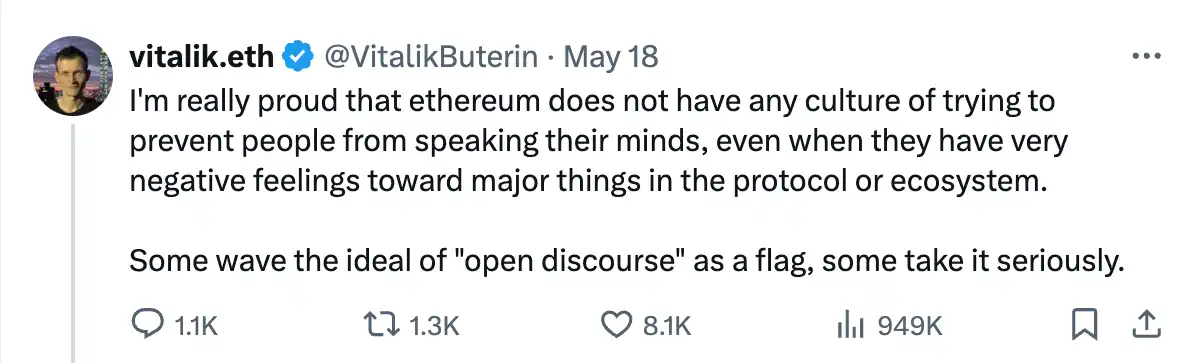
Yes, you can voice dissenting opinions in the Ethereum community. But notably, these debates rarely touch on Ethereum’s direction, governance, or cultural norms—they cluster narrowly around technical minutiae. Today’s Ethereum world feels lacking. Its culture appears poisoned, almost devoid of critical thinking on fundamental issues.
Vitalik as Hard Currency
At last April’s EDCON, the “DeBox incident” became one of the most viral moments. After a team member took a photo with Vitalik in Zuzalu, their project instantly gained massive attention. Soon, numerous Chinese teams followed suit, chasing Vitalik across Montenegro. Thousands crammed into a tiny campus, then stampeded toward Zuzalu upon learning he was staying in a seaside villa—desperate to catch a glimpse or snap a distant photo, later writing posts like “a spiritual awakening during my flash mob appearance in Zuzalu.”
In the market’s eyes, Vitalik *is* legitimacy. Anything associated with him gains instant credibility—a recognition permeating every corner of the ecosystem. After Montenegro, discussions about legitimacy intensified in Chinese communities. People realized how desperately they crave validation from Ethereum’s inner circle—yet how impossibly distant and inaccessible it remains.
As the arbiter of legitimacy, EF sustains its authority by closely orbiting Vitalik. Over the past year, Vitalik’s writings remain the most discussed content within EF and the wider community. Even outlets like Bankless rarely voice opposition. Some who’ve engaged deeply with EF members report that those around Vitalik tend to flatter and agree, leaving him insulated from genuine community feedback—though this claim remains unverified.
The classic example is Scroll. Once dismissed as an obscure “Chinese underdog,” it rapidly rose to become a mainstream $1B+ L2, surpassing Starknet and zkSync—all sparked by a reply from Vitalik to an email sent by its founder. Similarly, Farcaster remained niche despite massive funding from Multicoin and even a16z—until Vitalik joined. Now, you’d be hard-pressed to find EF researchers actively posting on X about their social activities.
The market craves Vitalik’s endorsement. EF needs market funding. So EF surrounds Vitalik, making the market revolve around them—and in turn, Vitalik becomes Ethereum’s “hard currency.”
Engineers Thinking for Users
Over the past two years, engineering thinking within the Ethereum community has hardened further—distinct from Google’s engineering culture. It avoids new experimental standards or use cases, focusing instead on pure technical research. Within EF, over a hundred researchers work exclusively on ZK tech. At events like EDCON, ETHCC, and Devcon, conversations revolve endlessly around ZK this and ZK that, leaving non-technical outsiders bewildered.
Great product managers know to think from the user’s perspective. Clearly, EF does not. In EF’s view, Ethereum must become a neutral, trustworthy world computer—achievable only through decentralization, security, and scalability. Any topic unrelated to these metrics—such as commercial viability or real-world applications—is deemed irrelevant.
This value system directly shapes product logic across the ecosystem—nowhere more evident than in L2s. From Optimism to Arbitrum to Starknet, all discourse centers on technical superiority: why ZK beats OP, whose TPS is higher, whose gas fees are lower, EVM compatibility across ZK rollups, etc. Yet looking at L2s’ actual market performance, these “code art” masterpieces that excite developers prove powerless against real market demand.
The only L2 consistently focused on product has become known as the “blue Solana”—now the most competitive player in the ecosystem. By contrast, the mainstream L2s that spent last year debating whose ZK tech was superior are now largely forgotten, some possibly doomed by technical bottlenecks.
Meanwhile, under EF’s influence and its “legitimacy” narrative, Ethereum has shifted toward public-goods-oriented development, drifting further from innovation—repeating cycles of purging “undesirables.”
L2s, designed as scaling solutions, have been shackled from day one by “Ethereum Alignment”—expected to obey EF’s directives. Everyone pledges loyalty: striving to be the most EVM-compatible, aiming to become Ethereum’s designated scaling heir. This created a race to the bottom where newer entrants always outdo predecessors in subservience—and EF welcomes it. The more obsequious, the higher the reward.
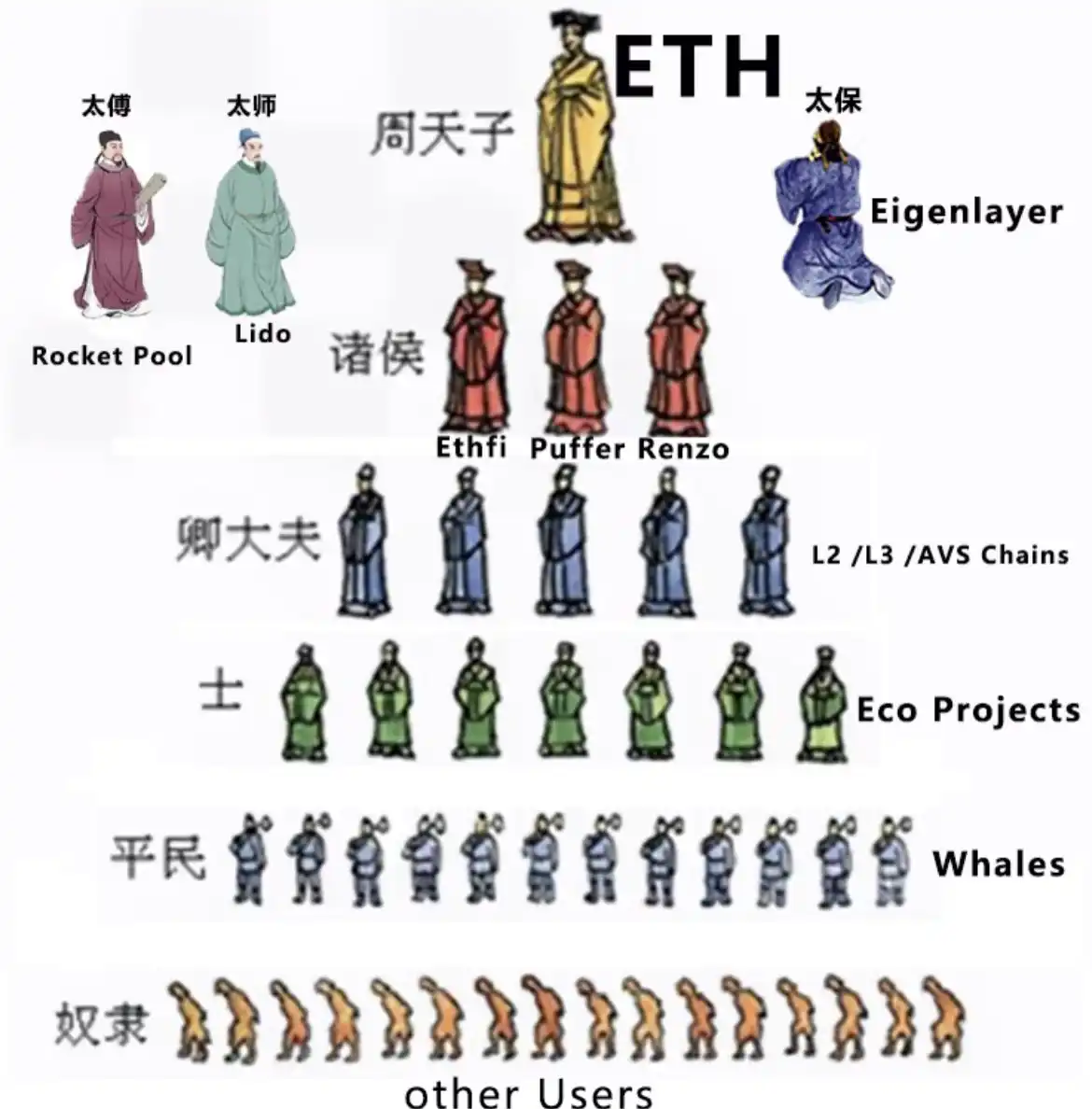
This pattern extends beyond L2s. Ethereum’s redundant infrastructure leads to high overlap in innovation. A recent example is EigenLayer—a new concept that threatens to displace LSDs, L2s, and even Ethereum itself. Still, EigenLayer must align ideologically with EF to signal loyalty. But as previously noted, purges aren’t always driven by loyalty.
Even as modular narratives like Celestia rise and Solana makes a strong comeback, EF’s obsession with legitimacy shows no sign of fading. You still hear Q-style arguments like “an L2 not using Ethereum DA isn’t a real Ethereum L2” or “Solana’s monolithic scaling will inevitably fail compared to L2s.” Yet no one discusses what new applications Ethereum could actually support today.
Escaping Ethereum
Even in decline, EF handles things poorly. In September last year, MakerDAO announced its “Endgame” plan, proposing to build a new chain using Solana’s codebase to “beneficially drive network effects across the multi-chain economy.” Vitalik immediately sold 500 MKR and called the move “suicidal” on social media.
Many major protocols face moral judgment from Vitalik or EF when attempting to leave Ethereum—perhaps reflecting a desire for loyalty unto death. But development teams clearly don’t want to die with Ethereum. Applications serve users, not blockchains. While security remains crucial for blue-chip protocols, completely ignoring user experience and market dynamics is equally foolish.
Thus, Ethereum-native protocols are fleeing to Solana. Render migrated its token to SPL; Aave passed a proposal with 83% approval to deploy its V3 isolated markets on Neon EVM; GMX’s community proposed deploying a standalone contract on Solana; rumors suggest Ethena and Pendle may soon follow.
When survival is at stake, legitimacy means nothing. Savvy developers already recognize: the future of on-chain finance has no absolute center. Whether Ethereum, Solana, or other settlement layers, retaining market share and staying alive is paramount—and EF cannot help with that.
ETH’s Burden
In crypto’s path to mainstream adoption, teams inevitably compromise with existing systems. Ripple fought SEC lawsuits for years over securities classification. Tornado Cash and Uniswap faced regulatory crackdowns. Even this ETF application required financial giants to play intricate legal games distinguishing “ETH” from “staked ETH.”
By contrast, Ethereum and EF seem to have effortlessly avoided regulatory scrutiny. Despite a two-year-old SEC investigation targeting EF, the ETF passed smoothly—an outcome unimaginable for Ripple. Does this mean EF has escaped danger? I don’t think so.
Setting regulation aside, EF today is becoming a liability for ETH as an asset. This highly ideological organization has turned into a net negative for Ethereum and its ecosystem. With ETF approval, ETH enters the殿堂of mainstream assets. When investors evaluate ETH, they compare it to gold, silver, and Bitcoin. The critical question is: Will future financial investors value Ethereum’s blockspace—or EF’s ideology?
Ten years on, Ethereum is no longer in startup mode. EF doesn’t need to fight tooth and nail like the Solana Foundation. But that doesn’t justify complacency from a position of authority. Throughout internet and corporate history, countless empires have fallen due to arrogance or failure to prepare for peace. Like the internet, crypto wars never end—and neither will Ethereum’s.
For ETH, future value depends solely on the scarcity of Ethereum blockspace—a scarcity not derived from EF’s lofty idealism, but from real-world demand for Ethereum’s settlement capacity. These demands come with diverse ideologies. ETH must flow like water, holding no bias, to absorb all potential demand.
Without value, all idealism is empty talk. Today, EF’s relationship with the Ethereum ecosystem resembles a coachman and an old ox. But as part of the Ethereum world, EF’s mission should no longer be controlling Ethereum’s mind and soul—it should be ensuring the value of Ethereum’s blocks, just like every other participant.
“If Ethereum can’t survive without you, then be a good ox. If Ethereum thrives better without you, then step aside.” Perhaps it’s time EF seriously considered this question.
Join TechFlow official community to stay tuned
Telegram:https://t.me/TechFlowDaily
X (Twitter):https://x.com/TechFlowPost
X (Twitter) EN:https://x.com/BlockFlow_News
 BlockBeats