
OKX Ventures April Investment Report: Continued Focus on Bitcoin Ecosystem and Industry Infrastructure Development
TechFlow Selected TechFlow Selected
OKX Ventures April Investment Report: Continued Focus on Bitcoin Ecosystem and Industry Infrastructure Development
OKX Ventures maintained consistent focus on the industry in April, covering developments in the Bitcoin ecosystem, startup dynamics within the Ethereum ecosystem, and potential progress on Ethereum ETFs in Hong Kong and the United States, investing in multiple projects.
 Navigating Web3 tides with focused insights
With the completion of the Bitcoin halving, for BTC deeply integrated with U.S. equities, macroeconomic conditions, financial data, and central bank policies have become key factors influencing Bitcoin's price movements. A high-interest-rate environment and low expectations for rate cuts will continue to impact market trends.
Currently, Bitcoin's ecosystem development remains in its early stages, but infrastructure is advancing rapidly. Layer 1 innovations like Arch, client-side validation represented by Nervos RGB++, and Layer 2 solutions such as Bitlayer and BounceBit are taking initial shape. Industry insiders widely believe that applications within the Bitcoin ecosystem will soon experience an explosive growth phase, potentially ushering in a "DeFi Summer," "NFT Summer," and "GameFi Summer" unique to Bitcoin.
Moreover, the crypto market’s infrastructure sector is showing increasingly diversified development. Parallel EVM has emerged as a major narrative trend, with leading projects like Monad and Aptos prompting dozens of blockchains to adopt this approach. The modularization narrative continues evolving, with Movement, Avail, and Staketone completing fundraising rounds in April. In addition, over one million new tokens were created across all chains in April alone—640,000 on Solana and 320,000 on Base—indicating accelerating infrastructure growth.
On the application front, game-focused projects continue to surge. High-quality games like Matr1x and fully on-chain games such as Cellula are poised for breakout success. Despite a 30% decline in market capitalization across gaming projects in April, daily active users (wallets) reached a record high of 3 million—an increase of 16.9% from March—suggesting growing user engagement and participation intent.
OKX Ventures maintained strong industry engagement throughout April, focusing on developments in the Bitcoin ecosystem, startup dynamics within the Ethereum ecosystem, and potential progress on Ethereum ETFs in Hong Kong and the United States, while actively investing in multiple projects.
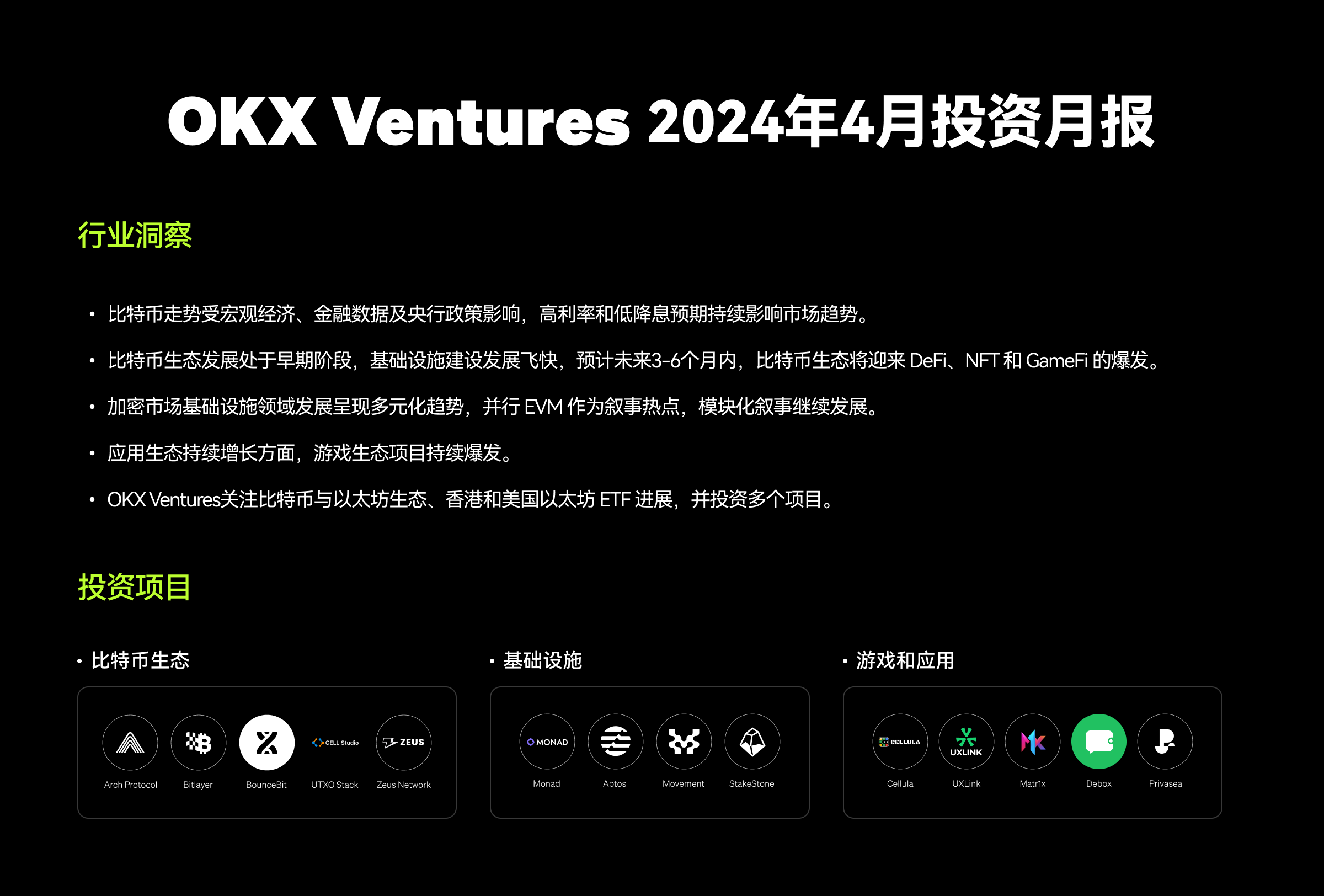
Bitcoin Ecosystem
Arch Protocol
According to the Arch Protocol whitepaper:
• Project Overview
○ Arch is a Bitcoin-native application platform designed to launch decentralized finance (DeFi) directly on the world’s most valuable blockchain without relying on bridging technology. By leveraging direct operations on the Bitcoin blockchain, Arch expands Bitcoin’s programmability and provides a secure, decentralized execution layer, enabling developers to build complex applications on Bitcoin.
○ Arch emphasizes preserving Bitcoin’s core value as a non-sovereign currency while maximizing its functional scope and applicability, enhancing both programmability and use cases—a milestone marking a new stage in Bitcoin’s evolution.
• Project Highlights
○ Native Bitcoin integration supporting DeFi and NFTs: Arch operates natively at Bitcoin Layer 1, avoiding the complexity and inefficiencies inherent in traditional Layer 2 solutions. It leverages Bitcoin’s own security and liquidity, allowing developers to create decentralized lending markets, exchanges, and high-end collectibles and NFTs stored entirely on-chain—adding significant new value and functionality to the Bitcoin ecosystem.
○ Smart contract capabilities: Through a zero-knowledge virtual machine (ZKVM), Arch enables smart contract execution, bringing unprecedented flexibility and diversity to Bitcoin. This supports everything from simple asset swaps to complex financial products.
○ Decentralized validation network: At the heart of Arch is a decentralized network of validator nodes that verify zero-knowledge proofs (ZK Proofs), ensuring correct transaction and application execution. This architecture enhances platform security and censorship resistance while mitigating centralization risks.
○ Fully on-chain operations: All transactions and state changes executed via the Arch platform are ultimately confirmed and recorded on the Bitcoin blockchain, maintaining transparency and immutability.
Bitlayer
According to the Bitlayer whitepaper:
• Project Overview
○ Bitlayer is a Bitcoin Layer 2 network built on BitVM technology, aiming to introduce scalability to the Bitcoin ecosystem. It offers security equivalent to Bitcoin Layer 1 and achieves Turing completeness, enabling arbitrary computation on Bitcoin.
○ Bitlayer aims to transform Bitcoin from a pure store of value into a more active and productive asset, providing fast transaction experiences and low fees.
• Project Highlights
○ Security: Bitlayer uses a fraud-proof protocol based on BitVM to validate state transitions, ensuring security comparable to Bitcoin’s base layer. Leveraging DLC/BitVM technology, it offers a more secure bridging model for cross-chain asset transfers than MPC-TSS or multi-signature schemes.
○ Scalability: Bitlayer supports flexible scaling solutions and aims to expand Bitcoin’s internet and cryptocurrency user base. Its modular design enables near-infinite scalability with fast confirmation times and low transaction costs.
○ Developer and user-friendly: Initially EVM-compatible, Bitlayer allows existing Ethereum ecosystem applications and developers to migrate with minimal cost and no deep modifications. Future support for additional VMs—including CairoVM, SolVM, and MoveVM—will offer users a richer selection of on-chain applications.
BounceBit
According to the BounceBit whitepaper:
• Project Overview
○ BounceBit is a Restaking infrastructure built on BTC, protected by regulated custodians Mainnet Digital and Ceffu.
○ BounceBit Chain is a PoS Layer 1 chain secured through restaking BTC, where validators stake both BTC and BounceBit’s native token using a dual-token system. This integrates native Bitcoin-level security with full Ethereum Virtual Machine (EVM) compatibility.
○ The BounceBit ecosystem features robust infrastructure including bridges and oracles, all secured via restaked BTC. Within an innovative CeFi-DeFi hybrid framework, BounceBit empowers Bitcoin holders to earn yield across multiple networks.
• Project Highlights
○ PoS Layer 1: Unlike Layer 2s dependent on Bitcoin’s mainchain, BounceBit stands independently, requiring validators to stake both its native token and BTC, creating a dual-token security model. This strengthens network security and increases Bitcoin’s intrinsic value by making BTC an active participant in consensus.
○ Cross-chain interoperability: BounceBit supports interoperability with EVM-compatible chains, diversifying staked assets like BTCB (Bitcoin on BNB Chain) and WBTC (Wrapped Bitcoin), expanding use cases for staked BTC.
○ Transparent CeFi delivering real yields: BounceBit leverages Mainnet Digital’s custody services and Ceffu’s MirrorX technology to keep Bitcoin on-chain while ensuring liquidity and transparency through T+1 settlement cycles, capturing profits from centralized exchange activities.
UTXO Stack
According to the UTXO Stack whitepaper:
• Project Overview
○ UTXO Stack aims to expand the Bitcoin ecosystem by enabling project developers to instantly launch BTC Layer 2s based on the UTXO architecture, natively integrating RGB++ protocol capabilities. This allows seamless interoperability between BTC and parallel Stack Layer 2s without cross-chain bridges, secured by staking BTC, CKB, and other BTC L1 assets.
○ By offering one-click deployment of UTXO-based BTC Layer 2s, UTXO Stack simplifies the creation of application-specific chains while ensuring native interoperability with BTC, CKB, and other UTXO assets—eliminating reliance on traditional cross-chain bridge technologies. UTXO Stack addresses market demand for higher performance, greater scalability, and lower-cost blockchain solutions.
• Project Highlights
○ UTXO Stack leverages Bitcoin’s security and reputation as foundational trust layers to drive broader asset issuance and financial innovation on Bitcoin. By enabling application chains that easily interoperate with BTC and other UTXO assets, UTXO Stack gives developers powerful tools for rapid development and deployment of financial applications. Additionally, by employing PoS (Proof-of-Stake) mechanisms to secure these app chains, UTXO Stack also seeks to address the energy consumption and efficiency challenges associated with Bitcoin’s PoW (Proof-of-Work) mechanism.
Zeus Network
According to the Zeus Network whitepaper:
• Project Overview
○ Zeus Network aims to bring the next billion users into the Web3 ecosystem by building cross-chain infrastructure on Solana. This is achieved by developing Zeus Layer—a pluggable and programmable node network—on the Solana Virtual Machine (SVM). Zeus envisions a future where developers can freely build decentralized applications (dApps) on permissionless, bridgeless cross-chain infrastructure.
○ Zeus Network’s primary goal is to bring Bitcoin liquidity to Solana via its first dApp, APOLLO. The network is bridgeless because liquidity providers on each chain do not receive backflow liquidity on the other chain; assets on each chain are protected by their respective protocols.
• Project Highlights
○ Bridgeless cross-chain technology: Through innovative design eliminating traditional blockchain bridges, Zeus avoids bridge-related security risks, making cross-chain asset movement safer. Apollo acts as a cross-chain link between BTC and Solana, bringing Bitcoin liquidity to Solana.
○ Leverages Solana’s high performance: Built on Solana—the fastest, most cost-effective, and highest-performing blockchain—Zeus enables fast and low-cost cross-chain transactions.
○ Pluggable and programmable node network: Zeus Layer offers a modular and programmable framework, enabling developers to seamlessly integrate and build dApps that interoperate smoothly with Bitcoin and future blockchains.
○ Security and decentralization: Advanced cryptographic techniques, fraud proofs, and a decentralized network of distributed nodes ensure transaction security and system transparency and fairness.
Infrastructure
Monad
According to the Monad whitepaper:
• Project Overview
○ Monad is a high-performance, Ethereum-compatible Layer 1 blockchain designed to push the boundaries of decentralization and scalability through optimization in key areas.
○ By introducing four core technological optimizations—MonadBFT, deferred execution, parallel execution, and MonadDb—Monad significantly boosts system throughput, achieving up to 10,000 transactions per second (TPS).
○ Full compatibility with EVM bytecode and Ethereum RPC APIs ensures developers and users can seamlessly migrate existing Ethereum tools and DApps to Monad, enjoying superior blockchain performance.
• Project Highlights
○ Ultra-high performance and speed: For blockchain ecosystems requiring massive daily active users and high interaction rates, Monad delivers top-tier performance—up to 10,000 TPS, with 1-second block times and finality.
○ Ethereum ecosystem compatibility: Fully compatible with EVM bytecode, allowing Ethereum apps to migrate to Monad without code changes; Ethereum RPC API compatibility enables seamless access using familiar tools like MetaMask and Etherscan.
○ MonadBFT: An improved version of the HotStuff consensus algorithm, enabling efficient pipelined consensus.
▪ Deferred Execution: Separates consensus from execution via pipelining, dramatically increasing execution budget.
▪ Parallel Execution: Utilizes multi-core processing to execute tasks concurrently while maintaining transaction consistency, greatly boosting speed.
▪ MonadDb: A high-performance, SSD-optimized state backend storage system enabling efficient state updates and caching.
○ Low hardware requirements and accessibility: Monad maintains reasonable node operation hardware requirements, ensuring low entry barriers and broad accessibility.
Aptos
According to the Aptos whitepaper:
• Project Overview
○ A leading non-EVM Layer 1 public chain using the Move programming language. Since single-threaded execution has long been a bottleneck limiting blockchain throughput, Aptos developed the Block-STM parallel smart contract execution engine to improve transaction efficiency. The core team includes Mo Shaik and Avery Ching, former members of Meta, with extensive experience in traditional internet sectors. Past investors include A16Z, Dragonfly, Brevan Howard, Franklin Templeton, Tiger Global, Hashed, and Multicoin Capital.
○ Recently, Aptos Labs formed new partnerships with Microsoft, Brevan Howard, SK Telecom, and Boston Consulting Group to develop Aptos Ascend—a platform aimed at institutional clients for managing digital assets on-chain, supporting increased liquidity for RWA-type assets globally.
• Project Highlights
○ Technological innovation and performance: Aptos is known for its novel tech stack, including AptosBFTv4 consensus, Quorum Store mempool protocol, Block-STM parallel execution engine, and the Aptos Move programming language. Together, these deliver high throughput and low latency—achieving up to 30,000 TPS in testing environments and processing over 9 billion transactions during specific events.
○ Security and upgradability: Aptos prioritizes security and frequent upgrades. The Aptos Move language enhances smart contract safety, and the network supports regular upgrades to quickly deploy new technologies and fixes.
○ Ecosystem growth and partnerships: Since launch, Aptos has rapidly expanded its ecosystem through strategic collaborations with Microsoft, Google Cloud, Alibaba Cloud, funding programs, and hackathons. With a focus on strengthening presence in Asia-Pacific, it has partnered with prominent gaming companies and conglomerates, driving growth in DeFi, social media, gaming, and NFT applications.
○ Market adoption and network activity: Initiatives like the Chingari social media platform, Pyth oracle integration, and Graffio’s one-day public art event have driven strong network usage. Average daily transactions exceed 475,000, with over 72,000 daily active addresses, demonstrating robust user engagement and utility.
○ Forward-looking roadmap: Aptos’ future plans—including storage sharding, targeting 100,000 to 1 million TPS, and developing a new Aptos Move compiler—highlight its commitment to being an innovative platform adapting to future Web3 demands.
Movement
According to the Movement whitepaper:
• Project Overview
○ Movement Labs aims to solve widespread smart contract vulnerabilities in the Ethereum ecosystem while introducing a new execution environment capable of processing over 30,000 transactions per second. Movement combines smart contract security and parallelization with Ethereum’s liquidity and user base, bringing MoveVM to Ethereum via its flagship Layer 2 and Rollup connected to the Move Stack. As a ZK Layer 2 using fully EVM-bytecode-compatible interpreters and Ethereum for settlement, Movement enhances Ethereum’s parallelization and smart contract security.
• Project Highlights
○ Developer-friendly experience: Introducing MoveVM to Layer 2 with the powerful Fractal transpiler, converting Solidity smart contracts into Move bytecode—enhancing functionality and security while ensuring high interoperability with other blockchain systems.
○ Flexibility and scalability: M2’s modular design abstracts the consensus layer from execution, enabling independent yet synchronized operation across protocol layers.
○ High speed, low cost: Achieves sub-second finality via parallel Move-EVM and decentralized sequencers, with gas fees reportedly under $0.01 and theoretical TPS exceeding 160,000.
○ High compatibility: EVM-compatible, supports both Aptos and Sui Move, deeply integrated with Cosmos, and natively supports USDC and Cosmos wallets.
StakeStone
According to the StakeStone whitepaper:
• Project Overview
StakeStone is a cross-chain Liquid Staking Token (LST) liquidity protocol designed to bring native staking yields and liquidity to Layer 2 in a decentralized manner. Highly scalable and supporting various staking pools, it is compatible with upcoming restaking implementations. It also establishes a multi-chain liquidity market around STONE, StakeStone’s native LST, creating more use cases and yield opportunities for users.
• Project Highlights
○ Cross-chain LST liquidity market: StakeStone aims to build a dedicated cross-chain market for LST liquidity, connecting Ethereum and other blockchains. This enables seamless asset transfer across chains and addresses liquidity fragmentation between mainnets and Layer 2 networks.
○ OPAP mechanism: StakeStone’s pioneering Optimized Portfolio and Allocation Proposal (OPAP) mechanism offers a decentralized liquid staking solution. Users deposit ETH to receive STONE tokens whose value appreciates over time, enabling strategic allocation and optimized staking returns.
○ Diversified applications and efficiency: STONE is not just an ETH staking representation—it functions equivalently to ETH across various DeFi, GameFi, and NFTfi platforms. This versatility significantly enhances STONE’s utility and appeal.
○ LayerZero integration and cross-chain support: Powered by LayerZero, STONE enables seamless transfers and price alignment across multiple blockchains, including Ethereum, Manta, Base, BNB Chain, Mantle, and Linea.
○ Rapid capital and market growth: Since launch, StakeStone’s Total Value Locked (TVL) has grown rapidly, peaking at $1.38 billion—reflecting strong market demand and confidence in this solution.
○ These features position StakeStone as a forward-thinking, innovative staking solution that not only delivers stable staking yields but also tackles fragmentation and inefficiency in today’s blockchain ecosystem.
Gaming and Applications
Cellula
According to the Cellula whitepaper:
• Project Overview
Cellula is a fully on-chain artificial life simulation strategy game that lets users play Conway’s Game of Life via on-chain cellular automata. In-game NFTs can reproduce, grow, evolve, or die on the blockchain, turning each NFT into an autonomous entity and creating an “NFT Arena.”
• Project Highlights
○ Fully on-chain gameplay with unique mechanics: Cellula is a fully on-chain Conway’s Game of Life powered by the MUD engine, simulating life through programming that mimics actual evolution. Future integration with ERC6551 could enable NFTs to interact with various smart contracts.
○ Character progression: NFTs gain autonomous evolution. While traditional NFTs derive value top-down (creators assign value and distribute airdrops), Cellula empowers creators by building a game where NFTs grow and combine organically.
○ Composability: Game metadata can be combined with other NFTs as raw material. Like LEGO bricks, traditional NFTs or items can be merged, with special identities granted via gene traits.
UXLink
According to the UXLink whitepaper:
• Project Overview
○ UXLINK is the largest Web3 social platform and infrastructure, enabling users and developers to discover, distribute, and trade crypto assets socially and through groups.
○ One year after launch, UXLINK has surpassed 5.7 million registered users, over 100,000 groups, over 1.2 million daily active users on its dApp, and over 300,000 on-chain daily active users—consistently ranking among the top three in on-chain DAU.
• Project Highlights
○ Link To Earn: Unlike other social products, UXLINK emphasizes real-world social relationships through trusted peer referrals. Its disruptive “Web3-ified group” model introduces a new way of user connection and organization, forming a unique protocol and data layer that adds distinct value for Web3 developers.
○ High growth: Currently the highest-traffic product in the social category, with users evenly distributed across Southeast Asia, the Middle East, Europe, Japan/Korea, South Asia, South America, and Africa—accumulating rich, interconnected user data.
○ UXLINK redefines real social relationships and scenarios through Web3 innovation, merging assets with social interactions. Its unique traffic and data attract numerous paying partners, creating a positive feedback loop between users and collaborators.
Matr1x
According to the Matr1x whitepaper:
• Project Overview
○ Matr1x is a Web3 gaming platform pursuing a premium strategy, self-developing and co-publishing games. It has built a proprietary Web3 gaming middleware protocol to help more Web2 games transition into Web3.
○ Its first game, Matr1x Fire—a mobile FPS—has achieved 1.05 million cumulative registrations, over 1.19 million downloads, 490,000 unique active wallets, and 1.26 million transactions, currently ranking #1 on Polygon.
• Project Highlights
○ Integrates esports elements, naturally attracting young users. Matr1x has hosted over 40 online and offline tournaments worldwide, covering more than 50 gaming communities across 20+ countries and regions, with over 100,000 total participants—making it the leading esports brand in the entire Web3 industry.
○ Emphasizes in-game asset value—a proven concept in Web2. Focusing on shooter genre accessories trading, such as CS:GO’s annual $38 billion trading volume, Matr1x sees huge potential. It has successfully launched three NFT collections with over 800,000 holder addresses and cumulative trading volume exceeding $150 million.
○ The team comprises veterans from top global companies, with years of combined experience in gaming and blockchain, having successfully developed and published multiple games generating over 3 billion RMB in revenue and serving over 300 million users.
Debox
According to the Debox whitepaper:
• Project Overview
○ DeBox is a DID-based Web3 community management tool. Users holding ERC-20 tokens or NFTs can join corresponding groups permissionlessly and use features like raffles, proposals, and voting provided by the platform.
• Project Highlights
○ DeBox bridges user and community needs. On the community side, it serves as a community-driven governance tool—supporting elections, voting, finance, events, raffles, airdrops, and evaluations. On the user side, it offers equal, permissionless, and simple access to information. As a result, DeBox has built a strong user base: over 11,000 DAU, 90,000+ holders, 24,241 communities—with most users being crypto newcomers from apps.
○ AI and intent-centric: Over 100 large-model-powered AI bots—including GC, trading, and search—deliver seamless user experiences.
○ DeBox’s ecosystem shows organic growth. Internal DEX volume exceeds $120 million, $59.1 million from innovative social assets, with monthly net profit surpassing $80,000.
Privasea.io
According to the Privasea whitepaper:
• Project Overview
○ Privasea AI Network is a privacy-focused artificial intelligence processing system using Fully Homomorphic Encryption (FHE) to compute on encrypted data, ensuring confidentiality and security of sensitive information.
○ Through advanced FHE technology and a multi-layered architectural design, Privasea AI effectively addresses privacy protection and data security challenges in AI processing, delivering efficient and user-friendly solutions adaptable to diverse users and scenarios.
• Project Highlights
○ Privacy protection: Using FHE, Privasea AI analyzes and processes data without decryption. Even when processed in cloud or untrusted computing environments, users’ sensitive data remains protected—offering GDPR-compliant privacy-preserving AI solutions.
○ Distributed AI computing: Privasea AI leverages blockchain to incentivize and manage a distributed network of computing nodes, providing necessary AI processing power. This increases resource availability and enhances transparency and security through decentralization.
○ Rich application scenarios: Combining FHE and AI, Privasea opens new paths for privacy-preserving machine learning and AI applications. Use cases span finance, healthcare, and regulatory compliance, offering a comprehensive solution that protects data privacy while unlocking data value.
Risk Warning:
This article is for informational purposes only.
This article does not constitute (i) investment advice or recommendation; (ii) an offer or solicitation to buy, sell, or hold digital assets; or (iii) financial, accounting, legal, or tax advice. Digital assets (including stablecoins and NFTs) involve high risk, may fluctuate significantly in value, and may become worthless. Please take full responsibility for understanding and complying with applicable local laws and regulations.
Join TechFlow official community to stay tuned
Telegram:https://t.me/TechFlowDaily
X (Twitter):https://x.com/TechFlowPost
X (Twitter) EN:https://x.com/BlockFlow_News
 OKX
OKX