








Why was Worldcoin, the Web3 project by OpenAI's founder, banned from operation?
TechFlow Selected TechFlow Selected
Why was Worldcoin, the Web3 project by OpenAI's founder, banned from operation?
Worldcoin's operations are affected by the virtual currency policies of various countries.
 Navigating Web3 tides with focused insights
By Liu Honglin
Recently, the Office of the Privacy Commissioner for Personal Data (PCPD) in Hong Kong has completed its investigation into the Worldcoin project and determined that its operations in Hong Kong violate the Personal Data (Privacy) Ordinance (PDPO).
On May 22, the Privacy Commissioner, Alice Tsong, issued an enforcement notice to Worldcoin, ordering it to immediately cease all operations in Hong Kong involving the use of iris-scanning devices to scan and collect the public's iris and facial images.
The PCPD began investigating the Worldcoin project in January 2024 to determine whether this identity verification method posed a serious risk to individuals' personal data privacy and violated requirements under the PDPO.
From December 2023 to January 2024, the PCPD conducted 10 covert visits to six locations involved in operating the Worldcoin project. According to the PCPD, during its operation in Hong Kong, Worldcoin scanned the faces and irises of 8,302 people for verification purposes. However, collecting facial images was unnecessary because operators of the iris-scanning device could already personally verify participants’ identities on-site, making facial scanning or image collection an unnecessary step. Additionally, Worldcoin’s privacy statement lacked a Chinese version, meaning non-English-speaking participants could not understand the project's policies, practices, terms, and conditions. In the view of the PCPD, Worldcoin failed to provide sufficient information, hindering individuals from making informed decisions and giving genuine consent.
For these reasons, the PCPD concluded that Worldcoin’s collection of facial and iris images was unfair and unlawful, breaching data protection principles. The PCPD ruled that retaining sensitive biometric data—including facial and iris images—for up to 10 years solely for training artificial intelligence models is unreasonable.
Introduction to Worldcoin
Worldcoin’s mainnet and its cryptocurrency, Worldcoin, officially launched in over 20 countries on July 24, 2023. Since launch, its price has fluctuated multiple times. As of May 17, 2024, the price of Worldcoin reached $4.863.
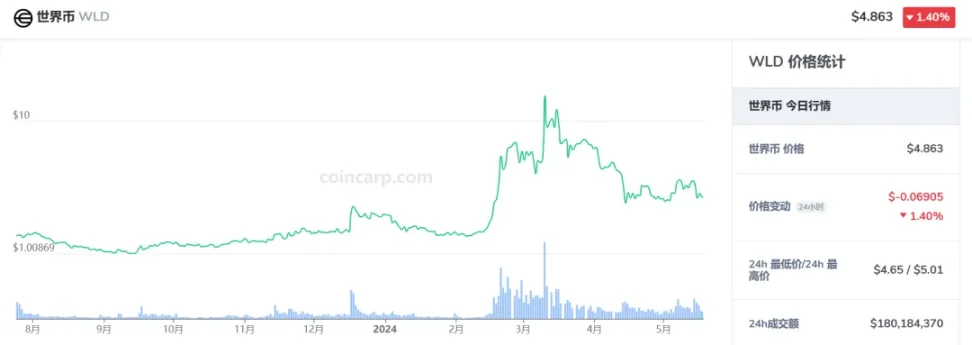
As of May 17, 2024, according to data published on the official Worldcoin website, Worldcoin has been operational for 298 days, with World ID verification available across more than 160 countries and regions. The Worldcoin website claims that Worldcoin aims to become the world’s largest real-person identity and financial network—privacy-protecting and owned by all humanity. It seeks to provide universal access to the global economy regardless of nationality or background, creating a space where everyone benefits in the age of AI.
Worldcoin’s co-founder is Sam Altman. In addition to co-founding Worldcoin, Sam Altman served as president of the startup accelerator Y Combinator from 2014 to 2019 and as CEO of the artificial intelligence company OpenAI from 2019 to 2023. He is known for his belief in Artificial General Intelligence (AGI), which he believes will be capable of performing any task a human can do.
OpenAI released the first version of the ChatGPT model in June 2020, followed by several updated versions. The ChatGPT website states: "Our mission is to ensure that artificial general intelligence benefits all of humanity."
Similarly, Worldcoin’s whitepaper declares its founding purpose as building a globally inclusive identity and financial network owned by the majority of humankind. If successful, it could significantly expand economic opportunities, offer a reliable solution to distinguish humans from AI online, protect privacy, advance global democratic processes, and demonstrate a potential pathway toward AI-powered Universal Basic Income (UBI).
The Three Key Elements of Worldcoin
Worldcoin consists of three main components: World ID, Worldcoin token, and World App.
(1) World ID
World ID is a privacy-preserving identity verification method allowing users to prove they are human online via a device called Orb, without compromising personal privacy. Based on zero-knowledge proof technology, it enables identity verification without revealing detailed user information. World ID is personally exclusive and usable only by its holder. Even if lost or stolen, users can recover their World ID.
(2) Worldcoin Token
To encourage user growth, Worldcoin will distribute tokens to all network participants. This may lead Worldcoin to become the most widely distributed digital asset.
(3) World App
World App is the first application for World ID. It guides users through identity verification using Orb, manages their World ID credentials, and allows secure sharing of these credentials with third parties while preserving privacy. The app also provides seamless access to decentralized financial services worldwide.
Built upon World ID, Worldcoin aims to fairly conduct airdrops, protect social media from bot or Sybil attacks, and achieve equitable distribution of limited resources. To participate in the Worldcoin protocol, one must first download the World App and complete identity verification via Orb to obtain a World ID.
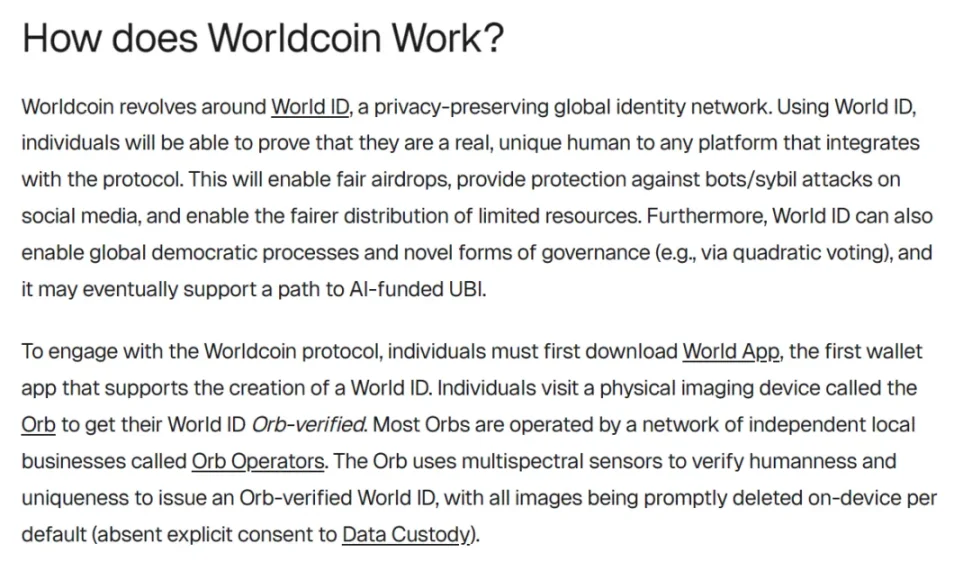
Worldcoin's Feature – Biometric Verification
A defining feature of Worldcoin is verifying each unique individual through biometrics. The underlying idea is that rapidly advancing AI can generate content so convincing that it appears human. Therefore, inclusivity and privacy protection are crucial for public infrastructure. By ensuring every message or transaction includes verified human origin, much noise could be filtered out from the digital world. Currently, collective decision-making in Web3 largely depends on token-based governance, which excludes some people and gives disproportionate advantage to those with greater economic power. Thus, including every individual in governance systems becomes increasingly important—and forms the foundation for AI to benefit all humanity to the greatest extent possible.
Biometric verification also relates to the fair allocation of societal resources. As AI advances, fairly distributing usage rights and generated value through UBI will play an increasingly vital role in counterbalancing concentrated economic power. Decentralized proof-of-personhood protocols can assist any global project or organization in achieving fair resource distribution. Obtaining a World ID through biometric verification ensures each person is verified only once, preventing duplicate registrations and guaranteeing fairness. Moreover, biometric verification enhances the security of World ID, ensuring only the rightful holder can use it and enabling recovery in cases of loss or damage.
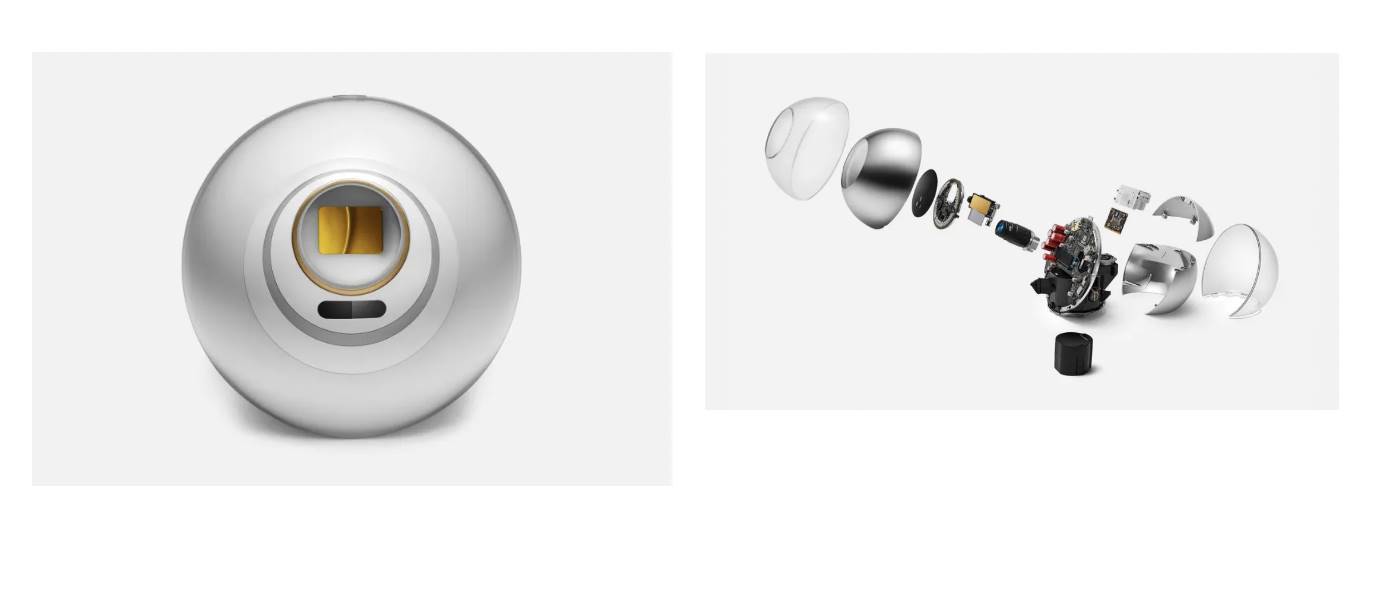
Worldcoin uses iris biometric technology to verify personal information. Tools for Humanity—the advisory body behind the Worldcoin Foundation and operator of World App—developed the Orb device to carry out this verification.
Reasons for Restrictions on Worldcoin
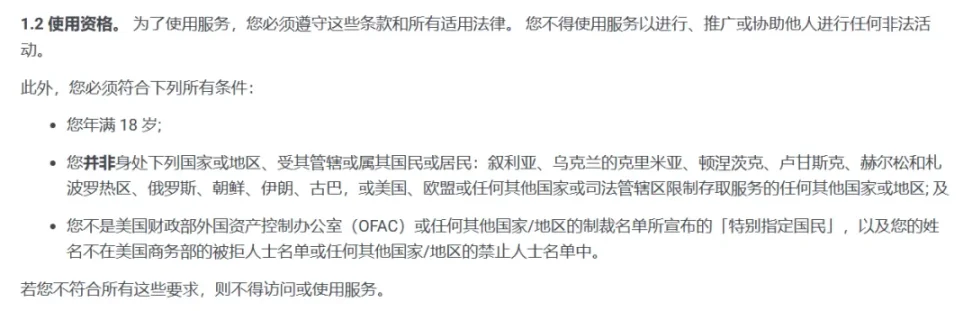
The “Worldcoin Foundation Terms and Conditions” state: “To use the Services… you must meet all of the following conditions: You are not located, established, or resident in, or a national of: Syria; Crimea, Donetsk, Luhansk, Kherson, or Zaporizhzhia Oblasts of Ukraine; Russia; North Korea; Iran; Cuba; or any other country or jurisdiction where access to the Services is restricted by the United States, the European Union, or any other country or jurisdiction… If you do not meet all of these requirements, you may not access or use the Services.”
(1) Impact of Virtual Currency Policies
Different countries have vastly different policies, laws, and regulations regarding virtual currencies, leading to highly variable market environments for such projects globally. As a virtual currency, the Worldcoin token is no exception. Divergent national attitudes toward cryptocurrencies result in restrictions on purchasing and using the Worldcoin token in certain jurisdictions. Some governments restrict virtual currencies to mitigate financial risks and prevent illegal activities.
China. On December 3, 2013, Chinese regulators issued the “Notice on Preventing Bitcoin Risks” (Yinfa [2013] No. 289), stating that “to protect the property rights and interests of the public, safeguard the legal tender status of the RMB, prevent money laundering risks, and maintain financial stability,” “Bitcoin should be regarded as a specific virtual commodity, does not have the same legal status as currency, and cannot and should not be used as currency in market circulation.” From 2013 to 2014, China classified Bitcoin as a “virtual commodity,” permitted private ownership at individuals’ own risk, but prohibited banks and payment institutions from providing services for Bitcoin transactions. Between 2017 and 2019, Chinese regulators introduced a series of measures declaring initial coin offerings (ICOs) illegal, banning cryptocurrency exchanges from operating within China, and prohibiting mining operations. On September 15, 2021, Chinese regulators issued the “Notice on Further Preventing and Addressing Risks of Cryptocurrency Trading and Speculation” (Yinfa [2021] No. 237), noting that “recently, speculation in cryptocurrency trading has resurged, disrupting economic and financial order and breeding gambling, illegal fundraising, fraud, pyramid schemes, money laundering, and other criminal activities, seriously endangering the safety of people’s property. To further prevent and address risks associated with cryptocurrency trading and speculation, and to effectively safeguard national security and social stability,” it stipulated that cryptocurrency-related business activities constitute illegal financial activities, and criminal liability will be pursued where such activities amount to crimes.
South Korea. In September 2017, the Financial Services Commission (FSC) of South Korea announced a ban on ICOs and margin trading of virtual currencies. According to News1Kim, FSC Vice Chairman Kim Yong-Bum stated: “Financial authorities are banning ICOs. The aim is to prevent overheating caused by speculative demand arising from increased risks of consumer harm due to fraudulent ICOs, thereby protecting the market.” On July 18, 2023, the FSC enacted the “Act on the Protection of Virtual Asset Users,” aiming to protect users’ rights and interests by establishing rules on user asset protection, regulation of unfair trading practices, and related matters, promoting transparency and sound trading practices in the virtual asset market. The law sets out specific provisions concerning user asset protection, prevention of unfair trading, supervision, and enforcement actions.
(2) Use of Biometric Technology
Worldcoin’s use of iris biometric technology to verify personal information is another reason it faces restrictions in certain countries.
Kenya. Kenya was among the first countries to launch Worldcoin registration and verification. However, the government later imposed a ban, halting Worldcoin’s registration activities. In a statement, Kenya’s Ministry of Interior announced the “immediate suspension of Worldcoin activities until relevant government agencies confirm there is no public risk.” The government expressed concern about Worldcoin’s activities involving the collection of eye/iris data from citizens and said investigations were underway “to determine the authenticity and legality of the activities, the security and protection of collected data, and how the collectors intend to use the data.”
France. French authorities have expressed skepticism about Worldcoin’s collection of users’ iris data. France’s data protection regulator, the National Commission on Informatics and Liberty (CNIL), questioned the legality and storage conditions of Worldcoin’s biometric data collection methods. Consequently, CNIL launched an investigation into Worldcoin’s data collection and processing activities to ensure compliance with French and European data protection laws. This investigation received support from authorities in Bavaria, Germany.
Germany. The Bavarian State Office for Data Protection Supervision also initiated an investigation into Worldcoin’s handling of sensitive biometric information, beginning in November 2022. The office raised concerns about the large-scale processing of biometric data, stating that these technologies are “neither mature nor sufficiently analyzed with regard to the specific core purpose of handling financial information.”
Spain. Spain’s Data Protection Agency (AEPD) ordered Worldcoin to stop collecting and processing data in Spain and issued a temporary three-month ban. AEPD stated it was investigating complaints regarding Spanish users being unable to withdraw consent and allegations that Worldcoin had collected data from minors. “AEPD requires the cessation of collection and processing of special categories of personal data and blocks already collected data. AEPD has received several complaints, including insufficient information disclosure, collection of data from minors, and inability to withdraw consent.”
Summary
The Worldcoin project carries the noble vision of its founders. Its whitepaper proudly proclaims that Worldcoin will respect user privacy and integrate everyone into the global economy regardless of nationality, region, or background, creating a globally inclusive identity and financial network owned by the majority of humanity. It strives to significantly increase economic opportunities and promote global democratic processes. However, in practice, Worldcoin’s operations are constrained by varying national policies on virtual currencies. Furthermore, its collection of biometric data has led to investigations and regulatory restrictions.
Join TechFlow official community to stay tuned
Telegram:https://t.me/TechFlowDaily
X (Twitter):https://x.com/TechFlowPost
X (Twitter) EN:https://x.com/BlockFlow_News












