
The Rise of Polymarket, a Cryptocurrency Prediction Market: Its Founder Dropped Out at 22 to Build a Platform for Betting on the Real World
TechFlow Selected TechFlow Selected
The Rise of Polymarket, a Cryptocurrency Prediction Market: Its Founder Dropped Out at 22 to Build a Platform for Betting on the Real World
Attitudes toward cryptocurrency have become a significant issue in the U.S. election this November.
 Navigating Web3 tides with focused insights
By Weilin

Attitudes toward cryptocurrency have become a significant issue in the U.S. presidential election this November. Interestingly, users are not only seeing traditional polling agencies provide data but also witnessing the rising popularity of Polymarket, a crypto-based prediction market platform. As of May 16, nearly $127 million has been wagered on the topic of "winner of the 2024 presidential race," with $15 million bet on Trump at a 50% win probability, $14.55 million on Biden at 42%, and all three other candidates each below 3%.
Just days earlier, on May 14, Polymarket announced it had raised $70 million across two funding rounds, with its latest round led by Peter Thiel's venture capital firm Founders Fund. Polymarket’s investors also include Ethereum co-founder Vitalik Buterin.
Polymarket was founded amid widespread misinformation during the pandemic. The project launched in May 2020 and went live in mid-June that year. Its timing coincided with major events such as the 2020 and 2024 U.S. elections, gradually bringing this cryptocurrency-based prediction market into public view and market focus.
Dropped out of NYU Computer Science to build a startup, inspired by Hayek
Shayne Coplan, founder of Polymarket, is 26 years old. His LinkedIn profile shows he previously studied computer science at New York University. According to public reports, Coplan embodies many traits of a new generation of entrepreneurs. He is an artist who became fascinated with P2P file sharing during the era when people loved sharing music. From there, he discovered Bitcoin and quickly grasped the intrinsic value of global peer-to-peer asset networks.
When Ethereum announced its launch in 2014, Coplan became an early follower and is believed to have been the youngest participant in its token presale. Two years later, at age 18, Coplan began working on blockchain projects. In June 2016, he interned at Chronicled in the San Francisco Bay Area, where his role was “to follow the chief product officer and help determine how products would interact with the Ethereum blockchain.”
Afterward, Coplan remained deeply engaged with cryptocurrency, launching a series of ventures, including a DeFi startup called Union.market—which directly preceded Polymarket. Although he eventually dropped out of school, he spent years thinking critically about challenges faced by prediction markets and decentralized platforms. He cites Friedrich Hayek’s seminal essay “The Use of Knowledge in Society” as an early entrepreneurial inspiration, and draws from decades of academic research on prediction markets. Hayek’s core idea—that economic incentives encourage individuals to more accurately assess uncertain outcomes—resonates strongly with Coplan: people seek better information, think more deeply, and put their money behind outcomes they believe are most likely.
“When the coronavirus broke out, there was so much uncertainty and conflicting opinions—I thought, if only there were free markets on these topics, people could align their money with their beliefs,” Coplan once told the media.
On June 16, 2020, Polymarket launched its beta version. However, initial user experience was high-friction, supporting only MetaMask login, facing high Ethereum gas fees, and suffering from limited liquidity. Three months later, with the release of Polymarket’s second phase, Coplan’s vision for the platform became clearer. The platform migrated to Matic (now Polygon), Ethereum’s Layer 2 solution, to reduce betting gas costs. He also built a system for users without Ethereum wallets. All bets are placed using USDC, a stablecoin pegged to the U.S. dollar, which can be purchased via debit or credit card.
Within months of its initial launch, Polymarket gained traction and completed a substantial $4 million seed round led by prominent investors Polychain Capital and Naval Ravikant.
The 2020 U.S. election served as a catalyst for Polymarket. On November 3, driven by election-related activity, Polymarket’s trading volume surged to $1.297 million, propelling it from obscurity to prominence.
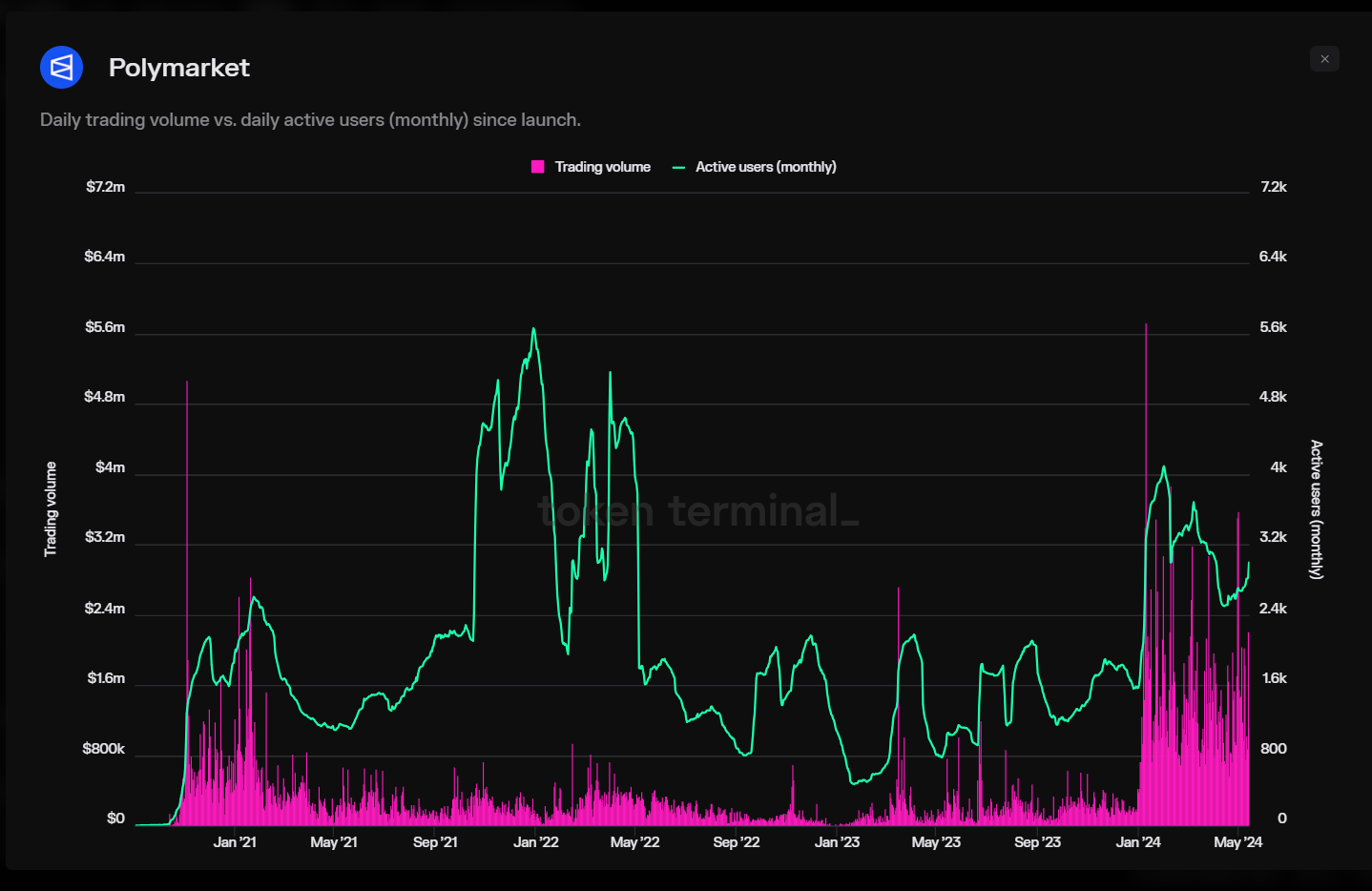
Polymarket's trading volume and monthly active users since its 2020 launch
With growing community feedback and market validation, Polymarket later secured a Series A round, raising $25 million with General Catalyst leading the round, joined by Airbnb’s Joe Gebbia and Polychain, among others.
Most recently, Polymarket raised $45 million in its Series B round, led by Peter Thiel’s Founders Fund alongside existing investors 1confirmation and ParaFi, with participation from Ethereum co-founder Vitalik Buterin, Dragonfly, and Eventbrite co-founder Kevin Hartz.
Fined $1.4 million by CFTC; submarine prediction sparks controversy
Polymarket’s growth hasn’t been smooth. In January 2022, it was fined $1.4 million by the U.S. Commodity Futures Trading Commission (CFTC) and issued a cease-and-desist order for regulatory violations, including failure to register as a Swap Execution Facility. As part of the settlement, Polymarket agreed to scale back services in the U.S. while continuing operations overseas.
Nonetheless, Polymarket has strengthened its compliance efforts. In May 2022, it appointed J. Christopher Giancarlo, former chair of the CFTC, as chairman of its advisory board.
Beyond the fine, in June 2023, a viral tweet about the Titan submersible incident brought negative attention to Polymarket. A market on whether the submersible would be found by a certain date attracted over $300,000 in bets on whether the missing vessel would be “found before June 23.” This sparked online debate about the ethics of profiting from potentially fatal events.
“At which stage of capitalism do we start betting on people’s deaths?” asked one Twitter user, posting a screenshot showing Polymarket odds. The sentiment resonated widely, with the post gaining over 9,000 retweets and 150,000 likes. “Absolutely insane. Imagine making money based on whether someone lives or dies,” replied another user, receiving over 1,000 likes. Others began criticizing Polymarket directly for allowing such predictions.
In response, Polymarket addressed the ethical concerns, clarifying that the submarine market was “unrelated to any outcome involving the passengers.” “We understand that misunderstandings about our prediction market being tied to the fate of the passengers caused confusion. We want to emphasize that this is not true,” Polymarket stated. “Our goal is not to profit from such unfortunate events—nor have we done so. Instead, we aim to help people better understand the world around them.”
Breaking through in the crypto prediction market race—when will it mature?
Prediction markets have a long history, but in the crypto space, the first decentralized prediction market was Augur, launched on Ethereum in July 2018. Developed by Forecast Foundation, established in 2014 by Jack Peterson, Joey Krug, and Jeremy Gardner, the foundation received advisory support from Ron Bernstein, founder of the defunct Intrade, and Ethereum founder Vitalik Buterin.
Besides Augur, today’s prediction market landscape includes several players such as Gnosis, Hedgehog, PlotX, Projection Finance, Sanr.app, Better.fan, and Feel.market. However, Gnosis shifted toward community governance after failing to meet expectations, while others like Veil have shut down entirely.
Early crypto-based prediction market experiments like Augur and Gnosis were severely hampered by Ethereum’s long-standing scalability issues. Additionally, both used native tokens, adding friction to the user experience. Polymarket learned from these predecessors’ mistakes.
After four years of development, Polymarket has successfully broken through, becoming a reference point cited by media and industry analysts on key issues as an alternative gauge of public sentiment.

As of May 14, Polymarket hosts numerous trending topics: Who will win the 2024 presidential election? Will the Ethereum ETF be approved by May 31? Will $GME reach an all-time high before Friday?
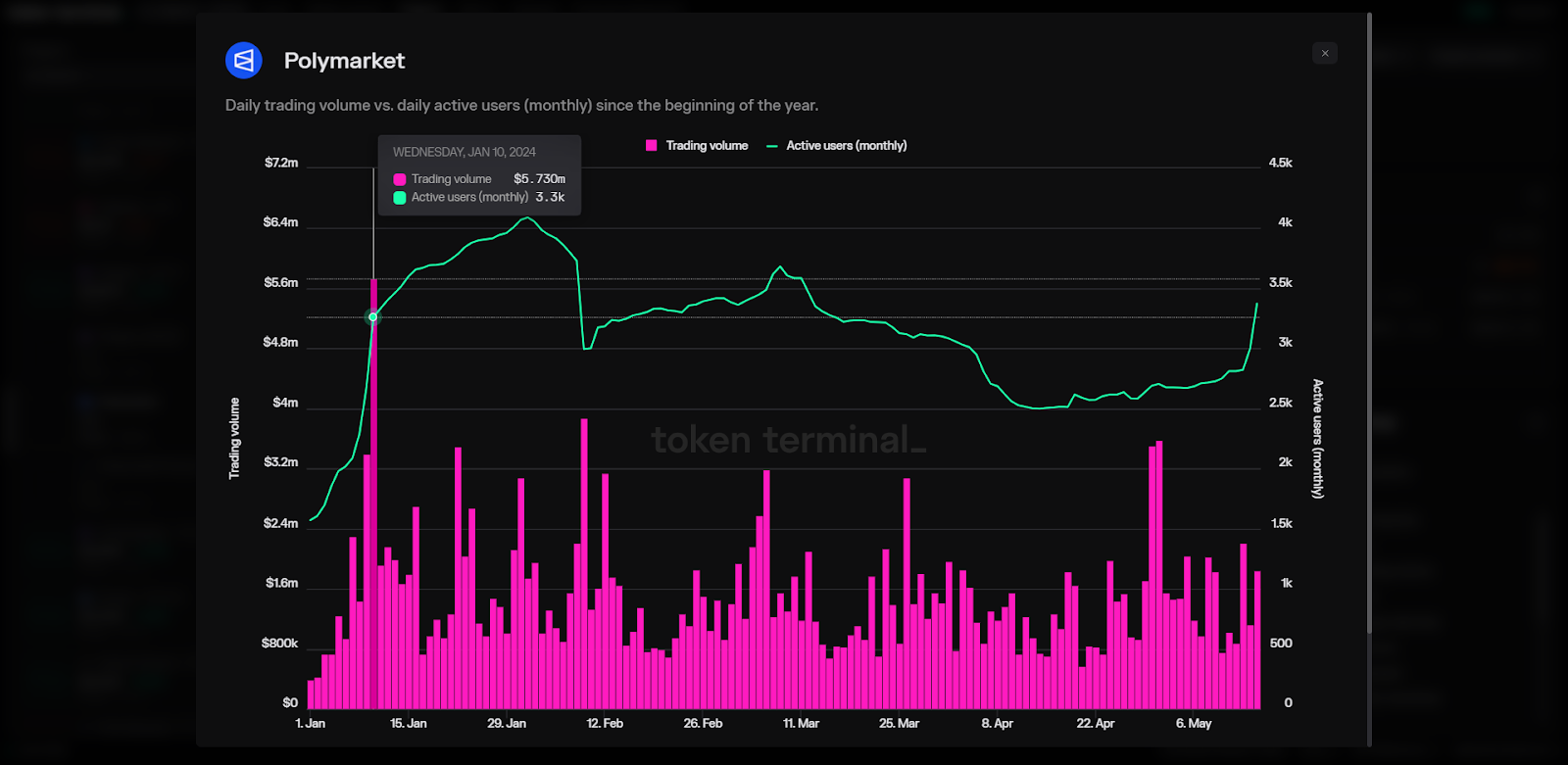
According to Token Terminal, Polymarket’s highest daily trading volume this year occurred on January 10 at $5.73 million. The platform saw a sharp increase in monthly active users in January, rising from 1,600 on January 1 to 4,100 on February 1, though growth slowed in April. As of May 15, the total amount wagered on Polymarket reached $202.7 million.
Following the recent funding round, Coplan wrote on LinkedIn: “What’s most gratifying is seeing Polymarket widely adopted as an alternative news source. The trend is clear: because Polymarket exists, people are more informed about what’s happening in the world. Enough with the self-promoting experts and algorithmically generated headlines. In this age of rampant misinformation, Polymarket offers a new form of information driven by financial incentives toward truth, not clickbait. People want unbiased information. Polymarket is delivering that.”
A staunch believer in market theory, Coplan sees prediction platforms as a genuine pathway to understanding reality.
Polymarket has drawn attention from many industry insiders. Vitalik once used Polymarket to track Sam Altman’s board ousting incident. Packy McCormick, advisor at a16z Crypto, once said Polymarket’s homepage might be the best place on the internet to start your day.
Riding the wave of social trends and backed by high-profile users, Polymarket has become the largest crypto prediction market. Yet, to fulfill its original mission, continuously improving product experience while navigating risks and ethical dilemmas remains a critical challenge for future growth.
Join TechFlow official community to stay tuned
Telegram:https://t.me/TechFlowDaily
X (Twitter):https://x.com/TechFlowPost
X (Twitter) EN:https://x.com/BlockFlow_News
 PANews