Is Vietnam, known as a "tax haven," fertile ground for the development of the crypto industry?
TechFlow Selected TechFlow Selected
Is Vietnam, known as a "tax haven," fertile ground for the development of the crypto industry?
Despite the absence of tax regulations, difficulties in transacting cryptocurrencies with fiat currency have hindered explosive growth in Vietnam's market.
 Navigating Web3 tides with focused insights
Authors: Chi Anh, Yoon Lee, Tiger Research
Translation: Felix, PANews
TL;DR:
-
Under current Vietnamese regulations, cryptocurrencies are not recognized as legal means of payment, currency, assets, or foreign exchange.
-
The ambiguous classification of cryptocurrencies, along with the diverse and non-standardized forms of investment activities, makes it difficult for the government to tax these entities.
-
Therefore, due to the lack of a clear regulatory framework, Vietnam's cryptocurrency market remains unaffected by taxation. However, difficulties in transacting cryptocurrencies with fiat currencies hinder explosive market growth.
1. Introduction
Taxation plays a critical role in any industry, either stimulating or discouraging retail investor participation. For example, in Japan, despite government initiatives to promote the Web3 sector, crypto transactions are taxed at up to 50%, which suppresses trading volume. India imposes a 30% tax on crypto gains and an additional 1% tax withheld at source, similarly deterring investor engagement.
In contrast, Vietnam faces different challenges characterized by ambiguous tax regulations that create uncertainty about the market outlook. This report will delve into Vietnam’s cryptocurrency tax environment, assessing the potential opportunities and challenges posed by these policies—or the lack thereof.
2. Current Cryptocurrency Regulatory Landscape in Vietnam
April 2016, Ministry of Finance, Circular 4356/BTC-TCT
-
Announced that cryptocurrency trading is not prohibited and defined cryptocurrencies as "property" and liquid "commodities"
July 2017, State Bank of Vietnam (SBV), Circular 5747/NHNN-PC
-
Explicitly declared that cryptocurrencies such as Bitcoin and Litecoin are not legal tender or payment methods within Vietnam
-
Clearly prohibits the issuance, supply, and use of cryptocurrencies as money or payment methods; violators may face administrative or criminal penalties
April 2018, Prime Minister, Directive 10/CT-TTg
-
Directed agencies including the General Statistics Office, Ministry of Finance, and Ministry of Public Security
-
Ordered enhanced management of cryptocurrency-related activities such as Bitcoin, tighter control over related transactions, and prevention of harm
April 2018, SBV, Decision No. 02/CT-NHNN
-
Instructed financial institutions, payment intermediaries, and SBV branches to strengthen measures controlling cryptocurrency transactions
May 2020, Vietnamese Prime Minister Phạm Minh Chính instructed the State Bank of Vietnam (SBV) to launch a pilot project exploring blockchain applications in digital currencies
July 2021, Prime Minister Phạm Minh Chính urged SBV to study and evaluate cryptocurrencies, expecting the bank to develop guidelines on taxation and consumer protection, though no specific timeline was announced
March 2022, the Vietnam Blockchain Association (VBA), centered around the Ministry of Home Affairs, was established—the first legal entity in Vietnam focused on crypto assets—with a mission to create and foster a development framework for cryptocurrencies
Vietnam faces significant regulatory and adoption challenges regarding cryptocurrencies. Under current Vietnamese legislation, cryptocurrencies are neither considered legitimate forms of payment nor recognized as currency. Additionally, they are not classified as assets or foreign exchange.
According to Vietnamese law, cryptocurrencies are explicitly excluded from recognized legal payment methods, indicating the government's restrictive stance toward their use. The SBV, responsible for regulating crypto rules, has issued a clear statement: "Cryptocurrencies, including Bitcoin and/or Litecoin, are not legal means of payment in Vietnam. Issuing, supplying, or using Bitcoin and/or Litecoin and other similar cryptocurrencies as payment is prohibited." Therefore, issuing or using cryptocurrencies as payment may result in penalties.
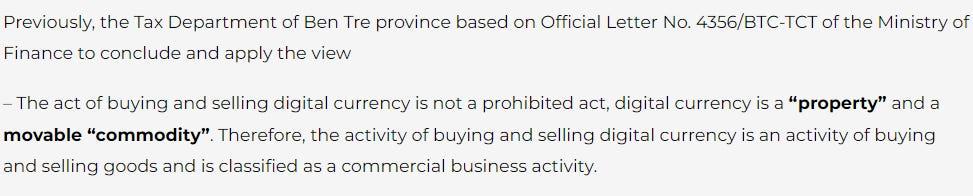
Key points from the Ministry of Finance's 2016 Circular 4356/BTC-TCT. Source: Vietnamese Legal Library
According to the Ministry of Finance directive, transactions involving buying and selling digital currencies were initially categorized as taxable commercial activities. However, due to the absence of clear legislation defining cryptocurrencies as assets or goods, this directive remains in a state of ambiguity. The lack of a clear legal classification creates uncertainty, making compliance and enforcement related to crypto transactions relatively complex.

Source: Civil Code of Vietnam
Furthermore, under Vietnam’s 2015 Civil Code, particularly Article 105.1, assets are defined as including various physical items, currency, monetary instruments, and property rights. Digital assets, including cryptocurrencies, clearly do not fall into any of these categories. Thus, under current Vietnamese law, these assets are not legally recognized as tangible property. This absence of classification creates significant legal gaps affecting how these assets are handled and regulated within the legal framework.
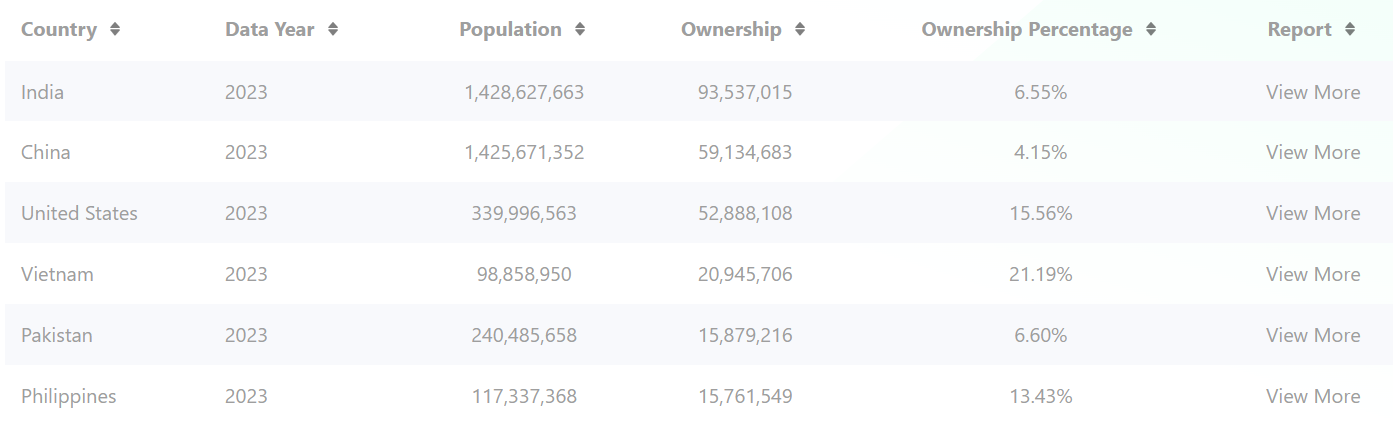
Cryptocurrency ownership ranking. Source: AAA
This ambiguous classification intensifies legal uncertainty surrounding cryptocurrencies, placing them in a largely unregulated gray area that poses challenges for both regulators and market participants. Despite these regulatory obstacles, Vietnam has a high rate of cryptocurrency ownership compared to other countries, indicating strong interest in the crypto market. In this complex situation, the government reminds investors of the risks associated with digital assets and cryptocurrencies, emphasizing the lack of regulatory safeguards.
3. Cryptocurrency Taxation in Vietnam
Vietnam’s current cryptocurrency regulation exists in a regulatory gray zone, complicating the establishment of a comprehensive taxation framework for cryptocurrencies in the country. Currently, Vietnam does not impose taxes on cryptocurrency transactions or gains. Typically, governments tax any investment activity that generates income. However, the crypto space includes a broad range of activities beyond simple trading.
For instance, Vietnamese investors frequently trade on international exchanges such as Binance and OKX, largely outside Vietnam’s regulatory oversight. They also participate in crypto mining and peer-to-peer (P2P) transactions. The diversity and breadth of the crypto industry pose significant challenges to formulating and uniformly enforcing tax laws. Unlike the stock market—where each stock transfer is taxed at 0.1%—activities in the crypto space currently evade government taxation.
The wide variety of profit-generating mechanisms in the crypto space further increases the complexity of tax legislation, which often lags behind technological advancements. As a result, regulators face the daunting task of inadequately monitoring and taxing these new forms of income, potentially leading to tax gaps and revenue losses.
In Vietnam, this situation has led to the emergence of many crypto millionaires who enjoy substantial profits from spot trading, futures trading, airdrop farming, and other activities without bearing any tax obligations.
4. Impact of Tax Exemption on Vietnam’s Retail Market
Due to the absence of specific provisions taxing cryptocurrencies, Vietnam is often seen as a tax haven for crypto earnings. However, acquiring cryptocurrencies using Vietnamese dong (VND) is inconvenient. Crypto exchanges are officially banned, meaning that unlike in many other countries where users can directly deposit fiat currency into exchanges, the primary method for purchasing cryptocurrencies in Vietnam is through peer-to-peer (P2P) trading. Platforms like Binance P2P or direct purchases from sellers are the only channels available to Vietnamese users.
However, the government can track and intervene in P2P transactions. These trades typically involve bank transfers to exchange VND for USDT. Intermediaries receive VND via bank transfer and then send USDT to the buyer’s wallet or centralized exchange account. The same process applies when selling USDT for VND. If a bank transfer is identified as linked to crypto activity, authorities may suspend the transaction and require traders to provide supporting receipts or documentation.
To avoid such regulatory scrutiny, some individuals resort to cash transactions. A person sends USDT to the seller, who then delivers cash to a designated location. This process can be completed with just a few messages and one transaction. However, this method carries risks such as fraud, as transactions conducted this way are not legally protected.
Although one might assume that lax regulation would encourage active retail participation in the crypto market, this is not the case. Investors often find market entry inconvenient and face the possibility of being tracked and intervened by regulators who may demand proof of transactions. Moreover, the methods used to circumvent regulations expose participants to fraud and other risks.
5. Conclusion
Due to regulatory and tax uncertainties, Vietnam’s cryptocurrency market currently faces challenges. The lack of clear rules leaves investors uncertain about tax obligations and exposed to risks such as fraud due to inadequate investor protections.
However, the Vietnamese government has recently been working to establish a regulatory framework to promote healthy development in the crypto market. Active discussions are underway regarding the management and monitoring of cryptocurrency activities, and the Vietnam Blockchain Association (VBA) has been formed. These efforts are expected to boost investor participation and strengthen market confidence.
If the Vietnamese government successfully establishes clear regulations and a tax system for cryptocurrencies, along with mechanisms for investor protection, Vietnam’s crypto market could achieve more stable and sustainable growth. This would lay the foundation for Vietnam to play a leading role in the global cryptocurrency industry.
Join TechFlow official community to stay tuned
Telegram:https://t.me/TechFlowDaily
X (Twitter):https://x.com/TechFlowPost
X (Twitter) EN:https://x.com/BlockFlow_News
 @tiger_research