
Tornado Cash Developer Sentenced: Is "Code is Speech" Dead?
TechFlow Selected TechFlow Selected
Tornado Cash Developer Sentenced: Is "Code is Speech" Dead?
From a legal standpoint, Alexey Pertsev's case is more significant for the future of DeFi than the fraud cases against SBF and Do Kwon or Zhao Changpeng's anti-money laundering violations.
 Navigating Web3 tides with focused insights
Author: Nianqing, ChainCatcher
Yesterday, Alexey Pertsev, a 31-year-old Russian national and developer of Tornado Cash, was sentenced in the Netherlands to five years and four months in prison for laundering $2.2 billion through the cryptocurrency mixing platform. Pertsev had previously been detained for eight months, which will be deducted from his sentence, leaving him with four and a half years to serve. His lawyers have 14 days to appeal the judge's decision.
The case is widely seen within the industry as not only a watershed moment for DeFi regulation but also one that could reshape the trajectory of crypto privacy. It risks creating a "chilling effect" across the global open-source community—marking a precedent where open-source software developers are held criminally liable, signaling that Web3 smart contract developers may now be bound by traditional legal frameworks.
In their ruling, the judge and prosecutors in the Alexey Pertsev case stated that “the nature and function of Tornado Cash is a tool designed for criminals” and that “Tornado Cash is not merely a set of smart contracts—it operates more like a company.”
Last August, Tornado Cash co-founders Roman Storm and Roman Semenov were charged in the U.S. with conspiracy to commit money laundering and conspiracy to violate the International Emergency Economic Powers Act (IEEPA), each carrying a maximum penalty of 20 years in prison. They were also charged with conspiracy to operate an unlicensed money transmitting business, punishable by up to five years in prison.
Roman Storm has since been arrested in Washington State, while Roman Semenov remains at large. Storm’s trial is scheduled for September 23. The outcome of Pertsev’s sentencing is expected to significantly influence the proceedings against Storm.
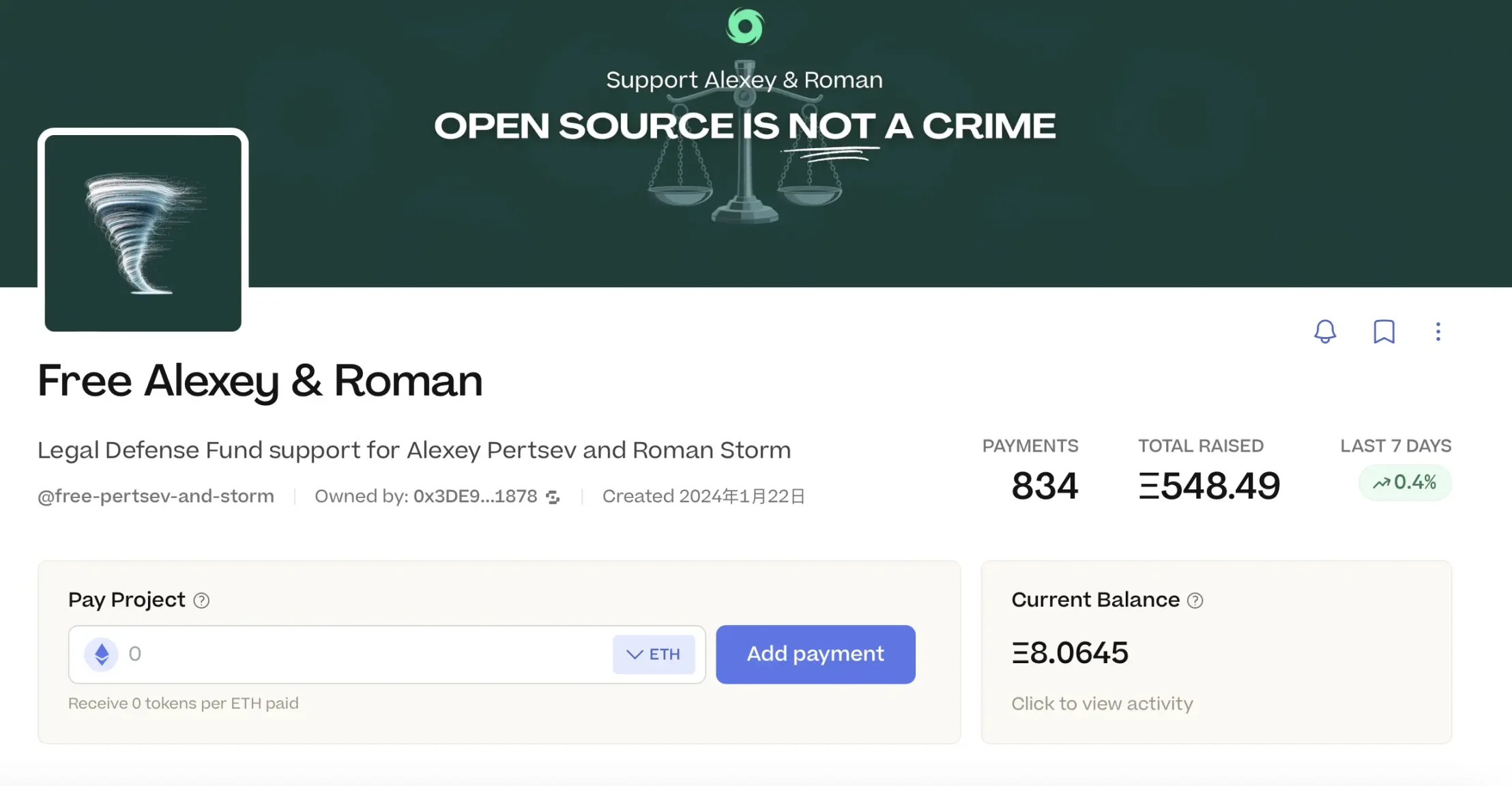
Notably, following Pertsev’s sentencing yesterday, the crypto community continues to send donations to the “Free Alexey & Roman” fund on Juicebox, with messages such as “privacy is not a crime,” “code is speech,” “defend freedom,” and “XX stands with privacy and open-source public goods” expressed in support of Tornado Cash’s developers and the broader ethos of crypto.
Timeline of the Tornado Cash Case
Launched in August 2019, Tornado Cash was founded by Roman Storm, Roman Semenov, and Alexey Pertsev. The core team consisted of zkSNARK researchers, with Pertsev also serving as a key member of security auditing firm Peppersec.
Below is a complete timeline of events related to the Tornado Cash case (compiled from DL News, supplemented and modified by ChainCatcher):
2019
August 6: Tornado Cash launches, enabling users to “send Ethereum cryptocurrency 100% anonymously.”
September 13: The U.S. Office of Foreign Assets Control (OFAC) sanctions North Korean hacking groups including Lazarus Group.
2020
May 10: Tornado Cash completes its “trusted setup ceremony,” burning administrative keys for all deposit pools and updating its smart contracts. The protocol becomes permanently autonomous code beyond control by any single party. Tornado Cash calls this “the largest trusted setup ceremony in the world,” involving 1,114 participants.
June 4: Tornado Cash developers deploy an optional compliance tool allowing users to voluntarily disclose transaction history if required.
September 25: Hackers steal $275 million worth of cryptocurrency from KuCoin exchange. This becomes one of the largest hacks linked by Dutch prosecutors to Tornado Cash.
2022
March 23: The Axie Infinity Ronin sidechain bridge is hacked, losing approximately $625 million—one of the largest crypto heists to date. Criminals launder the stolen funds via Tornado Cash.
May 6: OFAC sanctions Blender, the first virtual currency mixer used by North Korean cybercriminals.
June 24: Lazarus Group attacks the Harmony Horizon Bridge, stealing nearly $100 million in crypto, which is then funneled through Tornado Cash. Dutch prosecutors cite this as another major incident involving Tornado Cash in money laundering.
August 8: OFAC sanctions Tornado Cash for facilitating the laundering of $7 billion.
August 9: The Tornado Cash website goes offline, its code repositories are removed from GitHub, and co-founder Roman Semenov’s GitHub account is suspended.
August 10: Alexey Pertsev is arrested in the Netherlands and imprisoned without formal charges being publicly disclosed.
October 12: Coin Center, a nonprofit focused on cryptocurrency policy issues, files a lawsuit against OFAC over the Tornado Cash sanctions.
November 22: Dutch prosecutors publicly reveal their allegations against Pertsev during a court hearing.
2023
April 20: Alexey Pertsev is released from detention pending trial.
August 23: The U.S. Department of Justice indicts Tornado Cash developer Roman Storm and sanctions developer Roman Semenov.
August 25: Tornado Cash co-founder Roman Storm is granted bail.
December 7: Binance delists Tornado Cash’s native token, TORN.
2024
March 25–26: Alexey Pertsev undergoes a two-day trial in 's-Hertogenbosch, the Netherlands.
April 5: A U.S. trade association submits an amicus brief defending Roman Storm and addressing each charge brought against him.
May 14: Alexey Pertsev is sentenced to 64 months in prison for money laundering.
September 23: Roman Storm is scheduled to stand trial in the United States.
Controversy and Core Issue: Defining the Role of Smart Contract Developers
The central question in the Tornado Cash trial is whether existing anti-money laundering laws apply to blockchain and decentralized finance platforms.
During the trial, Pertsev’s defense attorney Keith Cheng argued that neither Tornado Cash developers nor anyone else can prevent others from using open-source smart contract code. Contributors to a smart contract form a decentralized network rather than a single responsible entity akin to a traditional corporation.
After Roman Storm and Roman Semenov were indicted last August, Coin Center issued a statement supporting them, arguing that the new charges contradict guidance documents from FinCEN, the Financial Crimes Enforcement Network.
Their core argument is that Tornado Cash developers provided only “pure software development or communication services,” not engaging in “transmitting funds on behalf of the public.” Prosecutors should not conflate “service providers” with “money transmitters.” Tornado Cash’s sole technical control over the contract involves modifying cryptographic logic related to privacy features, with no ability to view or move user funds.
In early April this year, Coin Center submitted an amicus brief in the ongoing criminal case against Roman Storm in the Southern District of New York, urging the court to reject the prosecution’s vague and prejudicial characterizations of Tornado Cash. Open-source developers cannot control how others use their tools, and publishing code is explicitly protected under the U.S. Constitution. Furthermore, Coin Center emphasized that the indictment and potential conviction have profound implications for individuals engaged solely in open-source software development, code publication, and technical discourse—and called for safeguarding the right to freely develop and publish software in the U.S.
In late March, Roman Storm’s legal team filed documents stating that Tornado Cash is a non-custodial smart contract, meaning users retain full control over their assets without relying on third-party custodians. Writing code constitutes free speech and is thus protected under the First Amendment of the U.S. Constitution.
However, during the May 14 hearing, the court rejected these arguments, asserting that technological innovation does not absolve actors of legal obligations to prevent platforms from aiding criminals and sanctioned entities in hiding the origins of stolen assets. Prosecutor Martine Boerlage concluded that Tornado Cash is “not just smart contracts—it operates like a company.”
The U.S. Department of Justice reiterated that the indictment is not about whether computer code qualifies as speech or is protected under the First Amendment. Defendants are not being prosecuted for publishing code, but for using it to facilitate a profitable illegal enterprise.
The DOJ further explained that banks use computer code to process financial transactions. If such code performs functions legally defined as money transmission, then it transcends pure expression and becomes regulated conduct requiring compliance with money transmission laws. Tornado Cash is part code, part speech, and part business—an artificial creation by humans. Storm did not merely publish code; he operated a business and made operational decisions over many years. The Tornado Cash protocol is not synonymous with the Tornado Cash business. Just because some components are open-source does not mean every action taken by Roman Storm as the owner of the Tornado Cash business is constitutionally protected.
Petitions, Protests, and Donations
Cryptocurrency lawyer David Lesperance noted that legally speaking, Alexey Pertsev’s case holds greater significance for the future of DeFi than straightforward fraud cases like those against SBF and Do Kwon, or even Changpeng Zhao’s failure to implement proper AML protocols. Precisely because the Tornado Cash case is so emblematic, its three founders have received widespread support in various forms.
The crypto community, especially developers, strongly protested Pertsev’s arrest. Beyond online petitions and expressions of solidarity, supporters distributed posters advocating for Alexey Pertsev outside Dutch courts.

In August 2022, some anonymous crypto users staged protest “poisoning” attacks by sending small amounts of ETH via Tornado Cash to addresses belonging to prominent figures, expressing dissatisfaction with the U.S. government’s sanctions. High-profile individuals including Shenyu, Justin Sun, Coinbase CEO Brian Armstrong, and digital artist Beeple were among those “poisoned.”
Additionally, on January 22 this year, members of the crypto community launched a fundraising campaign titled “Free Alexey & Roman” on the Juicebox crowdfunding platform, aimed at funding legal defense efforts to protect Tornado Cash co-founder Roman Storm and developer Alexey Pertsev from legal penalties. As of publication, the fund has received 834 donations totaling 548.49 ETH, equivalent to approximately $1.6 million. Ethereum co-founder Vitalik Buterin and Kraken co-founder Jesse Powell are among those who contributed.
Notably, after Pertsev’s sentencing yesterday, donation volumes surged sharply, accompanied by messages such as “privacy is not a crime,” “code is speech,” “defend freedom,” and “XX stands with privacy and open-source public goods”—expressions of support for Tornado Cash’s developers and the ideals of the crypto movement.
The Other Side of the Coin
Although Pertsev maintains he was merely a programmer with no criminal intent, he expressed disappointment that criminals used Tornado Cash to conceal illicit proceeds—but claimed he was powerless to stop it.
When questioned by the judge about whether he took criminal misuse seriously, prosecutors presented group chat logs between Pertsev and fellow developers Roman Storm and Roman Semenov. Upon learning of the $625 million Axie Infinity Ronin Bridge hack, Pertsev responded with “haha.” However, he clarified that this was not out of amusement but rather a habitual expression of surprise.
Moreover, an objective fact remains: since its sanctioning, Tornado Cash has continued to be the largest cryptocurrency mixer. Hackers and attackers still actively exploit the tool for money laundering.
On one hand, convicting Tornado Cash developers threatens the future of technological innovation and digital privacy. On the other hand, from a legal standpoint, technology cannot exist in moral neutrality—it is inherently embedded within human relationships and societal structures.
Join TechFlow official community to stay tuned
Telegram:https://t.me/TechFlowDaily
X (Twitter):https://x.com/TechFlowPost
X (Twitter) EN:https://x.com/BlockFlow_News
 ChainCatcher 链捕手