
What innovation have we seen from bridge liquidity to full-stack chain abstraction frameworks?
TechFlow Selected TechFlow Selected
What innovation have we seen from bridge liquidity to full-stack chain abstraction frameworks?
Simplifying the technology for users to interact across multiple blockchains, will chain abstraction become the ultimate solution to cryptocurrency liquidity fragmentation?
 Navigating Web3 tides with focused insights
Author: IOSG Ventures
Chain Abstraction
Humans are typically not asset managers, yet they are forced to become monetary managers. In the U.S., the average person holds between 3 to 4 bank accounts, indicating that even within a highly developed banking system, Americans manage only about four accounts on average—despite money flowing seamlessly among them.
Fifteen out of the top 25 market cap projects are "consumer-centric L1s." Will ordinary non-crypto users engage with more than 3–4 blockchains? Will they also need to treat their gas tokens as assets?
As the crypto market grows rapidly, I believe users are ready to pick their favorite three chains (including rollups). But if technology is advancing, why would they still need to do this?
Chain abstraction is the endgame for liquidity fragmentation in crypto. When liquidity is fragmented across different DEXs, DEX aggregators win; when liquidity is fragmented across bridges for cross-chain operations, bridge aggregators emerge (though their contribution to the ecosystem goes far beyond that); finally, when liquidity is fragmented across different chains, the rationale for chain abstraction becomes clear. We've long said: "One day, users won't even know which chain they're using."
This is why I’m bullish on chain abstraction—it can dramatically increase crypto participation while relieving users of the mental burden of managing multiple accounts across multiple chains. This article will dive into the implementation methods, pros and cons, trade-offs, and potential winners in the chain abstraction space.
I define chain abstraction as: any user intent initiated on a chosen chain (where liquidity resides) and executed on the application’s chain (where the result lands).
A user submits an intent on Chain A, and through some magic, receives the desired outcome either on the target chain or back in the same wallet.
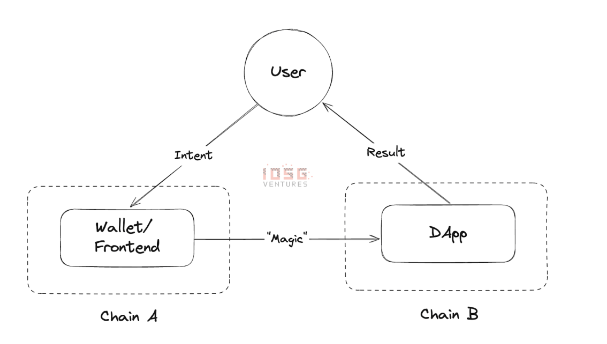
This “magic” can be achieved in multiple ways, involving different trust assumptions, adoption curves (for both users and developers), and the ultimate chain-abstracted experience applications aim to unlock. Different projects have varying views on chain abstraction, but below are the key layers enabling it. Various projects are tackling different layers—after reading this, you should have a balanced understanding of the critical components and what the final landscape might look like.
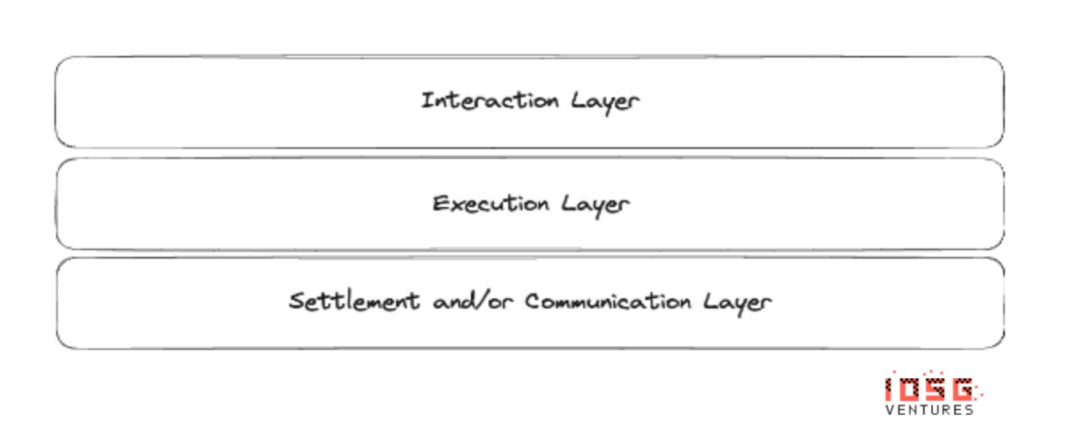
Interaction Layer
These projects aim to abstract chains from the very first user interaction.
For users, this may appear as a multi-chain version of account abstraction—a wallet or unified frontend interface to interact with multiple chains (e.g., a cross-chain lending platform).
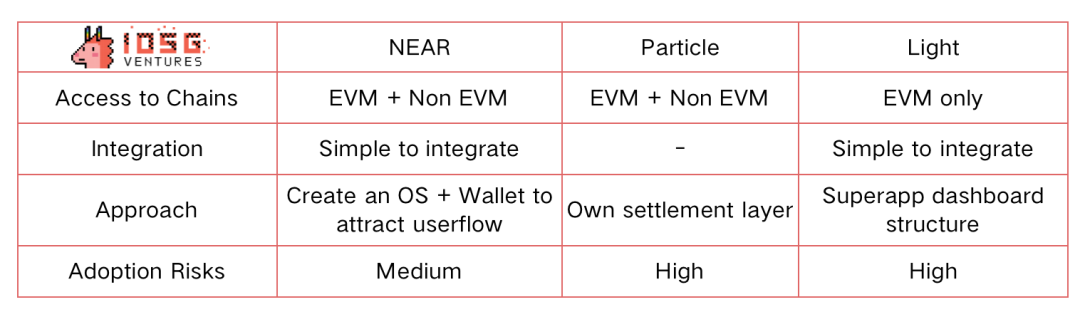
Projects building in this direction include: NEAR, Particle Network, Light.
NEAR Protocol
The NEAR Protocol aims to simplify blockchain abstraction for users as much as possible. They use relayers to subsidize gas fees, offer an authentication service allowing account recovery via email (similar to Web2 UX), and most importantly, enable NEAR accounts to generate multiple signature types.
Applications can remain unchanged, requiring almost no development cost beyond integrating the NEAR wallet.
Multiple signature types allow users to interact with multiple chains simultaneously. While this sounds simple, solving liquidity and message passing is crucial. NEAR must connect to multiple chains via one or more messaging protocols and liquidity networks.
Because they sit closest to users, NEAR must also aggressively market and capture high market share.
Particle Network
Particle Network shares a similar vision for chain abstraction. They began as an AA wallet within the EVM ecosystem, but are now abstracting chains by creating a "universal account" on their modular L1, built using the Cosmos SDK. This allows Particle Network to be IBC-compatible with any chain supporting interchain communication. They also use Berachain's Polaris framework to achieve EVM compatibility for Cosmos chains.
Particle Network does not rely on any external protocol for liquidity. As their own chain, they optimistically execute cross-chain atomic transactions and have their own gas token.
We see significant overlap between NEAR and Particle’s approaches. While Particle controls most of the tech stack, beyond facing similar challenges as NEAR, they also bear the additional burden of bootstrapping and maintaining their liquidity network.
Light
Light.so is a relatively new project taking an account abstraction approach, but limited within the EVM (Ethereum Virtual Machine) ecosystem. By leveraging typical gas fee abstraction and batch execution benefits, they transform wallet UX, offering a full dashboard-like experience. Light focuses on abstracting many common operations and delivering a dashboard-style interface to users.
Future developments could include integrating various DeFi operations into the dashboard—such as swaps, borrow/lend, structured yield products, etc. However, backend bridging/messaging layers are still required to facilitate these actions.
Communication Layer
The interaction layer needs task execution infrastructure—this can be bridges, agents, validators, or any infrastructure enabling cross-chain interoperability.
Standardized Validator Networks
Across has taken an early lead in cross-chain aggregation. Crypto users familiar with the Ethereum ecosystem likely already know Across. In its V2 version, Across shifted to an intent-driven architecture, positioning itself as a leader in the bridge aggregator race. This evolution helped enable V3, where developers can conveniently combine bridging and protocol operations in a single transaction.
Example scenario: OpenSea integrates Across+. If I want to buy a Base Chad on Base, I simply sign one transaction on Arbitrum using my preferred wallet, and successfully acquire the Base Chad at the same address on Base.
This example is the easiest to grasp because it looks exactly like the solution we’ve been seeking.
This method works well for quickly purchasing selected memecoins or buying NFTs listed on marketplaces, but may not suit high-frequency activities like Telegram bots, or signing every action as a transaction in a poker-hosting rollup. In the latter case, bridging and using the rollup directly may offer lower latency and better execution.
Anoma adopts a unique off-chain, intent-driven approach, featuring its own validator-based L1 and consensus mechanism. Developers can build directly on Anoma or use it as middleware (essentially a validator network). To standardize internal communication, Anoma has its own DSL, which developers must learn to leverage the network.
Standardizing validator networks is one of the hottest research areas in chain abstraction. Issues like validator centralization, auction mechanisms, and the impact of open validator networks have been debated for years—I won’t dive deep here. Arjun Chand has written one of the best articles on intent-based bridge architectures, covering risks and trade-offs.
Projects like Ethereum Swap, UniswapX, and 1inch Fusion demonstrate top-tier execution of intent-based architectures. There’s no doubt intent-based architectures will dominate cross-chain and chain abstraction spaces—but who will win? We’ve seen order flow is king. Validator networks that guarantee optimal execution will attract the best order flow, regardless of origin. Can chain-abstraction wallets deliver the best order flow to them?
How effective are validator networks for high-frequency activities? How well do they handle latency-sensitive transactions (e.g., buying low-liquidity memecoins)? These may not be typical ideal use cases for validator networks or chain abstraction.
Top-tier activities that mature validator networks can enable under the chain abstraction paradigm include large-scale cross-chain transfers (e.g., moving ETH from all L2s to a single Ethereum mainnet account). Any process involving research overhead, integration costs, bridging expenses (including aggregators), or gas management is where validator infrastructure can help. Buying Injective derivatives on Injective should be a seamless one-click experience—even if I have no funds available.
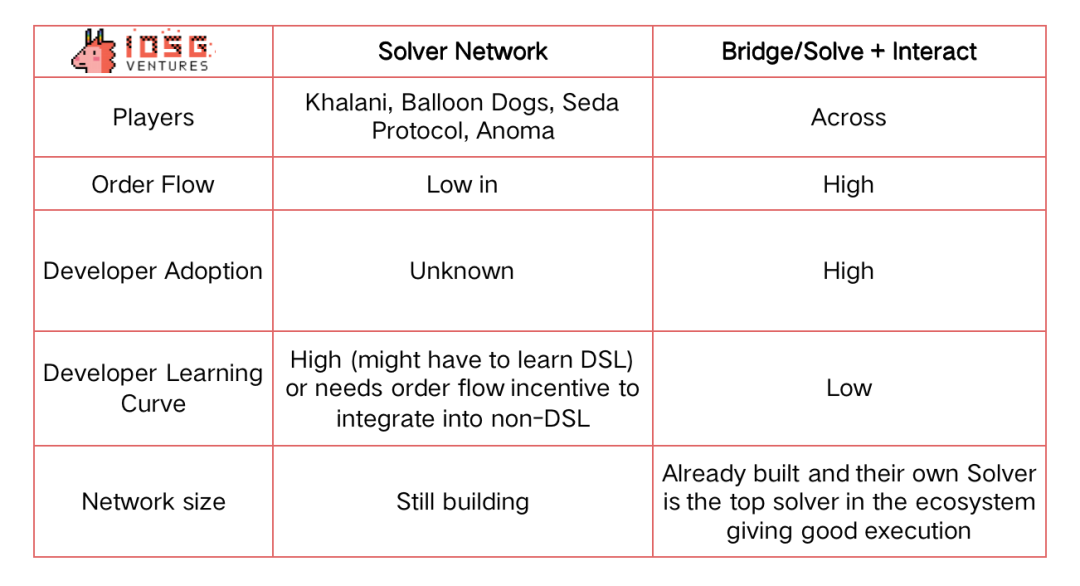
Validator Network Competitive Landscape
To ensure execution, each validator network must integrate with certain contracts. Across V3 leads with its intent-driven architecture and currently only needs to streamline protocol integrations. Protocols are likely to adopt battle-tested projects like Across, and will need continuous architectural innovation to attract more validators (or what they call relayers) without compromising execution quality.
However, Across V3 isn’t clearly winning in order flow. Stargate Bridge is competing head-on with Across in terms of order flow and volume, and Celer Circle and cBridge also seem to be catching up.
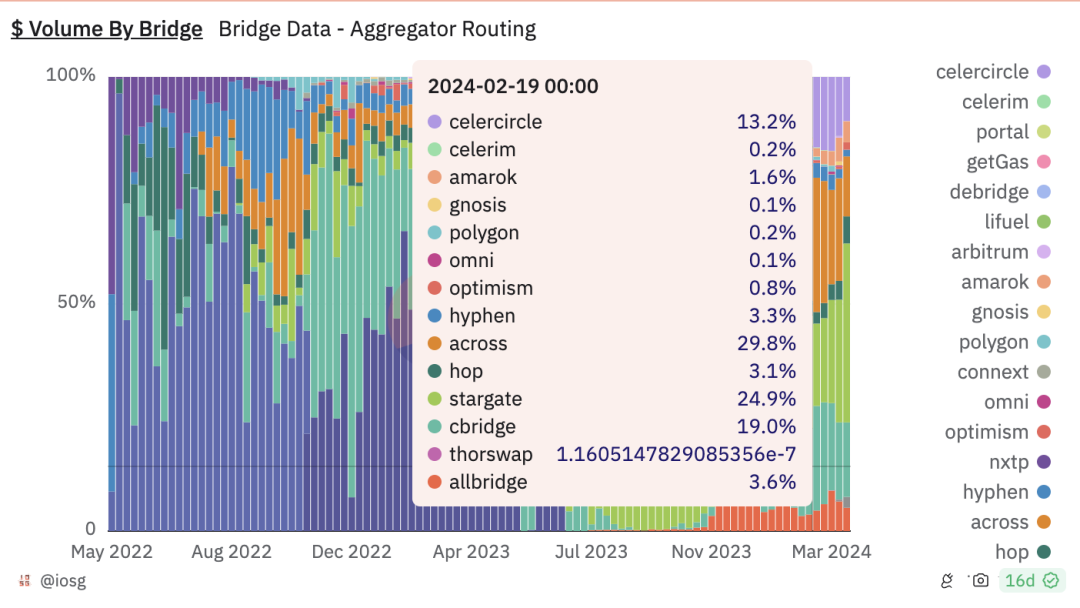
Across is the only project with an intent-driven architecture consistently delivering superior execution. For a long time, there’s been speculation that Stargate’s volume is artificially inflated through incentives—but this remains unproven. Despite matching Across in volume, Stargate processes twice the number of transactions. Only after the LayerZero airdrop will we know how much volume is incentive-driven versus organic.
Socket takes a unique approach with its Modular Order Flow Auction (MOFA) architecture, where any of the above modules can submit orders or participate in auctions. I’m not deeply familiar with the underlying tech, but given the team’s track record of shipping strong products, this could be very interesting.
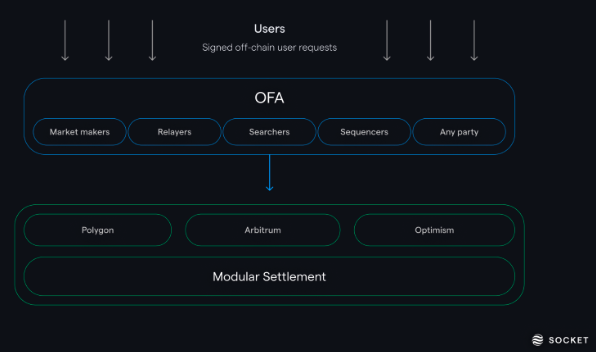
Image Courtesy: Socket
Bridges and Bridge Aggregators
“Cross-chain bridges are annoying to use”—User sentiment
Bridge aggregators used to be my go-to method for transferring assets cross-chain. They guarantee optimal routing of assets to the user’s chosen chain. While currently the best form of cross-chain transfer, they only hide the bridge itself—not the blockchain. Users still need minimal gas on the destination chain to complete the transfer. They also don’t help users execute actions on the target chain, adding complexity for newcomers.
At scale, bridges are less efficient than validator networks. Why? I recommend watching Hart Lambur’s talk at EthDenver 2024 to understand why batching intents can be over 50x cheaper than traditional bridges. (See 9:11 - 13:25).
While I deeply respect the teams and founders building bridges that let me operate in a multi-chain world, I’d prefer to eliminate the 3–4 steps in the user journey—and the subtle anxiety that comes with them.
Full-Stack Frameworks
Full-stack frameworks help establish standards from wallet to settlement layers, seemingly capable of delivering complete chain abstraction to users with high technical efficiency (security, communication, etc.). Frameworks like CAKE make it easy for protocols to adopt and integrate into the broader ecosystem.
For developers, fully relying on a brand-new framework or chain to build projects would be extremely difficult. The main incentive for developers to choose a specific framework is usually order flow.
I don’t know how to convince an entire developer ecosystem that has already committed to their preferred environment to adopt a completely new framework. This would be a marketing- and partnership-heavy battle, nearly as hard as launching a new L1.
Participants in the full-stack framework space include: CAKE, DappOS, Aarc.
Summary
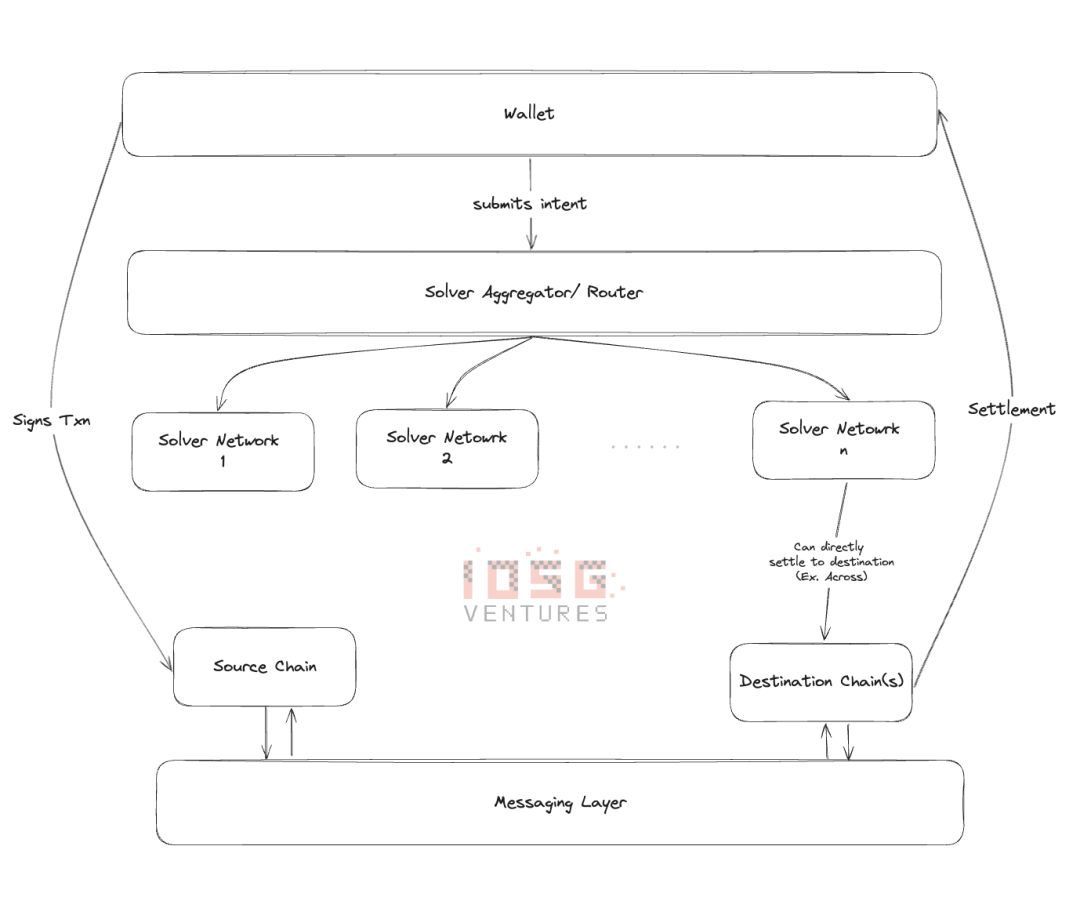
A unified framework is crucial—the leader in each module will be determined by best order flow, which depends on consistently delivering optimal execution. The entire chain abstraction framework might look like this:
If I were to introduce my grandmother to crypto, I’d probably wait until NEAR or Particle Network launches their product. I wouldn’t want her stuck in a loop of learning bridges/aggregators, validations, and managing multiple private keys—just because she wants an EVM wallet to buy a token on Solana.
Achieving all this will require some form of account abstraction, balance abstraction, and even gas abstraction—many participants are tackling each of these problems individually.
Based on current information, the leaders in each module will shape the ideal framework. NEAR seems most likely to become the entry point for new order flow; Across appears battle-tested and easiest to integrate (dependent on Chaos Labs further optimizing the protocol—they know how to win in crowded ecosystems); finally, the cross-chain messaging layer will provide a secure environment for auxiliary infrastructure (like bridges and oracles), settling assets moving across chains.
Join TechFlow official community to stay tuned
Telegram:https://t.me/TechFlowDaily
X (Twitter):https://x.com/TechFlowPost
X (Twitter) EN:https://x.com/BlockFlow_News
 IOSG Ventures