








KIP Protocol: Unlocking Value and Enabling Efficient Circulation of AI Assets in the AI Infrastructure Sector
TechFlow Selected TechFlow Selected
KIP Protocol: Unlocking Value and Enabling Efficient Circulation of AI Assets in the AI Infrastructure Sector
The ecological value logic of KIP Protocol can be summarized in one sentence: KnowledgeFi, where knowledge is monetized and labor is rewarded.
 Navigating Web3 tides with focused insights
Written by: TechFlow
Accurately identifying alpha projects is the most profitable investment strategy, and in this bull market, focusing on AI-sector opportunities offers exceptional leverage.
On one hand, AI has become the greatest consensus between East and West in this bull cycle, resulting in a flourishing landscape: from Masa focusing on AI data, to Bittensor specializing in AI models, to numerous AI dApps targeting specific applications such as social platforms, chatbots, and DeFi. Amid ongoing market volatility and upward momentum, AI sector tokens are broadly surging—Bittensor (TAO) has seen an astonishing annual gain of 972.6%.
On the other hand, while AI development is booming, its ecosystem remains incomplete—nowhere more evident than in digital property rights and tokenization of AI assets. Web3 aims to break the monopoly of AI giants by leveraging decentralization, trustless contract execution, and privacy protection. Only by ensuring that contributors to AI are fairly compensated can we truly aggregate the power of tens of thousands of small AI entities to collaboratively advance AI cooperation.
This is precisely what KIP Protocol—a Web3 infrastructure protocol dedicated to AI—is building:
Using SFTs (Semi-Fungible Tokens) to achieve digital ownership and tokenization of AI assets, KIP Protocol establishes a virtuous cycle among data owners, model designers, and AI app developers. Participants retain full digital ownership rights while seamlessly interacting with other AI assets for revenue generation without losing access control. By creating an AI "Lego" framework, KIP unleashes composability in AI, driving industry-wide progress toward a decentralized AI economy where assets circulate efficiently and contributors are fairly rewarded.
Recently, with the announcement of its partnership with leading Web3 education platform Open Campus and the successful minting of its Genesis NFT, KIP Protocol has once again captured the attention of alpha hunters. This article explores KIP Protocol’s innovative designs in data ownership, knowledge asset tokenization, and efficient circulation of AI assets, examining how it empowers the AI sector and assessing the opportunities and challenges it faces as a foundational Web3 decentralized protocol.
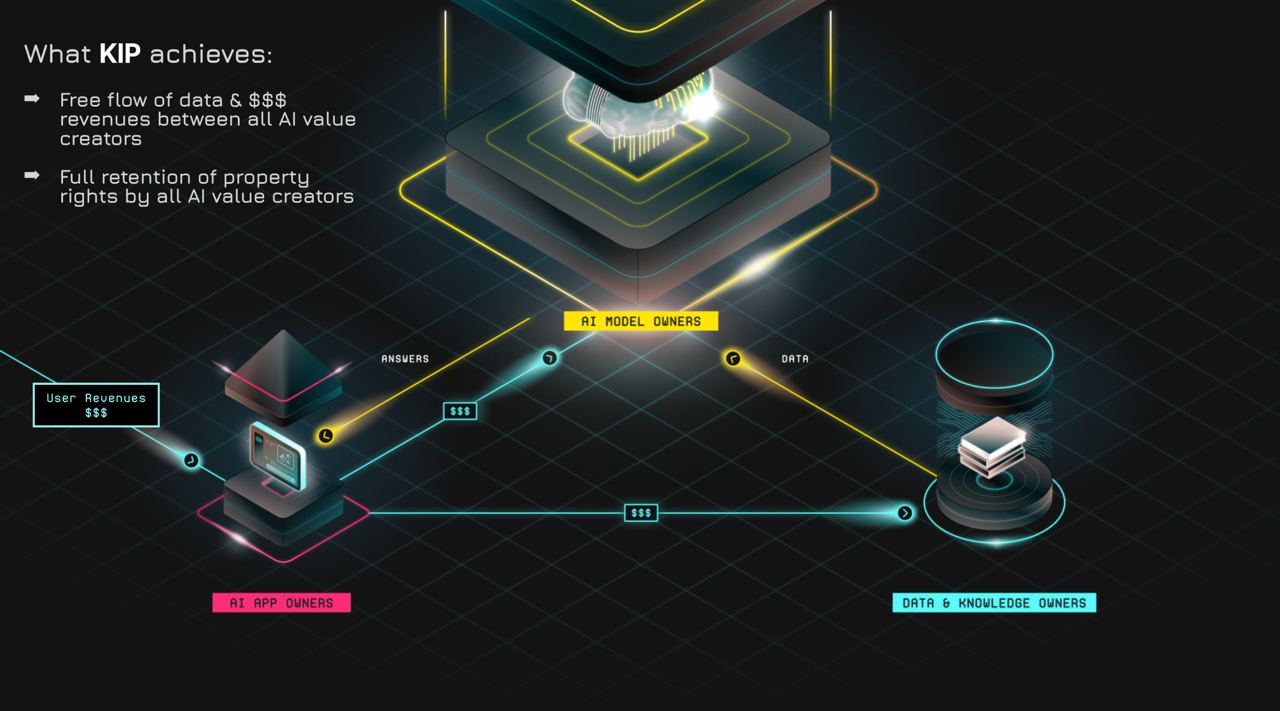
Breaking Monopolies, Rewarding Contributors: Unlocking Value and Efficient Circulation of AI Assets
The core value proposition of KIP Protocol can be summarized in one phrase: KnowledgeFi—monetizing knowledge, rewarding contributors.
To reward contributors, we must first identify who they are—the key participants in the AI ecosystem. Examining how AI projects operate reveals three primary categories of value creators:
-
Data Owners: Data fuels AI development. The richer the data fed into AI systems, the smarter they become. Incentivizing broader participation from data owners to share larger datasets is crucial for advancing AI.
-
AI Model Creators: Models serve as the brain of AI, providing logical reasoning capabilities. Different types of AI models enable diverse real-world applications.
-
AI App Developers: As concrete manifestations of AI services, AI apps bridge technology and users, earning revenue through high-quality offerings and user growth.
Once contributors are identified, the next challenge is quantifying their contributions to enable transparent and efficient value distribution—a process that can be broken down into three steps:
First, contributors need a unique on-chain identifier to bind value directly to them—establishing ownership over AI knowledge assets. Second, their contributions must be recorded honestly and immutably. Finally, these recorded contributions should be tokenized and programmatically transferred across contributors via smart contracts.
KIP Protocol achieves this vision using SFTs (Semi-Fungible Tokens).
SFTs sit between fungible tokens (FTs) and non-fungible tokens (NFTs), combining properties of both. They are computable, partially combinable, yet inherently heterogeneous—divisible yet unique. Under the ERC-3525 standard, SFTs describe both form and quantity of an asset, enabling ID-to-ID transfers and significantly expanding token use cases in the real world—such as branded membership cards with validity periods and usage limits, or co-created artworks that automatically distribute revenue based on fan contributions.
Within the KIP Protocol ecosystem, SFTs primarily serve two purposes: digital ownership verification and AI asset tokenization.
For digital ownership, SFTs include an EIP-721 equivalent ID attribute, uniquely identifying each AI contributor as a distinct entity so tokens can be transferred between addresses and managed using EIP-721 compatible operations.
For AI asset tokenization, different contributors can represent their AI assets as SFTs: data owners can tokenize data value under privacy-preserving conditions, with SFTs representing vectorized knowledge bases or encrypted raw data file links used for model training; model creators can tokenize their AI models, where SFTs represent APIs pointing to off-chain models or sellable weight sets; app developers can tokenize their products, with SFTs representing frontend APIs or entire applications. These SFTs interact on-chain, recording earnings generated from specific transactions.
To illustrate how SFTs enable tokenization and efficient circulation of AI asset value, consider an AI model minted as an SFT and then divided into fungible shares. The creator might retain 60%, selling the remaining 40% to investors. This allows even ordinary users to invest in and earn dividends from AI models.
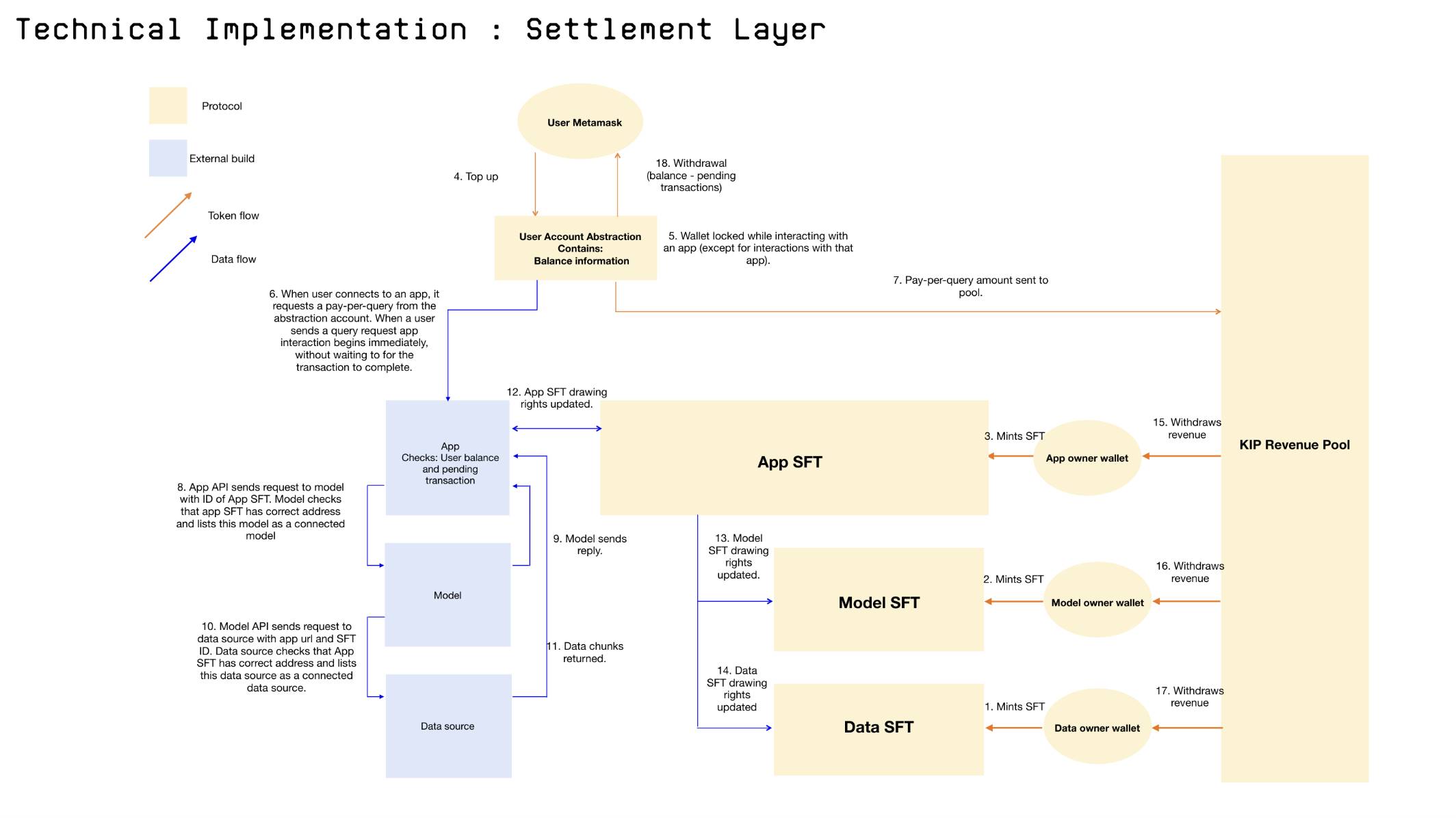
Another major innovation of KIP Protocol—as a Web3 infrastructure layer focused on AI—is being the world’s first protocol supporting decentralized RAG (Retrieval-Augmented Generation).
Typically, AI intelligence evolves through data ingestion, allowing models to learn and generate responses. RAG—short for Retrieval-Augmented Generation—enhances large language model outputs by retrieving information from external databases during response generation, combining generative AI with indexing to deliver smarter answers.
In KIP Protocol’s decentralized RAG workflow: Users first mint their AI assets as SFTs. When a RAG query accesses a user's SFT, the system logs the contribution and automatically executes revenue sharing and withdrawals. This greatly reduces privacy risks since RAG only indexes data rather than learning from it—ownership and access control remain fully with the user. It also lowers barriers for everyday users to participate in AI development. Whether on-chain or off-chain, even small-scale AI creators can contribute to answering queries via KIP’s decentralized RAG framework. This model not only disrupts traditional, centralized AI monopolies but accelerates AI advancement toward greater intelligence, fairness, and transparent value flows through broad participation.
Building upon its decentralized RAG framework, KIP Protocol has outlined a growing suite of ecosystem products: Kipley.ai is a security-first multi-model RAG platform enabling users to create and trade knowledge assets, currently in testing; KnowledgeFi.xyz is a knowledge-sharing platform built on KIP Protocol that leverages AI to connect users directly with experts, facilitating efficient knowledge exchange and tokenization; KIP Starter is a launchpad for decentralized knowledge assets, offering value discovery, project exposure, fundraising, and financing services within the KIP ecosystem.
Indeed, KIP Protocol’s ambitious decentralized AI vision is rapidly taking shape. Yet many industry practitioners believe practice is the ultimate test of truth. After understanding KIP Protocol’s architecture, its recent collaboration with Web3 education platform Open Campus offers a tangible demonstration of its operational logic in action.
Focusing on the Education Sector Championed by CZ: Partnering with Open Campus to Build Engaging Web3 Learning Experiences
In April 2024, KIP Protocol announced a strategic partnership with Open Campus, a well-known Web3 education platform, to jointly explore blockchain and AI applications in education—delivering smarter ways to access industry knowledge and more transparent, efficient monetization of digital intellectual property. Going forward, the two parties will co-host AMAs and other community-building activities to attract early adopters and experiment with new forms of Web3 education.
The collaboration between KIP Protocol and Open Campus isn’t just a successful application of KIP’s framework in education—it reaffirms market confidence in KIP’s vision of “breaking monopolies, rewarding contributors, and enabling efficient value circulation of AI assets.”
For Open Campus, partnering with KIP enhances its ability to deliver intelligent educational services, further fulfilling its mission of recognizing educators’ contributions and continuously attracting new users to the ecosystem.
For KIP Protocol, the collaboration brings high-quality projects into its ecosystem, showcases mature product capabilities, and extends its reach to tens of millions of schools, institutions, educators, and learners worldwide.
Notably, the Web3 education space targeted by this collaboration has gained significant traction recently—and Binance’s former CEO CZ has been a vocal advocate. After serving a four-month sentence, CZ responded to community concerns by stating he would focus on “the next chapter of my life: education.” Previously, CZ revealed plans to enter the education field by building a high-quality, fully free learning platform powered by AI and NFTs, offering rich content with engaging experiences.
In this context, the KIP Protocol–Open Campus partnership perfectly aligns with CZ’s vision: leveraging AI and blockchain to deliver diverse, enriching, and enjoyable educational experiences to a global audience. As one of the few BNB Chain projects selected for Binance Launchpad, Open Campus benefits from strong support from Binance. Combined with its own robust capabilities, Open Campus is widely expected to rapidly grow its market share in education.
Looking ahead, this collaboration promises deeper impact: delivering stronger industry education across Web3 while enabling KIP Protocol to benefit from Open Campus’s growth potential and resources, gaining increased traffic and richer partnership opportunities.
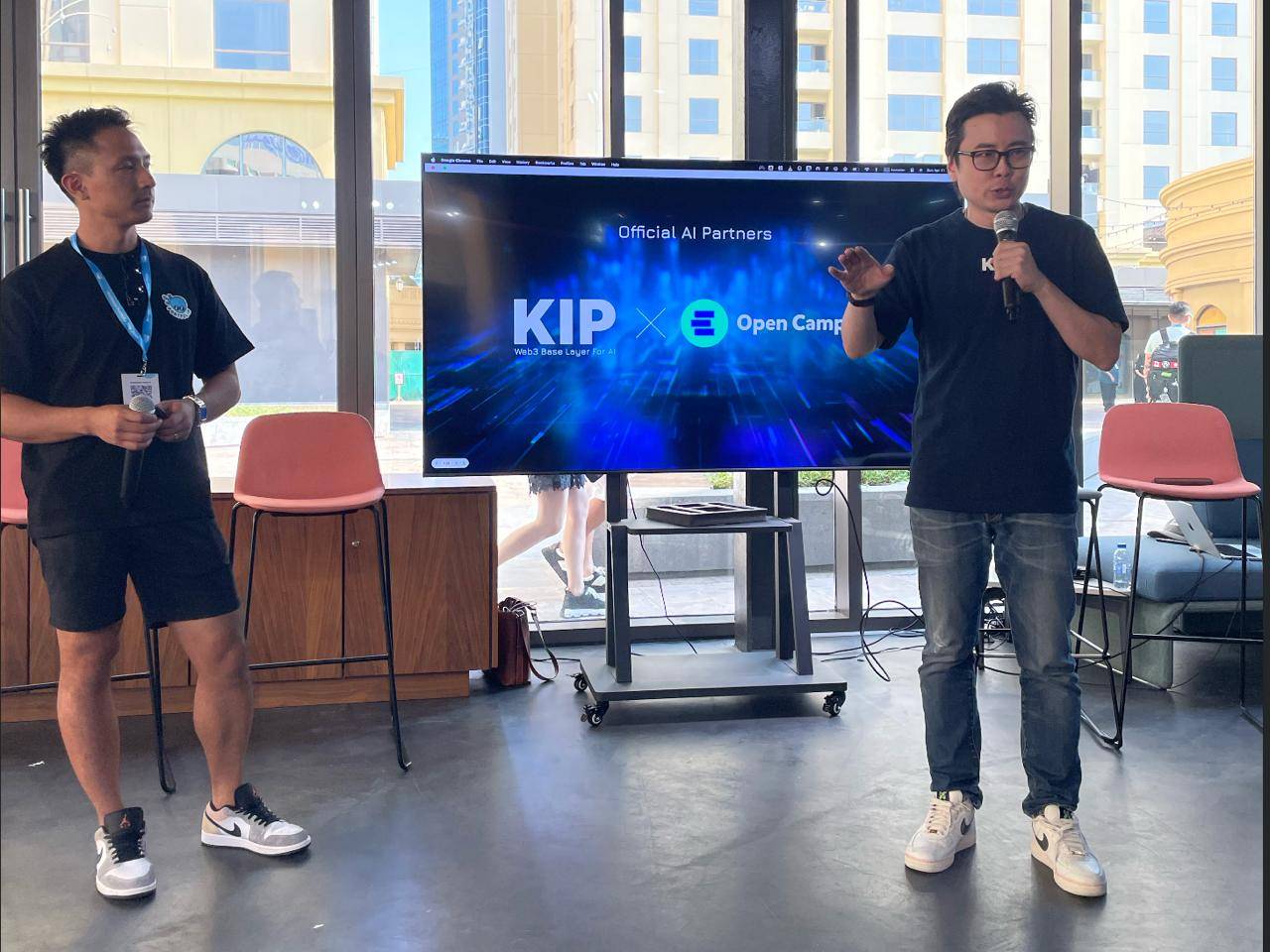
Of course, the Open Campus partnership marks a pivotal milestone in KIP Protocol’s early ecosystem development. In fact, backed by solid technical foundations, a standout team, and extensive industry connections, KIP Protocol is making bold strides toward becoming the premier Web3 infrastructure layer for AI.
A Rising Star in AI Infrastructure: Praised by Top-Tier VCs Globally
In the Web3 space, institutions act as trendsetters, while KOLs reflect market sentiment. Anyone following industry developments closely will notice that whether online—on Twitter, Telegram, and other Web3 hubs—or offline at events like Hong Kong Web3 Festival and Dubai TOKEN2049—KIP Protocol has emerged as a widely praised, unmissable alpha project among top-tier KOLs and crypto VCs.
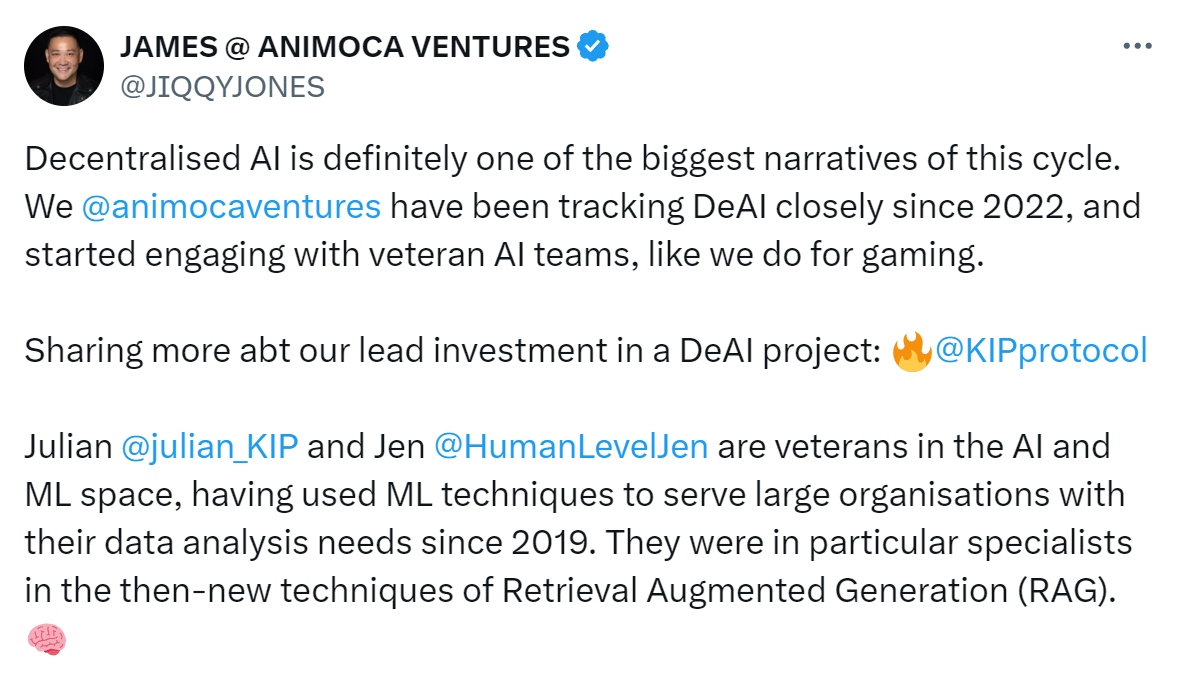
James Ho, Head of Animoca Ventures, engaged in deep discussions with Julian, CEO and Co-Founder of KIP Protocol, and core team member Jen during TOKEN2049 Dubai, later publicly praising the project:
“DeAI is absolutely one of the most important narratives of this cycle. Animoca Ventures has been tracking DeAI since 2022 and collaborating with experienced AI teams… We’ve used KIP Protocol’s RAG framework for investment data analysis, which impressed us because we don’t need to train our own models but can still leverage AI for insights… We believe KIP’s approach to democratizing AI asset ownership and tokenization could become a force multiplier for enterprises across multiple industries.”
Beyond Animoca, prominent figures including BTC investor KOL Marco Johanning, AI-focused crypto influencer AI Project Hub, international crypto thought leader Crypto Phoenix, Twitter personality @wauwda, and well-known crypto blogger Tomb have all organically discussed KIP Protocol on social media, many expressing strong admiration—with some even revealing their participation in KIP’s early funding rounds.
Beneath the wave of praise lies an elite team of seasoned PhDs and technical experts deeply rooted in AI. Core members of KIP Protocol hail from world-renowned universities and bring over a decade of experience in AI development, project consulting, Web3 investing, and entrepreneurship.
Dr. Jennifer Dodgson, Chief AI Officer at KIP Protocol, holds a PhD in Qualitative Analytics, Policy, and Statistics from the National University of Singapore and is an expert in Retrieval-Augmented Generation (RAG). With 10 years of experience advising governments, corporations, and large organizations on NLP/AI projects, she now leads a team of AI pioneers exploring practical DeAI applications. Beyond her achievements in AI, Dr. Dodgson is passionate about Web3 entrepreneurship and previously founded gaming DAO DAObi.
Julian Peh, CEO & Co-Founder of KIP Protocol, is a veteran entrepreneur with 20 years of experience in tech innovation, having founded and led four startups—all achieving notable success—while accumulating deep expertise in mergers and acquisitions. He entered the blockchain space as early as 2016 and served for several years as a partner at a cryptocurrency fund, giving him profound insights into industry dynamics and project execution.

The team’s strength is reflected in precise market positioning and high-quality product delivery, earning consistent acclaim from crypto KOLs and driving outstanding results across community growth, fundraising, and partnerships.
On the community front, KIP Protocol surpassed 100,000 followers on X (formerly Twitter) in April and has grown to 127,000—an important milestone—while its Discord and Telegram communities continue rapid expansion.
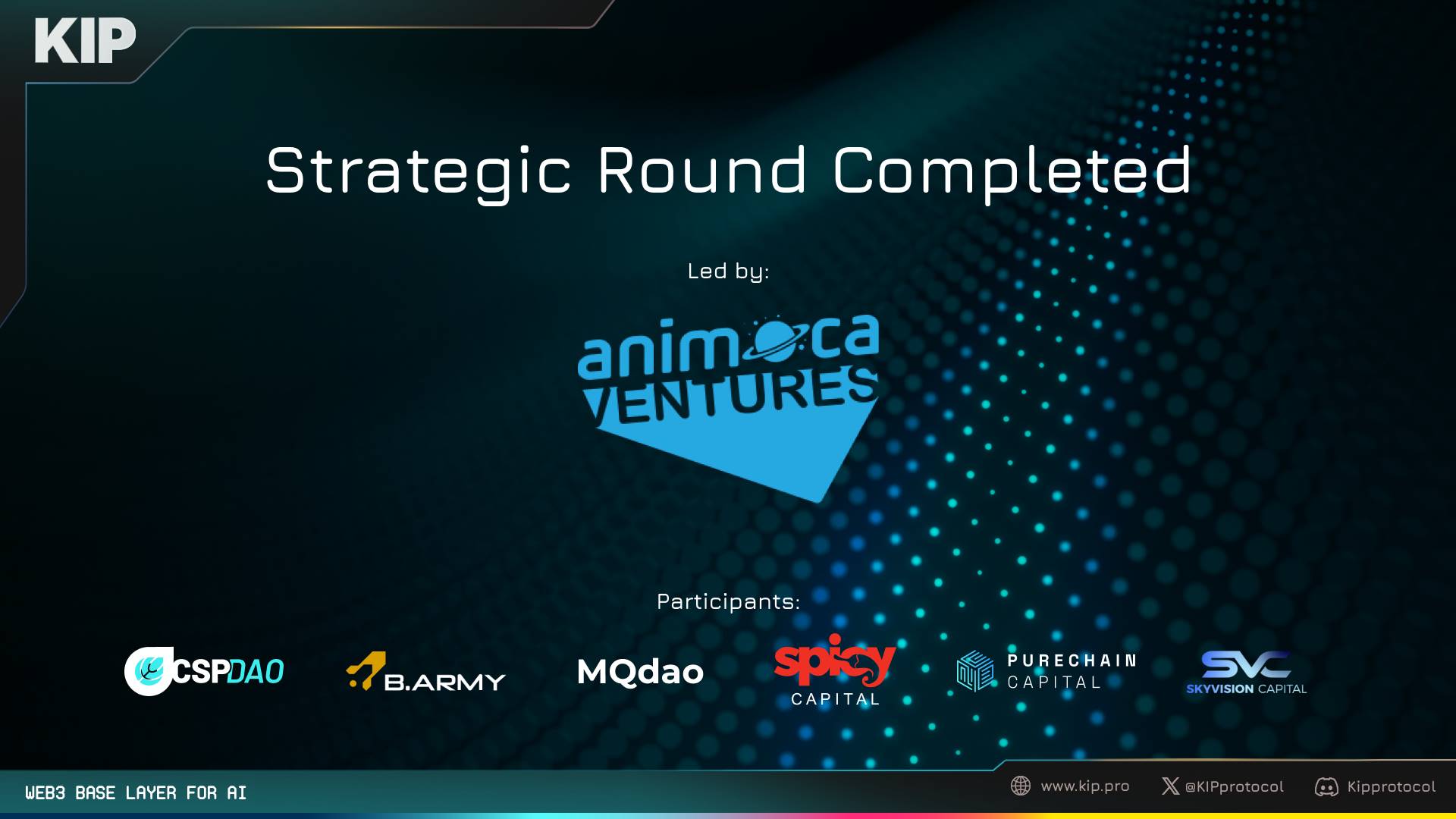
In fundraising, KIP Protocol completed a strategic round in March led by Animoca Ventures, with participation from B.Army, CSP DAO, MQdao, Spicy Capital, Skyvision Capital, and Purechain Capital—spanning Europe, Latin America, and Asia.
Additionally, KIP Protocol has recently announced multiple partnerships: beyond Open Campus, on May 4, KIP Protocol announced a strategic partnership with Aethir, becoming its preferred deployment partner. KIP will provide critical data and payment infrastructure for Aethir’s AI ecosystem, while Aethir will supply enterprise-grade decentralized GPU computing power for KIP’s AI product ecosystem. Together, they aim to integrate their infrastructures to lay a solid foundation for a robust decentralized AI ecosystem. On May 8, KIP Protocol partnered with OKX Wallet—the leader in decentralized wallet technology—to seamlessly bridge emerging decentralized AI and Web3 worlds, enhancing utility and accessibility across both platforms.
Other KIP Protocol partners include SFT Labs, PORT3 Network, Devolved AI, KPR, zkPass, Particle Network, MoleDAO, TinTinLand, Mirror World, and others—indicating an increasingly expansive ecosystem footprint.
Throughout Q1 2024, KIP Protocol’s growth has been undeniable. With the successful conclusion of its Genesis NFT mint and multiple milestones achieved, KIP is poised for continued high-speed development in the foreseeable future.
Looking Ahead: Genesis NFT Ignites Community Enthusiasm—Participate to Win Airdrops and Ecosystem Benefits
On April 29, KIP Protocol successfully completed its Genesis NFT mint: conducted in two phases, the first allocated 1,788 NFTs to community OGs and strategic partners; the second offered 2,100 NFTs to participants of GALXE and TASKON campaigns. Community enthusiasm was unprecedented—3,888 Genesis NFTs sold out entirely, with Phase Two closing in just four minutes. Even more exciting, after the mint, KIP airdropped KIP SBT rewards to active participants of Season One community tasks.
Holders of the Genesis NFT enjoy multiple benefits, including airdrops, priority access to AI tools, whitelisting for KIP projects, and entry to incubated initiatives. Across earlier campaigns, over 148,000 users participated, earning points and eligibility to mint Genesis NFTs for free.
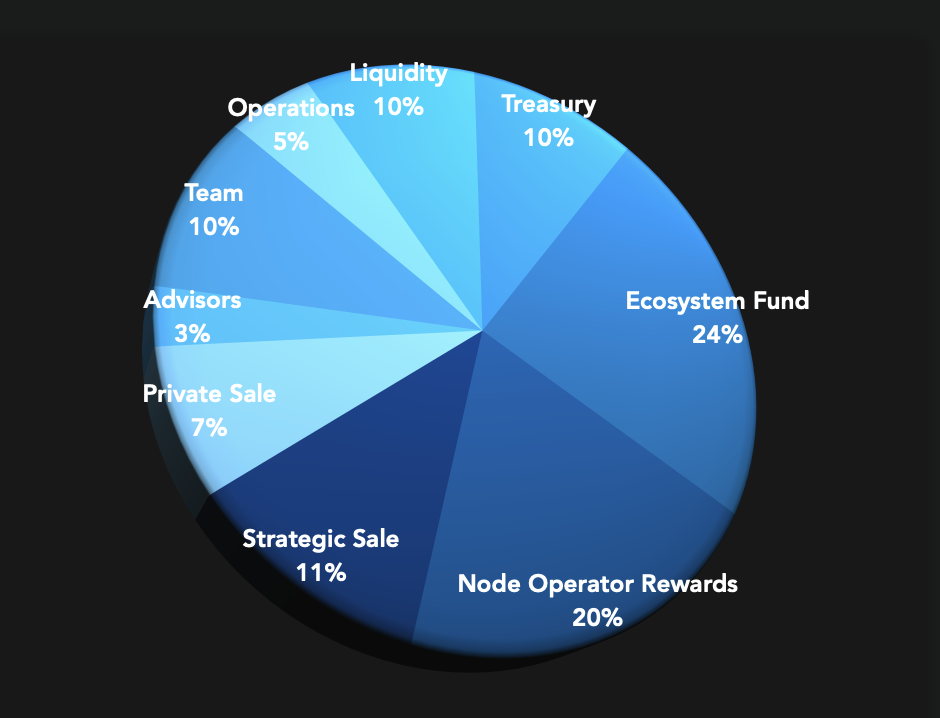
Like many pre-TGE projects, KIP currently distributes ecosystem incentives via points, which may be deeply linked to future token airdrops—rewarding early supporters. Notably, according to the whitepaper, 35.8% (3.58 billion) of the total 10-billion KIP token supply is allocated to the ecosystem fund—highlighting the project’s commitment to community building and long-term sustainability. For those seeking alpha in the AI sector, although Season One has ended, the KIP team has confirmed Season Two is coming soon, featuring more interactive community events. Staying updated via KIP’s social channels and actively participating to accumulate points and airdrop eligibility presents a compelling opportunity to position oneself in a promising AI project.
Regarding its roadmap and plans for the rest of 2024, KIP Protocol has clear objectives:
Product-wise, the team will deepen integration with broader AI/ML ecosystems, build cross-chain bridges to enhance interoperability, and launch KIP Starter to promote high-value assets. Additionally, the team will focus on AI application chains, with a testnet potentially launching in 2025.
For ecosystem development, KIP will expand its network of partners and projects, seek listings on global strategic exchanges, and cultivate a large, global community of users, token holders, and developers—amplifying its worldwide influence and maintaining leadership in decentralized AI innovation.
Conclusion
In Messari’s widely read report “Crypto Theses for 2024,” the firm openly expressed strong optimism about the convergence of AI and Web3. As one of 2024’s hottest narratives, the AI sector sees no shortage of founders and investors. For projects aiming to stand out, differentiation through superior product design and execution is essential.
From a product perspective, KIP Protocol stands out as the world’s first protocol supporting decentralized RAG: this enables AI models to retrieve data from external knowledge bases, delivering enhanced AI services. At the same time, its data handling method provides stronger privacy protection, encouraging broader participation in AI development.
From a user perspective, human nature seeks profit. By introducing SFTs, KIP reinforces ownership of AI models, algorithms, and datasets while unlocking trading and investment potential. This empowers smaller AI creators to join the ecosystem. By challenging tech giants and reshaping AI economics, KIP enables fair, transparent value distribution—and opens new possibilities for the future of AIFi.
Outstanding technical capabilities, rigorous product logic, rapidly growing community engagement, and relentless pursuit of DeAI—these are likely why top crypto KOLs and VCs consistently praise KIP Protocol. With the Genesis NFT mint concluded and multiple milestones achieved, the world eagerly anticipates what comes next.
Join TechFlow official community to stay tuned
Telegram:https://t.me/TechFlowDaily
X (Twitter):https://x.com/TechFlowPost
X (Twitter) EN:https://x.com/BlockFlow_News
 深潮TechFlow


