









A Lamborghini Sparks a He-Said-She-Said Between Binance and DWF Labs, Highlighting Hidden Market Maker Rivalry
TechFlow Selected TechFlow Selected
A Lamborghini Sparks a He-Said-She-Said Between Binance and DWF Labs, Highlighting Hidden Market Maker Rivalry
The YGG incident has brought DWF's market manipulation issues to light.
 Navigating Web3 tides with focused insights
Compiled by Jordan, PANews
Reference: The Wall Street Journal)

In October 2023, Andrei Grachev, DWF's Russian managing partner, posted a photo of a Lamborghini sports car on social media with the caption "DWF Lambo." This ostentatious display of wealth quickly drew attention in the crypto industry—how could the head of an institution that appears relatively small afford such a luxury supercar?
The 36-year-old Andrei Grachev previously served as head of Huobi’s Russian division and is listed as a co-founder of DWF Labs, though he is based in Switzerland.
DWF Labs operates as a market maker (MM) in the crypto market—a type of intermediary firm that simultaneously buys and sells assets, typically indifferent to whether asset prices rise or fall. Market makers enhance market liquidity, making it easier for participants to trade assets, and profit from the spread between buy and sell prices. In traditional finance, market makers must maintain price neutrality according to exchange rules.
On Binance’s trading platform, DWF Labs holds the “VIP 9” label, indicating the firm executes at least $4 billion in trading volume per month. At this level, Binance typically offers fee discounts and access to private client managers.
According to someone familiar with Binance’s operations, Binance does not require market makers to sign specific agreements governing their trading activities, meaning Binance largely allows market makers to trade as they see fit. However, a Binance spokesperson stated that all users on the platform must comply with general terms of use prohibiting market manipulation.
Yet, according to a 2022 proposal document sent to potential clients, DWF Labs did not adhere to price-neutral practices. Instead, it proposed using its active trading positions to inflate token prices and generate so-called “artificial trading volume” on exchanges including Binance, aiming to attract other traders. In a report prepared that year for a token project client, DWF even explicitly stated that it had successfully generated artificial trading volume equivalent to two-thirds of the token’s total volume and was working to create a “believable trading pattern.” The document suggested that partnering with DWF Labs could bring “bullish sentiment” to a project’s token.
The YGG Incident Brings DWF’s Market Manipulation Allegations to Light
In August 2023, Binance announced the listing of high-leverage derivative contracts tied to YGG, the native token of gaming guild Yield Guild Games, a company in which DWF Labs had invested. The firm had already agreed to purchase $10 million worth of tokens from YGG, representing about a quarter of its market value at the time.
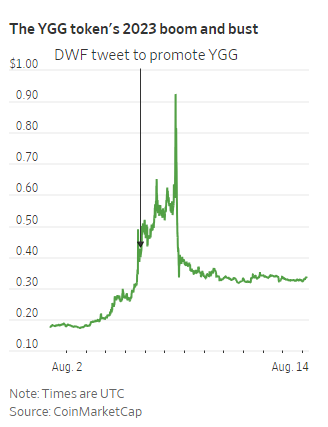
Andrei Grachev heavily promoted YGG on social media, claiming the listing would bring “sustainability and strength” to the token. However, shortly after the YGG derivatives launched on Binance, its price plummeted (as shown in the chart above).
The volatility caught the crypto industry’s attention. Two other market makers privately expressed concerns about DWF Labs to Binance. One of these firms filed a complaint about DWF Labs’ trading activity with Binance’s VIP client department, which then escalated the matter to Binance’s market surveillance team. By September 2023, Binance had initiated an internal investigation into DWF Labs.
Investigation and Dismissals
According to insiders at Binance, investigators found that DWF Labs was suspected of manipulating the prices of YGG and at least six other tokens, conducting over $300 million in wash trades during 2023. The conclusion was that these actions violated Binance’s terms of use.
Moreover, investigators reportedly discovered that such wash trading had become widespread on Binance, particularly among VIP clients upon whom the exchange relies. In the previous year, top-tier traders—those executing over $100 million in monthly volume—accounted for two-thirds of Binance’s total trading volume. As a result, investigators recommended closing hundreds of accounts that violated the terms of use before the first half of 2023.
Regarding DWF Labs specifically, the investigation revealed that shortly after Andrei Grachev promoted YGG on social media, DWF sold nearly 5 million tokens in two batches as the price neared its peak, triggering a sharp price collapse. YGG co-founder Gabby Dizon claimed he was unaware of Binance’s investigation findings.
In late September 2023, Binance’s market investigation team submitted a report concluding that DWF Labs engaged in suspicious market manipulation and recommending that the firm be removed from the platform. However, the situation took a turn.
Over the following days, the head of Binance’s VIP client department and staff members challenged the findings and lodged complaints with senior leadership. Binance executives subsequently argued that the market investigation team lacked sufficient evidence to prove DWF Labs’ involvement in market manipulation. They claimed the detected wash trades might have been coincidental self-trading, which may not constitute manipulation. Binance also alleged that the head of the market investigation team had collaborated too closely with rival market makers who initially filed complaints against DWF Labs. A week later, Binance dismissed several investigators involved in the case, citing cost-cutting measures.
Responses from All Sides
Undoubtedly, Binance plays a pivotal role in today’s global digital currency economy. It currently lists around 400 cryptocurrencies and offers derivative products allowing users to bet on price movements. With 190 million users, industry data shows Binance processed over $4 trillion in spot and derivatives trading volume in March alone.
According to The Wall Street Journal, a former Binance insider said the exchange appeared to be “shielding” DWF Labs from market manipulation allegations. Despite DWF Labs’ massive trading volume, Binance did not act on the market investigation team’s recommendation to suspend the firm. Instead, it fired the investigators looking into the matter—a move likely aimed at continuing to earn high trading fees from major clients.
In response, a Binance spokesperson rejected any suggestion that the platform permits market manipulation. The spokesperson added that Binance is prioritizing improvements in compliance: “We have a robust monitoring framework to detect market abuse and take action. Binance will not favor any individual user regardless of size when it comes to platform security.”
The spokesperson also emphasized that Binance does not remove users lightly and requires solid evidence of violations. Under no circumstances, the spokesperson said, does Binance engage in profit-driven trading or market manipulation, adding that its operations are “under rigorous scrutiny.” The spokesperson disclosed that over the past three years, Binance has shut down nearly 355,000 user accounts due to violations, involving over $2.5 trillion in trading volume.
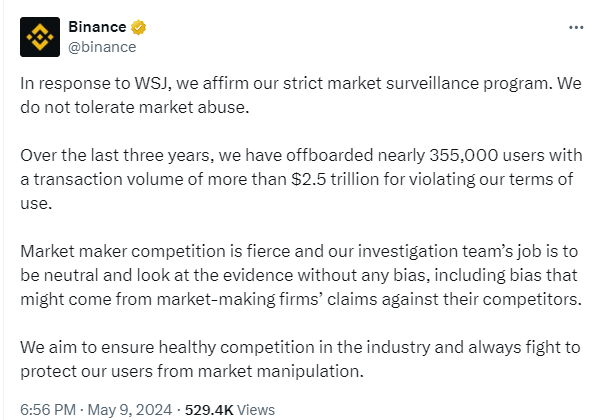
After The Wall Street Journal exposed DWF Labs’ alleged wash trading and potential market manipulation on Binance, Binance responded on social media late on May 9:
“Binance firmly rejects any claims that its market surveillance program allows manipulative activities on the platform. Binance maintains a strong market oversight framework designed to identify and act against market abuse. Any user violating our terms of use will be removed, and we tolerate no market abuse. Over the past three years, nearly 355,000 users have been removed for violating our terms, with trading volumes exceeding $2.5 trillion. Binance serves 190 million users. They can rest assured that Binance prioritizes platform security and does not favor any individual, regardless of scale. In other words, these decisions are never made lightly. Binance employs multiple tools for in-depth investigations and only removes users when there is sufficient evidence of violations. Furthermore, Inca Digital recently conducted an independent review of Binance’s market monitoring practices, validating the effectiveness of our methods and finding minimal traces of anomalous trading activity.”

Meanwhile, DWF Labs, one of the parties involved, also issued a statement on social media:
“DWF Labs wishes to clarify that many of the recent media allegations are unfounded and distort the facts. DWF Labs operates under the highest standards of integrity, transparency, and ethics and remains committed to supporting over 700 partners.”
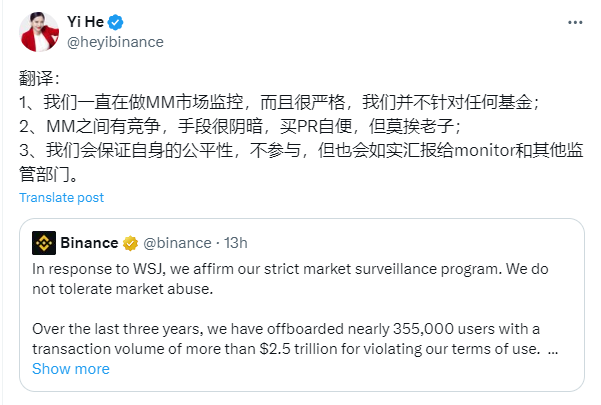
Following this, Yi He, Binance co-founder and Chief Customer Officer, interpreted Binance’s response, emphasizing that Binance continuously monitors market maker (MM) activities—and strictly so—but does not target any particular fund. She noted that competition among market makers can be fierce and tactics sometimes underhanded, implying that some PR campaigns may involve smear tactics, but stressed that Binance should not be dragged into such disputes. She affirmed Binance’s fairness, stating it does not participate but will truthfully report findings to monitors and regulatory authorities. Yi He added:
“People are inevitably influenced by their culture, background, and biases. I sincerely appreciate The Wall Street Journal’s sustained engagement with Binance, which has brought us significant exposure and saved us considerable marketing costs. But I’ve noticed an interesting trend: some mainstream media reports are increasingly driven by emotion and bias rather than facts—for example, turning former employees’ grievances (opinions) into articles, while Binance’s assistance to law enforcement in proactively investigating, reporting, and helping arrest the mastermind behind Zkasino (a fact) goes unreported.”
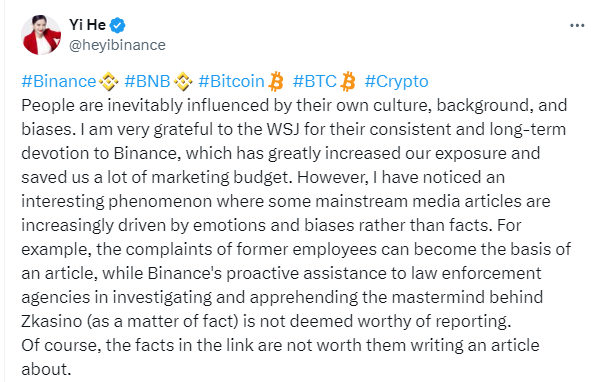
From Yi He’s comments, it appears this incident may stem from infighting among market makers, with competitors possibly releasing negative stories through media outlets to damage market-making firms like DWF Labs.
On the same day The Wall Street Journal published its article, Binance announced a new coin mining program. At least for now, Binance does not appear significantly affected by the controversy.
Join TechFlow official community to stay tuned
Telegram:https://t.me/TechFlowDaily
X (Twitter):https://x.com/TechFlowPost
X (Twitter) EN:https://x.com/BlockFlow_News
 PANews








