
Sudden Shift in U.S. Cryptocurrency Regulatory Policy Triggers Legal Dilemma: Wallet and DeFi Developers May Face Greater Challenges and Response Strategies
TechFlow Selected TechFlow Selected
Sudden Shift in U.S. Cryptocurrency Regulatory Policy Triggers Legal Dilemma: Wallet and DeFi Developers May Face Greater Challenges and Response Strategies
The FBI has also warned cryptocurrency wallet users that they could lose their funds due to criminal seizures and investigations if they do not transfer their assets to regulated institutions.
 Navigating Web3 tides with focused insights
By Aiying
Since 2013, U.S. government policy has been clear: developers and users of cryptocurrency wallets are not money transmitters. However, the Department of Justice recently decided to charge wallet developers with unlicensed money transmission—an unexpected move, especially since these developers do not actually control the assets protected by their software.
Federal prosecutors have advanced this unprecedented interpretation in two recent cases: the April 26 public indictment against Samourai Wallet and the same-day filing opposing Roman Storm’s motion to suppress evidence in the Tornado Cash case. Meanwhile, the FBI has warned cryptocurrency wallet users that they may lose their funds due to criminal seizure or investigation if they fail to transfer their assets to regulated institutions.
I. A Brief Review of Existing Money Transmission Policy and Summary of Recent Events
The United States has a series of federal laws regulating money transmitters under anti-money laundering (AML) frameworks, primarily based on the Bank Secrecy Act (BSA) and its amendments. These laws define the category of “financial institution” and authorize the Secretary of the Treasury to redefine this category as needed. As a result, the implementing regulations under the BSA effectively determine who must—or need not—register as a money transmitter or other financial institution, comply with “know your customer” (KYC) requirements, file reports with the government, and implement other AML controls.
The regulations define a money transmitter as:
-
Any person who provides money transmission services, where “money transmission services” are defined as “accepting currency, funds, or other value that substitutes for currency from one person and transmitting currency, funds, or other value that substitutes for currency to another location or person by any means”; and
-
Any other person involved in the transfer of funds.
In the context of cryptocurrency, there is some ambiguity about whether digital assets qualify as “currency, funds, or other value that substitutes for currency.” If cryptocurrency is considered “funds,” then anyone “involved in transferring funds” would be a money transmitter. If it is seen as “currency” or “other value that substitutes for currency,” then anyone who “accepts” and “transmits” cryptocurrency would be classified as such. Under a straightforward reading of the regulation, cryptocurrency is treated as a substitute for traditional currency. Therefore, someone who commercially accepts and transmits others’ cryptocurrency would be a money transmitter. In other words, if a person exercises actual control over another person’s cryptocurrency and uses that control to transfer it to another individual or location, they are a money transmitter. This legal framework predates cryptocurrencies and has never been amended, overturned, or reinterpreted by Congress, courts, or regulatory agencies.
This minor ambiguity regarding whether cryptocurrency constitutes currency, funds, or alternative value was resolved early in the regulatory history of digital assets by FinCEN.
In 2013, FinCEN issued its first guidance on “virtual currency.” In this document, FinCEN confirmed that cryptocurrency (which it called virtual currency) qualifies as “value that substitutes for currency,” but is neither “funds” nor “currency” itself (hence the term “virtual currency”). In a footnote, it explicitly stated it does not treat virtual currency as “funds,” because doing so would trigger certain prepaid access rules that FinCEN deemed inappropriate for cryptocurrency activities.
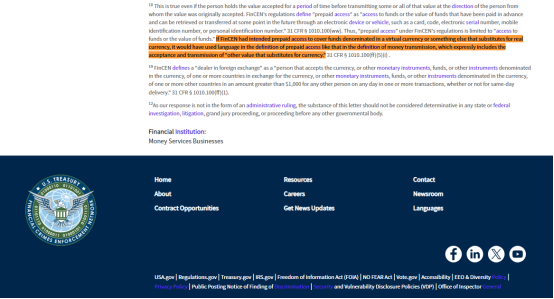
FinCEN further explained that mere users of virtual currency are not money transmitters, and in a subsequent administrative ruling found that software developers are also not money transmitters: “The mere development and distribution of software, even if designed to facilitate the sale of virtual currency, does not constitute accepting and transmitting value.”
Additionally, in 2019, FinCEN released further guidance clarifying that partial control over virtual currency is insufficient to classify wallet developers as money transmitters, noting that individuals who participate in transactions and act at the request of holders to perform additional validation lack full, independent control over those assets.
This guidance established that only businesses offering custodial cryptocurrency services are required to obtain licenses and comply with federal money transmission regulations. The law has long been clear: non-custodial cryptocurrency developers are not money transmitters.
II. Case Details and Key Legal Arguments
On April 26, 2024, a public indictment charged the developers of Samourai Wallet—a Bitcoin wallet using CoinJoin transactions to enhance user privacy—with illegal money transmission and other offenses. For this discussion, we will set aside the allegations of money laundering conspiracy, which depend on specific facts and do not necessarily hinge on whether the developers provided custodial rather than non-custodial services. It is possible, as alleged, that the defendants operated a centralized server to coordinate CoinJoin transactions. However, based on current understanding, Samourai Wallet did not grant developers or any third party full, independent control over the Bitcoin secured through the wallet software. Under a direct reading of the regulations—and particularly in light of FinCEN’s guidance and prior administrative rulings—the developers of Samourai Wallet did not exercise “full independent control” over any user funds and therefore fall outside the definition of a money transmitter.
In the case of Roman Storm involving Tornado Cash, prosecutors responded to an earlier motion to dismiss. They focused on a statute known as “Section 1960,” which makes it a crime to operate a money-transmitting business without a license. In their response, prosecutors emphasized that the definition under this law is far broader than the commonly referenced regulatory definition.
Their main argument is that whenever the Tornado Cash software processes a deposit or withdrawal request, causing cryptocurrency to move on the Ethereum blockchain, the developers should be held responsible. This expansive view implies that, under this logic, nearly all cryptocurrency wallets and smart contracts engage in money transmission, making virtually every developer potentially liable for unlicensed money transmission.
On regulatory definitions, the prosecution ignored all prior guidance and interpreted “funds” extremely broadly, defining it simply as anyone involved in a transfer. They even drew an analogy to package delivery, arguing that control over funds is not necessary. This interpretation disregards FinCEN’s explicit prior statement that virtual currency does not constitute “funds”—a point that renders the argument deeply flawed.
If Tornado Cash is likened to a package delivery service, it clearly does not serve only criminals. Moreover, the prosecution’s analogy actually proves the opposite of what they intend. A courier service that cannot access the contents of the packages it delivers is obviously not a money transmission service. After all, if you can’t open the package, how do you know what’s inside? If you’re told you’re just transporting boxes of canned food and you can’t inspect them, how could you possibly be guilty of operating an unlicensed money transmission business? Furthermore, FinCEN has clearly stated that armored transport services limited to securely moving physical currency are not considered money transmitters!
At the same time, the Federal Bureau of Investigation (FBI) issued a public warning about cryptocurrency wallets. The notice urges Americans not to use cryptocurrency transfer services that are not registered as Money Services Businesses (MSBs) under U.S. federal law. The FBI also provided FinCEN’s official tool for checking whether a company is registered as an MSB.
Given the indictments against Tornado Cash and Samourai Wallet, if the DOJ’s position is that any action enabling the movement of cryptocurrency from one place to another on the Ethereum blockchain constitutes money transmission—as argued in the Tornado Cash brief—then every cryptocurrency wallet, whether running as software on your phone, on a Trezor or Ledger USB device, or on Coinbase servers, would be considered a money transmitter. Among these three examples, only Coinbase is registered. In light of the recent prosecutions, this sets a concerning precedent for many wallet providers in the industry, including decentralized ones.

It remains unclear whether the DOJ is deliberately altering long-standing policy through criminal enforcement or whether there is a serious disconnect between the DOJ and FinCEN. Either way, this approach seriously undermines the rule of law in the United States. Incidentally, whether observing the passage of legislation targeting TikTok or the recent controversy surrounding the Anti-Semitism Awareness Act, one can sense growing internal divisions within the U.S.
III. Regulatory Uncertainty Drives Crypto Wallets Out of the U.S. Market
Paris-based Bitcoin company Acinq announced that recent U.S. government statements have raised questions about whether self-hosted wallet providers, Lightning service providers, or even Lightning nodes might be classified as money services businesses subject to regulation. Citing regulatory uncertainty, Acinq will remove its popular Lightning Network wallet, Phoenix, from U.S. app stores. Users are advised to close their channels and transfer funds before May 3, 2023.
One day later, zkSNACKs announced it would block access to its privacy-focused Wasabi Wallet in the United States, stating in a release on April 27: “Due to recent announcements by U.S. authorities, zkSNACKs now strictly prohibits U.S. users from accessing its services.”
IV. Questions
1. If a wallet does not target U.S. users, does it still need a license or registration?
If a cryptocurrency wallet or service explicitly does not target U.S. users and ensures that U.S. residents cannot access it, it generally does not need to obtain a U.S. money transmission license or register as a Money Services Business (MSB). U.S. laws and regulations primarily apply to entities operating within the United States or serving U.S. residents.
However, even if a service does not directly target U.S. users, it may still attract scrutiny from U.S. regulators if it interacts with the U.S. financial system or if U.S. users find ways to access the service. Thus, completely avoiding legal risk may be difficult, especially in a globalized, internet-based environment.
To minimize potential legal risks, non-U.S. cryptocurrency service providers should take steps to ensure their services are inaccessible to U.S. users. This may include geoblocking, IP address filtering, and clearly stating in terms of service that services are not available to U.S. residents.
2. If U.S. users inevitably find ways to access the service, what is the safest approach?
-
Register as a Money Services Business (MSB):
-
Under guidelines from the U.S. Department of the Treasury’s Financial Crimes Enforcement Network (FinCEN), any individual or company providing money transmission services must register as an MSB. This includes submitting required registration forms and updating information for any material changes.
-
Comply with Bank Secrecy Act (BSA) Requirements:
-
Registered MSBs must comply with the Bank Secrecy Act and its amendments, including anti-money laundering (AML) obligations and filing Suspicious Activity Reports (SARs).
-
Implement Know Your Customer (KYC) Procedures:
-
Money transmission services must implement KYC procedures—identity verification processes designed to prevent identity theft, financial fraud, and money laundering.
-
Obtain State-Level Licensing (MTL License):
-
In addition to federal registration, most states require money transmission services to obtain state-level licenses. Specific requirements vary by state, so applications must be tailored to the jurisdictions in which the business operates.
-
Maintain Compliance Records and Reporting:
-
Adhere to all recordkeeping requirements and regularly report large transactions and suspicious activities to FinCEN. Such records may be subject to audits or inspections.
-
Capital and Insurance Requirements:
-
Depending on the scale of operations and types of transactions, businesses may need to meet certain capital reserve and insurance coverage requirements to safeguard customer funds.
Join TechFlow official community to stay tuned
Telegram:https://t.me/TechFlowDaily
X (Twitter):https://x.com/TechFlowPost
X (Twitter) EN:https://x.com/BlockFlow_News
 Aiying Compliance