








From CZ Changpeng Zhao's 4-Month Sentence: Discussing the Legal Challenges Facing Cryptocurrency Exchanges
TechFlow Selected TechFlow Selected
From CZ Changpeng Zhao's 4-Month Sentence: Discussing the Legal Challenges Facing Cryptocurrency Exchanges
Four months is not long, but still a crime.
 Navigating Web3 tides with focused insights
Author: Liu Zhengyao, Senior Lawyer at Shanghai Manqin Law Firm
On April 30, the U.S. federal court in Seattle sentenced Changpeng Zhao (CZ), founder of Binance, to four months in prison, rejecting the Department of Justice’s (DOJ) request for a 36-month sentence. The charge was that CZ (or Binance) violated anti-money laundering provisions under the U.S. Bank Secrecy Act.

Following the verdict, CZ stated on social media that he would serve his sentence and afterward focus on education. He emphasized the importance of compliance for cryptocurrency exchanges and noted that Binance’s close cooperation with authorities and its commitment to user fund security during the DOJ investigation were crucial factors in receiving a lenient sentence. Finally, CZ reiterated his commitment to “Protect users!”
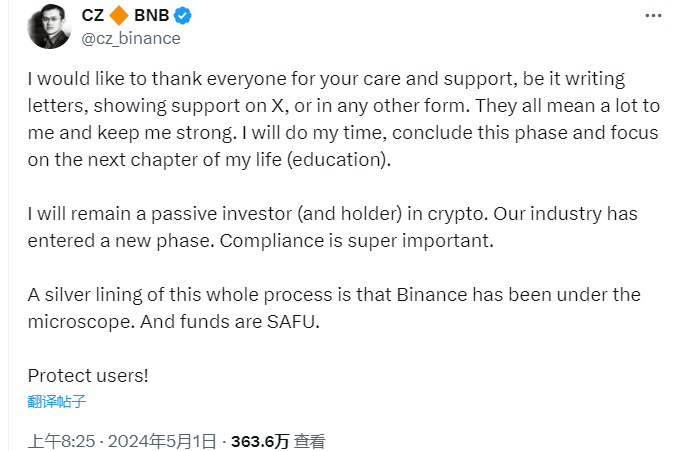
The final plea—“Protect users!”—inevitably recalls the case of FTX founder SBF (Sam Bankman-Fried), who was sentenced to 25 years in March this year for defrauding customers and misappropriating over $8 billion in client funds.
In this light, CZ’s fate may not seem so dire. But the story isn’t over. Attorney Liu outlines the various demands from different U.S. enforcement agencies regarding CZ or Binance, which may help us better understand the legal challenges facing cryptocurrency exchanges:

Some observers feel CZ has fallen victim to an American “pig-butchering” scam, while certain articles carry an undertone of schadenfreude. Attorney Liu believes such views are superficial (though this does not mean his own perspective is necessarily profound). At its core, the situation involving Binance or CZ reflects centralized governmental institutions’ reactive stance toward decentralized technologies applied in finance, particularly in monetary systems.
When confronted with powerful, conservative governments, cryptocurrency exchanges often have no choice but to compromise. Ironically, these exchanges themselves are classic centralized entities, contradicting the original decentralized ethos of cryptocurrencies. While their existence is justified today—for example, by greatly facilitating peer-to-peer crypto transactions—they remain inherently vulnerable to the pitfalls of centralization. CZ is not always spotless, nor is Binance the “guardian” of the crypto world; it's just that CZ didn't cross as many red lines as SBF did.
From the regulator’s standpoint, whether it’s the U.S. DOJ, SEC, CFTC, or China’s criminal jurisdiction based on territoriality, nationality, protective principles, or universal jurisdiction, national lawmakers and enforcers can always find legal grounds to justify their actions. In other words, at least in the eyes of many politicians, politics is the law of law, and law is merely a tool of politics (though Attorney Liu remains firmly committed to the rule of law!)
The U.S. accused Binance of violating anti-money laundering requirements under the Bank Secrecy Act—for instance, failing to report nearly 100,000 transactions involving Hamas, ISIS, and Al-Qaeda through Binance; allowing $890 million in transactions between U.S. and Iranian users without restrictions; and earning substantial fees from millions of transactions involving users from countries like Cuba, Syria, and Crimea, Donetsk, and Luhansk in Ukraine. (Quoted from “Trials of Changpeng Zhao | Prism,” author Wen Shijun)
According to some U.S. attorneys, the application of the Bank Secrecy Act in CZ’s case is uncommon within American jurisprudence. Thus, one cannot rule out the possibility that the CZ case was deliberately orchestrated.
However, as previously mentioned, the author raises this speculation not to accuse any particular government—we cannot guarantee that CZ would have received a lighter sentence elsewhere, and he might even have faced harsher penalties. The point being made is that widespread governmental acceptance of cryptocurrency exchanges and the decentralized digital currencies they represent remains difficult in the short term. Yet some remain optimistic—the fact that the United States, the dominant global financial power, did not deliver a fatal blow to the “dominant force” in the crypto world, might suggest increasing chances of mainstream acceptance?
But for true believers in decentralization—Who cares what the “mainstream world” thinks?
Join TechFlow official community to stay tuned
Telegram:https://t.me/TechFlowDaily
X (Twitter):https://x.com/TechFlowPost
X (Twitter) EN:https://x.com/BlockFlow_News












