Two major gaming IPs acquired, Yuga Labs focuses on NFT development with a product simplification strategy
TechFlow Selected TechFlow Selected
Two major gaming IPs acquired, Yuga Labs focuses on NFT development with a product simplification strategy
Why did Yuga Labs choose to spin off certain gaming products?
 Navigating Web3 tides with focused insights
By Nancy, PANews
On April 18, game studio Faraway announced the acquisition of two major gaming IPs from Yuga Labs — "HV-MTL" and "Legends of the Mara" (LoTM) — and plans to introduce a new points system for both, sparking controversy and skepticism within the community. Why did Yuga Labs choose to divest part of its gaming portfolio? How did Faraway become the acquirer, and can it revive these games’ market relevance?
Two Major Game Brands Acquired, To Introduce Points System
After more than a year of negotiations, Yuga Labs has formally agreed to Faraway's acquisition proposal. Faraway successfully acquired HV-MTL, Sewer Passes, Otherside Vessels, Otherside Maras, Otherside Kodamaras, Otherside Ship parts, Otherside Catalyst, and Otherside Partner Loot. These gaming assets will now support cross-game interoperability within the Faraway network.
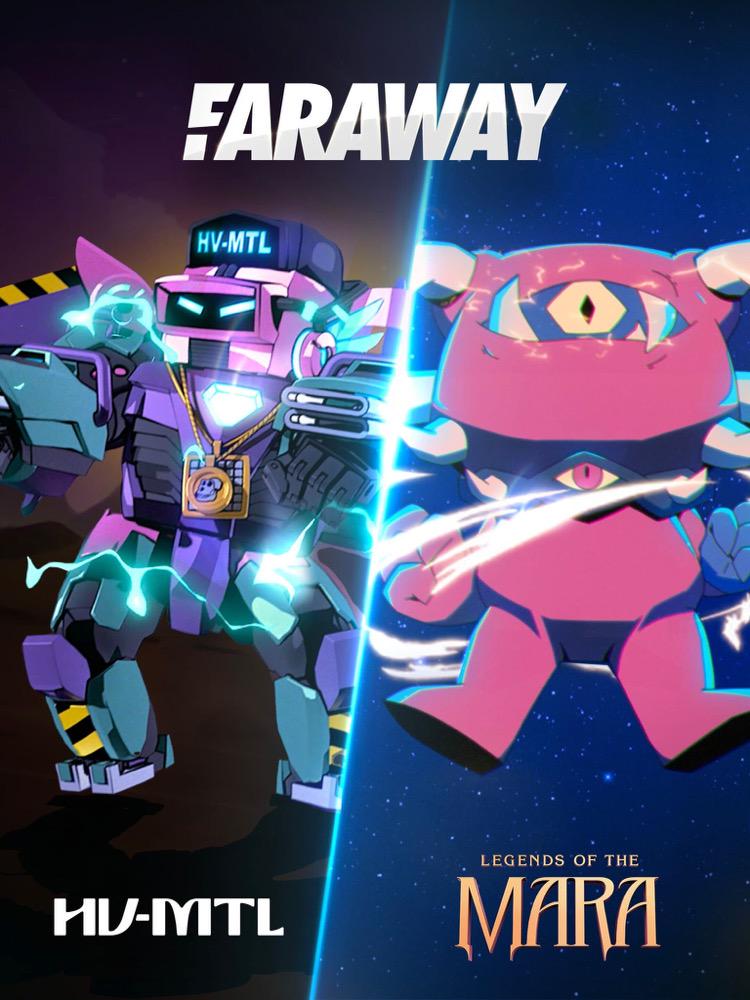
Additionally, both HV-MTL and Legends of the Mara will implement a new points system. All HV series NFTs will receive a new metadata field called "HV-MTL Points," where factors such as HV tier, Companion, and Powerscore will contribute to determining a user’s base score. Progression to EVO-2 and consumed AMP, along with rarity types, will also influence the points calculation. Similarly, all Kodas and Kodamaras will receive a new metadata field named "LoTM Points." It should be noted that the Otherside Koda series in Legends of the Mara remains under the Yuga Labs brand but can still earn different points based on NFT asset type. As part of the acquisition, 4,295 unrevealed HVMTL NFTs held by Yuga Labs will be permanently burned.
Furthermore, Faraway announced the appointment of Spencer Tucker, former Chief Gaming Officer at Yuga Labs, as its new Chief Product Officer. Tucker previously served as President of Games at mobile gaming studio Scopely and brings nearly two decades of experience in game development, design, UGC, Web3, and creative community engagement.
However, the acquisition news did not significantly boost Yuga Labs' gaming asset prices. According to Magic Eden data, within the past 24 hours, HV-MTL’s floor price briefly rose before dropping to 0.0699 ETH, reflecting only a 1.39% increase; Otherside Vessels saw a 1.3% rise with just 0.2 ETH in daily trading volume; Otherside Maras increased by 1.48%, with daily volume reaching only 5.2 ETH.
Community reactions to Faraway’s acquisition have been mixed. Some members criticized Yuga Labs for selling user gaming assets without prior community consultation, calling it a disregard for holders’ interests. Additionally, critics argue that by offloading its most commercially promising games amid declining NFT values, Yuga Labs may struggle to generate sustainable revenue through royalties.
On the other hand, some believe specialized tasks should go to specialists. They point out that Yuga Labs’ prolonged inactivity in gaming demonstrates its lack of operational capability in this space, suggesting Faraway might bring much-needed revitalization.
Acquirer Raised Nearly $30M, Already Launched Three Games
“HV-MTL and LoTM are better suited for a team with stronger gaming DNA like Faraway — they’ve found their best ‘home,’” said Yuga Labs.
Founded in 2021, Faraway is a blockchain game development studio offering a Web3 game development kit and creator suite. These tools enable users to build games via APIs and development tools, create and sell interoperable assets, and analyze on-chain player activity. The platform primarily targets game studios, brands, asset creators, and curators, currently supporting Solana, Ethereum, and Polygon.
Faraway’s co-founders Alex Paley and Dennis Zdonov have collaborated on multiple projects in the past, including working together with Spencer Tucker at midcore mobile gaming studio. To date, Faraway has raised nearly $30 million in funding, including an undisclosed seed round exceeding $8 million and a $21 million Series A round. Investors include former FTX, a16z, Lightspeed, Solana, Jump Capital, Sequoia Capital, and Pantera Capital.
According to its official website, Faraway currently operates three games: Mini Royale: Faraway, a Solana-based shooter launched in 2021; Serum City, an NFT game developed in collaboration with Yuga Labs; and Dookey Dash Unclogged, an adventure game. Given Faraway’s history of issuing tokens within its games, the community speculates that token issuance for the newly acquired Yuga Labs titles may follow.
Greg Solano, CEO of Yuga Labs who recently resumed leadership, expressed confidence in Faraway following the acquisition announcement. He noted that compared to Yuga Labs, Faraway’s team boasts extensive professional experience and excels at leveraging popular global IPs to create engaging, sticky games for communities. Moreover, Faraway is a crypto-native game development team of over 100 people, possessing sufficient resources to build and operate these games effectively. Solano also revealed that Yuga Labs will now focus more intently on the Otherside metaverse, Bored Apes, and Punks.
Notably, in an interview with NFTNOW, Greg Solano admitted regret over Yuga Labs’ failure to quickly re-engage with Ordinals after launching its Bitcoin NFT collection TwelveFold, adding that chasing narratives can sometimes be risky.
Overall, while this acquisition has not reversed Yuga Labs’ current downward trajectory, its renewed focus on strengthening NFT IP development could offer future opportunities. Meanwhile, whether "HV-MTL" and "Legends of the Mara" can regain market momentum under Faraway’s stewardship remains to be seen.
Join TechFlow official community to stay tuned
Telegram:https://t.me/TechFlowDaily
X (Twitter):https://x.com/TechFlowPost
X (Twitter) EN:https://x.com/BlockFlow_News
 PANews