








Interpreting the Runes Protocol: Launching at the Halving on the 19th, Betting on Its Potential to Replace BRC-20
TechFlow Selected TechFlow Selected
Interpreting the Runes Protocol: Launching at the Halving on the 19th, Betting on Its Potential to Replace BRC-20
Unless BRC-20 evolves, Runes could become the primary token standard on Bitcoin.
 Navigating Web3 tides with focused insights
Author: Marlon
Translation: TechFlow
With the halving approaching, speculators are eagerly anticipating the launch of Runes. Runes have generated widespread attention across crypto social platforms, and there's considerable confusion and misinformation surrounding this new token standard—especially as many unrelated protocols have adopted "Rune" in their names and tokens, further muddying the waters.
Let’s clear things up.
What Are Runes?
Casey Rodarmor, the developer behind Ordinals, is building another novel innovation—a fungible token standard for Bitcoin called the Runes Protocol. As a meta-protocol, Runes itself isn't a token; rather, quoting Casey from his podcast, it’s “where people make shitcoins on Bitcoin.”
Tokens created using this standard are called Runes. Unlike BRC-20, Runes is a fungible token standard, meaning each Rune is interchangeable. The closest analogy would be ERC-20 tokens on Ethereum. The Runes token standard is similar but simpler, purpose-built for the Bitcoin network.
High-Level Overview
-
The Runes Protocol and Runes go live at the halving block (around April 19)
-
Rune balances are stored within Bitcoin UTXOs
The Runes Protocol extends UTXOs, leveraging Bitcoin’s security framework to store both Bitcoin and Rune balances. As a result, users can create and trade Runes via regular Bitcoin transactions.
-
Runes 0–9 are hard-coded to ensure fair issuance
Many protocols are rushing to launch their own Rune tokens, employing creative gamification models and promising airdrops. Be cautious of false marketing claims about being the “first Rune token”—at best, they can only secure and mint Rune #11.
The genesis Rune, Rune 0, will open for minting at the start of the halving and continue for approximately four years. Each mint grants one genesis Rune with zero divisibility.
-
Initially, only token names with 13 or more characters will be available
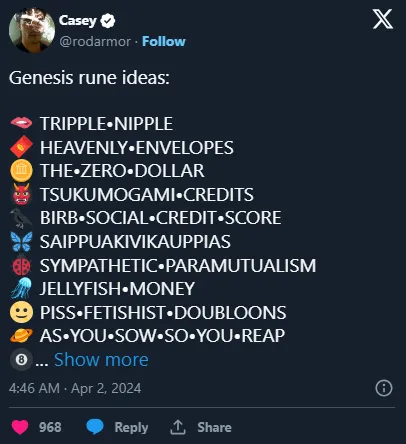
Approximately every four months, token names with one fewer character will become available. The maximum name length is 28 characters. To prevent front-running, a “commit-reveal” scheme has been implemented. The token name unlock schedule can be found here. Either way, brace yourself for some wild token names:
-
OP_Return fields are used to create Runes
This ensures each Rune name is unique. Additionally, each token will have a Unicode code point as its currency symbol.
Will Runes Replace BRC-20?
BRC-20 has a total market cap of $2.65 billion and represents a significant market presence on Bitcoin. The narrative around Runes is largely driven by speculators betting that Runes will supplant BRC-20 and become the dominant new token standard on Bitcoin.
Is Rune a Superior Token Standard?
The differences between the two are clear, as emphasized in our in-depth analysis of Ordinals and Runes:
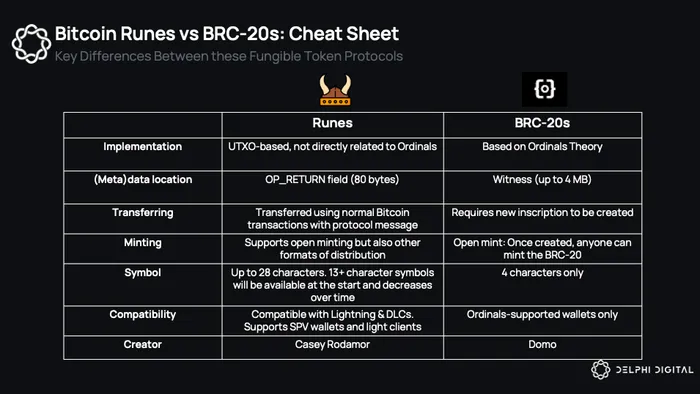
Runes do not use witness data but instead utilize the OP_RETURN field, simplifying token creation. Users can deploy (engrave), mint, and transfer Runes, enabling standard Bitcoin transactions.
Runestones are messages defined by the Runes Protocol that store transfer instructions within unused Bitcoin transaction outputs—UTXOs. These instructions determine how Runes are transferred between outputs, such as destination addresses and transfer amounts. By default, when transferred to a new UTXO, the Rune balance on the input UTXO is destroyed.
This is far more network-friendly than the BRC-20 standard, which currently generates numerous unused UTXOs, cluttering the network. Another drawback of BRC-20 is that each token transfer requires creating a new inscription.
Rune creation is also more flexible. They support open minting, fair distribution, and users can choose to mint the entire supply to a single address (similar to ERC-20). In contrast, BRC-20 is limited solely to open minting.
More importantly, BRC-20 inscriptions are more vulnerable to front-running. Anyone can see your inscription transaction in the mempool and decide to front-run it by paying higher fees—particularly frustrating when attempting to deploy a new token. In contrast, Runes aim to prevent front-running using a “commit-reveal” scheme. At a high level, this allows users to privately commit to a transaction, with details revealed only shortly before confirmation, drastically reducing the front-running window.
Finally, Runes support compatibility with SPV wallets and Bitcoin L2s that use the UTXO model. This theoretically enables integration with lightweight wallets and even the Lightning Network for faster, cheaper transactions. It's worth noting, however, that while interoperability exists in theory, the necessary infrastructure must first be developed.
Some FUD
On paper, Runes solve many of the user experience and compatibility issues faced by BRC-20. However, I remain cautious about claims that Runes will unconditionally replace BRC-20.
To enable protocol upgrades and ensure client synchronization, Casey introduced what he calls the Cenotaphs model into the Runes Protocol. Cenotaphs are malformed Runestones created by erroneous inputs. When included in a transaction, any Runes associated with a Cenotaph are destroyed or rendered unusable.
This is a controversial point, as it introduces the risk of accidentally losing Runes. For example, if you interact with an application that creates a Rune transaction and inadvertently generates a Cenotaph, you could lose all Rune balances stored in the same UTXO.
Is this a serious or trivial risk? It's hard to say before the protocol launches, but it's something to keep in mind. Casey addresses these concerns in a post, summarizing that, in his view, the risk is negligible. Regardless of its severity, avoiding untested third-party services immediately after the Rune launch is a good way to mitigate risk.
Incidentally, there's recently been rumor on Twitter suggesting BRC-20 might soon receive an update. Allegedly, BRC-20 indexers may soon be capable of computing EVM smart contract code over token balances. If true, this could resolve many current design limitations, making BRC-20 significantly more competitive against Runes. Again, this remains speculative and should be taken with caution.
Ultimately, Rune’s success will come down to user experience. If Runes’ broad compatibility is quickly adopted and leveraged, the chances of replacing BRC-20 could be substantial.
If you're interested in learning more about Runes ahead of launch, check out Haze’s deep dive on $PUPs. For deeper technical insights, I highly recommend reviewing the official documentation and listening to Casey’s podcast.
Redphone’s Summary
Special thanks to Redphone, who originally conceived BRC-20, for sharing his thoughts on Runes below:
-
Unless BRC-20 evolves, Runes are likely to become the dominant token standard on Bitcoin.
-
Runes are more efficient.
-
Runes store token balances in UTXOs, shifting trust from indexer layers to the Bitcoin blockchain itself. This alone is a massive win.
-
Because they exist within the UTXO set, Runes should integrate more easily with L2s, bridges, and other DeFi applications.
-
If Runes ever reach the Lightning Network, it will never be the same again. Can you imagine running a Rune-based stablecoin on it? Currently, Coinbase is working on Lightning support. Perhaps one day we’ll be able to withdraw Bitcoin directly into a Lightning wallet.
-
Runes expand token issuance mechanisms. Unlike BRC-20, they aren’t limited to fair launches. This will drive greater adoption, as fair launches make it difficult to align incentives with contributors over time.
-
In another life, Casey Rodarmor was a game designer. I mention this because he’s a master at gamifying protocol launches. With Ordinals, he gave every satoshi a lettered name based on its number and created rarity tiers for different sats (spawning an entire sub-industry known as “sat panners”). Similarly, he’s gamifying the Rune launch by gradually allowing shorter names. Initially, token names must be at least 13 characters long. Every four months, names shorten by one character. It’s a magical, gradual evolution that sustains interest. Every protocol designer can learn from his approach.
-
Combining the Rune launch with Bitcoin’s halving is another brilliant marketing move by Rodarmor. Usually, I’d look forward to the halving itself. Now, I’m almost entirely excited about Runes.
-
Many BRC-20 tokens will transition to Runes and live on in new forms.
-
Still, BRC-20 has a passionate following, and the BRC ecosystem will evolve. I’m uncertain where it will go. As mentioned earlier, rumors suggest BRC-20 indexers may soon compute EVM smart contract code over token balances. This would greatly enhance their competitiveness against Runes—and possibly surpass any innovation happening natively on Bitcoin core.
-
Having multiple coexisting token standards is perfectly acceptable. What matters more is what you can do with these tokens. BRC-20 has already been integrated into centralized exchanges, proving its staying power.
-
Bitcoin moves too slowly for native meme coins to reach their full potential. This means competition among Bitcoin L2s represents one of the biggest opportunities in crypto. I hope to see Ordinals (and BRC-20) indexers win this race by launching a tokenized L2 network. Either way, we’ll see a breakthrough L2 ecosystem emerge in the coming months or years, and I believe Runes will be a key part of that story.
In summary, I’m a fan of both Runes and BRC-20. In the short term, both may continue to thrive, but BRC-20 must evolve or risk being replaced over time.
Beyond Runes, I deeply admire Rodarmor’s creativity. From the moment I first encountered Ordinals, I’ve regarded him as one of crypto’s iconic figures—visionaries etched into history like Hal Finney, Vitalik Buterin, Hayden Adams, and others. A successful Rune launch would simply be the cherry on top for Rodarmor.
Join TechFlow official community to stay tuned
Telegram:https://t.me/TechFlowDaily
X (Twitter):https://x.com/TechFlowPost
X (Twitter) EN:https://x.com/BlockFlow_News
 Delphi Digital









