Countdown to the fourth halving — witness Bitcoin's new era with OKX
TechFlow Selected TechFlow Selected
Countdown to the fourth halving — witness Bitcoin's new era with OKX
Historical data shows that in the periods following Bitcoin's first two halvings, Bitcoin's price achieved significant growth.
 Navigating Web3 tides with focused insights
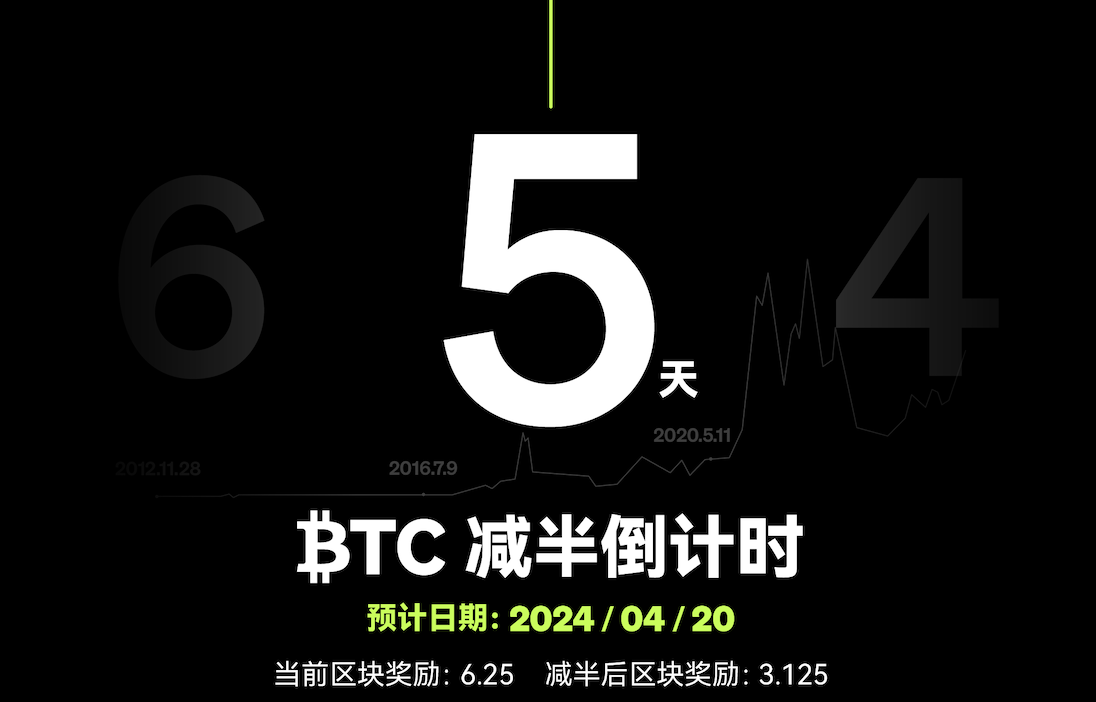
Looking back, since its inception in 2009, Bitcoin has undergone three halving events. The first occurred in November 2012, when the block reward dropped from 50 BTC to 25 BTC. The second halving took place in July 2016, reducing the block reward further to 12.5 BTC. Following this, Bitcoin began gaining broader mainstream recognition and adoption. Influenced by supply-demand dynamics and other factors, Bitcoin’s price surged significantly after the second halving. While there is no definitive proof that halvings directly drive price changes, the expectation of a “halving effect” started taking root in market sentiment.
In May 2020, Bitcoin experienced its third halving, cutting mining rewards to 6.25 BTC per block. This was a particularly unique halving cycle, coinciding with the global pandemic and a period of macroeconomic adjustment—making market drivers more complex and multifaceted. Now, the fourth halving is approaching.
Historical data shows that after each of the previous two halvings, Bitcoin's price achieved substantial growth. Past trends offer a degree of reference for observing and forecasting future market movements.

How is this halving different from previous ones?
Bitcoin’s price increases have always been tied to macroeconomic cycles, supply-demand dynamics, regulatory developments, and ecosystem innovations. Halvings primarily affect supply-demand balance—a factor consistent across all past halvings. However, what sets this cycle apart is the approval of spot Bitcoin ETFs and the emergence of inscription-related innovations, both driving structural changes in the Bitcoin market.
According to SoSoValue data, on March 28, spot Bitcoin ETFs saw a total net inflow of $179 million. On that day, Grayscale’s GBTC recorded a single-day net outflow of $104 million, bringing its historical cumulative outflow to $14.77 billion. BlackRock’s IBIT led inflows with approximately $95.12 million on the same day, reaching a total historical net inflow of $13.96 billion. As of publication, spot Bitcoin ETFs hold a total net asset value of $59.1 billion, representing an ETF net asset ratio (market cap relative to Bitcoin’s total market cap) of 4.25%, with cumulative net inflows amounting to $12.12 billion. Continued adoption of Bitcoin ETFs may significantly absorb selling pressure and potentially reshape Bitcoin’s market structure by introducing a new source of stable demand.
To better understand the potential trajectory of spot Bitcoin ETFs, one can look at the development of gold ETFs. In November 2004, the U.S. launched its first gold ETF—SPDR Gold Shares (GLD)—which amassed over $1 billion in assets within just three days. In its first year, GLD’s assets under management (AUM) rapidly climbed above $3 billion. By 2023, global gold ETFs had reached approximately $150 billion in AUM, demonstrating the profound and lasting impact such investment vehicles can have on a market.
Additionally, the rise of inscriptions has revitalized on-chain activity. As of February 2024, over 59 million NFT-like collectibles have been inscribed on Bitcoin, generating more than $200 million in transaction fees for miners. With upcoming Bitcoin ecosystem innovation protocols like Runes launching progressively, the vitality of the Bitcoin ecosystem is likely to be further stimulated.
More importantly, as the cornerstone of crypto, Bitcoin has already achieved strong global consensus on value.
Currently, the number of Bitcoin accumulated addresses exceeds 1.2 billion. According to TokenTerminal, Bitcoin has around 13.7 million monthly active users and records approximately 17.5 million on-chain transfers. In terms of blockchain growth, Bitcoin’s chain size stands at roughly 507GB—70% larger than three years ago. These metrics reflect the explosive growth in usage rates for cryptocurrencies, especially Bitcoin.
Moving into a New Era of the Bitcoin Ecosystem with Long-Term Builder OKX
As an active contributor to the development of the Bitcoin ecosystem, OKX’s R&D team has long been inspired by Bitcoin’s origins and its hacker ethos—this spirit is precisely why OKX moved quickly to support ecosystem-building initiatives from the outset.
Since last year, the emergence of the Ordinals protocol and the BRC-20 token standard has sparked a wave of interest in asset issuance on Bitcoin, giving rise to diverse asset issuance protocols such as Atomicals, Runes, BTC Stamps, and Taproot Assets, along with new token standards including ARC-20, SRC-20, and ORC-20. At its core, the inscription sector introduced a new model of fair launch, drawing massive attention to the Bitcoin ecosystem and reigniting broader interest in its development.
Beyond asset issuance protocols and scaling solutions, infrastructure projects are also flourishing—wallets supporting inscriptions, decentralized indexers, cross-chain bridges, launchpads, and more are all thriving. On both Layer 1 asset issuance protocols and application-layer infrastructure, OKX Web3 has maintained continuous investment. Notably, OKX was among the first to support the Ordinals marketplace, achieving significant success early on.
As early as July last year, OKX Web3’s Ordinals marketplace became the largest platform for BRC-20 token trading by volume. Today, as the Bitcoin ecosystem continues to expand, OKX Web3 is actively building across every dimension—from wallets and explorers to trading markets, protocol standards, cross-chain bridges, and Bitcoin Layer 2 solutions. For instance, OKX DEX supported Bitcoin cross-chain trading early on, and OKX Web3 has progressively integrated various Layer 2 scalability projects such as Babylon, Merlin, and B². Recently, it’s worth noting that OKX Web3 Wallet has launched a dedicated Runes market page, enabling immediate support for the protocol so users can mint and trade Runes-based assets right away.
Currently, OKX Web3 offers users an all-in-one experience for exploring the Bitcoin ecosystem. Users can easily acquire and trade assets via the Web3 wallet, discover and participate in trending Bitcoin ecosystem projects, and directly access DeFi features such as staking Bitcoin assets on-chain to earn yield with low gas fees.
Furthermore, OKX Ventures, the investment fund under OKX, is committed to supporting innovation and growth within the Bitcoin ecosystem. It has already invested in projects including ALEX, B² Network, Bitmap Tech, Babylon, bitSmiley, BounceBit, Nubit, Portal DeFi, and Zeus Network. As previously reported, OKX Ventures has allocated $10 million to continuously fund emerging entrepreneurs in the BTC ecosystem, accelerating blockchain innovation while providing services and resources to help partners grow together.
Reflecting on over a decade of Bitcoin’s evolution, each cycle represents a phase of advancement—and OKX, having grown alongside Bitcoin and provided robust support for its ecosystem, shares this journey. As OKX’s Chief Innovation Officer once said in an interview, some members of OKX’s R&D team studied the Bitcoin whitepaper around 2012, back when Bitcoin was still confined to geek circles, where every innovative idea was thrilling. Ever since, all of OKX’s innovations have been driven by that original spirit. Now, as Bitcoin enters a new phase with the arrival of the fourth halving, OKX remains committed—for the next decade—to continue innovating across its Web3 offerings, exchange operations, and support for ecosystem innovation, advancing hand-in-hand with Bitcoin and the broader crypto industry.
Disclaimer:
The content of this article is for informational purposes only and does not constitute and should not be construed as an invitation, offer, solicitation, recommendation, or investment advice regarding any product or service. Investing carries risks. Digital asset prices are subject to significant market risk and volatility. Derivatives such as contracts and options are especially vulnerable to market fluctuations and may result in the loss of your entire investment. Therefore, digital asset trading may not be suitable for all investors. You must understand how these products work and make independent judgments and investment decisions. Readers are solely responsible for understanding and complying with applicable local laws and regulations.
Join TechFlow official community to stay tuned
Telegram:https://t.me/TechFlowDaily
X (Twitter):https://x.com/TechFlowPost
X (Twitter) EN:https://x.com/BlockFlow_News
 OKX
OKX