








ByteDance-affiliated product Gauth gains popularity overseas: What's the secret to AI app globalization?
TechFlow Selected TechFlow Selected
ByteDance-affiliated product Gauth gains popularity overseas: What's the secret to AI app globalization?
AI is important, but not the most important.
 Navigating Web3 tides with focused insights
By Mu Mu
As the AI wind rises, Gauth, an education product under ByteDance, is soaring overseas.
According to AppGrowing data, as of April 15, 2024, Gauth's iOS version ranked fourth among education apps in the U.S., having reached second place on April 8, trailing only language-learning app Duolingo.
Data.ai reports that Gauth has achieved 1.474 million downloads and 449,000 active users. The analytics platform awarded the app a Mobile Performance Score (MPS) of 98 out of 100.
Launched between 2020 and 2021 as a math-focused tutoring tool, Gauth remained relatively obscure on education app charts until early this year, when it began delivering standout performance. According to AppGrowing, within three months, Gauth’s global downloads surged 14-fold while daily active users increased by 1.4 times.
Reportedly powered by artificial intelligence, Gauth provides step-by-step solutions for academic subjects including mathematics, chemistry, biology, and physics. Evaluations suggest Gauth performs at the level of a ninth-grade student in the U.S. for math problems, while its proficiency in language arts matches that of top scorers on standardized tests like the SAT.
Riding the AI wave, Gauth has taken off—but capturing a share of the overseas market involves more than just leveraging AI.
AI-Powered Photo Problem-Solving Drives Educational Resource Traffic
Gauth’s explosive growth began at the start of this year. Starting in January 2024, according to AppGrowing, Gauth rapidly rose through the ranks in both the U.S. and global education app markets, amassing over 200 million users worldwide. It closely followed popular language-learning app Duolingo and briefly claimed second place on the U.S. free education app chart.
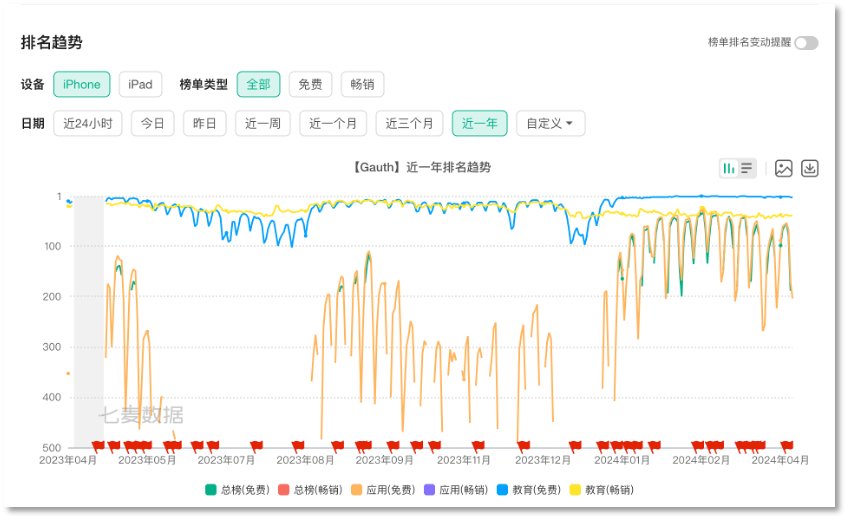
AppGrowing data showing Gauth's ranking performance over the past year
According to Data.ai, Gauth’s daily active users (DAU) in the U.S. soared from 505,600 in January to a peak of 1.39 million. Globally, DAU peaked at 2.065 million, marking a rise of over 1.4 times compared to the beginning of the year. Meanwhile, single-day downloads spiked nearly 14-fold by early April.
Clearly, Gauth isn’t just strong in the U.S.—it’s also making waves internationally. But what fueled its sudden popularity?
In fact, Gauth officially launched in December 2020 under the name Gauthmath, operated by GAUTHTECH PTE. LTD., registered in Singapore, with shareholder LEMON INC., a subsidiary of ByteDance. To this day, traces remain online of ByteDance’s job postings seeking AI project interns for Gauthmath (though the listing is now offline).
From the outset, Gauth emphasized two key features: international focus and AI integration.
Initially, Gauth didn’t stand out—apps offering photo-based homework help were already common in China, with multiple edtech companies launching similar tools. This may explain why Gauth chose to go overseas rather than compete domestically. However, even abroad, it didn’t immediately gain traction and remained relatively unknown in education app rankings.
In 2023, generative AI exploded into mainstream awareness thanks to ChatGPT. Gauth, already incorporating AI functionality, seized the moment and began its comeback.
Users simply snap a photo of a problem, and Gauth analyzes it using AI to deliver detailed solution steps and reasoning within seconds. As stated on its official website, Gauth covers disciplines such as math, statistics, physics, chemistry, history—and even demonstrates language and comprehensive skills comparable to high scorers on the U.S. SAT exam.
For Gauth, AI serves not only as foundational technology but also as a strategic advantage. Yet Gauth’s appeal extends beyond AI alone. The app connects users with a professional tutoring team comprising experienced teachers, university students, and graduate researchers, and fosters a global community where learners can discuss questions together.
Testing reveals that while AI efficiently solves most subject questions, some complex or tricky problems still stump it. For example, when Chinese college entrance exam questions were uploaded, Gauth recognized them and provided step-by-step explanations in Chinese—but delivered incorrect answers.
Mathematical reasoning remains a persistent challenge for natural language models. Such bugs are understandable given Gauth’s status as an application, but the platform compensates through human expertise via expert teams and community support—laying the groundwork for monetization.
The Gauth app is free to download, but premium features—especially those involving “real expert” tutors—require a paid subscription included in Gauth Plus. In addition to unlocking all answers, Gauth Plus offers 24/7 teacher Q&A support.
In the U.S., Gauth Plus offers monthly, quarterly, and annual subscriptions priced at $11.99 (~¥86.78), $21.99 (~¥159.15), and $99.99 (~¥723.66) respectively.
Thus, in Gauth’s commercialization strategy, AI acts both as technical capability and a traffic-driving banner. Combining AI technology with real human teaching resources enhances user experience and highlights the indispensable value of people behind so-called “AI-driven tools.”
Is the Overseas AI Market Truly a Blue Ocean?
With AI booming globally, Chinese application-focused tech firms are pursuing international expansion early in the technological lifecycle, aiming to secure a foothold in overseas markets—an approach honed from years of experience during the mobile internet era.
Since 2010, amid the mobile internet surge, Chinese enterprises have increasingly favored app globalization. Gaming led the way, exemplified by MiHoYo; next came cross-border e-commerce platforms exporting vast product lines, with TikTok emerging as a leader; later, brand globalization gained momentum—seeing familiar names like Mixue Ice Cream & Tea across Southeast Asia evokes a sense of pride.
Today, this wave has reached the AI sector. Numerous homegrown AI applications—including Heygen, Opus Clip, Meshy, and PixVerse—are gaining traction overseas.
Baidu has launched AI Camera Meira, AI chat SynClub, and AI social app WiseAI for international audiences. HeyGen, which went viral overseas last year, was co-founded by Liang Wang, a former ByteDance product designer. Many individual entrepreneurs and small teams have also introduced successful products abroad—emergent AI-native platforms like TheB.AI and FlowGPT were initially developed independently by their founders.
Chinese AI players rush overseas primarily for three reasons: first, foreign users exhibit stronger willingness to pay; second, domestic large language models still lag in English processing and openness, so most overseas-facing products integrate APIs from models like GPT, Claude, and Bard, enabling rapid development by focusing on vertical, niche scenarios and wrapping them into functional mini-apps.
Yet avoiding domestic competition by targeting overseas markets entails both opportunities and challenges.
While enthusiasm for AI globalization grows, so does competition—not every product achieves commercial success. Even major companies struggle without established user bases overseas to quickly build momentum.
Despite launching Meira, SynClub, and WiseA, Baidu has seen lukewarm responses. SynClub ranks outside the top 100, with downloads in the low thousands. In contrast, leading performers like Gauth enjoy surging DAUs, while Duolingo already boasts tens of millions in daily active users.
Take Duolingo: only recently did its Max version introduce AI-powered role-playing and smart error correction—features added post-AI boom. In Q4 2023, Duolingo reported revenue of $151 million, up 45% year-over-year, and a net profit of $12.11 million, reversing losses with an 187% increase in profitability. This marked Duolingo’s third consecutive profitable quarter. Its enduring position atop education app charts stems less from AI and more from years of market accumulation.
Duolingo CEO Luis von Ahn has stated that AI in education should prioritize application-layer innovation and end-user experience. Let AI serve as the “door opener” for education—not let education companies lose themselves in the dazzle of technology, obsessing over model engineering at the expense of the product itself.
Indeed, AI technology presents unprecedented opportunities for product globalization. But the core of any product’s success lies in the product itself—not merely slapping an “+AI” label onto it. In a saturated market of homogenized large models, the key to overseas success lies in leveraging AI to build truly compelling products. Gauth’s rise sends a positive signal to the market and shows what AI-powered products should aspire to be: deeply embedded in real-world use cases and centered on user experience.
Join TechFlow official community to stay tuned
Telegram:https://t.me/TechFlowDaily
X (Twitter):https://x.com/TechFlowPost
X (Twitter) EN:https://x.com/BlockFlow_News












