Pantera: As L2 matures, blockchain's "dial-up internet" era has arrived
TechFlow Selected TechFlow Selected
Pantera: As L2 matures, blockchain's "dial-up internet" era has arrived
Since its launch in 2021, Arbitrum has emerged as the L2 of choice for leading Web3 projects and developers.
 Navigating Web3 tides with focused insights
Authors: Franklin Bi, Jonathan Gieg, Nihal Maunder
Translated by: TechFlow
The "dial-up" era of blockchains has arrived.
The early internet was slow, clunky, and frequently broke down. When broadband replaced dial-up connections, new activities and products emerged online. The massive upgrade in bandwidth unlocked the full potential of the global information network. Today, a similar upgrade is happening across blockchain networks.
Over the past two years, the Ethereum ecosystem has achieved roughly a 10x scale increase through Layer 2 (L2) blockchains. L2s achieve higher speed and lower costs by batching transactions and settling them on a separate blockchain—a scaling approach known as “rollup chains.”
The total transaction throughput across Ethereum-based Layer 2s currently exceeds 140 TPS (transactions per second), compared to 14 TPS on Layer 1 (see chart).
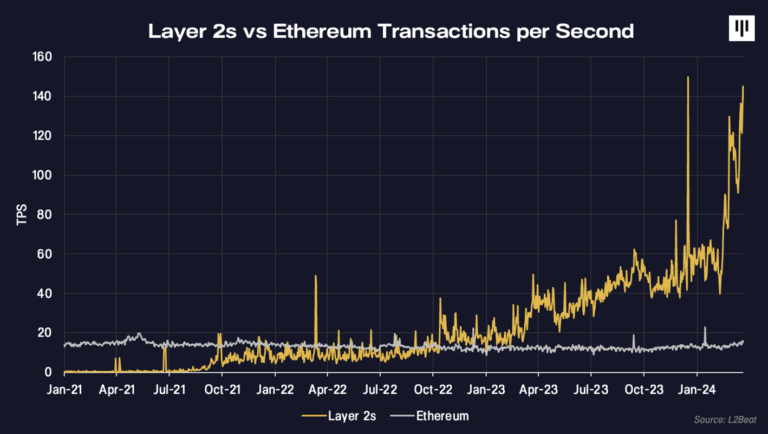
Today’s leading L2 is Arbitrum. Since its launch in 2021, Arbitrum has led the L2 space across all key metrics—from transaction volume and developer activity to on-chain fee revenue. The design of the L2 protocol prioritizes compatibility with Ethereum. Users and developers experience Arbitrum almost identically to Ethereum, but at lower cost and faster speeds.
The result is a major leap forward in Ethereum's scalability. Over the past 30 days, the Arbitrum network has processed four times more transactions than Ethereum. L2’s 7-day transaction volume increased over 850%, rising from 18.6 million to 163 million. The blockchain network’s “broadband moment” has arrived.
Arbitrum, Day One
At Pantera’s second Blockchain Summit in 2015, we invited a small group of industry friends to a lakeside cabin in Lake Tahoe. Among them was Ed Felten, a professor at Princeton University. Dr. Felten, a distinguished computer scientist and technology policy advisor, was renowned for his pioneering work in cybersecurity and digital content protection. But it was his growing interest in Bitcoin that brought him west.
At the time, Ed was actively researching Bitcoin, often collaborating with fellow academics, including two postdoctoral researchers, Steven Goldfeder and Harry Kalodner. The trio had been studying Bitcoin wallet security until they turned their attention to the industry’s most pressing challenge: how to scale blockchains for mass adoption. The key insight stemmed from an idea Ed had conceived a decade earlier—one that now defines an entire category of scaling solutions: “Interactive Fraud Proofs.”
In 2018, Steven, Harry, and Ed publicly shared a research paper titled: “Arbitrum: Scalable, Private Smart Contracts.” The proposal was elegant and clear. But implementing this critical work would require much greater effort, so we reunited with Ed, Steven, and Harry—now co-founders of Offchain Labs.
When meeting the founding team of Offchain Labs, we found their strengths extended far beyond technical talent. They brought:
-
A passion for building a better world through blockchain
-
A steadfast commitment to open-source development and community
-
A focus on creating the best possible developer experience for Web3 creativity to flourish
From that point on, writing them the first check—and ultimately leading their seed round at the end of 2018—was a simple decision, marking day one of scaling Ethereum.
The Arbitrum Ecosystem
Since launching in 2021, Arbitrum has emerged as the L2 of choice for leading Web3 projects and developers. Its early growth was largely driven by DeFi activity. Arbitrum ranks third in transaction volume among all blockchains, behind only Ethereum and Solana.
Today, the rapidly expanding Arbitrum ecosystem includes:
-
500+ projects (more than any other L2)
-
1,800+ monthly active developers (more than Solana)
-
$16 billion in assets bridged from other chains (the highest among all L2s)
-
$3 billion in DeFi deposits on Arbitrum (three times that of the nearest L2 competitor)
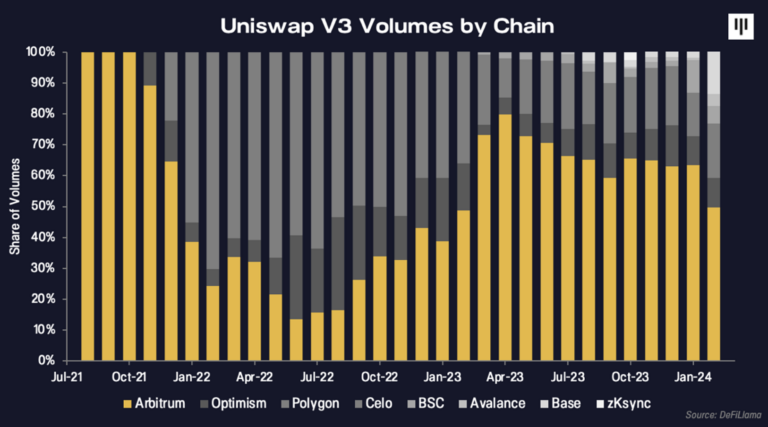
Many established teams have expanded to Arbitrum from Ethereum and other L2s, achieving greater success than on any other chain. For example, Uniswap, the market-leading decentralized exchange, now processes the majority of its L2 transaction volume on Arbitrum, despite initially being built on Optimism. Uniswap’s Arbitrum instance recently became the first L2 deployment to reach $1 billion in daily trading volume.
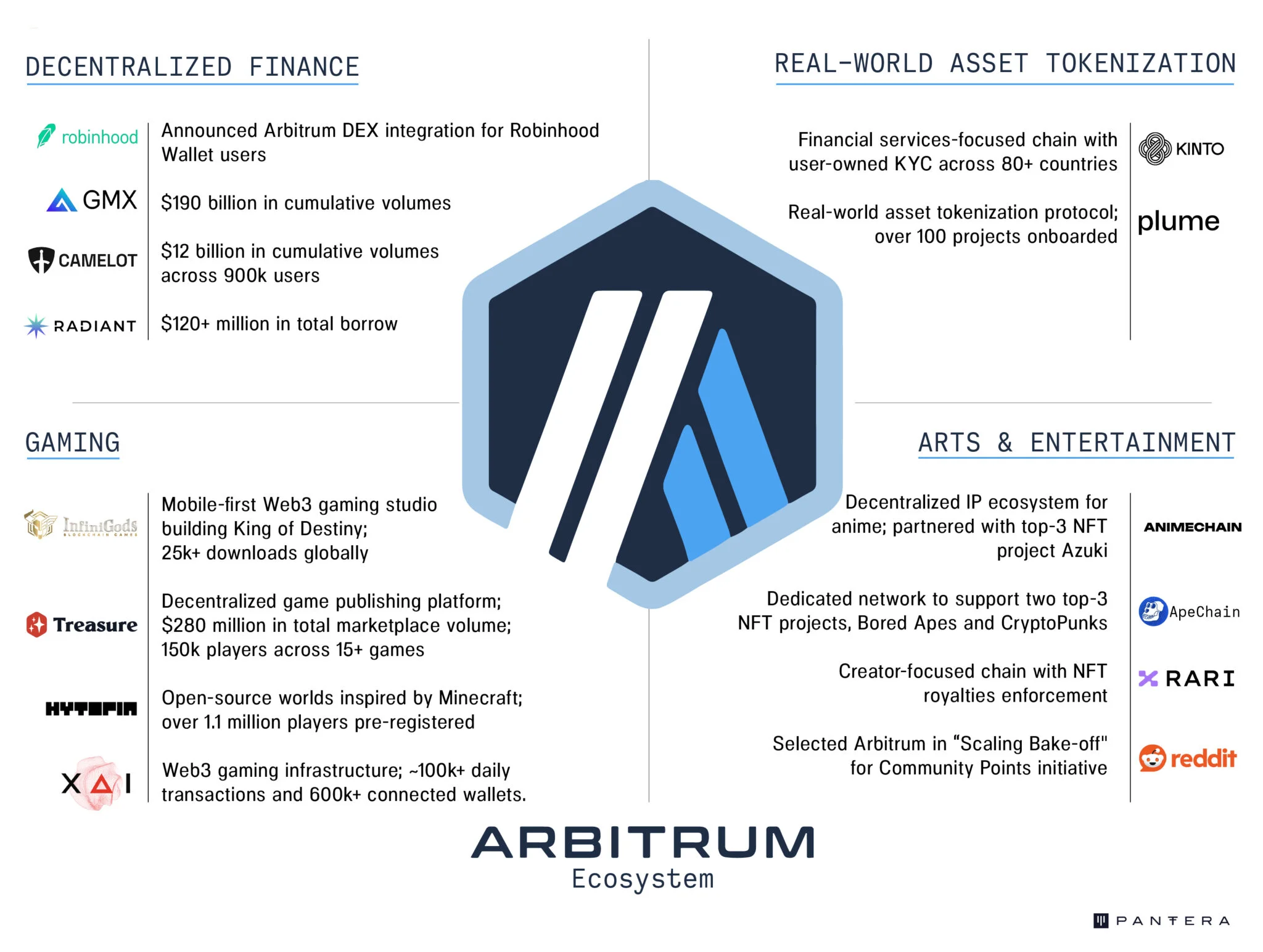
One of Arbitrum’s most outstanding qualities is its homegrown talent. From DeFi to gaming, Arbitrum-first teams have gained impressive traction across multiple verticals. Below are some leading projects within the Arbitrum ecosystem:
Decentralized Finance:
-
Robinhood: Investment platform announced integration of Arbitrum DEX for Robinhood Wallet users
-
GMX: Decentralized perpetual exchange with $190 billion in cumulative trading volume
-
Camelot: Decentralized spot exchange with $12 billion in cumulative trading volume and 900k users
-
Radiant: Cross-chain lending protocol with over $120 million in cumulative borrowings
Gaming:
-
InfiniGods: Mobile-first Web3 gaming studio developing "King of Destiny," with over 25k global downloads
-
Treasure: Decentralized game publishing platform; $280 million in marketplace volume; 150k players across 15+ games
-
Hytopia: Open-source world inspired by Minecraft; over 1.1 million pre-registered players
-
XAI: Web3 gaming infrastructure; ~100k+ daily transactions, over 600k connected wallets
Real-World Asset Tokenization:
-
Kinto: Chain focused on financial services, with KYC for users across 80+ countries
-
Plume Network: Real-world asset tokenization protocol that has onboarded over 100 projects
Art & Entertainment:
-
AnimeChain: Decentralized IP ecosystem built for anime; partnered with Azuki, one of the top three NFT projects
-
ApeChain: Dedicated network created to support two of the top three NFT projects, Bored Apes and CryptoPunks
-
RARI Chain: Creator-centric chain implementing NFT royalty enforcement
-
Reddit: Previously selected Arbitrum for its community points program during the “Scaling Bake-off”
As Arbitrum continues to attract top-tier teams and projects, we believe its ecosystem growth will accelerate further. The roadmap includes key developments aimed at expanding its developer base and attracting new builders, such as:
-
Arbitrum Stylus: A custom programming environment enabling smart contracts in Rust, C, and C++, minimizing the need for Web3 developers to learn new languages like Solidity
-
Arbitrum Bold: An improved, permissionless fraud proof technology designed to accelerate transaction processing
Arbitrum’s journey from a DeFi cornerstone to a thriving blockchain ecosystem reflects both its technical strength and the rapid growth of a high-quality community behind it.
By the Numbers
Active community engagement, top-tier developer experience, and technological breakthroughs have made Arbitrum a leading contender in the L2 space. The numbers back this up.
Let’s examine the fundamental metrics driving L2 adoption:
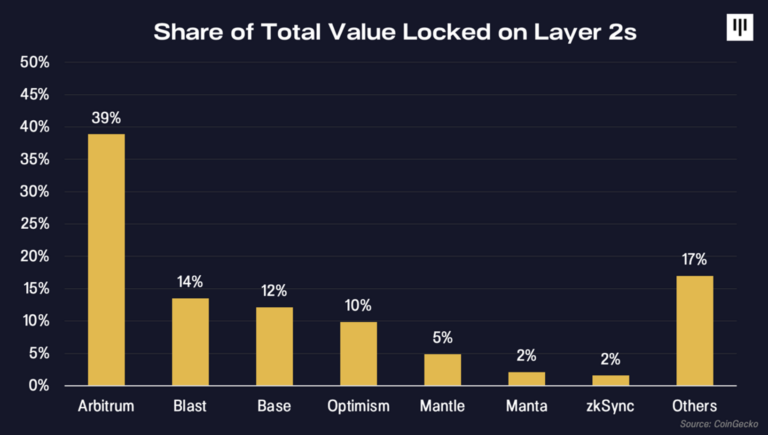
Total Value Locked (“TVL”) measures the value of assets deposited on a blockchain to support liquidity or lending activities. Among L2 rollups, 39% of TVL resides on Arbitrum. Arbitrum holds $4 billion in its DeFi protocols, compared to Blast, the nearest competitor, which has locked $1.4 billion. This metric is significant because TVL serves as an indicator of transaction activity, liquidity, and overall project health. High TVL signals strong user engagement and confidence in the platform.
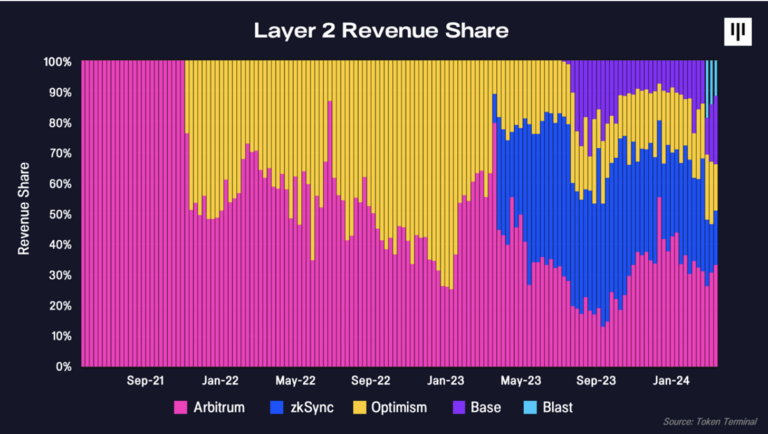
Compared to other L2 scaling solutions, Arbitrum has consistently been the largest source of revenue. Fee generation on other chains can fluctuate, especially around anticipated token airdrops (such as zkSync today), whereas Arbitrum’s organic community activity ensures predictable revenue regardless of external dynamics. Arbitrum achieves this by establishing niches like DeFi, where it has nurtured protocols such as GMX and Uniswap, allowing it to become the preferred chain for DEX swaps and perpetual trading.
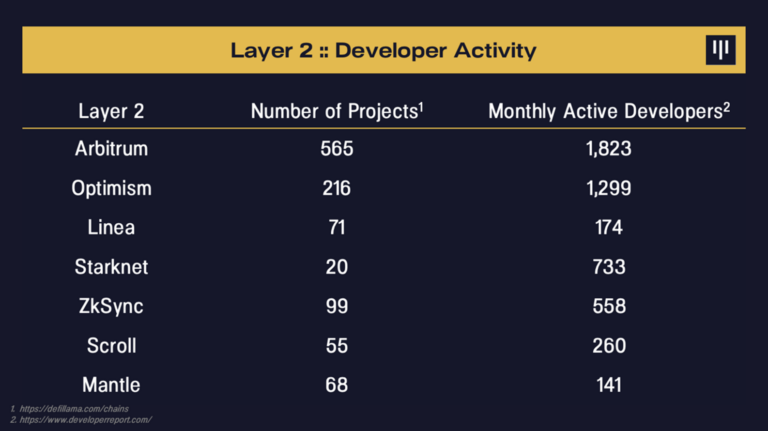
Looking ahead from its current dominance, we believe Arbitrum will continue to be Ethereum’s preferred scaling solution due to its focus on developer activity. As shown in the table above, Arbitrum has built the most attractive platform for developers seeking to deploy decentralized applications. Users ultimately gravitate toward the ecosystems with the best applications, and by doubling down on its developer community, we believe Arbitrum is securing its long-term sustainability.
We hosted a webinar with two experts in the field on blockchain scalability, whose projects are paving the way for mass blockchain adoption.
Here are some highlights from the discussion:
Steven Goldfeder, Co-founder and CEO of Offchain Labs, said: “The Arbitrum ecosystem places a strong emphasis on sustainability, which will be the factor that differentiates it from others in the long term. The system must run, must work, and must be self-sustaining. It cannot prioritize short-term growth through unsustainable mechanisms.”
Eli Ben-Sasson, Co-founder and CEO of StarkWare, said: “I prefer to call the technology we’re building an ‘integrity network’ rather than a ‘blockchain,’ because it really emphasizes that it’s a ‘network,’ like the World Wide Web. But this technology also provides integrity—meaning doing the right thing even when no one is watching.”
Join TechFlow official community to stay tuned
Telegram:https://t.me/TechFlowDaily
X (Twitter):https://x.com/TechFlowPost
X (Twitter) EN:https://x.com/BlockFlow_News
 Pantera Capital