
2023 Crypto Compensation Report: How Are Salaries, Equity, and Tokens Calculated?
TechFlow Selected TechFlow Selected
2023 Crypto Compensation Report: How Are Salaries, Equity, and Tokens Calculated?
Which positions in the crypto industry offer higher salaries? What payment methods do crypto companies at different stages prefer?
 Navigating Web3 tides with focused insights
Written by: Zackary Skelly, Chris Ahsing
Translated by: Frank, Foresight News
The cryptocurrency industry is evolving rapidly, yet comprehensive compensation data remains scarce—especially aggregated analyses. This gap can become a critical bottleneck for crypto startups aiming for strategic growth. Hence, this annual salary survey was conducted to fill that void.
In short, this report provides a more granular dataset on crypto-related compensation and aims to deliver a clear, accessible overview of compensation trends across the industry—useful for anyone setting, negotiating, or trying to understand pay, whether from hiring teams, candidates, or industry observers.
Demographic Data Collection
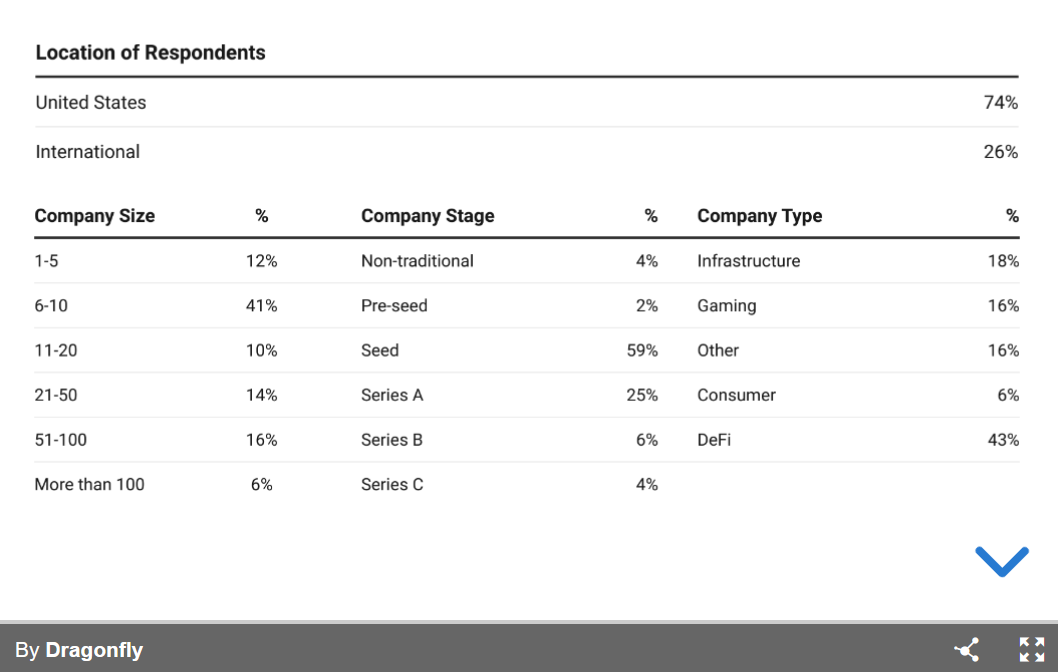
This report’s analysis is based on a 2023 survey of 49 portfolio companies, using available data to reflect overall trends. Further research with larger sample sizes will help confirm these patterns. We recommend interpreting the results in light of the respondent response rates listed below and the following points:
-
Roles: “Crypto engineering” refers to engineers focused on protocol or blockchain development; “Marketing” includes sales, marketing, and business development, with compensation reflecting total target income including commissions;
-
Reporting Method: We asked companies to select predefined salary ranges across different experience levels so we could report average minimum and maximum ranges. For founder salaries, however, we used median values derived from open-ended responses in the survey;
-
Founder Equity: Founder compensation primarily reflects percentage ownership of equity/tokens, without distinguishing between the two;
-
Definition of “International”: “International” refers to companies not based in the United States;
-
Definition of “Non-traditional”: “Non-traditional” funded companies have either conducted public token sales or are DAOs;
-
Rounding: Minor discrepancies may exist due to rounding (e.g., in demographic figures);
Salary, Equity, and Token Compensation Ranges
Below are salary, equity, and token compensation ranges for various employee roles, split between U.S. and international companies: Software Engineers, Crypto Engineers, Product Managers, Product Designers, and Marketing personnel.
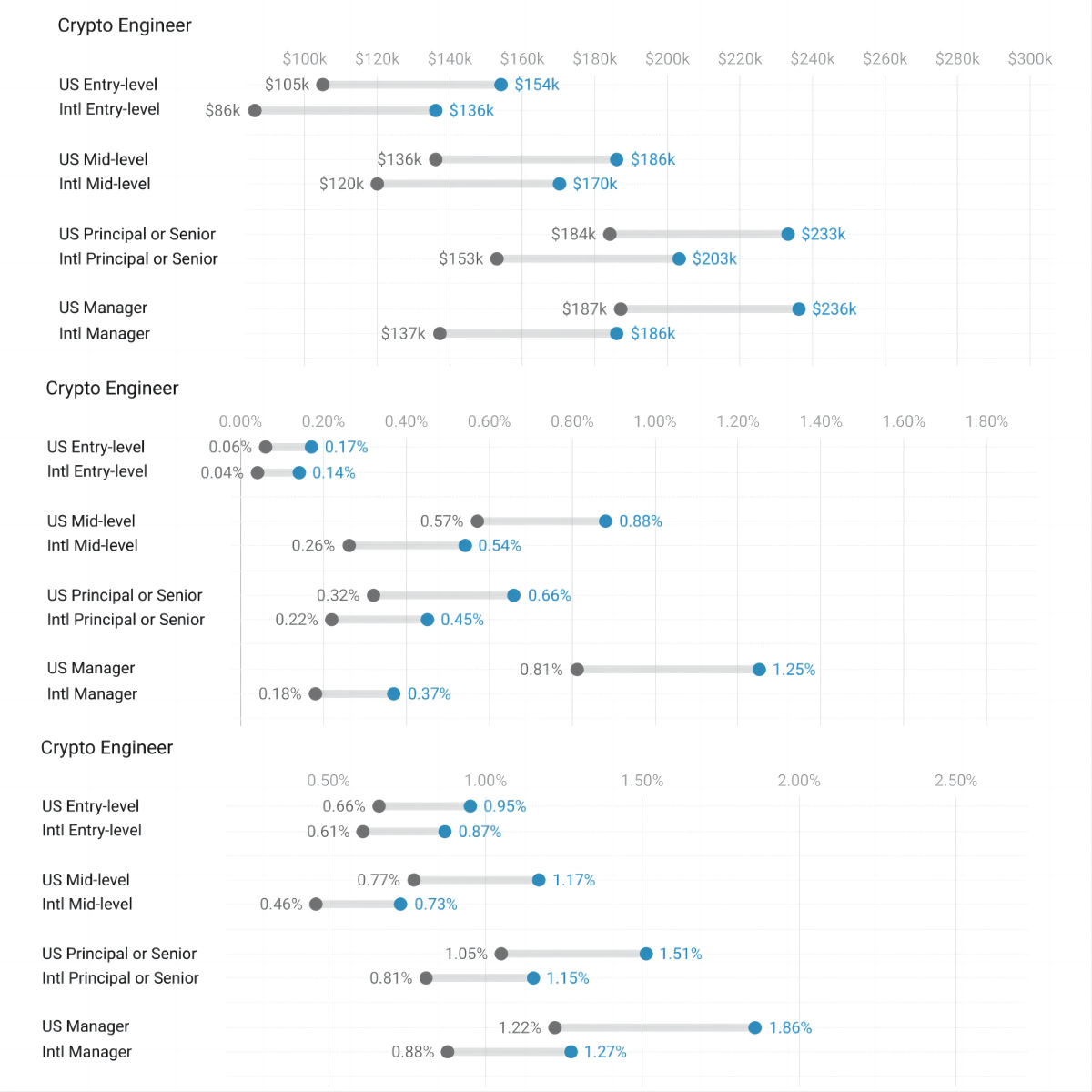
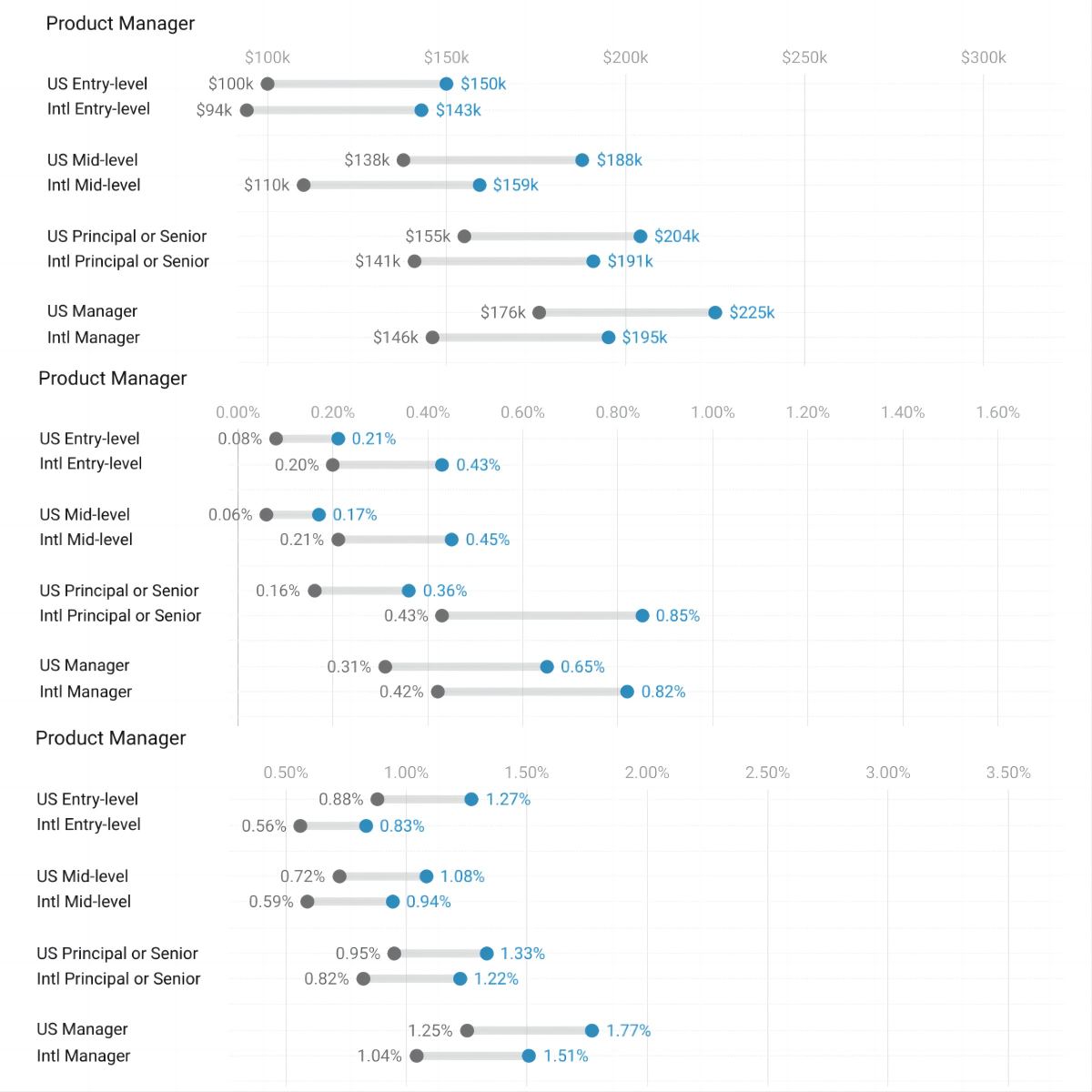
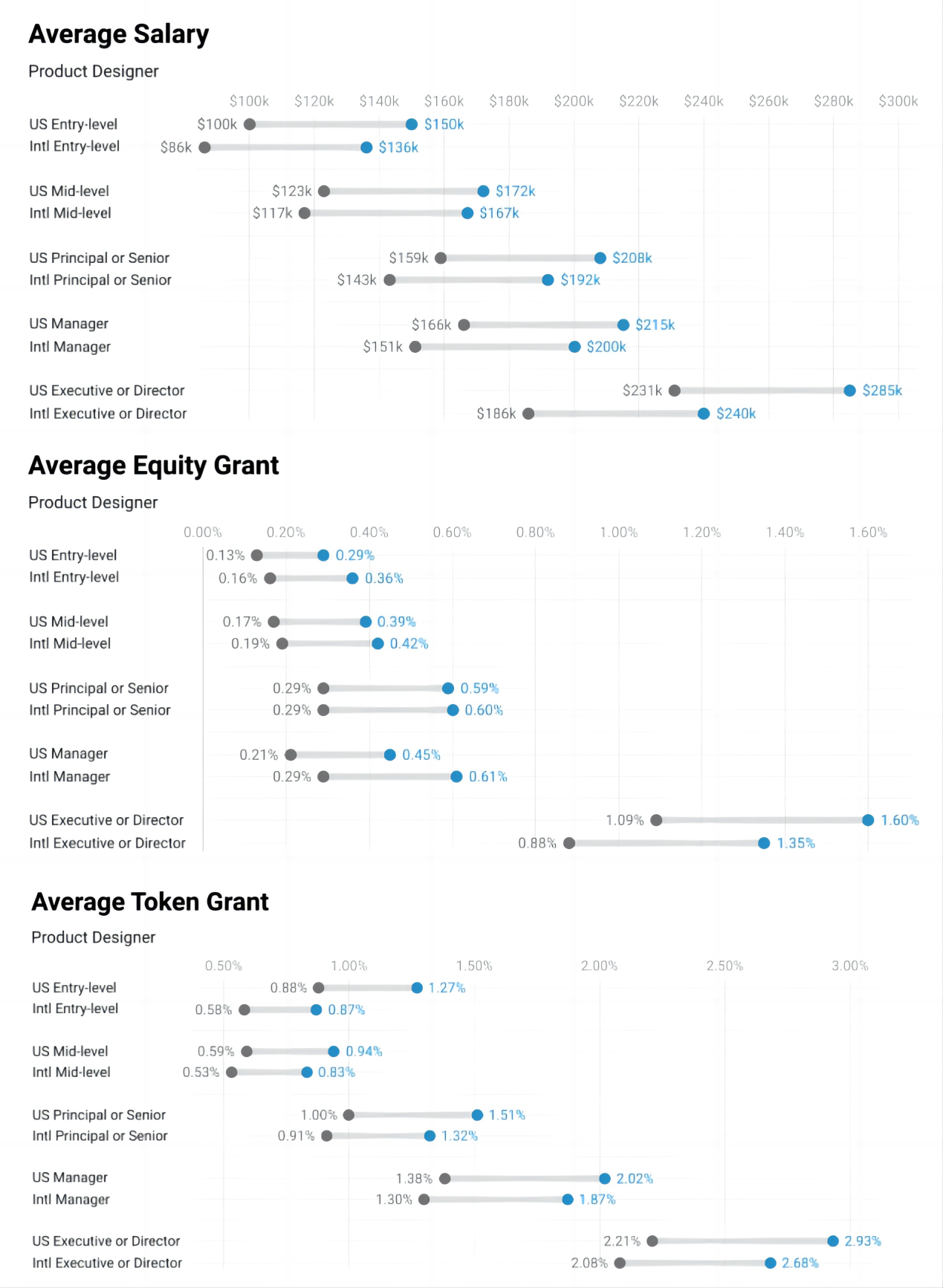
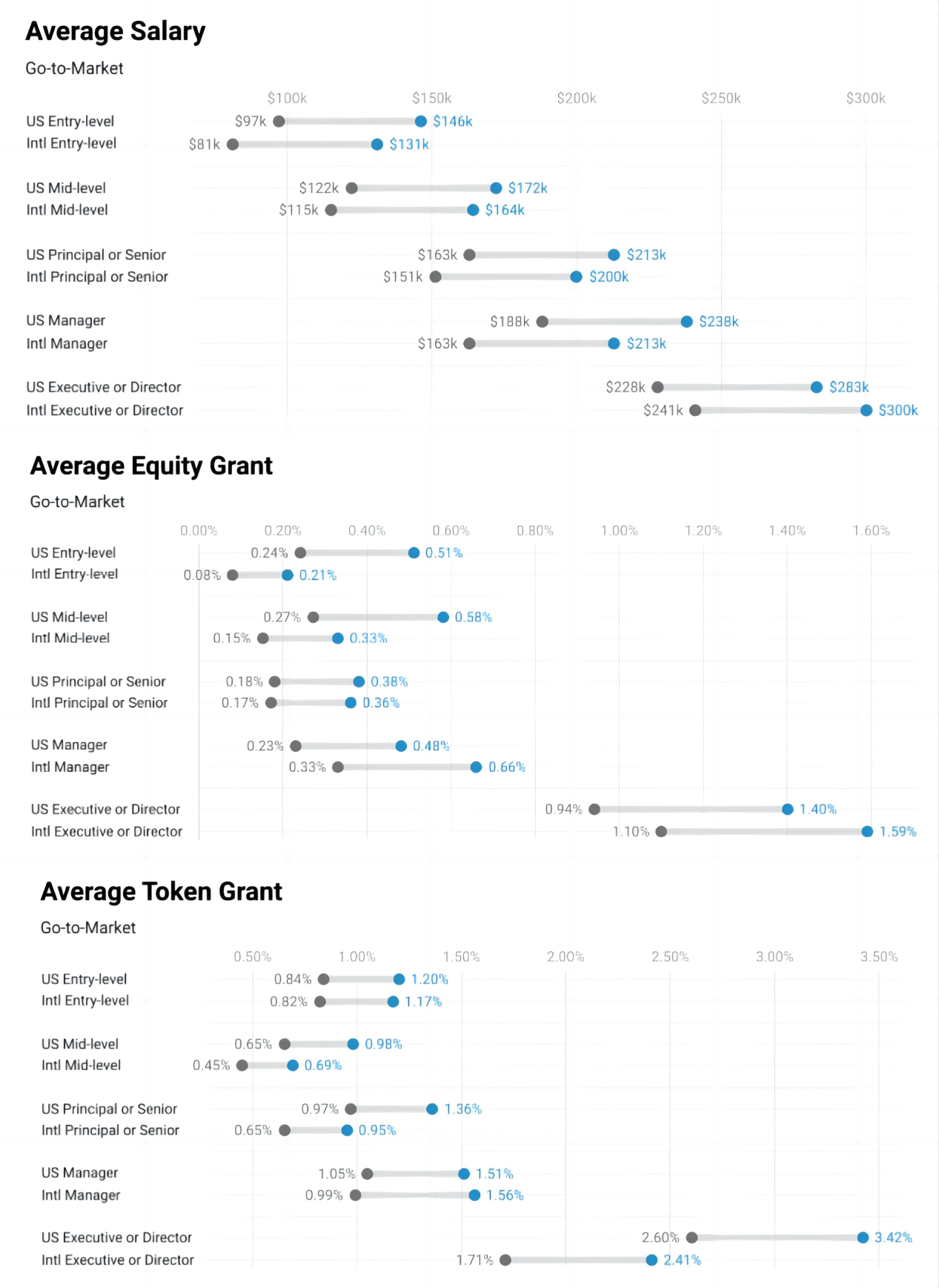
Compared to international firms, U.S. companies offer higher compensation across nearly all positions and experience levels. On average, U.S. companies provide roughly 13% higher base salaries and about 30% higher equity and token-based incentives.
Notable Data Points and Outliers:
-
International product designers receive equity and token packages closer to U.S. levels than other roles;
-
International product managers receive significantly higher equity compensation across all levels—an anomaly unique among roles;
-
Executive/director-level marketing staff at international companies earn higher salaries and equity than their U.S. counterparts;
Observations on Robustness and Reliability:
-
On Salaries: The data shows generally reliable patterns across roles and experience levels, especially useful when comparing U.S. vs. international markets;
-
On Equity and Tokens: In the U.S., equity data is relatively reliable; token compensation data may be even more robust, particularly for international data and junior-level roles;
Founder Compensation
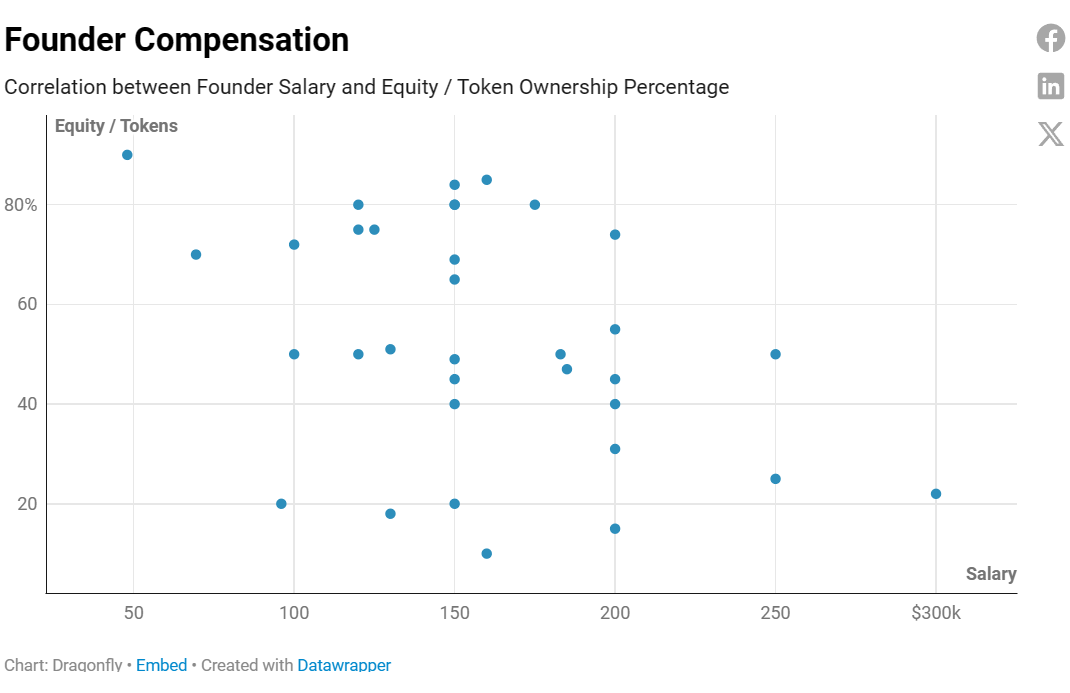
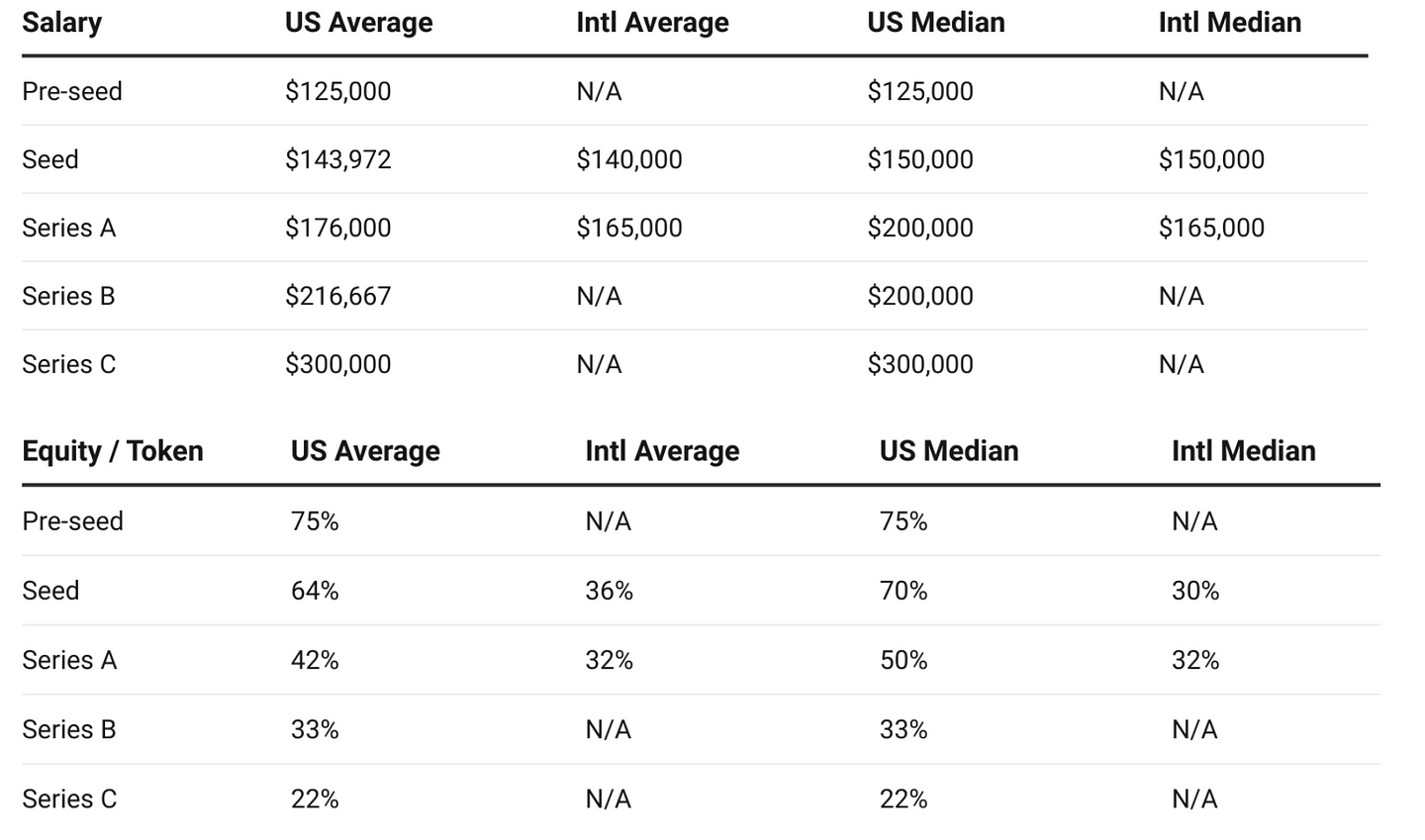
As expected, founders’ salaries increase as companies raise more funding, while their equity/token ownership percentages decrease—likely due to dilution. Most founders reported earning below-average salaries prior to Series B funding.
Due to a lack of international data at seed, Series B, and Series C stages, it's difficult to compare U.S. and international founders directly. However, interestingly, U.S. founders tend to earn slightly higher salaries during seed and Series A rounds, but hold significantly higher ownership stakes—especially at the seed stage.
Cost-of-Living Adjustments and Methodology
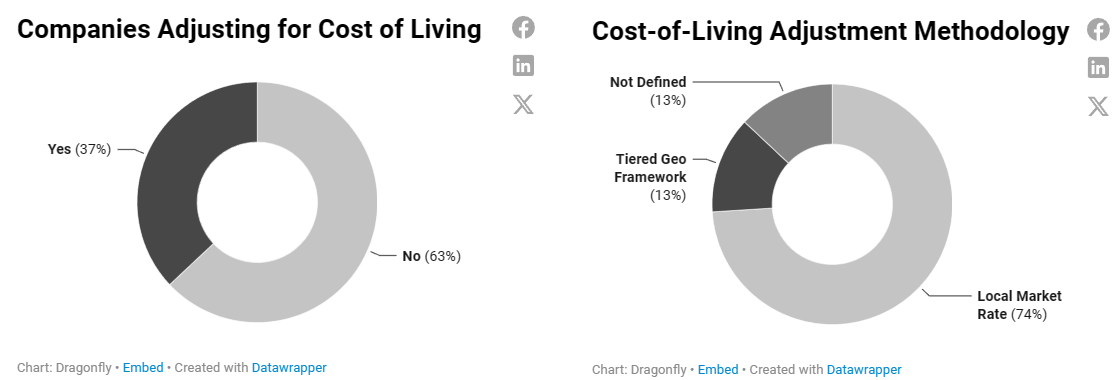
Most companies do not adjust salaries based on cost of living (COL).
Among those that do, two common approaches emerge:
-
Adjustment based on local market rates (a very popular method);
-
Or adjustment within a tiered geographic framework. With this approach, companies first establish salary benchmarks from specific locations (often highly competitive areas), then adjust offers by a certain percentage according to geographic tiers (sometimes defined by radius from major metropolitan areas). This aims to balance internal pay equity with external competitiveness across regions;
Companies that don’t adjust for cost of living typically believe compensation should strictly reflect an individual’s value to the company, regardless of location—a stance that continues to offer advantages in recruitment speed and attracting top talent. That said, we always encourage companies to consider the most sustainable way to build a high-performance team within their budget.
Teams might also choose not to adjust for COL due to fairness concerns regarding purchasing power across global regions—not everyone living in high-cost areas can relocate to cheaper ones to benefit from cost differences.
We anticipate seeing more middle-ground approaches in the future, where some companies shift from cost-of-living to labor-cost adjustments. To clarify:
-
Cost of Living: “We’ll adjust your pay based on local market rates in your region”;
-
Labor Cost: “We’ll adjust your pay based on demand for your role in your region”;
For example, remote parts of Texas may have low living costs, but if there’s high demand for petroleum engineers, salaries for those roles rise accordingly.
Currently, there isn't enough industry data to easily adopt labor-cost adjustments—especially in crypto, such as city- or country-specific demand for protocol engineers. However, many compensation experts and data providers are considering this model, and we believe teams can benchmark and adjust for more standardized/general roles.
Access to real-time salary and hiring demand data is key. Supplementing market-available data with compensation insights gathered from candidates could prove helpful. We may explore related trends in our next salary survey, though few teams currently use this method.
Ultimately, recruitment strategies may vary by role: for undifferentiated engineering roles (e.g., general frontend engineers), you’d likely pay adjusted compensation; but for globally competitive, differentiated roles (e.g., Solidity engineers), you may need to pay strictly based on the value they deliver.
At its core, this comes back to the classic hiring trade-off we often discuss: speed, cost, and quality. At any given time, you can likely optimize only two of these three factors.
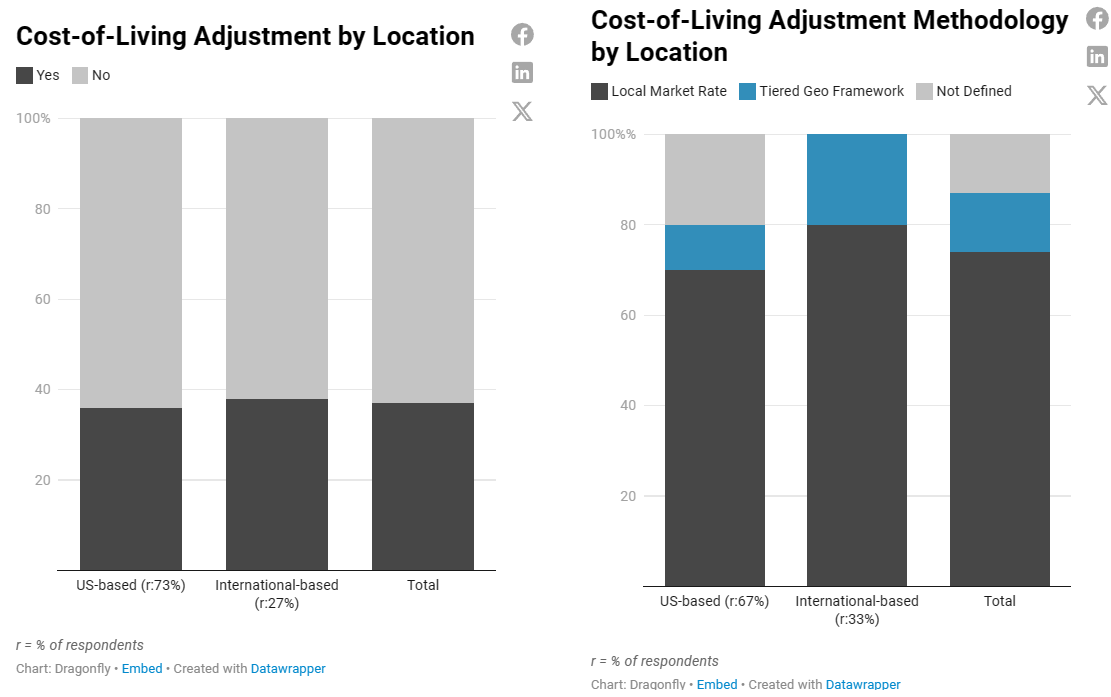
Both U.S. and international companies show similar proportions adjusting for COL, though international firms slightly favor local market rate adjustments.
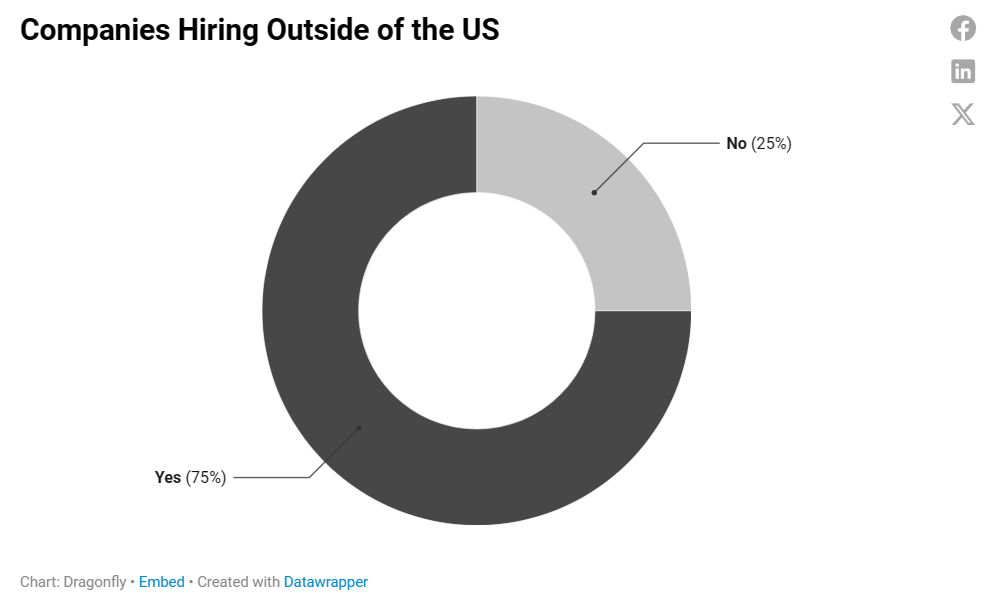
Across all surveyed companies—regardless of size, stage, or funding—75% hire talent outside the U.S.
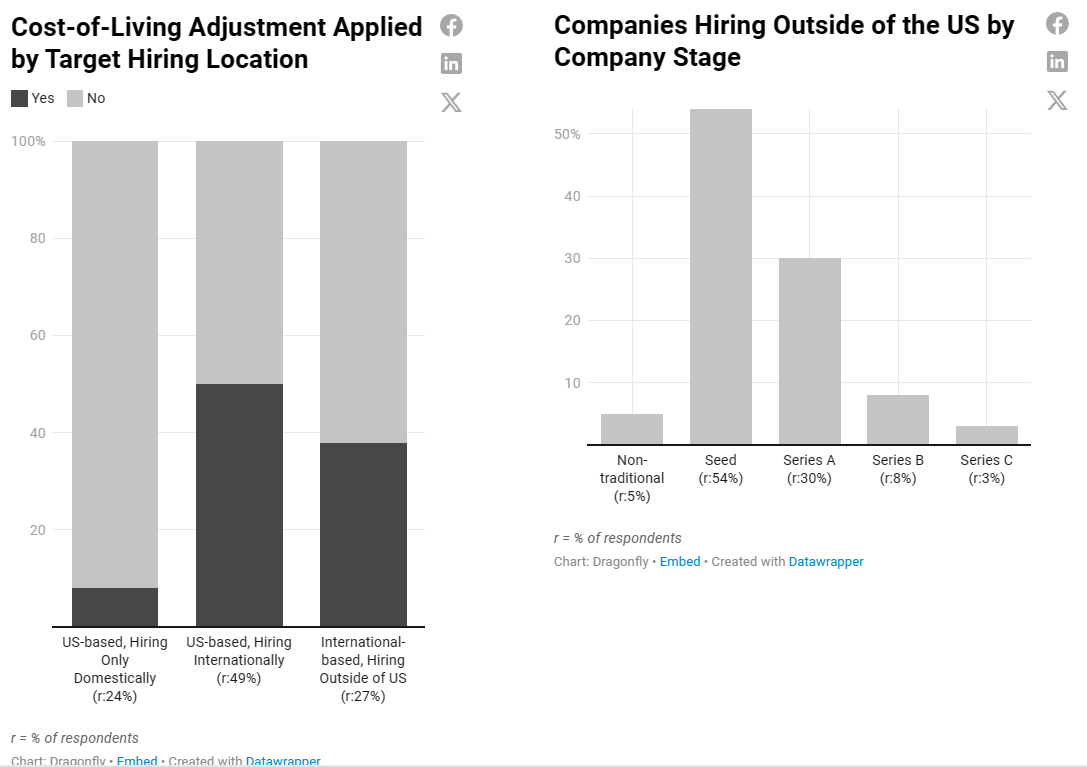
U.S.-only hiring U.S. companies are less likely to adjust for COL—possibly indicating both the competitiveness of the U.S. hiring market and relative stability in U.S. cost of living compared to international locations. U.S. companies hiring internationally are split evenly between adjusting and not adjusting.
All international companies hire outside the U.S., and most do not adjust for cost of living.
Companies tend to reduce international hiring in later funding stages. It’s worth noting, however, that most respondents in this analysis were based in the U.S.
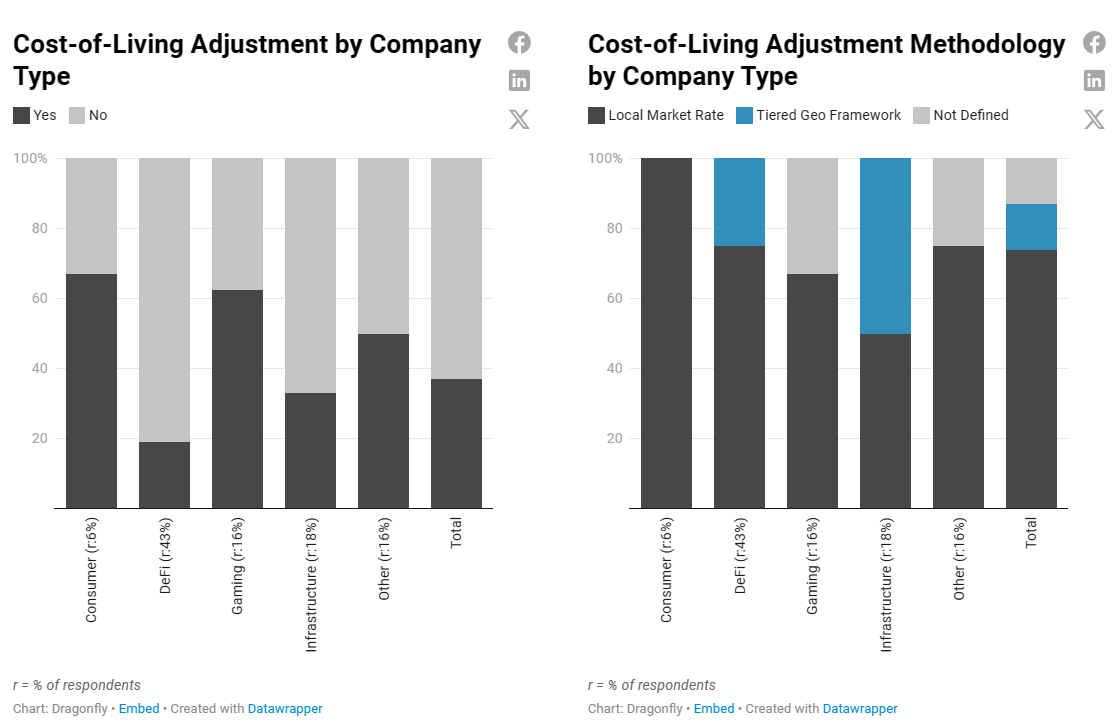
While most companies use local market rates for adjustments, infrastructure firms (all of which hire internationally and are among the largest, best-resourced in the survey) are most likely to employ more sophisticated tiered geographic models.
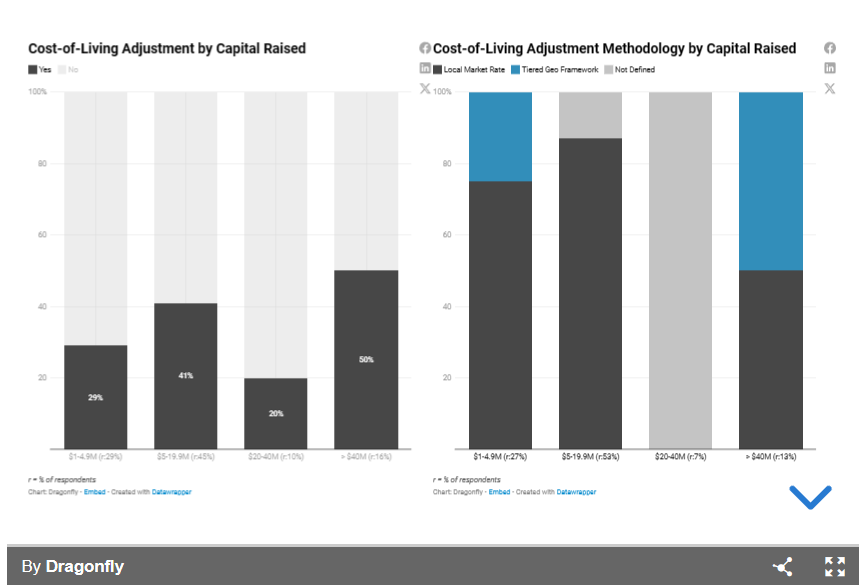
There’s a clear trend: most companies don’t adjust for COL in early stages, but the likelihood increases as they mature.
Seed and Pre-seed companies with 1–10 employees are less likely to adjust for COL, allowing them to remain competitive in hiring, since building a strong core team at this stage profoundly impacts the company’s entire lifecycle.
Additionally, they may lack operational expertise or resources to implement complex compensation structures and budgeting strategies, and may not hire across many locations.
From a size perspective, the tendency to adjust for COL increases notably over time.
At nearly every company size, stage, and funding level, paying local market rates is preferred, highlighting its appeal as a fair and competitive COL adjustment method (and also the simplest beyond temporary "undefined" setups).
Note: Once a COL adjustment policy is set, reversing it fairly is extremely difficult and risks damaging morale, perceived fairness, and employer brand.
Payment Methods (Fiat vs. Cryptocurrency)
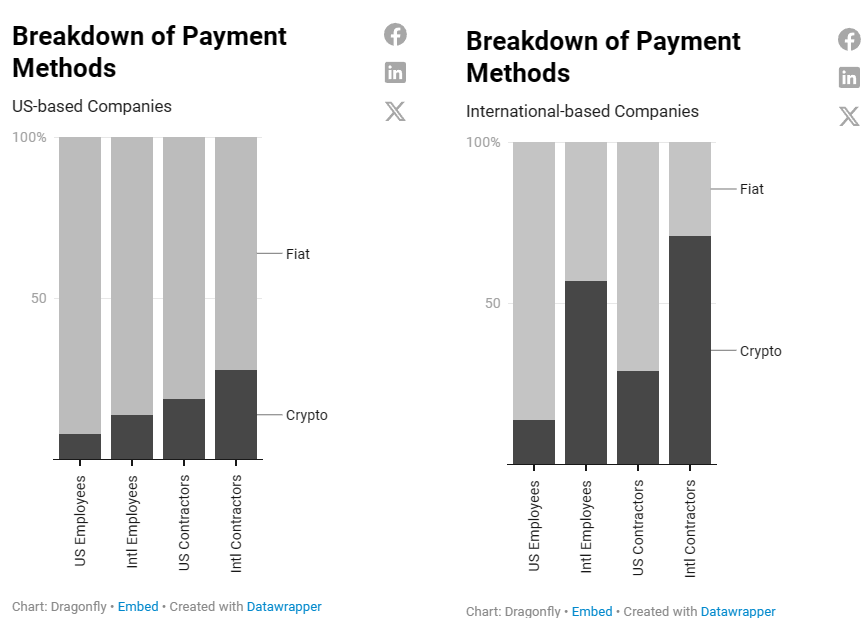
In most cases, companies pay salaries in fiat currency.
When it comes to paying in cryptocurrency (e.g., USDC), international companies lead the way—especially when compensating international employees. Regardless of location, U.S. companies are more likely to pay contractors in crypto rather than employees; they also prefer using crypto to pay international employees, whether contractors or full-time staff.
Internationally, crypto payments are often used to simplify cross-border transactions, mitigate exchange rate volatility, and/or leverage tax advantages in certain jurisdictions. Crypto is also valuable for teams operating in regions with limited banking infrastructure or for companies requiring privacy (e.g., those with anonymous contributors).
As crypto regulations and legal distinctions between employees and contractors evolve, global payroll providers (e.g., Liquifi) are streamlining adoption by embedding compliance features and natively supporting crypto transactions. Over time, we wouldn’t be surprised if this begins to influence broader practices.
Likelihood of Having a Token
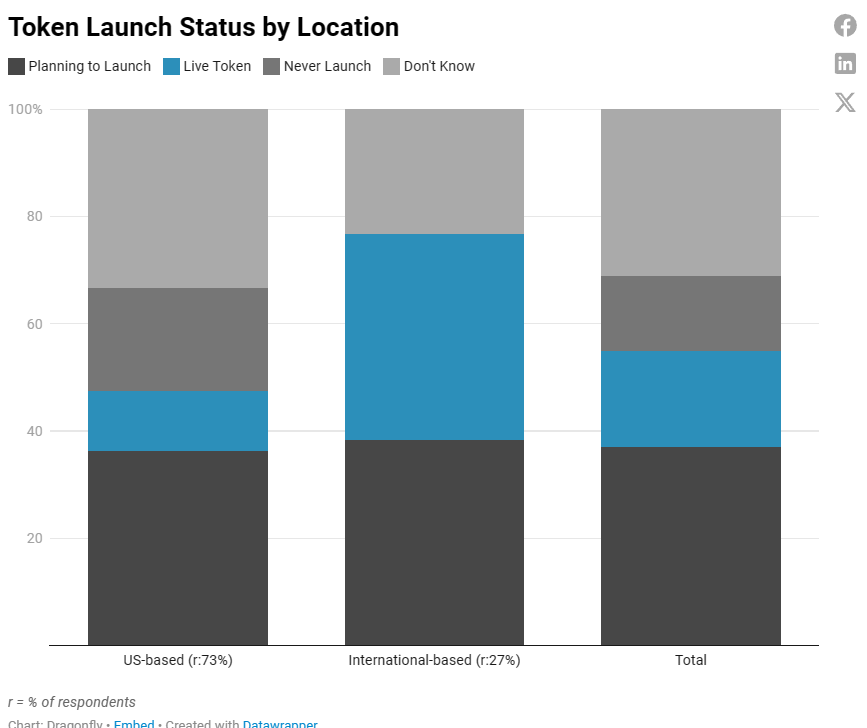
Companies in our portfolio strongly consider launching tokens—only 14% explicitly stated they would never issue one.
International companies are more inclined toward tokens, with a higher proportion already having or planning to launch one. While some remain uncertain about future plans, none completely rule it out.
U.S. companies, possibly due to regulatory considerations, show more varied responses—fewer actually have tokens, more teams are hesitant, and more opt out entirely.
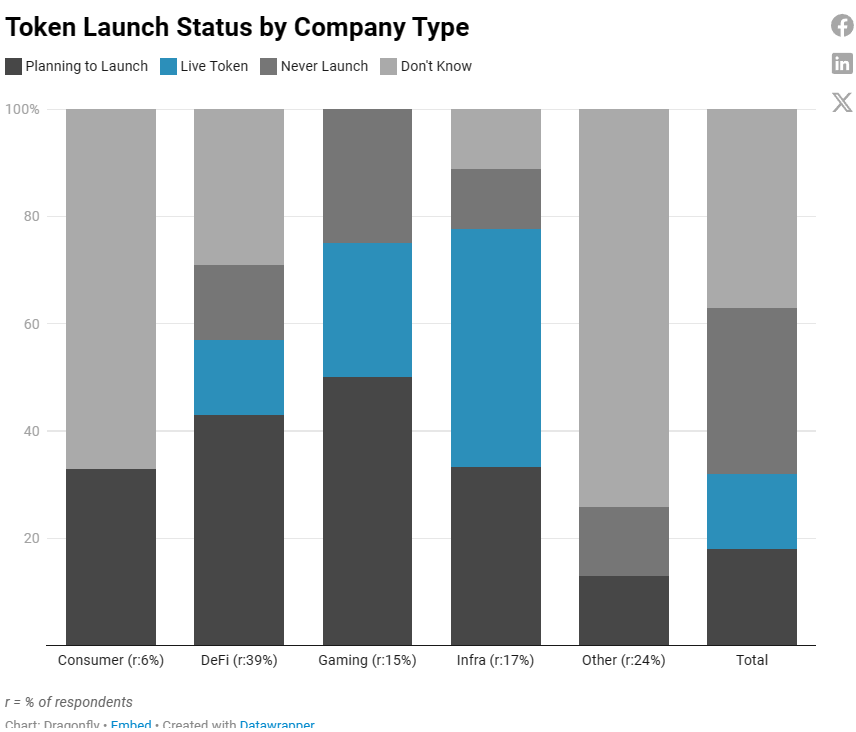
Overall, infrastructure companies lead in token adoption, with over three-quarters either already using a token or planning to launch one. These firms may use tokens as base currencies (especially L1 and L2 blockchains).
Close behind are gaming companies, underscoring the growing importance of tokens in-game assets, currencies, rewards, incentives, gated content (special access unlocked via tokens), and occasionally governance. DeFi is also prominent, where tokens are integral to governance, staking, and reward-based business models.
Consumer-focused companies show initial interest, often integrating tokens into more traditional business models, while the “Other” category shows significant uncertainty.
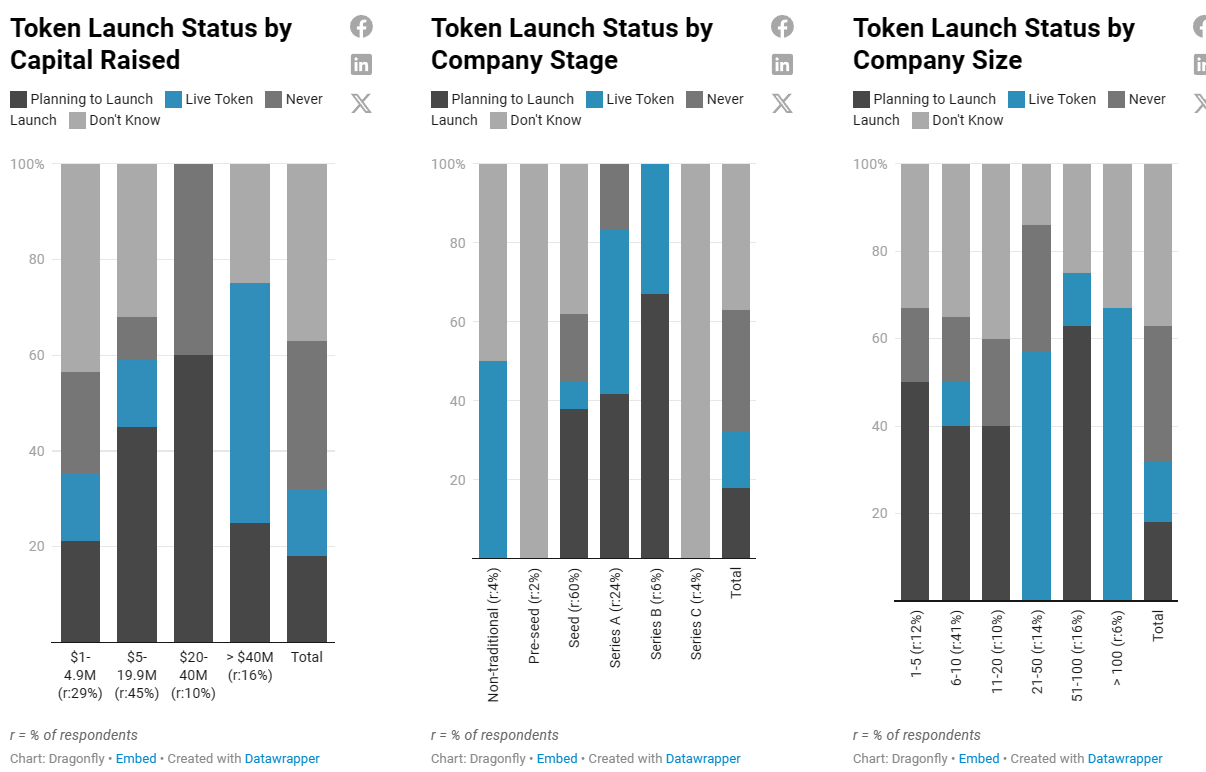
While overall data suggests companies become more likely to plan and launch tokens as funding, stage, and scale increase, these factors don’t form a simple narrative.
Small startups, especially at the seed stage with funding between $1M and $4.9M, show strong interest in exploring tokenization—but few actually launch tokens this early. As headcount grows and further funding closes, the trend rises sharply—particularly evident at Series A and B stages.
Companies raising $20M–$40M are an exception—they actively plan to launch tokens, yet none have done so. These fall within seed, Series A, and Series B stages.
For the largest companies—over $40M raised and more than 100 employees—the proportion engaging in token activities is significantly higher. An interesting counterpoint is the hesitation among Series C firms; they may be reevaluating how tokens fit into an already mature product or considering token use in new projects/joint ventures.
Relatedly, 75% of all companies raising over $40M (the highest bracket in the report) focus on infrastructure development—a capital-intensive field that frequently integrates tokens into products.
Token / Equity Compensation Plans
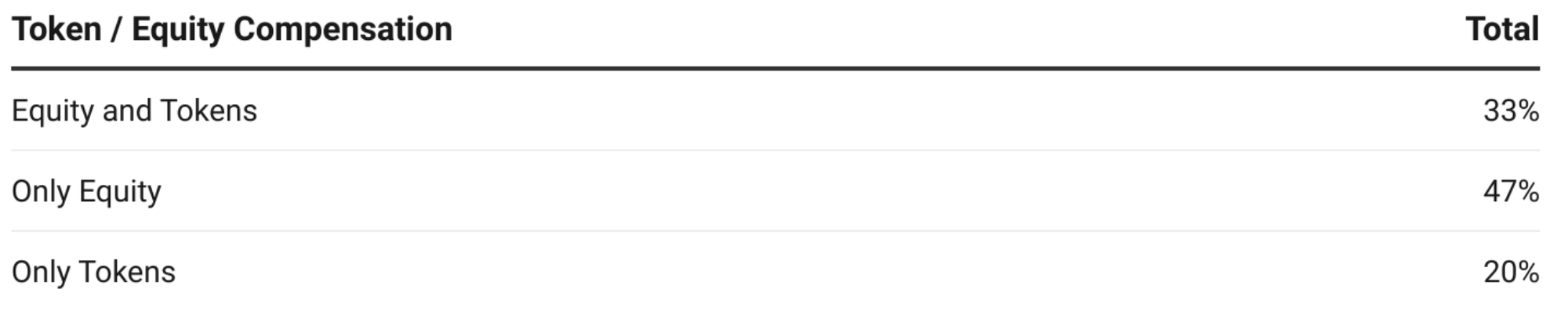
Companies typically offer compensation through salary plus equity, tokens, or a combination. When structuring pay or evaluating offers, it’s crucial for founders and candidates alike to understand how value is created—and whether that value resides in tokens or equity.
Nearly half of companies currently grant only equity. Note, however, that most companies expressing potential future token issuance (but unsure) currently offer only equity, while all projects with active tokens include tokens in compensation. Consider that undecided companies may eventually change their minds.
We’ve seen other reports suggest fewer companies offer tokens over time—we’re curious how our own accumulated data will unfold.
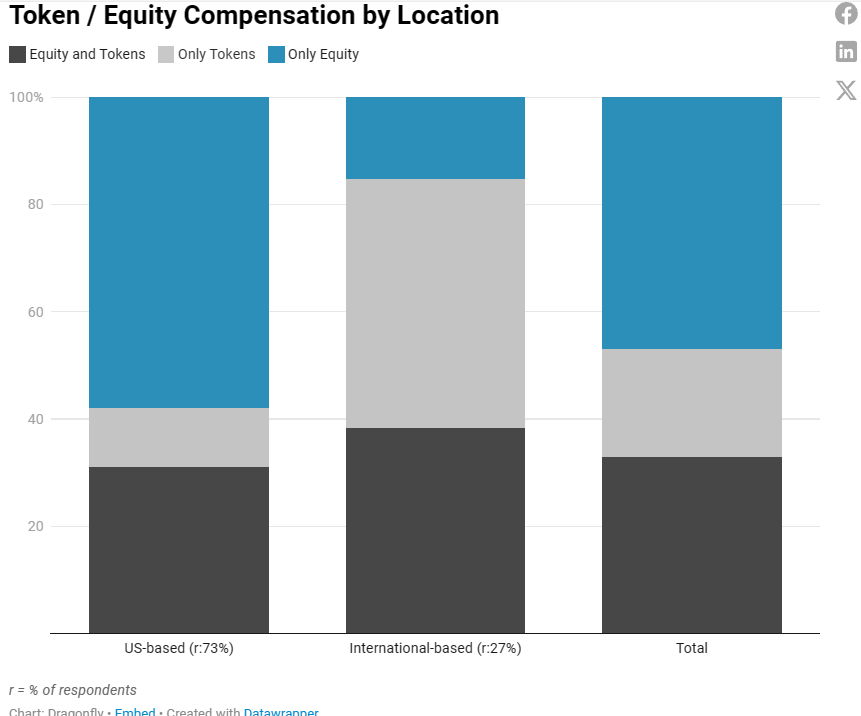
Both U.S. and international companies include some offering combined equity and token compensation. Beyond that, preferences differ: more U.S. companies offer equity-only, while more international companies offer token-only (as previously noted, international firms overall appear more token-friendly).
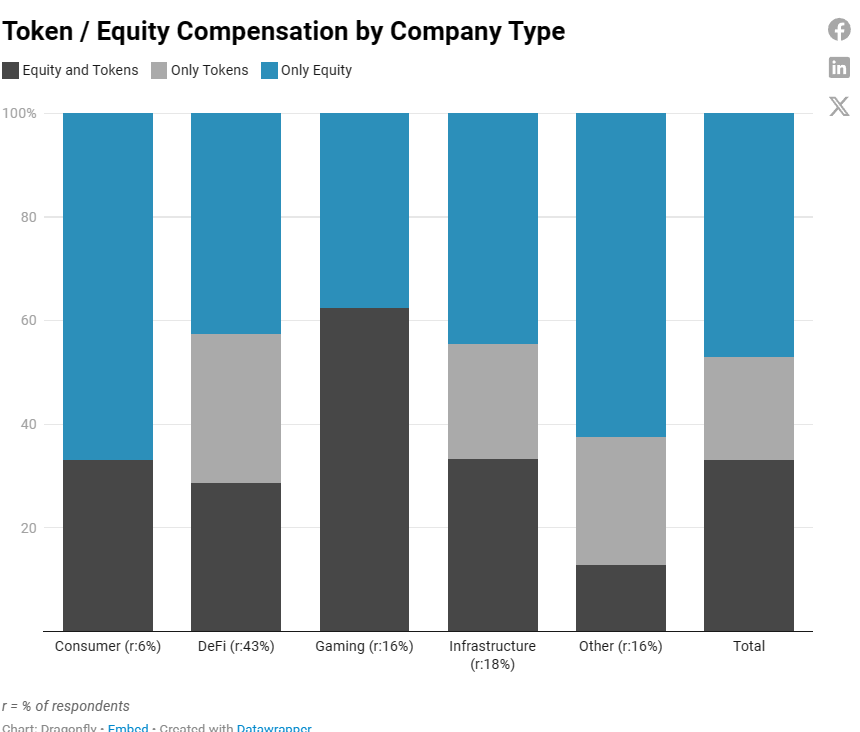
Despite being most likely to have or plan tokens, most infrastructure firms grant only equity—not token-only or mixed.
DeFi (another token-prevalent sector) follows a similar pattern, though compensation methods are slightly more balanced. Gaming companies strongly prefer offering both equity and tokens, notably, no gaming company offers tokens-only.
All consumer and “other” type companies either don’t know whether they’ll launch a token or ultimately decide against it—hence, it’s understandable that the vast majority offer equity-only.
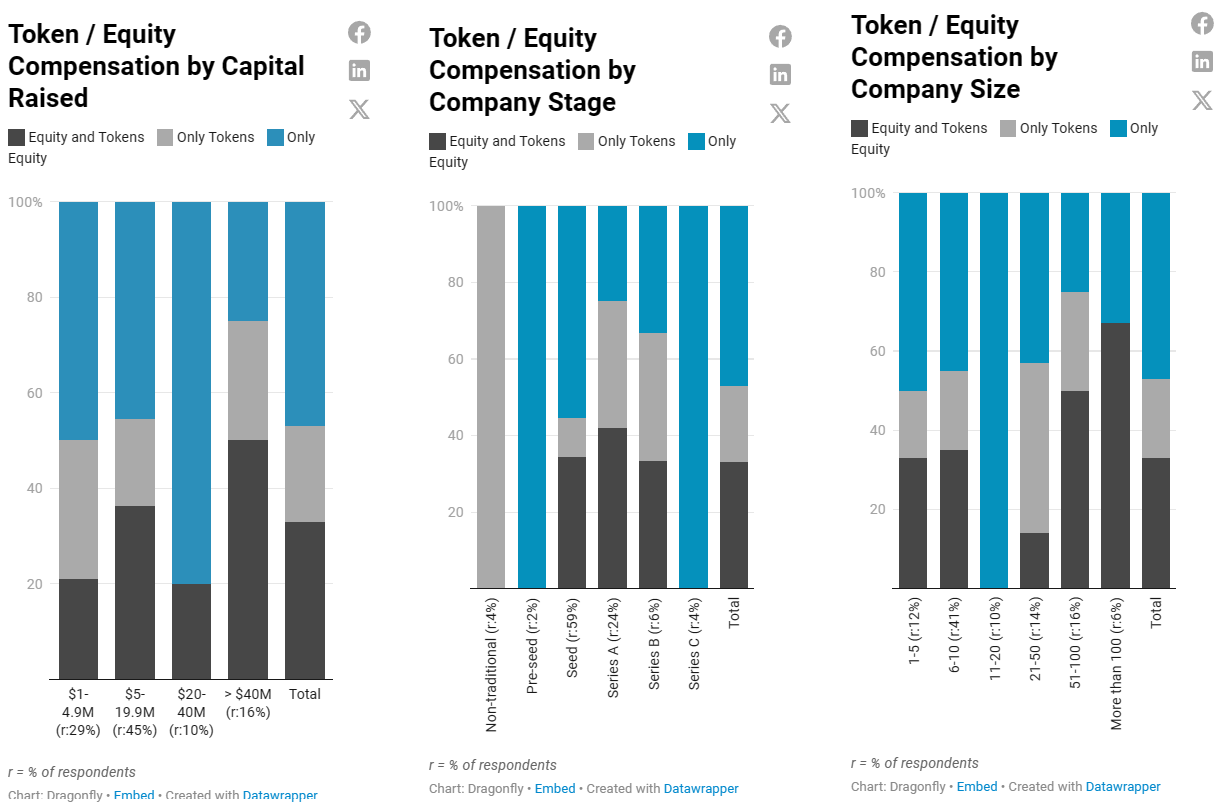
Examining funding amount, company stage, and size, we observe:
First, earliest-stage startups primarily use equity incentives; as they secure meaningful seed funding, their compensation strategies diversify.
At the Pre-Seed stage, all surveyed companies offer equity-only (as noted earlier, all Pre-Seed firms were uncertain about launching a token). A few raising $1M–$4.9M in seed funding begin offering token incentives, but overall still lean heavily on equity.
Those raising $5M–$19.9M are typically still in the seed stage with over 10 employees. Overall, more companies begin offering token incentives and increasingly adopt hybrid equity+token models.
Second, as headcount grows, companies are generally more inclined to offer both equity and token incentives.
Relationship Between Tokens and Equity

Most companies distribute tokens proportionally to equity (which may indicate use of the “token ratio” calculation method introduced below).
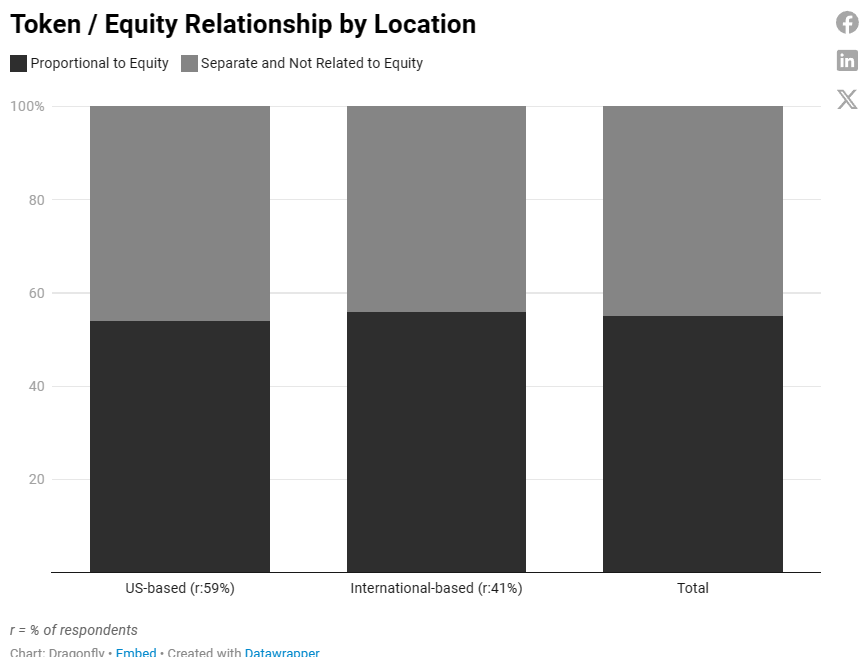
U.S. and international companies show balanced distributions in token-to-equity relationships, with a slight preference for proportional allocation.
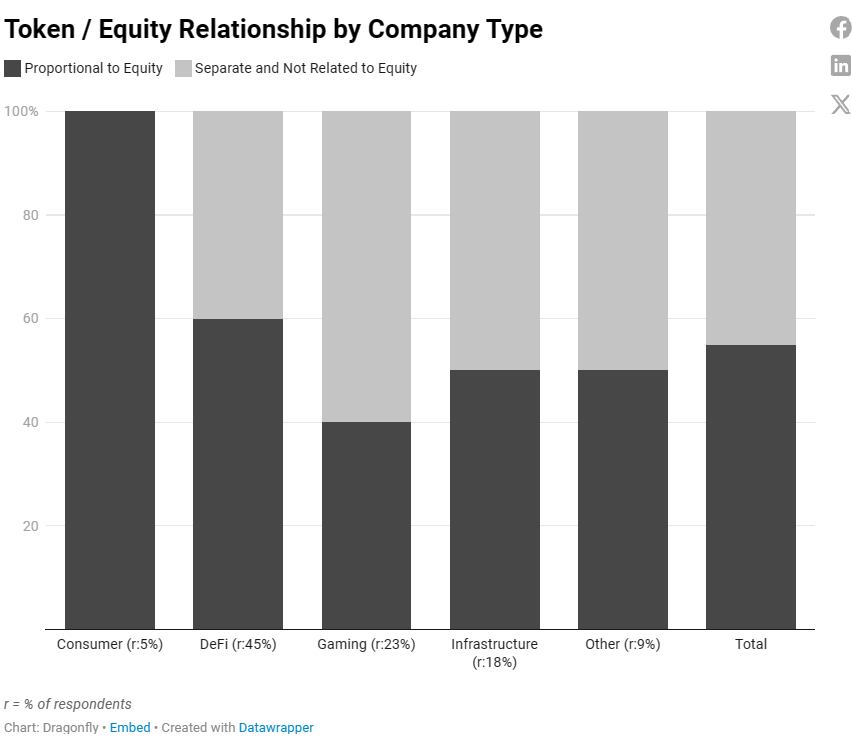
Preference for proportionality remains relatively balanced across company types, with equal shares among infrastructure and “Other” categories.
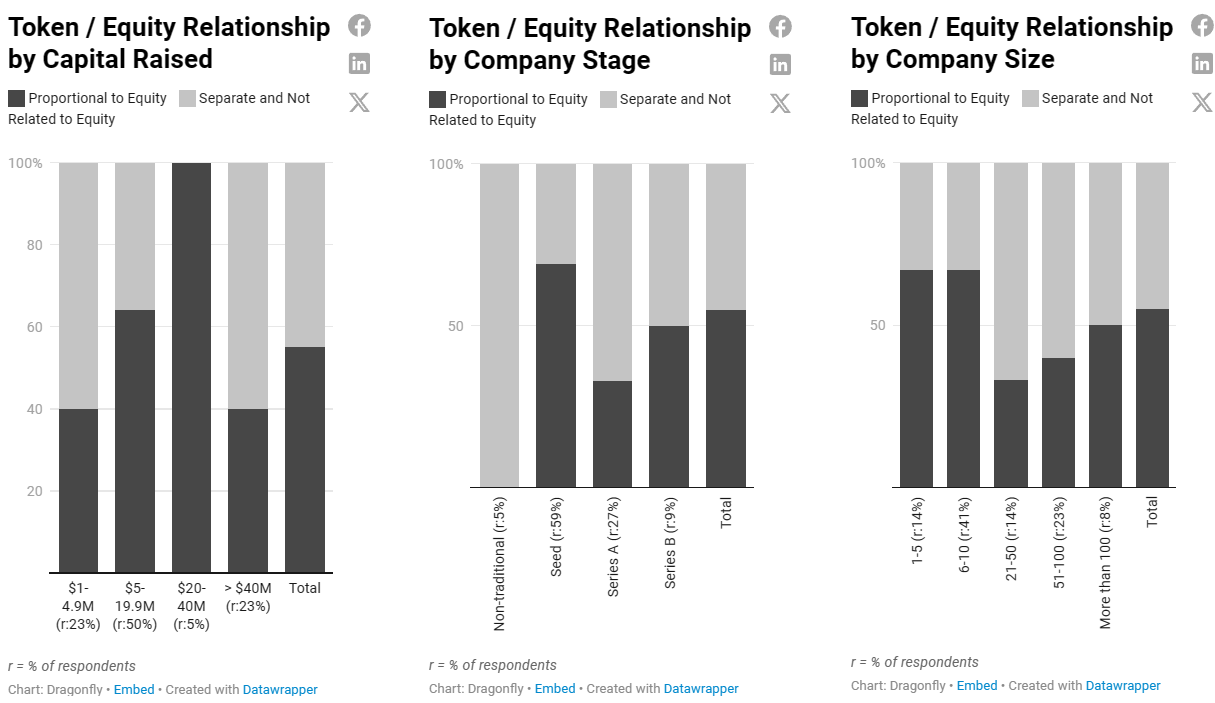
Smaller, early-stage teams (seed-funded, 1–10 employees) lean toward proportional equity-token distribution (though this trend isn’t consistent across all early-stage funding bands).
As companies grow, preference for proportionality softens, with no dominant strategy emerging clearly.
Token Calculation Methods
In a previous article, we explored and outlined methods companies use to calculate token grants for employees. This report doesn’t aim to exhaustively cover best practices or all possible methods.
That said, the most common and well-defined approaches we see are:
-
Market Value-Based: Teams with active tokens use this method to first determine the intended dollar value of the employee’s total compensation package, then calculate the number of tokens based on the fair market value at calculation, grant, or vesting time. In the referenced article, we observed most teams prefer this method due to its simplicity. However, we advise caution—token grant value can fluctuate significantly due to market volatility, leading to inconsistencies in token cap tables. In this sense, tokens resemble public stock but lack equivalent protections and stability. For teams without active tokens, this valuation method is uncommon. Typically, we see reliance on verbal agreements promising future tokens based on equity share ratios. Another approach involves calculating market value based on the fully diluted value of future tokens locked in for VCs. Since VC token prices are fixed, this offers a fair basis for compensation before public listing (interestingly, we haven’t heard of any company doing this yet);
-
Token Ratio: This method attempts to mirror how traditional startups calculate equity-based rewards. It’s the only approach that accounts for market volatility, reduces inequities in employee pay, minimizes unnecessary token dilution, and preserves asymmetric upside for employees. Effectively using the token ratio method requires careful planning and ideally starts early. In short, you apply the same allocation bands used for equity, adjusted for token specifics, ultimately granting a fixed percentage of the token pool;
“Other” methods may include annual grants, performance-based bonus structures, sliding scales between equity and tokens, or undefined approaches.
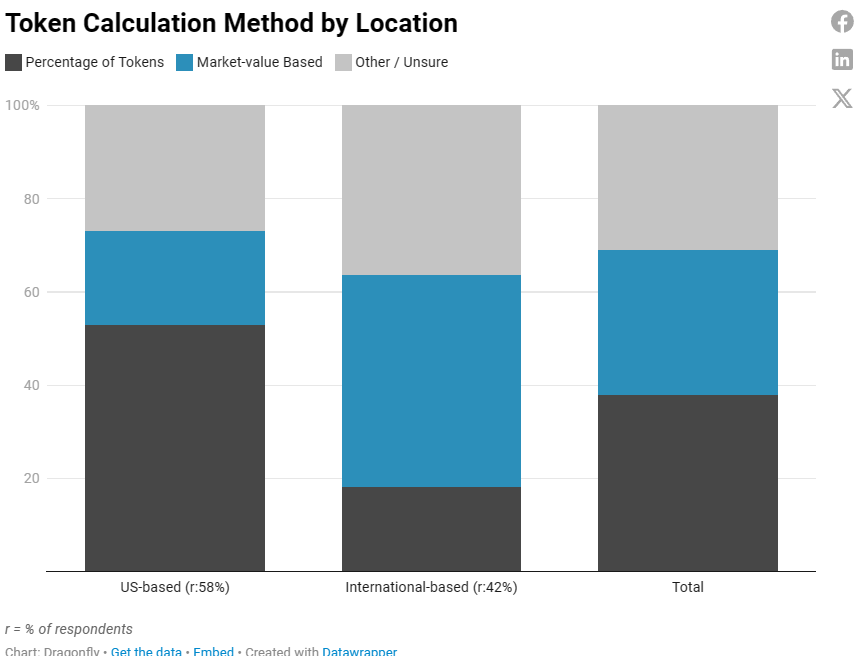
In summary, most companies use the “token ratio” method.
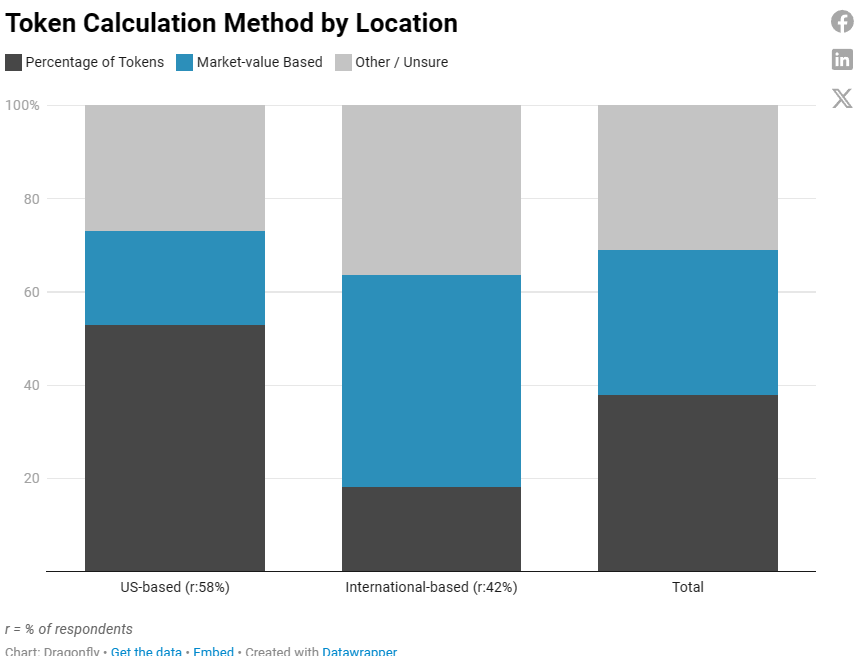
Clear regional differences exist: U.S. teams are more inclined to use the “token ratio” method.
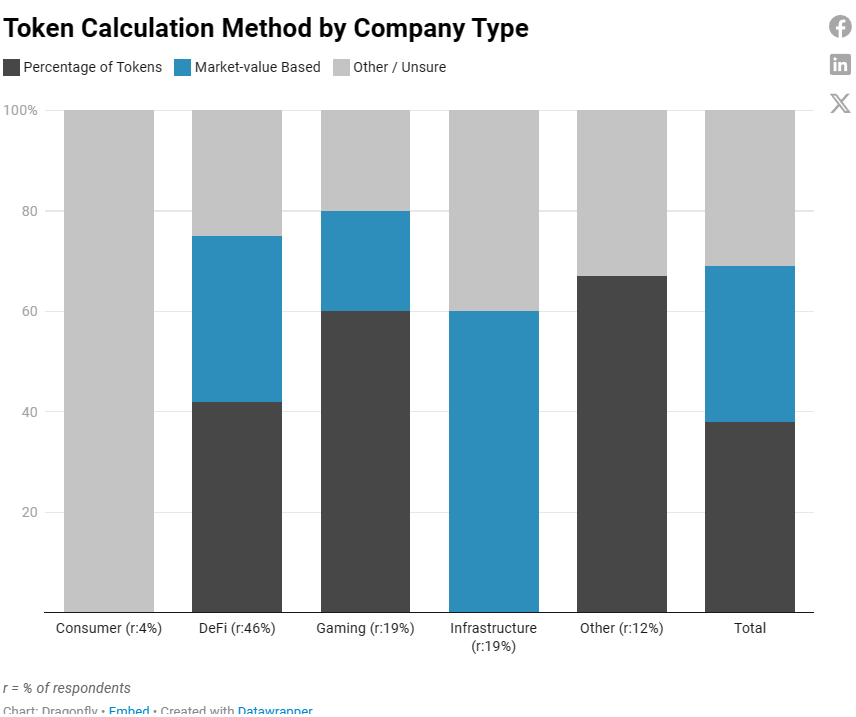
Industry preferences also differ: gaming and “other” companies favor the “token ratio” method, while infrastructure firms lean toward market-value-based approaches.
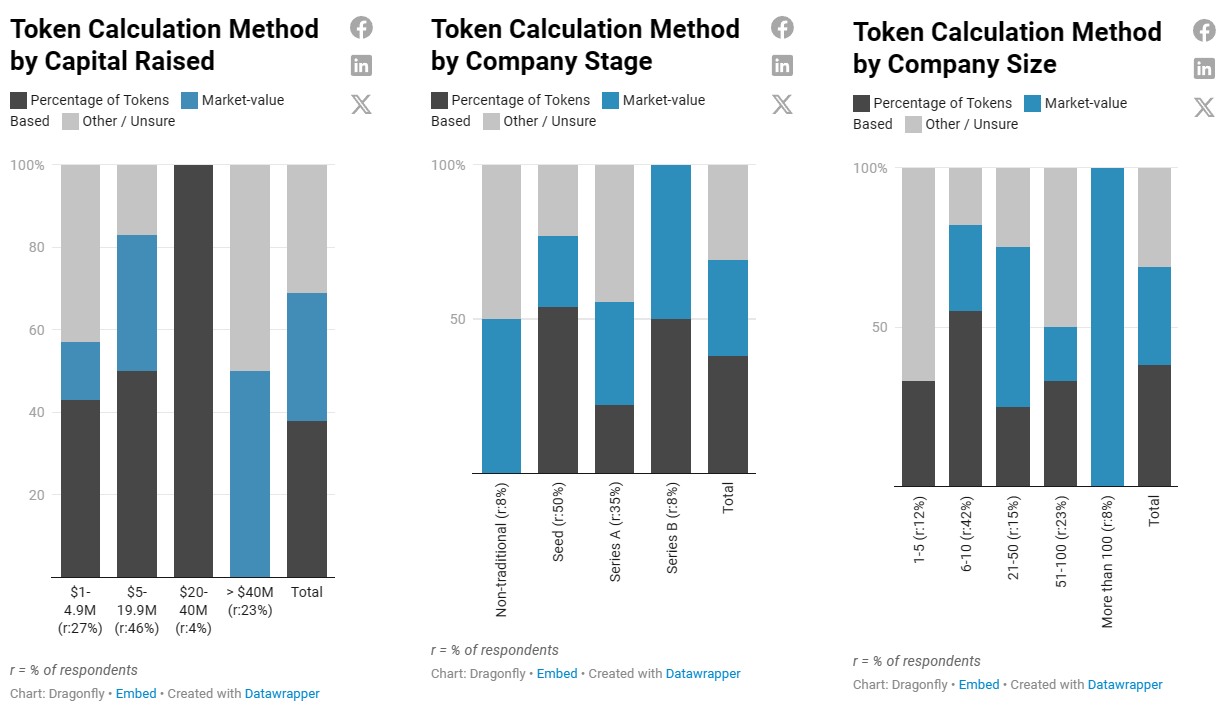
As funding size and total capital raised increase, more companies adopt market-value-based methods.
Seed-funded companies and those raising up to $40M primarily use the “token ratio” method. Market-value calculations gain favor starting at Series A, especially among companies with 21–50 employees, and become more widespread at Series B and in firms with over 100 employees. Notably, companies raising over $40M tend to balance market-value methods with other, less-defined approaches.
We recommend early-stage teams use the “token ratio” method. While we intuitively understand why later-stage teams prefer market-value approaches (e.g., once token price is established, speculation decreases, and more data like time-weighted or volume-weighted averages become available; or it allows greater flexibility with remaining token reserves), we are researching the reasons behind this trend alongside teams.
Join TechFlow official community to stay tuned
Telegram:https://t.me/TechFlowDaily
X (Twitter):https://x.com/TechFlowPost
X (Twitter) EN:https://x.com/BlockFlow_News
 @dragonfly_xyz