









After the GTC Conference: Can Web3 Save AI Computing Power?
TechFlow Selected TechFlow Selected
After the GTC Conference: Can Web3 Save AI Computing Power?
The competition for GPU computing power has arrived at decentralized platforms, where more computing power equates to stronger computational performance.
 Navigating Web3 tides with focused insights
Author: Zuo Ye
Fashion is cyclical—and so is Web3.
Near has “rebranded” as an AI blockchain; its founder’s identity as one of the creators of Transformer earned him a seat at NVIDIA's GTC Conference, where he discussed the future of generative AI with Jensen Huang. Solana has successfully transformed into an AI-focused chain by hosting projects like io.net, Bittensor, and Render Network. Meanwhile, new players such as Akash, GAIMIN, and Gensyn are rising rapidly in the space of GPU-based decentralized computing.
Looking beyond token price surges, we can identify several interesting trends:
-
The race for GPU computing power has shifted to decentralized platforms—more compute means stronger processing capabilities, with CPU, storage, and GPUs often bundled together;
-
As computing paradigms transition from cloud to decentralization, demand is shifting from AI training to inference, making on-chain models more than just theoretical concepts;
-
The underlying hardware and software architecture of the internet hasn’t fundamentally changed—the decentralized compute layer mainly serves as an incentivized networking layer.
First, let's clarify terminology. Cloud computing power in Web3 originated during the cloud mining era, referring to packaging and selling mining rig hash power to avoid users’ high upfront costs. However, providers often "over-sold" capacity—for example, distributing the output of 100 miners among 105 buyers—to maximize profits, which eventually gave the term a scam-like connotation.
In this article, cloud computing refers specifically to GPU-based resources offered by cloud vendors. The key question is whether decentralized compute platforms are merely front-end puppets of traditional cloud providers or represent the next evolution of cloud infrastructure.
The integration between traditional cloud providers and blockchains runs deeper than many realize. Public chain nodes, development environments, and daily storage often rely heavily on AWS, Alibaba Cloud, or Huawei Cloud, avoiding costly investments in physical hardware. Yet this brings risks—disconnecting a single cable could theoretically bring down an entire blockchain, directly contradicting the principle of decentralization.
On the other hand, decentralized compute platforms either build their own data centers for network stability or create incentive-driven networks. For instance, IO.NET uses token airdrops to boost GPU participation—similar to Filecoin rewarding FIL tokens for storage contributions. These initiatives focus less on real-world usability and more on token value creation. A telling sign: large enterprises, individuals, or academic institutions rarely use these platforms for actual ML training, inference, or rendering tasks, leading to significant resource waste.
Yet amid soaring token prices and rampant FOMO, all accusations of decentralized compute being a cloud scam quickly fade away.
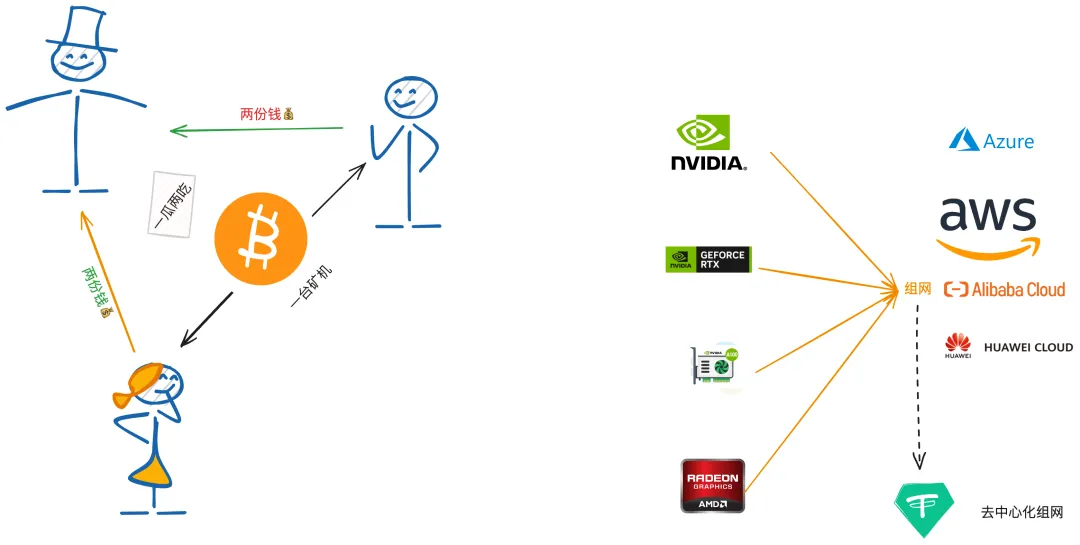
Two types of ☁️ compute—same name, same fate?
Inference and FLOPS: Measuring GPU Computing Power
Demand for AI compute is shifting from training to inference.
Take OpenAI’s Sora as an example. Although built on Transformer technology, its parameter count is estimated to be below hundreds of billions—Yann LeCun even suggested it might only have 3 billion parameters—significantly smaller than GPT-4’s trillion-scale. This implies lower training costs, which makes sense: fewer parameters require proportionally less computational power.
However, Sora may require stronger “inference” capabilities. Inference here refers to generating specific videos based on instructions. Since video is considered creative content, this demands greater comprehension from AI. Training, by contrast, is relatively simpler—essentially summarizing patterns from existing data through brute-force computation.
Previously, most AI compute was used for training, with only limited use for inference—all dominated by NVIDIA products. But with the emergence of Groq’s LPU (Language Processing Unit), things are changing. Enhanced inference performance, combined with model compression and improved precision, is gradually becoming mainstream—intelligence over raw power.
Also worth noting is the differentiation within GPUs. The saying that “gamers saved AI” holds some truth: strong market demand for high-performance gaming GPUs helped subsidize R&D costs. Cards like the RTX 4090 serve both gamers and AI practitioners alike. However, gaming GPUs and compute GPUs are slowly diverging—a process similar to how Bitcoin mining evolved from general PCs to specialized ASICs, following a progression from CPU → GPU → FPGA → ASIC.
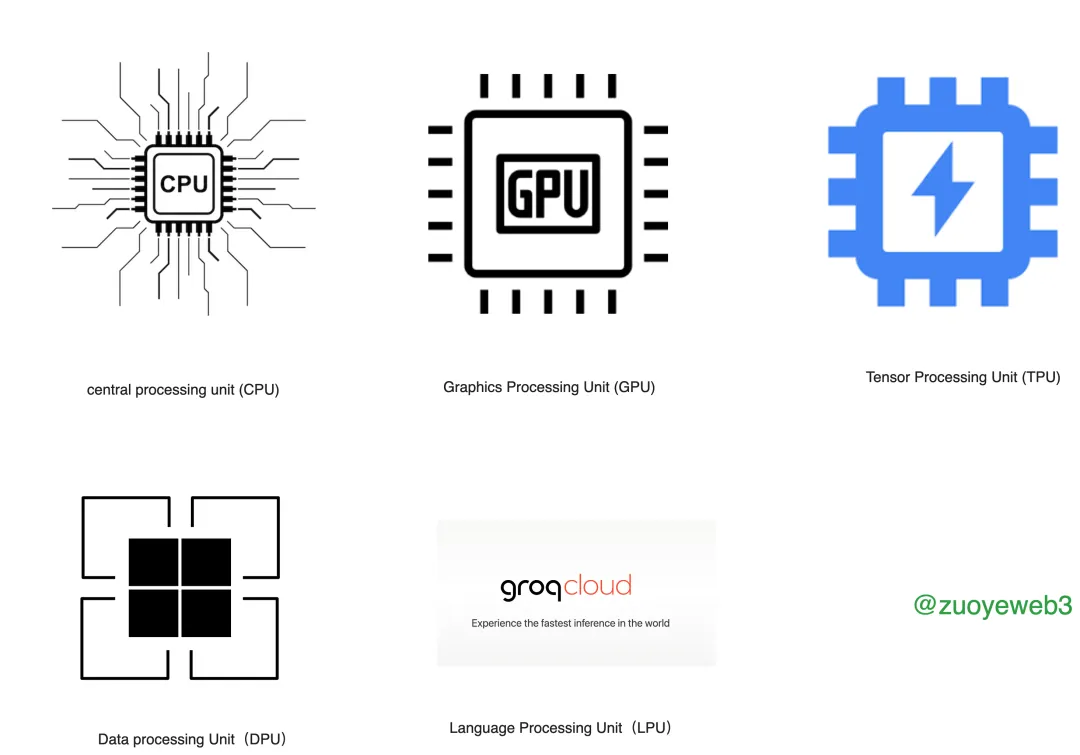
LLM-dedicated GPUs in development…
As AI technologies—especially LLMs—mature, we’ll see increasing experimentation with alternatives like TPU, DPU, and LPU. That said, NVIDIA’s GPUs still dominate today. All discussion below focuses on GPUs, while LPUs and others remain supplementary rather than replacements—for now.
Decentralized compute competitions aren't about securing GPU supply—they aim to establish new business models.
At this point, NVIDIA seems almost like the protagonist. It controls around 80% of the GPU market. While there’s theoretical debate between N-card and A-card, in reality everyone ends up using NVIDIA.
This near-monopoly fuels fierce competition for GPUs—from consumer-grade RTX 4090s to enterprise-level A100/H100 chips. Major cloud providers are among the biggest stockpilers. Meanwhile, companies like Google, Meta, Tesla, and OpenAI are developing custom silicon, and Chinese firms are turning to domestic alternatives like Huawei. The GPU landscape remains intensely crowded.
For traditional cloud providers, what they sell is essentially computing power and storage space. Whether they use their own chips isn’t as urgent as it is for AI-native companies. But for decentralized compute projects, currently focused on competing with traditional clouds by offering cheaper, more accessible compute, the likelihood of evolving into Web3-specific AI chips—like Bitcoin ASICs—is low.
One side note: since Ethereum switched to PoS, dedicated hardware in crypto has dwindled. Projects like Saga phone, ZK accelerators, and DePIN have small markets. Hopefully, decentralized compute can pave a uniquely Web3 path toward specialized AI hardware.
Is decentralized compute the next step for the cloud—or just a supplement?
GPU performance is typically measured in FLOPS (Floating Point Operations Per Second)—the standard benchmark for computing speed. Regardless of specifications or parallel optimization techniques, everything ultimately comes down to FLOPS.
The shift from local computing to cloud took about half a century. Distributed computing, however, has existed since the dawn of computers. Now, driven by LLMs, combining decentralization with compute power no longer feels abstract. I’ll summarize existing decentralized compute projects using two criteria:
-
Number of GPUs and other hardware—this reflects raw computing speed. According to Moore’s Law, newer GPUs are more powerful. Given equal specs, more units mean higher total capacity;
-
Incentive layer design—a hallmark of Web3—including dual-token systems, governance features, and airdrop strategies. These help assess long-term project viability beyond short-term token speculation. Ultimately, sustainability depends on how many GPUs a network can acquire or orchestrate.
From this perspective, decentralized compute still follows the DePIN model of “existing hardware + incentive network.” Or put differently, it monetizes virtualized hardware atop the existing internet architecture, emphasizing permissionless access. True networking still requires physical hardware coordination.
Compute Decentralization, GPU Centralization
Applying blockchain’s trilemma framework, security isn’t a primary concern for decentralized compute—focus lies on decentralization vs. scalability. Scalability here refers to post-networking GPU utility, currently dominated by AI applications.
Here’s a paradox: for a decentralized compute project to succeed, it needs as many GPUs on its network as possible. Why? Because models like GPT have exploding parameter counts—without sufficient GPU scale, meaningful training or inference becomes impossible.
While current decentralized projects offer permissionless access and free movement of GPU resources—contrasting sharply with centralized cloud control—future efficiency gains might lead to pool-like structures similar to mining pools.
Regarding scalability, GPUs aren’t limited to AI. Cloud gaming and rendering are viable paths too. For example, Render Network specializes in rendering, while Bittensor focuses on model training. Put simply, scalability equals use-case diversity.
Thus, beyond GPU count and incentive design, we can add two more dimensions: decentralization and scalability—forming a four-axis comparison framework. Note: this method isn’t technical analysis—it’s meant to be fun and illustrative.
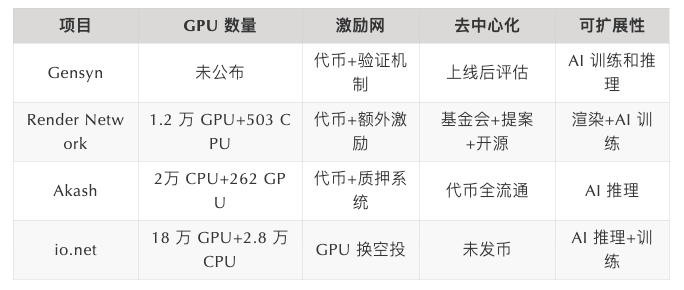
Among these projects, Render Network stands out. At its core, it’s a distributed rendering network—not directly tied to AI. In AI training and inference, processes like SGD (Stochastic Gradient Descent) and backpropagation require strict consistency across steps. Rendering, however, doesn’t need such tight coupling—images and videos can be split and processed independently.
Its AI training capability largely comes from integration with io.net, functioning almost like a plugin. After all, GPUs are GPUs—why not put them to work? More strategically, Render Network migrated to Solana when it was undervalued—an insightful move, given Solana’s superior performance for high-throughput networks.
Next, io.net’s aggressive expansion strategy has yielded impressive results—its website claims 180,000 GPUs, placing it firmly in the top tier of decentralized compute projects, far ahead of competitors in scale. On the scalability front, io.net primarily targets AI inference, treating AI training as a secondary function.
Strictly speaking, AI training isn’t well-suited for distributed deployment. Even lightweight LLMs involve massive parameter counts, making centralized computation more cost-effective. Where Web3 and AI intersect in training is mostly around data privacy and encrypted computation—technologies like ZK and FHE. But for AI inference, Web3 offers real potential: lower performance requirements allow tolerance for some inefficiency, and inference sits closer to end-user applications, enabling better user-level incentives.
Filecoin, another “mining-for-tokens” pioneer, recently partnered with io.net to share GPU resources—contributing 1,000 of its own GPUs. A heartwarming collaboration between old guard and newcomer—best of luck to both.
Then there’s Gensyn, still unlaunched but worth analyzing. Still in early network development, it hasn’t disclosed GPU numbers yet. Its main focus is AI training, which likely demands substantial high-performance GPU capacity—at least surpassing Render Network. Compared to inference, training competes directly with cloud providers and involves more complex mechanisms.
Specifically, Gensyn must ensure effective model training while improving efficiency via off-chain computation. Thus, verification and anti-cheating systems involve multiple actors:
-
Submitters: task initiators who pay for training costs.
-
Solvers: perform model training and submit validity proofs.
-
Verifiers: validate the correctness of training outputs.
-
Whistleblowers: audit verifiers’ work.
Overall, this resembles PoW mining plus optimistic proof mechanisms—an extremely complex architecture. Offloading computation to off-chain may reduce costs, but architectural complexity introduces operational overhead. At a time when most decentralized compute efforts focus on inference, we wish Gensyn good fortune.
Lastly, Akash—the veteran still going strong. Alongside Render Network, Akash started early, initially focusing on decentralized CPU compute, while Render pioneered GPU decentralization. Ironically, after the AI boom, both now operate in the GPU + AI space—with Akash leaning more toward inference.
Akash’s resurgence stems from recognizing opportunities in post-Ethereum-upgrade mining farms. Idle GPUs—once sold secondhand by college students on Xianyu—can now contribute to AI advancement. Either way, you’re serving humanity.
One advantage Akash has is fully circulating tokens—it’s an old project and has actively adopted PoS-style staking. But the team seems laid-back compared to io.net’s aggressive, youthful energy.
Other notable mentions include THETA for edge cloud computing, Phoenix for niche AI compute solutions, and established names like Bittensor and Ritual. Due to space constraints, I can’t cover them all—some simply lack publicly available GPU metrics.
Conclusion
Throughout computing history, nearly every computing paradigm could support a decentralized version. The tragedy is that none have made meaningful impact on mainstream applications. Today’s Web3 compute projects largely remain insular echo chambers. Near’s founder attended GTC not because of Near, but due to his role as a co-author of the Transformer paper.
More pessimistically, the scale and dominance of today’s cloud computing giants are overwhelming. Can io.net replace AWS? Only if it amasses enough GPUs—which is conceivable, considering AWS itself long relied on open-source Redis as a foundational component.
In a sense, the disruptive potential of open source and decentralization has never been equally recognized. Most decentralized projects remain concentrated in DeFi and finance. AI may finally offer a pathway into the mainstream.
Join TechFlow official community to stay tuned
Telegram:https://t.me/TechFlowDaily
X (Twitter):https://x.com/TechFlowPost
X (Twitter) EN:https://x.com/BlockFlow_News
 @zuoyeweb3








