








Frax Re-narrative: Focusing on L2 Fraxtal, Multiple Products Have Yet to Generate Vampire Effect
TechFlow Selected TechFlow Selected
Frax Re-narrative: Focusing on L2 Fraxtal, Multiple Products Have Yet to Generate Vampire Effect
Although Frax Finance has limited competitiveness in the stablecoin sector despite riding on market trends, it has significant growth potential in the LSD and RWA sectors.
 Navigating Web3 tides with focused insights
Author: Nancy, PANews
On March 22, Sam Kazemian, founder of Frax Finance, released a roadmap for Frax’s future, planning to launch 23 Layer 3 (L3) chains within the next year and aiming to achieve over $100 billion in Fraxtal TVL by the end of 2026. As an established algorithmic stablecoin protocol, Frax Finance has evolved from a single monetary protocol into a diversified product matrix, expanding into popular sectors such as LSD, lending, cross-chain bridges, RWA, and Layer 2 (L2). This article by PANews reviews the latest developments and market data of Frax Finance.
Enhancing Stablecoin Competitiveness: Focus on L2 Fraxtal This Year
Judging from this year's market dynamics, Frax Finance is no longer limited to asset issuance; it is accelerating upgrades in product functionality and narrative evolution.
On one hand, Frax Finance officially launched the FXB (Frax Bond) module in mid-January, completing the design and deployment of all new features under FRAX v3. This version aims to eliminate reliance on USDC, establish a new decentralized stablecoin mechanism, and formally enter the RWA sector. FXB is a utility token denominated in FRAX stablecoins that can be trustlessly converted into one FRAX stablecoin upon maturity. In simple terms, it allows holders to purchase future FRAX stablecoins at a discount. The bond yield corresponds to that of U.S. Treasuries with similar maturities and includes specific timestamps. Across multiple updates, Frax Finance has advanced its narrative from algorithmic stablecoins to LSD and now to RWA, achieving multidimensional upgrades.
On the other hand, similar to Uniswap’s fee switch proposal, Frax Finance is also planning reward mechanisms for token holders. A recent proposal titled “Reactivating the Fee Switch” suggests allocating 75% of protocol fee revenue to veFXS holders. Kazemian also proposed in the latest roadmap to reopen the protocol fee switch, directing 50% of revenues to veFXS holders and the remaining 50% toward FXS buybacks and other Frax assets. Additionally, he proposed reducing the conversion rate from FPIS to veFXS by 67%, setting a new four-year conversion rate of 1 FPIS → 1.33 veFXS. According to DeFiLlama, as of March 22, Frax Finance’s annual revenue is projected at $47.93 million. To accelerate expansion of asset coverage, Frax Finance recently launched the FRAX stablecoin on NEAR and plans to issue new assets such as frxTIA and frxMetis.
Moreover, following dYdX’s development of dYdX Chain (a Layer 1 blockchain), Synthetix’s deployment of SNX Chain, and MakerDAO’s plan to launch Newchain, Frax Finance has also adopted chain development as a new strategic move. In February, Frax Finance announced the launch of Fraxtal, a modular Layer 2 blockchain built on OP Stack, aiming to become a research paper-driven blockchain that encourages others to build and grow on its platform.
Compared to other Layer 2 solutions, Fraxtal employs a unique block space incentive mechanism called Flox, which rewards FXTL points based on usage of the Fraxtal chain or through staking veFXS. These points are tokenizable. FXS serves as the sequencer staking token on Fraxtal, capturing sequencer revenue. Fraxtal is central to Frax Finance’s 2024 growth strategy—going forward, all Frax assets including FRAX, sFRAX, frxETH, and new Frax assets will be prioritized for issuance on Fraxtal. As the only project among the top 200 by market cap with four distinct tokens/assets, once matured, all Frax assets could eventually serve as gas tokens on Fraxtal.
Notably, Frax Finance is also targeting Layer 3 (L3), a sector widely seen as offering strong application-building capabilities and high growth potential. Frax Finance plans to launch 23 official L3 chains within the next 365 days to kickstart the Fraxtal Nation community. Two L3s have already been built by the team, with the remainder expected to roll out over the coming months. According to official information, L3 chains can earn FXTL points via Flox, and the 23 L3 chain slots are reserved for official partners who will receive additional support from Fraxtal core developers and significant allocations of FXTL.
Popular Themes Attract Capital, Yet Lag Behind Peers
Market data shows that while Frax Finance benefits from riding current trends, its competitiveness in the stablecoin sector remains limited. However, it holds substantial growth potential in the LSD and RWA sectors.
In the stablecoin sector, CoinGecko data shows that as of March 22, FRAX, Frax Finance’s stablecoin, ranks eighth with a market cap of $640 million, accounting for just 0.4% of the total stablecoin market. Although it leads among decentralized stablecoins after DAI, its market cap is only a fraction of DAI’s. Given the current market landscape, breaking the dominance of leading stablecoins remains extremely difficult.
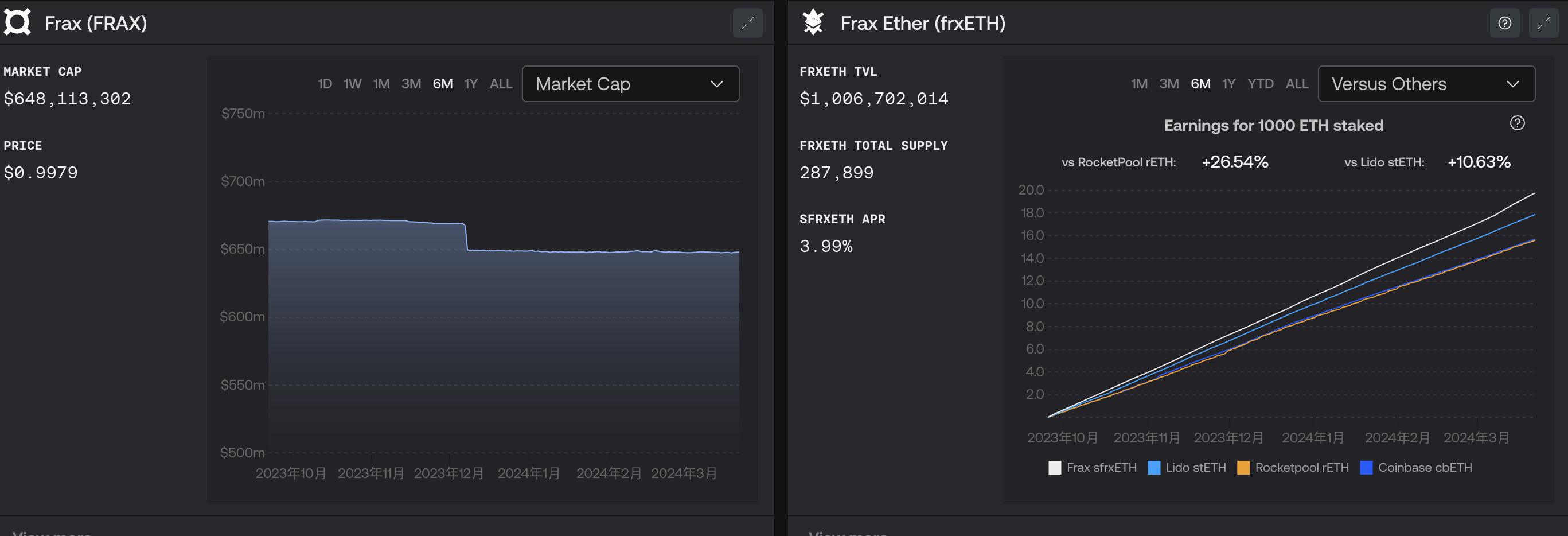
In the LSD race, DeFiLlama reports that as of March 22, the total TVL in the LSD sector reached $48.66 billion, with Frax Ether (frxETH) holding nearly $1 billion—2.09% of the total, up 42.5% since the beginning of the year. Compared to Lido, the market leader with over $34.5 billion in TVL, frxETH still lags significantly. However, according to the Frax Finance website, as of March 22, frxETH offers an APR of 4.08%, surpassing stETH, rETH, and cbETH during the same period. This relatively higher staking yield may attract more capital inflows.
Regarding RWA initiatives, Frax Finance’s website indicates that as of March 22, the total staked amount in sFRAX—the yield-bearing vault backed by U.S. Treasury returns—exceeds 28.388 million units. DeFiLlama data shows that as of the same date, the total TVL across RWA projects exceeds $4.01 billion. With an interest rate of 5.4%, sFRAX holds a competitive edge compared to leading RWA projects like stUSDT and Ondo Finance.
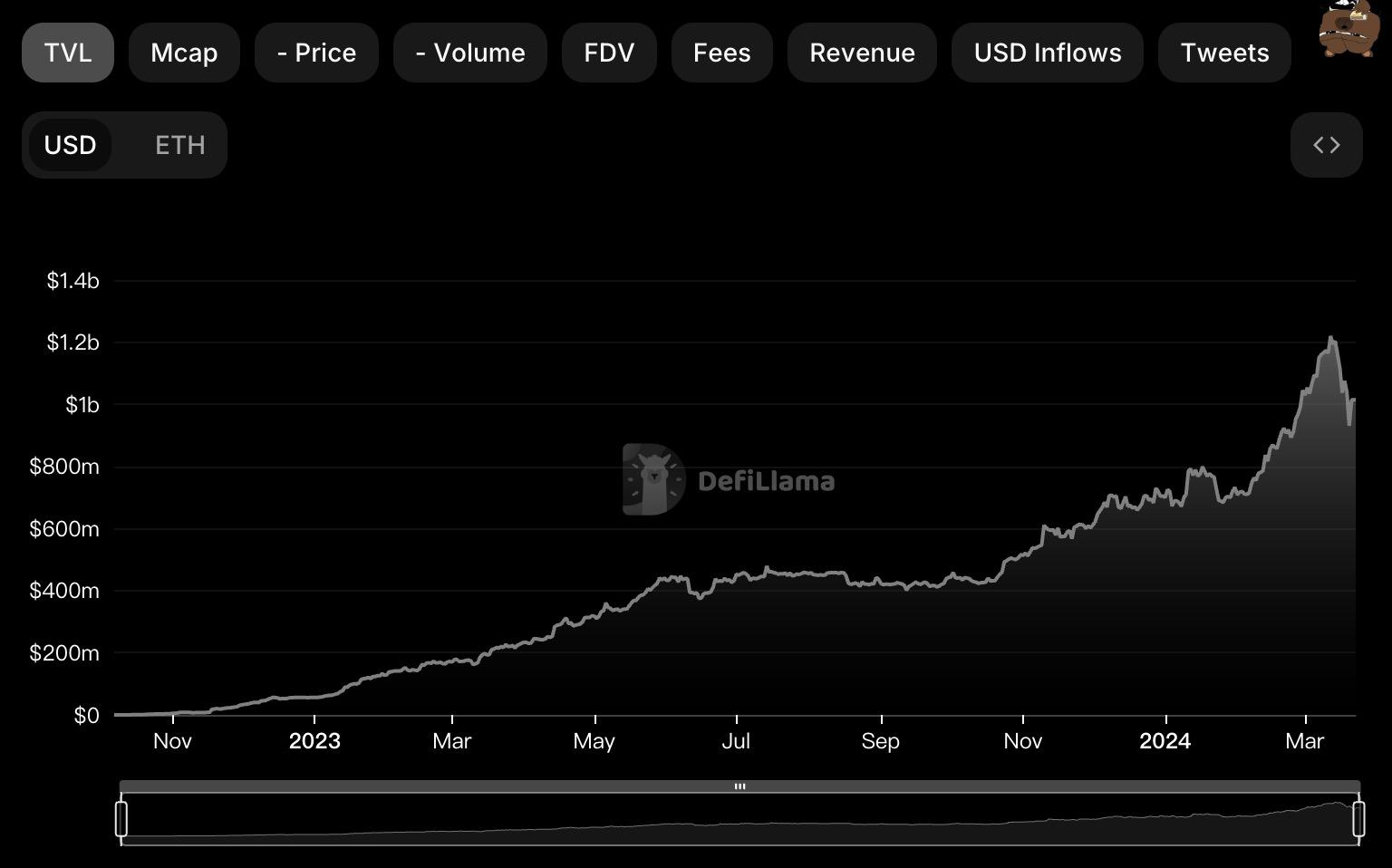
Strategic positioning in trending sectors has driven some growth in Frax Finance’s overall locked value. Data from DeFiLlama shows that Frax Finance’s TVL has increased by 30.6% since the start of the year. However, after a brief spike influenced by recent fee switch news, it has since declined. Meanwhile, the price of its governance token FXS has not seen significant improvement—according to CoinGecko, FXS is down 15.6% since the beginning of the year.
Overall, amid increasingly fierce competition among stablecoins, Frax Finance is exploring differentiated growth through an integrated suite of products. Whether it can truly establish a sustainable growth flywheel remains to be seen.
Join TechFlow official community to stay tuned
Telegram:https://t.me/TechFlowDaily
X (Twitter):https://x.com/TechFlowPost
X (Twitter) EN:https://x.com/BlockFlow_News
 PANews








