









Vitalik Discusses Cancun Upgrade, Quantum Threats, AI & Crypto, and Social in Taipei
TechFlow Selected TechFlow Selected
Vitalik Discusses Cancun Upgrade, Quantum Threats, AI & Crypto, and Social in Taipei
Vitalik said the upgrade is going smoothly, better than any previous fork.
 Navigating Web3 tides with focused insights
Compiled & Translated by Karen, Kean, Foresight News
At the ETHTaipei 2024 conference opening today, Vitalik Buterin sat down with multiple media outlets to share his thoughts on key topics including the Cancun upgrade,应对 strategies for potential quantum threats, AI & Crypto integration, Ethereum restaking, decentralized social media, and offered advice for non-native English speakers and new blockchain developers.
In addition, Vitalik Buterin discussed centralization risks associated with Ethereum staking and introduced a new conceptual framework called "Rainbow Staking." This framework aims to provide standardized, plug-and-play interfaces for integrating additional "protocol services," targeting a Minimal Viable Issuance (MVI) model to counter dominant Liquid Staking Tokens (LSTs) replacing ETH as Ethereum's native currency. It seeks to enhance individual stakeholders' economic value through competitive participation across differentiated service categories and support achieving Single-Slot Finality (SSF).
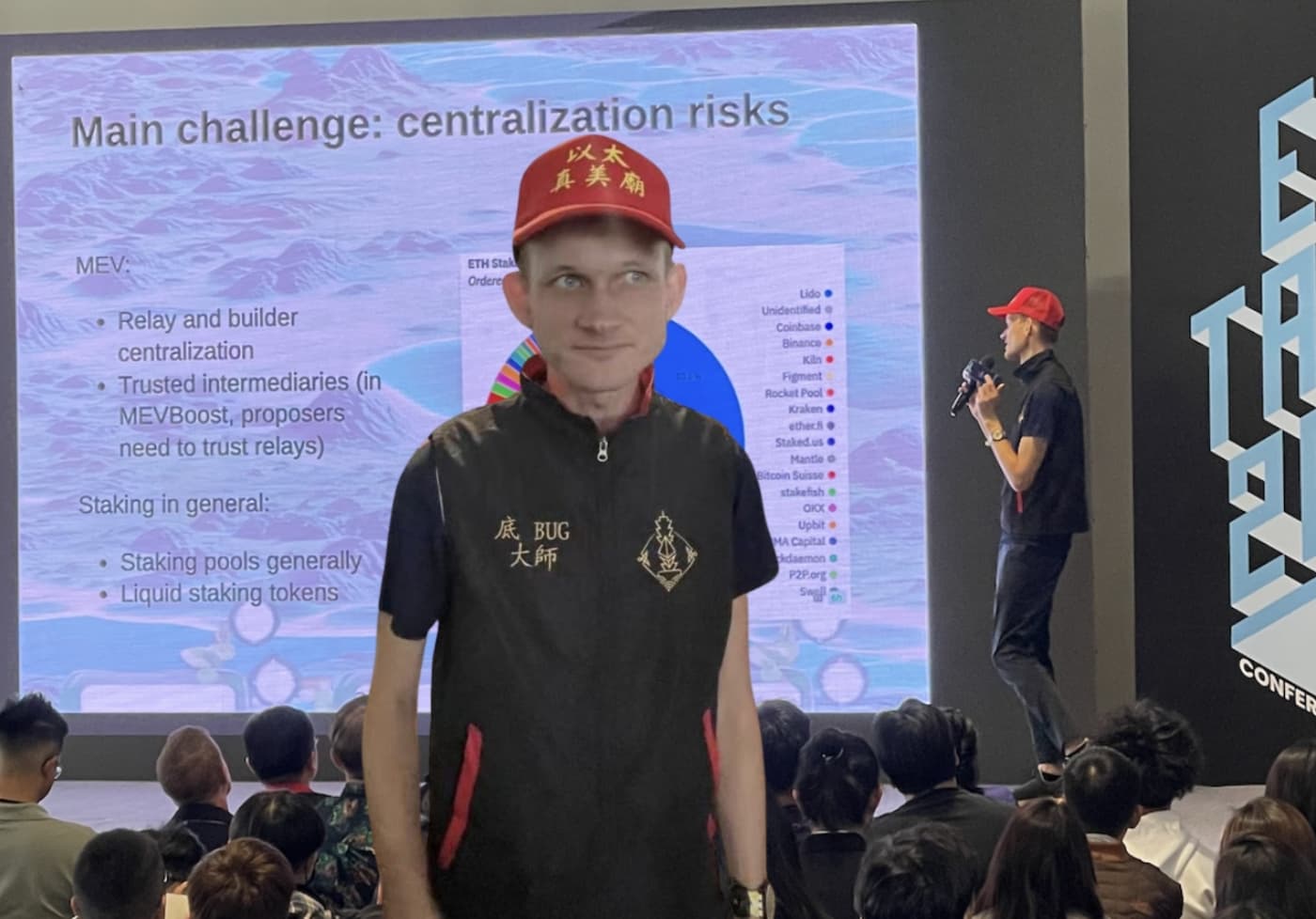
Image source: ABMedia
Below are Vitalik Buterin’s responses to media questions:
You seem more active on Farcaster than on Twitter. Can decentralized social applications like Farcaster really compete with Web2 social platforms? Or even disrupt the current social paradigm?
Vitalik Buterin: Yes, I think one interesting thing about social spaces is that while they have strong network effects, they also have anti-network effects. Twitter brings together diverse groups of people, but it's also become a magnet for truly annoying individuals. I've found that Farcaster has already accumulated enough users and remains genuinely interesting—a place where I get higher-quality interactions—even though there's still room for improvement.
I believe that even if Twitter tries to distinguish between high-quality and low-quality content or users, many criticize its mechanisms—like moderation and blue checkmarks—as potentially centralized tools favoring specific viewpoints or privileged groups. The crypto space, along with many non-financial applications such as Ethereum, fundamentally addresses these trust issues. Decentralized social can truly solve this problem.
An important feature of Farcaster is that it's not a single server but a shared platform. In principle, you can use your own client, which reads from and writes to the same data visible to all users on the network. I think this could absolutely become a place where people start building their own clients and adding novel features. For example, imagine users publishing community notes on Farcaster, or hosting AI-powered discussions or even prediction systems. On Farcaster, people could create their own mechanisms to identify high-reputation versus low-reputation participants. Different communities could adopt different approaches—all implemented via different clients.
Another thing that excites me is how practical, smooth, and simple Farcaster feels to use—and it's already being adopted by some non-crypto natives. I think this is something many apps fail to achieve, and it sets a strong precedent for other similar applications.
How does the Dencun upgrade contribute to the Ethereum ecosystem? Has the upgrade performed better than expected?
Vitalik Buterin: The goal of the Cancun upgrade is to significantly improve scalability and drastically reduce transaction fees for Layer 2s, especially Rollups. It achieves this by creating separate data spaces within each block—blob-carrying transactions—that are inaccessible to the EVM. This is crucial because it means clients validating Ethereum blocks don’t need to access this data directly. We’ve already seen L2 fees drop sharply over the past week. That said, I should caution that as user activity and block usage increase, these fees may rise again due to increased demand. Still, this represents a substantial leap forward in scalability.
Regarding the second part of your question, “better than expected” depends on what metric you’re using. From a technical standpoint, the upgrade went smoother than any previous fork. However, actual usage has been lower than anticipated—we aimed for three blobs per block, but average usage is only around one blob. I expect usage will grow over time, but currently, this low utilization is great news for Rollups since it keeps costs extremely low. I anticipate usage will ramp up over the coming months.
How do you think Ethereum should address the pressing issue of quantum computing threats, and what impact might this have on the broader cryptocurrency ecosystem?
Vitalik Buterin: Regarding quantum threats, there are several aspects to consider. First, the Ethereum Foundation is aware of the potential risks and is working on relevant standards and guidelines. Technically, we already have post-quantum cryptographic algorithms ready for every area vulnerable to quantum attacks. For instance, quantum computers could break existing elliptic curve signatures, but we already have alternatives such as hash-based functions and Winternitz signatures.
Another challenge is how to respond to the broader impact of quantum-enabled attacks on the entire cryptocurrency ecosystem. Here, we need to make Ethereum’s consensus layer quantum-resistant. There are engineering challenges because our current approach relies heavily on efficient BLS signatures. Any quantum-safe alternative would be less efficient. This is partly why I've been advocating for adopting 8192-epoch validator rotations—it gives us more flexibility to adapt to potentially inefficient algorithms. Meanwhile, researchers are actively optimizing, measuring, and benchmarking post-quantum alternatives.
Overall, we need a multi-faceted strategy involving adoption of quantum-resistant algorithms, adjustments to the consensus layer, and ongoing research into post-quantum solutions to safeguard Ethereum and the wider crypto ecosystem.
In your view, what are the benefits of combining AI with cryptocurrency? How might this reshape the industry? In February, you discussed AI’s role in debugging code—could you elaborate further on how AI might be used in crypto and Ethereum?
Vitalik Buterin: AI and cryptocurrency represent two of the most significant technological trends today. There's a common saying: AI tends toward centralization, while crypto strives for decentralization. There’s a kind of complementary relationship here. But the real question is whether we can move beyond abstract concepts to concrete applications that meaningfully and productively integrate both.
One possibility is AI participating in prediction markets or other market types on Ethereum, enabling finer-grained market dynamics and APIs for interaction. Another is integrating AI into wallets to help users understand the crypto environments they're interacting with. A third involves using cryptography—such as ZK, SNARKs, MPC—to embed AI models securely, creating robust, privacy-preserving AI systems that can serve as core components in on-chain applications, whether DApps or Oracles. And fourth, if successful, these techniques could eventually be applied to AI in other domains.
Among these, I see the first two as clear short-term applications, while the latter two remain more speculative. I definitely don’t want to give the impression that AI-crypto integration will immediately become the next big narrative driving the industry forward. But I do believe these intersections are worth deeper exploration.
Additionally, another promising application is AI-assisted rolling code debugging. One of the biggest challenges in crypto today is code bugs and vulnerabilities. A hopeful development is that AI could greatly simplify the process of using formal verification tools to prove that code satisfies certain properties.
What are your thoughts on the recent wave of Ethereum restaking?
Vitalik Buterin: Restaking is indeed an interesting idea, but there are potential risks—particularly that demand could be captured by centralized players, leading to systemic risks and negative impacts on Ethereum’s validator set. I know some projects are researching different approaches. So far, I’m mostly observing this space and looking forward to seeing how it evolves.
Looking back at the development and evolution of cryptocurrency, what has surprised you the most? What do you think the crypto industry will look like in another five years?
Vitalik Buterin: The rise of NFTs and meme tokens has surprised me the most. On the technical side, the rapid progress in zero-knowledge technology has far exceeded our expectations.
Do you have any advice for new blockchain developers?
Vitalik Buterin: I think the most important thing is finding motivation to engage and stay involved—actually joining and becoming part of the community. Pick a clear direction and build something tangible. Building something that actually works is much more valuable than just thinking about it. You can also try contributing through writing—it’s a great way to push yourself forward.
Do you have specific suggestions for non-native English speakers who want to participate in public goods ecosystems?
Vitalik Buterin: First, if you have decent English skills, translating content is valuable. You can also summarize information or actively contribute to protocol (community) development, as many protocols are actively trying to welcome more global participants—whether as contributors, voters, or badge holders.
Join TechFlow official community to stay tuned
Telegram:https://t.me/TechFlowDaily
X (Twitter):https://x.com/TechFlowPost
X (Twitter) EN:https://x.com/BlockFlow_News
 Foresight News








