Starbucks Says Goodbye to NFTs
TechFlow Selected TechFlow Selected
Starbucks Says Goodbye to NFTs
After just one year, the program dedicated to improving Starbucks' customer loyalty system has come to an end.
 Navigating Web3 tides with focused insights
By: Wentao
Recently, Starbucks announced it will discontinue its NFT initiative, Starbucks Odyssey. According to the official website, the program will end by the end of March, though holders can still trade their NFTs on the Nifty Gateway platform.
Having weathered the deep crypto bear market, Starbucks stood out as a successful example of a traditional brand venturing into Web3, skillfully leveraging Web3 for digital marketing. So why has it suddenly decided to halt its Odyssey NFTs just as the crypto market begins warming up?
Starbucks has not provided a clear explanation, only offering a vague response on its FAQ page: "The Starbucks Odyssey Beta must come to an end to prepare for the next phase of our evolving program."
In 2022, Starbucks Executive Vice President and Chief Marketing Officer Brady Brewer expressed great confidence in the Odyssey project, stating that "leveraging Web3 technology will allow our members to access experiences and ownership previously unavailable." At the time, the broader crypto market was in a bear phase, yet Odyssey NFTs saw rising floor prices and sales volumes, with new experiential offerings continually introduced alongside the program.
Yet after just one year of execution, this initiative designed to enhance customer loyalty has come to a halt. Checking current NFT prices reveals that the majority of the Odyssey NFT collection are trading below their initial sale price—possibly one reason Starbucks hit pause.
Starbucks is not the first traditional brand to retreat from the NFT space. Recently, game retailer GameStop and South Korean telecom giant KT have also scaled back their NFT product lines.
Most Odyssey NFTs Are Now Below Initial Sale Price
Last Friday, Starbucks announced the termination of its Odyssey Beta loyalty program.
Visiting the Starbucks Odyssey website, those attempting to join are greeted with a farewell message: "Starbucks Odyssey Beta will conclude on March 31, 2024." The page then redirects users to the registration page for Starbucks Rewards—the company's traditional loyalty program.
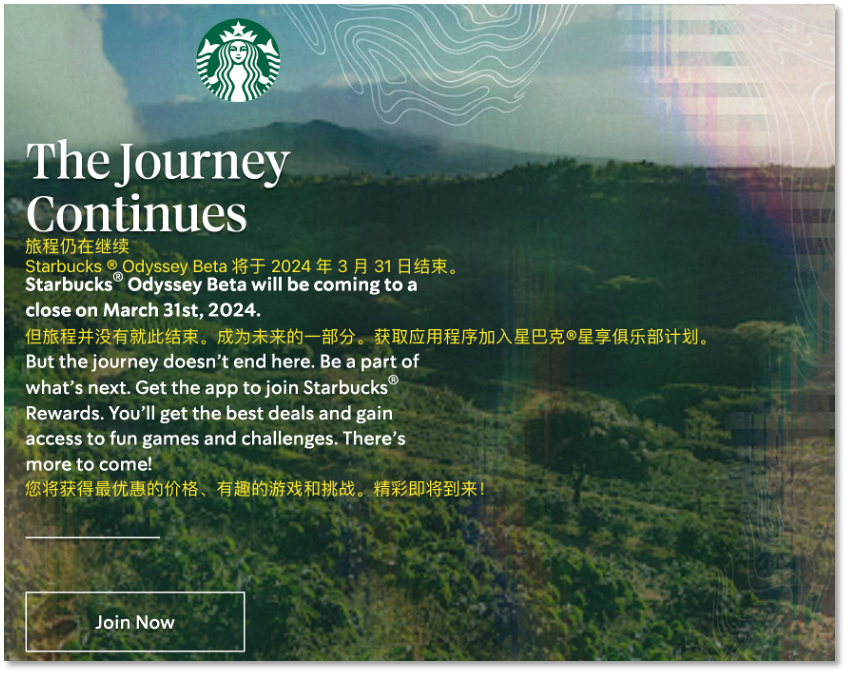 Odyssey’s official site notifies users the program will end in late March
This marks the end of Starbucks Odyssey, a Web3-powered product once intended to upgrade member loyalty. After years of development, the legacy Web2-based "Starbucks Rewards" system sheds its Web3 layer and returns to its original form.
As for the reason, Starbucks explains on its FAQ page: "The Odyssey Beta must end to prepare for the next stage of our program’s evolution." This statement hints at future plans, adding that Starbucks is "working to create a future space where members can connect."
What this "future space" might be remains unclear. Some netizens have joked on social media: "Could it be the metaverse?" Others speculate it may point toward a "gaming system." Starbucks has not publicly addressed these speculations.
For existing Starbucks Odyssey NFT holders, the company confirms they can continue trading their NFTs on the NFT marketplace Nifty Gateway.
The coffee giant first dipped into NFTs at the end of 2022. The Odyssey program was promoted as an extension of Starbucks’ existing rewards system, offering perks such as discounts on in-store purchases, interactive activities, and rewards including NFT stamps and barista classes. Lucky participants could even visit coffee farms in Costa Rica.
Initially launching a closed beta on the Polygon blockchain, the announcement immediately attracted attention from the Web3 community. To date, the Odyssey program has released 27 themed NFT series, with stamp NFTs generating $3.4 million in total sales on Nifty Gateway.
In March 2023, the program launched its first limited-edition NFT stamp—2,000 Siren Collection NFTs sold out in under 20 minutes, crashing the website due to overwhelming traffic. In August 2023, the "Green Apron" NFT series surged 23% within 15 hours. Notably, this occurred during a period when the broader NFT market remained deep in bear territory.
Both traditional industries and the Web3 sector watched closely to see if this legacy brand could use Web3 technologies and products to improve real-world business operations. Starbucks CMO Brady Brewer confidently proclaimed the initiative would deliver a "revolutionary Web3 experience" to its members.
Now, with the crypto market rebounding, why has Starbucks chosen to discontinue the Odyssey program?
According to TechCrunch, Steve Kaczynski, a community lead at Starbucks, noted that the NFT market may have declined significantly from its all-time highs, and the company hopes to engage fans in new ways, while maintaining value in branding and loyalty programs.
Indeed, even Starbucks' most popular NFT series are now facing market downturns.
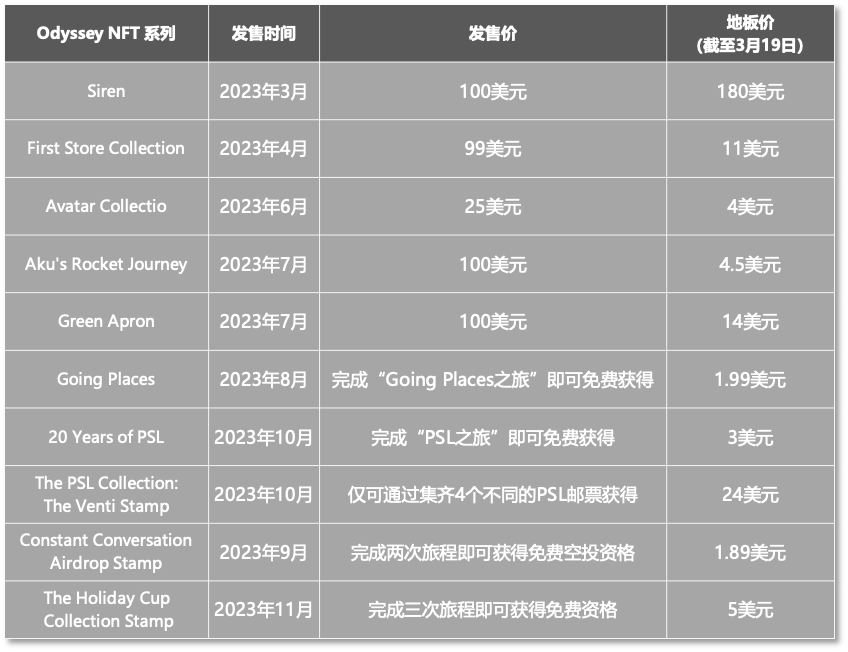 Most Odyssey NFT series are now trading below their initial sale price
Reviewing the Odyssey NFT collections, it's evident that aside from the Siren series, all other NFTs have dropped below their original mint price, with most losing over 90% of their value. This means early buyers who held onto their Odyssey NFTs are likely sitting on significant losses.
Even NFTs earned for free by completing tasks now have floor prices in single digits—insufficient to cover the time and effort invested, and sometimes not even enough to buy a cup of coffee.
Starbucks Isn’t the Only Traditional Brand Pausing NFT Efforts
Undeniably, the Starbucks Odyssey NFT program was once seen as a textbook case of a Web2 brand entering Web3. Its sudden termination has sent shockwaves through the industry. Starbucks’ exit is closely tied to the overall sluggishness of the NFT market.
Since February 2024, the broader crypto market has seen widespread gains—BTC (Bitcoin) reached new all-time highs, ETH (Ethereum) approached previous peaks, and surges in meme and AI sectors have delivered returns for many investors. Yet the NFT market appears stuck in a "winter."
According to CoinGecko, NFT trading volume in 2023 was less than half of 2022’s, dropping from $26.3 billion to $11.8 billion—a decline of $14.5 billion quarter-over-quarter. Total NFT sales in 2023 amounted to approximately $8.7 billion, down 63.35% from $23.74 billion in 2022.
Real-time data from NFT marketplace Blur shows broad declines in blue-chip NFT floor prices. Leading NFT collection Bored Ape Yacht Club (BAYC) has continued falling, down 7% over the past week. Pudgy Penguins, LilPudgys, and Azuki have each dropped 10%-20%. DeGods’ floor price even plunged over 40% in a single day.
This downtrend in the NFT market has persisted for six months. BAYC, once trading at 75 ETH, now hovers around 13 ETH—and the fall continues. Prominent BAYC holder and influencer Bunny once remarked: "Looking at the BAYC chart makes me want to commit suicide."
Amid this broader market slump, many traditional brands that once embraced or invested in NFTs are now reconsidering. Beyond Starbucks, companies like GameStop, social media platform X, and Nike are scaling back their NFT initiatives.
In February 2024, game retailer GameStop announced on its website that, due to regulatory uncertainty, it would begin phasing out its NFT marketplace starting February 2. From that point, users would no longer be able to buy, sell, or create NFTs. Prior to this, in November 2023, GameStop had already discontinued support for its NFT wallet.
GameStop, a U.S.-listed company with over 6,000 physical stores worldwide, showed signs of strain amid pandemic impacts, reporting consecutive annual losses in 2020 and 2021. In 2022, GameStop shifted focus to the crypto space, launching its namesake NFT platform in July. On launch day alone, trading volume on GameStop NFT reached $2 million.
Enthusiasm from crypto users briefly propelled GameStop NFT into the Top 10 marketplaces by volume—but this success was short-lived. Over the past month, the platform’s trading volume has dwindled to around $40,000.
Additionally, South Korean telecom giant KT will shut down its NFT platform MINCL on March 4, citing "changes in business conditions." According to the notice, NFT holders can transfer their assets to external wallets before the service ends; afterward, users will no longer be able to view any remaining NFTs.
In January this year, Elon Musk’s social media platform X also discontinued support for NFT profile pictures. Meta, the metaverse heavyweight, ended its own NFT initiative as early as 2023.
The discontinuation of the Odyssey program may indeed be linked to the sharp drop in NFT prices. Moreover, the program has been selling NFTs for less than a year—roughly aligning with its "Beta" designation. For Starbucks, this Web3 marketing experiment may have simply been a one-year trial that ultimately did not disrupt its established "Starbucks Rewards" membership ecosystem.
With traditional brands pulling back and native Web3 blue-chip NFT projects struggling, the reality is undeniable: NFTs, once darlings of the last crypto bull run, are now mired in a challenging market environment. This blockchain application, capable of carrying visual content and enabling on-chain ownership, urgently needs new use cases and应用场景.
Join TechFlow official community to stay tuned
Telegram:https://t.me/TechFlowDaily
X (Twitter):https://x.com/TechFlowPost
X (Twitter) EN:https://x.com/BlockFlow_News