The Cancun upgrade ushers in an era of reduced fees—how to fully explore the Ethereum and L2 ecosystem via OKX Web3 Wallet?
TechFlow Selected TechFlow Selected
The Cancun upgrade ushers in an era of reduced fees—how to fully explore the Ethereum and L2 ecosystem via OKX Web3 Wallet?
OKX Web3 Wallet now fully supports the Ethereum and L2 ecosystems, providing a crucial foundation for users to better explore the on-chain world.
 Navigating Web3 tides with focused insights
Author: 0xming
On March 13, according to OKLink data, Ethereum officially activated the Dencun upgrade at block height 269568, marking the beginning of a low-fee era for Layer 2. After cost reduction and performance improvements, can Ethereum make a comeback?
Launched on July 30, 2015, Ethereum pioneered the era of smart contracts. It once thrived due to the rapid growth of on-chain applications such as DeFi and NFT Summer, but later appeared somewhat overshadowed by high-performance public chains like Solana offering lower gas fees and by Bitcoin's ecosystem drawing significant attention. Although Ethereum attempted to reverse this trend through its 2.0 upgrade, the long and complex technical iteration process meant platform performance remained unsatisfactory in the short term, with high gas fees becoming a key reason for user migration. The severe congestion on Ethereum directly fueled the rise of the Layer 2 narrative. Vitalik Buterin began supporting various scalability solutions, profoundly stating in one article: "Without the development of Layer 2 and Rollups, Ethereum will fail due to high transaction costs." Resolving the core issue of being both expensive and congested has become central to Ethereum’s current development. According to OKLink data, the total value locked (TVL) in the L2 ecosystem shows a continuous upward trend, reaching as high as $38.31 billion.
Mainstream L2 solutions such as Arbitrum and Optimism share Ethereum's security. While computation is moved off-chain, data is still processed by Ethereum nodes and permanently stored on-chain—an expensive process that ultimately passes costs onto users. Thus, although L2s alleviate some of Ethereum’s transaction load and reduce gas fees to an extent, their impact remains limited compared to Web2 users who are accustomed to free services.
The successful Dencun (Kanquen) upgrade officially ushers in a new era of reduced L2 fees, injecting fresh vitality into both the L2 ecosystem and Ethereum itself. On March 15, OKLink data showed that after the upgrade, transaction fees on Starknet, OP, and other L2 networks dropped by over 90%, while active addresses and TPS significantly increased. As a leading all-in-one Web3 gateway, OKX Web3 Wallet now fully supports Ethereum and the L2 ecosystem, providing a solid foundation for users to better explore the on-chain world.
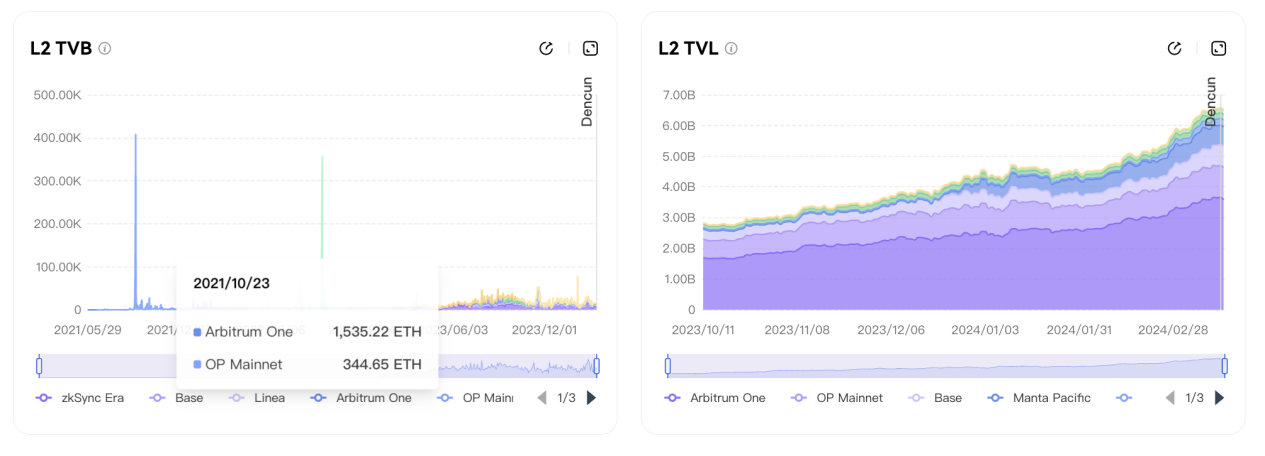
Data source: OKLink
Understanding the Dencun Upgrade
The Dencun upgrade is a shorthand term combining the execution client upgrade Cancun and the consensus client upgrade Deneb. The community commonly refers to it as the Kanquen upgrade, aiming primarily to optimize the Ethereum staking experience while enhancing Layer 2 efficiency and reducing costs. The Dencun upgrade includes nine Ethereum Improvement Proposals (EIPs): EIP-1153, EIP-4788, EIP-4844, EIP-5656, EIP-6780, EIP-7044, EIP-7045, EIP-7514, and EIP-7516. Among these, the most critical is EIP-4844—Proto-Danksharding.
EIP-4844 lays the groundwork for full sharding scalability known as Danksharding, introducing a new data storage structure called Blob to Ethereum. Blobs are specifically designed to store transaction data submitted by L2s to Ethereum, eliminating competition for Calldata space and making transactions cheaper and more efficient for users.
In the context where Ethereum’s prosperity conflicts with high gas fees, limited block space leads to inefficiency, congestion, and high costs—issues widely criticized by the market. Previously, all L2 transactions were stored within Ethereum’s Calldata, which has limited capacity and requires data to be processed and permanently stored on-chain by Ethereum nodes. It is estimated that up to 80% of L2 transaction costs and gas fees stem from Calldata storage expenses. By creating additional temporary data storage space via Blobs on Ethereum, L2 data storage costs are drastically reduced, enabling higher transaction throughput.
According to OKLink data, major L2 networks including Arbitrum, Optimism, Starknet, and Base have already integrated EIP-4844, achieving gas fee reductions exceeding 90%.
More data available at this link
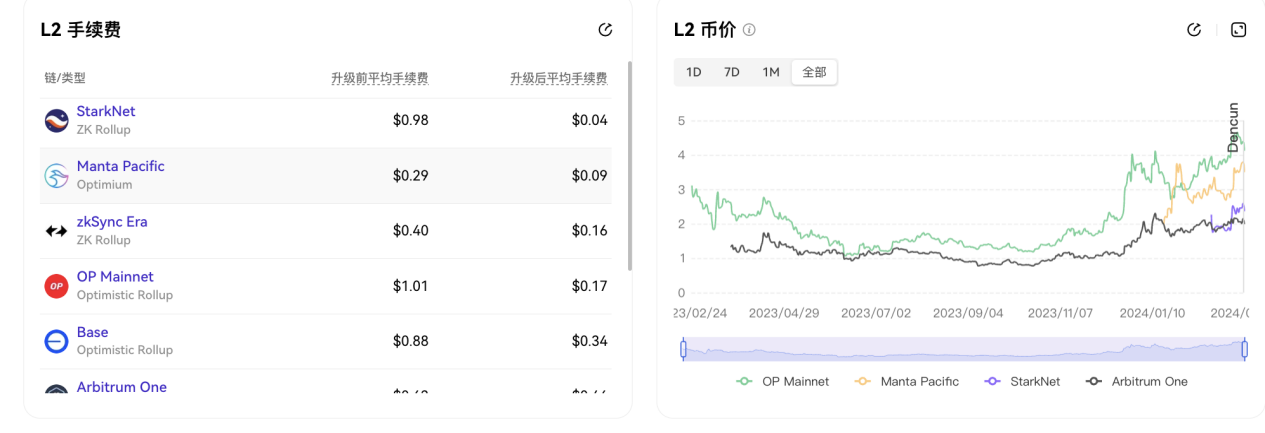
Data source: OKLink
However, it should be noted that Blob data storage is temporary, lasting 4,096 epochs—approximately 18 days. Ethereum prioritizes real-time data availability rather than long-term retrievability. Permanent storage of transaction data offers relatively low value, and periodic clearing of Blob data helps save storage space, maintaining or even increasing Ethereum’s competitiveness in the public chain landscape.
Still, parts of data discarded by Blobs may retain potential utility—for example, detecting malicious node behavior, preventing rug pulls by chain operators, or supporting escape hatch mechanisms or forced withdrawal systems. To address this, OKLink will securely store all blob data, ensuring historical data safety and retrievability to support the healthy development of the Ethereum ecosystem and provide services whenever needed by individuals or public chain teams requiring access to Blob data.
Additionally, EIP-4844 introduces a new fee market mechanism for Blobs, helping maintain optimal pricing. The introduction of the Blob data structure significantly reduces costs for Ethereum L2s on top of existing infrastructure. For instance, zkSync—the first L2 to adopt Blobs—saw its sequencer costs drop by about 88%; Starknet’s actual gas fees fell as low as $0.01. However, final results depend on various factors specific to each L2. Furthermore, transaction speeds could increase by 10x or even 100x. Besides EIP-4844, this upgrade also includes EIP-1153, EIP-6780, among others. Overall, the Dencun upgrade encourages greater transaction activity and sustainably supports the long-term growth of the L2 and Ethereum ecosystems.
How to Fully Explore the Ethereum and L2 Ecosystem via OKX Web3 Wallet?
After the Dencun upgrade, users can conduct on-chain transactions at very low gas fees. As a leading all-in-one Web3 gateway, OKX Web3 Wallet now fully supports the Ethereum and L2 ecosystems, offering a crucial foundation for users to better explore the on-chain world.
Currently, OKX Web3 provides comprehensive support for Ethereum and its Layer 2 ecosystem, having率先 integrated mainstream L2 networks such as Blast, Optimism, Arbitrum, Starknet, zkSync Era, and Manta Pacific. Users don’t need manual configuration—they can seamlessly switch between these networks for asset management with just one click.
To improve capital efficiency, users can interact with Ethereum restaking protocols through the OKX DeFi section. The concept of “restaking” was first introduced by EigenLayer, allowing users to re-stake ETH already pledged on the Ethereum mainnet onto other consensus protocols via EigenLayer. This enables those protocols to inherit Ethereum’s security while granting users additional rewards. OKX Web3 DeFi’s “Restaking Earn Campaign” now integrates multiple types of restaking protocols, offering users extra points or token incentives. Through “ETH restaking,” “liquid staking,” or “liquidity restaking,” users can earn additional rewards. For example, participating in Kelp earns 30% extra points; joining Renzo grants 10% extra points plus up to 20% bonus yield. Click here to participate: https://www.okx.com/cn/web3/defi/activity/8
Users can exchange Ethereum and L2 assets and perform cross-chain swaps via OKX DEX, enjoying best-in-class liquidity, optimal pricing, and zero trading fees, making it easy to trade any asset. Currently, OKX DEX supports multiple Ethereum Layer 2 networks, including Avalanche C, Arbitrum, Optimism, zkSync Era, Polygon zkEVM, Linea, Base, Mantle, Starknet, and Scroll. As a powerful DEX and cross-chain aggregator, OKX DEX aggregates over 20 cross-chain bridges, 20+ public chains, and 400+ DEXs, featuring additional tools such as DEX market data, limit orders, KYT security checks, and a newly added intent-based trading mode that enables gas-free transactions.
To help lower the barrier to Web3 adoption, reduce search costs, and allow precise interactions during fragmented time, Cryptopedia has launched interactive missions for L2 ecosystems such as zkSync Era. By aggregating and curating high-quality DApps and setting interaction tasks, Cryptopedia enables users to enjoy smooth onboarding experiences while earning multiple rewards. For instance, users exploring selected zkSync Era DApps via OKX Cryptopedia can better discover the L2 ecosystem and receive rewards. OKX Cryptopedia serves as an all-in-one DApp discovery and reward platform, regularly launching network-themed events in collaboration with partners to set interactive DApp challenges.
OKX Discover was among the first to launch Layer 2 ecosystem exploration, promptly supporting Ethereum’s Dencun upgrade and helping users safely and quickly engage with the Ethereum and L2 ecosystems. Additionally, to broadly explore Ethereum and L2 ecosystems and discover popular DApps, users can use the OKX Discover section to find and jump directly to trending DApps, simplifying and streamlining their journey into the on-chain world. For example, OKX Discover has added dedicated zones for restaking, Solana ecosystem, inscriptions, Bitcoin ecosystem, essential tools, and trending blockchain games, delivering the latest and hottest on-chain updates.
Moreover, users can monitor Layer 2 network data anytime via the OKX Browser or OKLink’s dedicated Dencun upgrade page, accessing intuitive metrics such as price movements and fee reductions, analyzing potential impacts from changes in fees and TPS on TVL, TVB, and active address counts, and tracking how the upgrade affects overall Ethereum data. Additional features include viewing Ethereum’s complete development timeline and past upgrade summaries.
Through coordinated support across its modules for the Ethereum and L2 ecosystems, OKX Web3 Wallet empowers users to explore the on-chain world simply, securely, and efficiently, establishing itself as an indispensable Web3 tool.
Dencun Upgrade: Revitalizing Ethereum and L2
Ethereum carved out a distinct path from Bitcoin’s peer-to-peer electronic cash system. As the world’s largest open-source platform, Ethereum introduced smart contracts to the blockchain world for the first time, shaping the direction of the crypto industry and laying the foundation for a decentralized future. Ethereum did not merely create a cryptocurrency—it established a new financial infrastructure, offering people a freer, safer, and more open transaction environment, driving innovation and progress across the entire sector.
As the L1 with the largest developer community, Ethereum’s legitimacy remains irreplaceable. Despite facing intense competition and criticism over congestion and high costs—placing it in a challenging position—innovations in L2 and Rollup scaling solutions will inevitably shoulder the massive transaction load of the mainnet, buying time and space for the arrival of Ethereum 2.0.
Looking back at its evolution, OKX Web3 Wallet not only supports the Ethereum and L2 ecosystems to strengthen community building but also brings massive liquidity by connecting users, positioning itself as a key contributor to both ecosystems. With full support for Ethereum and L2, backed by strong technical expertise and continuous innovation, OKX Web3 Wallet provides cutting-edge market tools that greatly lower user entry barriers, enabling seamless, one-stop exploration of the on-chain world.
Despite its slow pace, Ethereum—the great creative machine—has never stopped moving forward. From Frontier, Homestead, Metropolis to Serenity, through numerous upgrades and countless EIP proposals, every step brings it closer to its vision of becoming a scalable, decentralized, and globally accessible settlement layer. Moreover, as market attention shifts from spot Bitcoin ETFs to potential spot Ethereum ETFs, Ethereum stands to gain even more visibility and momentum.
Join TechFlow official community to stay tuned
Telegram:https://t.me/TechFlowDaily
X (Twitter):https://x.com/TechFlowPost
X (Twitter) EN:https://x.com/BlockFlow_News