








Phoenix: Decentralized AI Vertical Infrastructure | JDI Ventures Research Report
TechFlow Selected TechFlow Selected
Phoenix: Decentralized AI Vertical Infrastructure | JDI Ventures Research Report
The integration of DePIN (Decentralized Physical Infrastructure Networks) and AI (Artificial Intelligence) is bringing revolutionary changes to the market.
 Navigating Web3 tides with focused insights
Author JDI Ventures

With the launch of Sora, the text-to-video AI model, the AI field has reached another milestone. Undoubtedly, the AI wave initiated by ChatGPT is now unstoppable—a technological and commercial surge that will transform people's lives more profoundly than the internet, reshaping how we consume, work, and entertain ourselves.
This vision requires unprecedented scale in computing resources, and Phoenix provides a vertical solution for AI compute power.
Simply put, Phoenix leverages DePIN (Decentralized Physical Infrastructure Networks) to efficiently allocate resources, rapidly build and scale AI-driven automation tools and predictive models, and enable distributed AI computing across local device networks.
TLDR:
Phoenix, a leading decentralized AI infrastructure platform, recently launched its large language model (LLM) service, Phoenix LLM, on Telegram, enabling seamless access to AI capabilities for Telegram users. In short, users can easily link their SkyNet account with their Telegram username and start using the PhoenixLLM Telegram Bot for various AI-powered interactions.
Compared to traditional centralized LLMs like ChatGPT, Phoenix LLM offers a cost-effective solution—approximately one-third the cost—and prices are expected to decrease further as the GPU node network expands.
Phoenix plans to roll out specialized vertical LLMs targeting specific domains such as Web3, AI, data science, and trading/macroeconomic research.
Phoenix has formed a strategic partnership with Bobber.com, a leading Helium hardware provider, aiming to create a new generation of lightweight AI computing nodes, allowing individuals and partners to contribute GPU-powered computing resources to SkyNet.
For a deeper dive into Phoenix, read on:
Phoenix: Blockchain Infrastructure for Intelligent Web3 Applications via DePIN + AI
The convergence of DePIN (Decentralized Physical Infrastructure Networks) and AI (Artificial Intelligence) is bringing revolutionary change to the market.
At its core, DePIN optimizes resource allocation—such as storage and computing power—in a decentralized manner, supporting data-intensive applications. The role of AI in today’s market is increasingly prominent, especially in advancing high-level analytics and deep learning models.
Phoenix is redefining the development and deployment of intelligent Web3 applications through its decentralized AI infrastructure, combining DePIN and AI technologies.
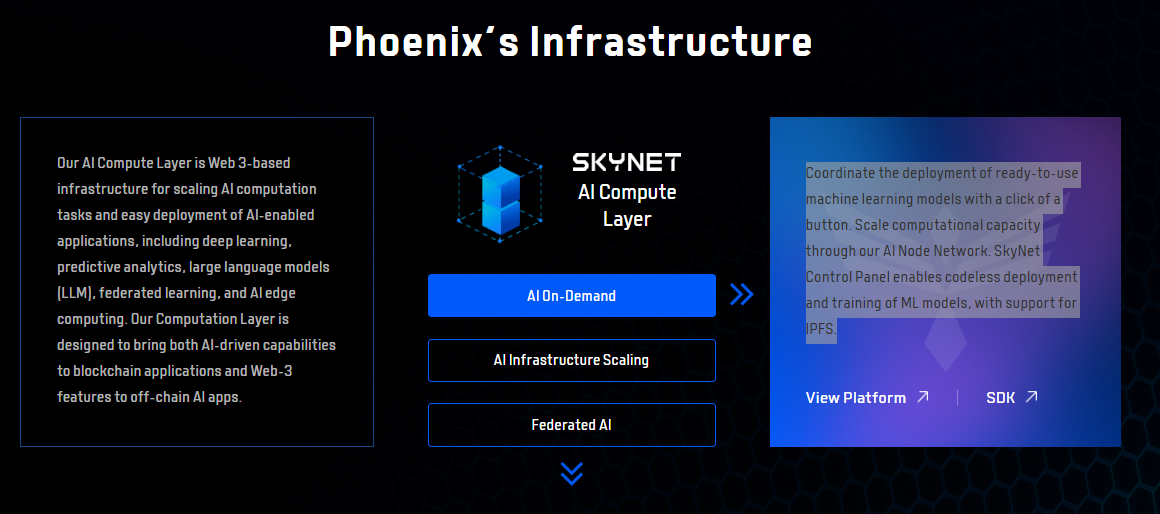 Phoenix’s AI computing layer is a Web3-based infrastructure designed specifically for scaling AI computing tasks and effortlessly deploying AI-enabled applications—including deep learning, predictive analytics, large language models (LLMs), federated learning, and AI edge computing.
Phoenix AI On-Demand Architecture
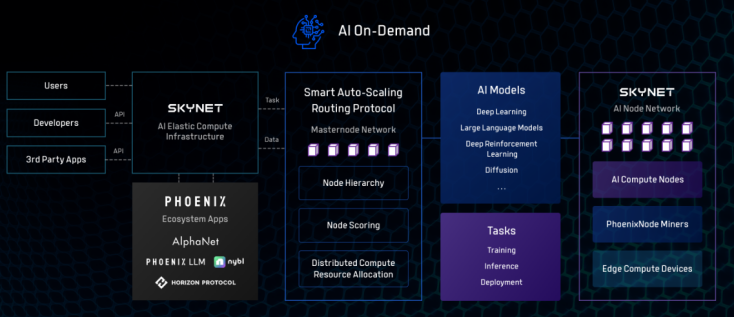
Phoenix’s decentralized AI architecture delivers a highly flexible ecosystem of AI services.
Ordinary users, developers, and third-party applications interact with SKYNET—the core AI computing infrastructure of Phoenix—via APIs, ensuring that different user types can easily access platform services tailored to their specific needs.
SKYNET sits at the center of this architecture as an elastic AI computing infrastructure, responsible for processing and executing AI tasks from users and developers, dynamically adjusting resource allocation based on demand.
An intelligent auto-scaling routing protocol further enhances resource efficiency, utilizing a master node network along with a complex hierarchy and scoring system to ensure optimal network performance.
Additionally, AI Model Blocks showcase the range of AI technologies supported by Phoenix—such as deep learning and large language models—all aimed at completing specific AI tasks like training, inference, and deployment.
Through the Phoenix platform, users can easily leverage these models to achieve their goals, whether it’s simple data analysis or developing complex new algorithms.
Applications within the Phoenix ecosystem—such as AlphaNet, PhoenixLLM, and HORIZON PROTOCOL—are all built atop this vast AI computing network, leveraging the AI capabilities provided by SKYNET to deliver targeted business functions and features.
Phoenix Trifecta
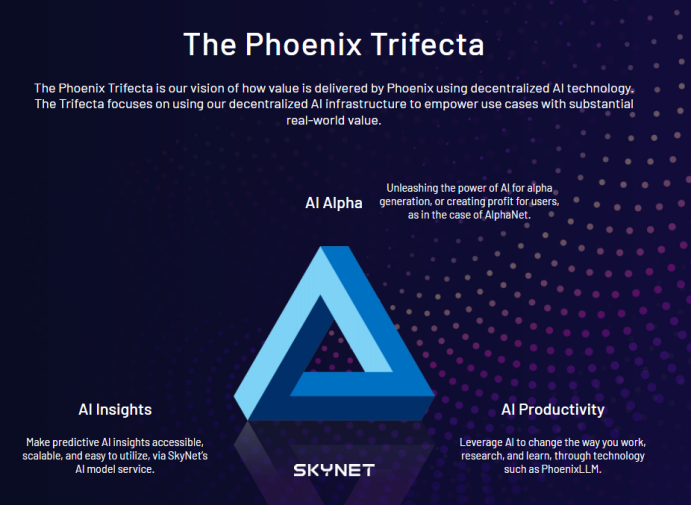
The Phoenix Trifecta represents Phoenix’s vision of delivering value through decentralized AI technology.
AI Alpha (AI Value Generation)
Creating financial returns for users using AI, such as through AlphaNet. This involves leveraging intelligent algorithms to analyze market trends and data, supporting investment decisions and generating additional value or profits.
AI Insights (AI-Powered Intelligence)
Making predictive AI insights accessible, scalable, and easy to use via SkyNet’s AI model services. This includes analyzing big data with AI to forecast future trends and inform decision-making—applicable across scenarios like financial analysis and market prediction.
AI Productivity (AI-Driven Efficiency)
Transforming the way we work, research, and learn through technologies like PhoenixLLM. This refers to using AI tools and services to optimize workflows, boost efficiency, and enhance productivity—such as automating tedious data processing or using large language models to assist in research and learning.
Overall, the Phoenix Trifecta emphasizes creating tangible value through decentralized AI technology—whether through financial gains, actionable insights, or improved efficiency—highlighting the immense potential and real-world applicability of AI.
Phoenix’s Vertical AI Solutions
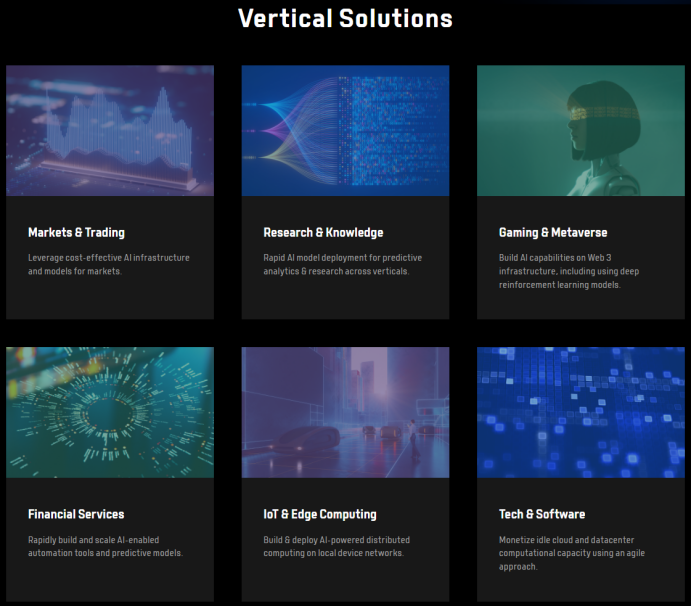
Phoenix’s vertical AI solutions span multiple industries, leveraging AI to improve efficiency and drive innovation in specific sectors. Below is an overview of its key vertical offerings:
Markets & Trading: Delivering services to markets using cost-efficient AI infrastructure and models. This may include algorithmic trading, risk management, market analysis, and real-time data processing to guide trading decisions.
Research & Knowledge: Enabling rapid deployment of AI models for predictive analytics and supporting diverse research fields. This accelerates scientific discovery, data analysis, and complex computations, improving both quality and efficiency in research.
Gaming & Metaverse: Building capabilities within Web3 infrastructure using deep reinforcement learning models. This includes creating smarter gaming environments, enhancing user interaction, and developing complex ecosystems in the metaverse.
Financial Services: Rapidly building and scaling AI-driven automation tools and predictive models. In finance, this could mean smarter robo-advisors, customer risk assessment, and personalized financial product recommendations.
IoT & Edge Computing: Constructing and deploying AI-powered distributed computing to strengthen local device networks. This enables smarter IoT devices, enhanced data processing, and real-time analytics at the edge.
Tech & Software: Commercializing cloud computing and data centers with flexible compute scaling. This includes SaaS, IaaS, and PaaS models, as well as leveraging cloud tech to optimize software development and operations.
These vertical solutions demonstrate Phoenix’s broad applicability and deep expertise in AI, offering customized AI services to support digital transformation and intelligent upgrades across industries.
Token Analysis: PHB
PHB, the native token of the Phoenix network, serves several key purposes:
Platform Utility Token: PHB is used as the primary currency for all transactions on the mainnet, representing transaction fees, service costs, and the value of various economic activities within the network.
Membership Points: PHB can be converted into Layer-2 data credits, granting users higher-efficiency data processing capabilities. By staking PHB, users gain faster transaction speeds and improved network performance.
Oracle Credits: Within the Phoenix network, PHB also functions as oracle credits, allowing users to access and utilize real-world off-chain data—an essential bridge between external data and the blockchain world.
Staking Rewards: Users can stake PHB through Phoenix’s staking system to support network security and stability. Stakers help protect the network from attacks and earn rewards generated from network operations based on their stake size.
The value of PHB extends beyond being a medium of exchange—it also incentivizes active participation. By taking on roles such as data providers, stakers, or node operators, PHB holders can actively contribute to and benefit from the Phoenix ecosystem.
As of March 8, 2024, Phoenix (PHB) has a market cap of approximately $133 million, with a 24-hour trading volume of around $189 million. The circulating supply is 48.41 million PHB, with a maximum supply capped at 64 million.
Overall, PHB holds a diversified market position, spanning both DePIN and AI sectors. Its high staking rate reflects strong community confidence in its long-term prospects.
Team Background & Partnerships
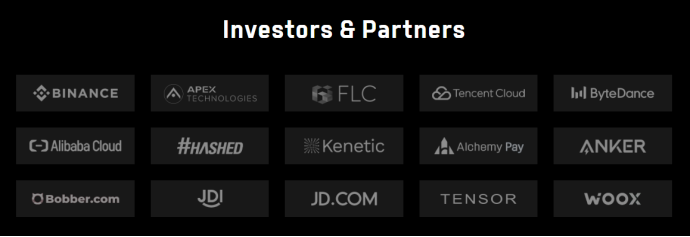
Phoenix counts top-tier exchanges like Binance, tech giants ByteDance and Alibaba Cloud, and e-commerce platform JD.com among its investors and partners. These collaborations provide critical technical support and market channels, particularly in advancing the integration of blockchain and AI technologies.
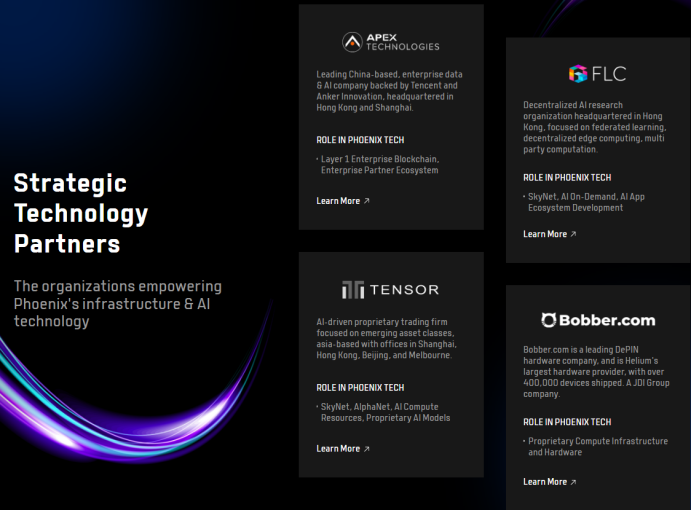
For example, APEX Technologies will play a role in enterprise-grade blockchain and multi-party computation within Phoenix Tech. Meanwhile, FLC, a research organization focused on federated learning and decentralized edge computing, will closely integrate with Phoenix Global’s technology.
Furthermore:
Phoenix has partnered with Bobber.com to co-develop the lightweight AI computing node, PhoenixNode. Bobber.com’s deep involvement stems not only from its proven success in deploying over 400,000 mining devices within the Helium ecosystem but also highlights its pivotal role in advancing AI computing hardware.
Competitive Landscape Analysis:
Helium
Helium leverages blockchain technology and its unique consensus mechanism—Proof-of-Coverage (PoC)—to address the challenge of providing decentralized, scalable IoT connectivity.
Since its founding in 2013, Helium has undergone multiple strategic shifts and technological advancements, evolving into a widely influential decentralized wireless network. In 2022, Helium transitioned into Nova Labs Inc., securing $200 million in funding led by Tiger Global Management and Andreessen Horowitz. Helium’s mission is to connect IoT sensor devices in areas with poor wireless coverage or high energy demands.
As of March 8, 2024, Helium (HNT) has a market cap of approximately $1.38 billion, with a 24-hour trading volume of about $43.09 million. The current circulating supply stands at 160.875 million HNT.
Bittensor
Bittensor is an open-source blockchain-based protocol designed to build a decentralized machine learning network. It supports collaborative training of machine learning models and rewards contributors in TAO tokens based on the informational value they provide.
Bittensor also aims to establish an AI marketplace where AI consumers and producers can interact in a trustless environment.
As of March 8, 2024, Bittensor (TAO) has a market cap of approximately $4.62 billion, with a 24-hour trading volume of around $31.7 million. Bittensor ranks first in the AI cryptocurrency sector.
DePIN + AI — The Growth Potential of PHB
Phoenix is more than just a blockchain platform—it represents the future of intelligent Web3 applications.
By integrating the powerful capabilities of Layer 1 and Layer 2 networks with innovative oracle technology, Phoenix is ushering in a new era for data-intensive, AI-driven applications.
As the core utility token of the network, PHB provides a reliable medium for value transfer, ensuring the smooth operation of the entire ecosystem. With continuous innovation in the DePIN + AI space, we can expect even more exciting applications and solutions to emerge on the Phoenix platform.
The fusion of DePIN and AI signals a transformative technological trend, embedding data and intelligent computing into decentralized infrastructure. We foresee a growing number of intelligent applications built on the Phoenix platform in the near future.
Phoenix embodies the future direction of Web3 technology. As innovation continues and use cases expand, Phoenix will continue to lead the industry in shaping a more open, intelligent, and efficient digital world.
X: https://twitter.com/Phoenix_Chain
Website: https://www.phoenix.global/
Github: https://github.com/phoenixglobal
Join TechFlow official community to stay tuned
Telegram:https://t.me/TechFlowDaily
X (Twitter):https://x.com/TechFlowPost
X (Twitter) EN:https://x.com/BlockFlow_News


