








How to better capture alpha in crypto trading?
TechFlow Selected TechFlow Selected
How to better capture alpha in crypto trading?
No cycle is truly different.
 Navigating Web3 tides with focused insights
Author: Tyrogue
Translation: Luccy, BlockBeats
Crypto researcher Tyrogue explores how to gain an edge and alpha in cryptocurrency trading by examining the types of crypto alpha—an essential topic for anyone trading cryptocurrencies on-chain or on centralized exchanges.
By reading this article, you will understand:
· The difference between Alpha and Edge
· What Alpha is, and how to use it
· How to develop an Edge and build your own intuition in crypto
· When to buy the bottom
· When to short a parabolic pump (haram)
In the CT (crypto community), the terms Alpha and Edge are frequently mentioned—but what do they actually mean?
Simply put, Alpha is actionable information that allows you to make money. There are different types of Alpha, each requiring a distinct Edge to profit from. Edge refers to the ability to extract profits from the market due to unique understanding or skill sets that others lack. Edge and Alpha are two sides of the same coin.
Alpha = Actionable information
Edge = The ability to act on that information
There are many variations—let’s break them down.
3 Basic Types of "Alpha"
Time-sensitive Alpha
This involves news-based trading and speculative plays where you take high-conviction positions with strong odds of success. Examples include shorting Cronje before his exit from crypto in 2022, or going long on FTT during its recent parabolic surge.
Psychological/Mass-behavior Alpha
This includes technical analysis patterns like familiar chart icons, or knowing certain fractal behaviors related to airdrops. It can be profitable to buy compromised or bankrupt projects despite poor fundamentals—SOL, FTT, CEL, and SRM are all great examples.
Look at LUNC—it delivered solid returns during the last bear market. This also extends to GCR’s massive buying at bottoms like 10 SOL, 1,000 ETH, and 15,700 BTC. The crowd was screaming about contagion and worse yet to come, but it never arrived (at least not yet).
Intuition
The ability to know, sense, and accurately predict what will happen next. This is the hardest to develop, and most people don’t have it. I’ve seen this among several CT members: @outpxce and his deep understanding of gaming; @0xJezza with his low-risk accumulation, selling, and entry into on-chain trades; @smileycapital who consistently forecasts price moves, rallies, and market trends ahead of the crowd; @ZoomerOracle spotting new breakout coins outperforming the market (TIA, ZETA, BEAM); and @GCRClassic with his killer insights and market predictions.
Analyzing GCR’s market views, you begin to see how his intuition was formed: he combines Schelling points, unit bias, and an understanding of market and human psychology at a genius level. His political forecasting background helped build this intuition—and most importantly, it comes naturally to him.
If you have the right intuition, making money should feel easy. If you've been around long enough, the best strategy might just be the simplest one. Whether it's buying FTT when the market started rising in 2023, APT when SOL began recovering, or BEAM when it rebranded, nodemonke launched, and PANDORA gained escape velocity—being able to quickly shift strong convictions is the winning approach. Let’s illustrate with examples:
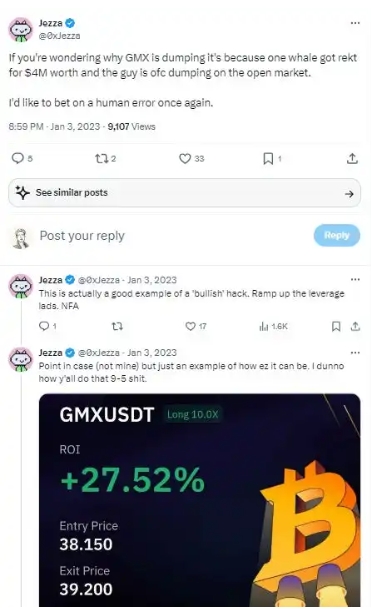
Example 1: Buy any hack or vulnerability as long as it doesn't fatally damage the protocol—GMX had a whale exploit costing $4 million, which turned out to be a bullish sell signal.
Example 2: Go long or short based on market trends and capitalize accordingly. Undoubtedly, the easiest trade last year was Blackrock ETF announcement, and noticing how the market reacted to a fake intern tweet (may his soul rest in peace).
Example 3: Wait for team-driven pumps or orchestrated rallies (not all projects are scams, but you get the idea). If you can identify projects that won’t go to zero and simply buy spot when volume drops and selling slows, teams often use announcements and catalysts to drive positive price action when conditions are right.
Research AVAX before its cultural incentive grants were announced, study Pengus and how they slowly became the preferred pfp, examine MC’s rebranding into BEAM—there are many such cases.
However, the most important principle behind all this is flexibility—adapting to whatever the market offers, meaning participating in currently thriving sectors. NFTs, leverage, Onchain, DeFi—you simply go where the money is. Know how to short/long on CEXs where capital is ready to deploy. Hold ETH or some funds on every semi-credible chain and L2 so you can seize new opportunities as they arise. Have a close friend who can invest on your behalf when you’re away from your computer, etc.
Summary of the post so far:
· Alpha is information that makes you money
· Edge is your ability to monetize that information
· Alpha can be found in many ways, and everyone has different advantages in this market. Find your edge, strengthen it, and win.
· Winning strategies change with the seasons. Therefore, the key to success is constant adaptation—never forget to turn off your intermediate brain, either become a dumb ape or a giant brain. There are no second places in the market.
Some Quick Thoughts on Cycles, Phases, Conviction, and Profiting from the Market

Now, most people in crypto hold various small-cap and large-cap coins worth six to seven figures in potential future value, but due to lack of cycle conviction, they sell too early.
If you don’t believe in an upcoming insane peak (possibly distribution, double top, single top, etc.), you’ll sell prematurely. To capture the insane multiples unique to crypto, you must be able to:
· Know when to take risk
· Know when to take profits to rebuy lower
· Know when to HODL firmly for massive upside volatility
· And know when to run
Imagine buying ETH for single digits and selling after the DAO hack due to lack of conviction—or upon hearing the false news of Vitalik’s death. Imagine buying AVAX for double-digit prices and selling before the second FTX and 3AC top in 2021. Or selling LUNA at single-digit prices after its first parabolic move, while it later peaked above $100.
I know someone who sold 20 Bored Apes for a few ETH each just before the real NFT season kicked off in 2021.
The easiest way to get absolutely destroyed in this space is to borrow someone else’s conviction and not truly understand what you’re doing here.
When you buy a token, you should know:
· Its potential upside—how high can it go? Understand its tokenomics, FDV, and what catalysts could drive a major rally.
· Is the technology actually good? Good tech might become a meme, a new L1, or a novel consensus mechanism—but try to learn more after entering so you know what you're holding.
· Are you an early or late participant in the narrative? If early, you can go all-in with large spot or leveraged positions and just monitor. If late, you may only catch downside moves. If early, you can front-run the crowd, but exit much earlier than you think.
You should also understand the token’s competitors and holders—are they:
· True believers who will never sell? Like TAO, KAS.
· Meme coin traders who dump on -70% candles to rotate into other tokens? Like recent meme dumps.
· Institutions and VCs waiting to dump on retail after unlock, or pumping beforehand? Like TIA, SOL in previous cycles.
· Retail investors who will keep bidding until they’re broke?
Tokenomics, holder composition, and narrative—study the combination of these three to assess whether the token you just discovered can actually generate returns. What is its market cap? How does it compare to others? What could its maximum market cap realistically reach?
Some tokens will never exceed $100 million. Others are destined to become multi-billion dollar assets. Some, despite strong PMF, are capped at $10 million because people only speculate on the story. You must balance realism about potential multiples with optimism about outperformance—it’s a delicate equilibrium.
Next, consider the token’s liquidity and buying process. When RLB was just pennies, SOL seemed dead—but if you saw product revenue and user growth, then held like diamond hands through panic and volatility, you could have captured sweet 20–50x gains. Generally, the earlier you buy, the harder it is to acquire.
TAO once traded OTC between $10–$25 with a complex purchase process—only true believers got in. Now it trades many times higher, rewarding early buyers.
During bull markets, there are countless ways to achieve massive gains—and just as many ways to crash and burn when the market turns. Your job is to ride the bull run, watch for signs that nearly everyone has entered, then swiftly start exiting before liquidity dries up, charts turn red, and people attack each other like hungry demons desperate to recover their money.
Stop thinking about how to win the next market move. Start thinking about how to succeed across the entire cycle. Countless tokens, NFTs, and innovations will emerge in crypto—you just need to listen closely and stay alert. Even now, the next unicorn in crypto is being born. When its token launches, you must be ready. But you must deeply understand yourself and your market perception to act correctly and win. Some will earn millions via leveraged trades, others through on-chain token holdings, some simply by owning the right spot tokens or minting the right NFTs. Find your path, but also learn how to succeed using others’ paths when needed.
If history repeats, we’re now roughly 18 months into a bull market—but it will be tough. You may want to sell early, or at the peak, you’ll believe this time is different, that we’ve finally built the future of finance. You’ll want to exit before the party ends, but you might not squeeze enough juice from that orange before it’s over.
No cycle is truly different. The drivers of bubbles may vary—inflation, apocalyptic narratives, modernization—but behavior remains the same. A group believes a new asset, stock, or commodity is the next big thing, credit expansion fuels rising prices, until the bubble bursts and wealth transfers from the many to the few. Just as another bull market will come, so will another bear market.
There will always come a time when people again call everything an illusion—but for now, to those of us still here in crypto, everything feels like shiny new objects.
You must be prepared. You must believe.
Join TechFlow official community to stay tuned
Telegram:https://t.me/TechFlowDaily
X (Twitter):https://x.com/TechFlowPost
X (Twitter) EN:https://x.com/BlockFlow_News
 @TyrogueD











