Forbes: With Spot Bitcoin ETFs Here, What's Next for Bitcoin Futures ETFs?
TechFlow Selected TechFlow Selected
Forbes: With Spot Bitcoin ETFs Here, What's Next for Bitcoin Futures ETFs?
The arrival of Bitcoin spot ETFs has posed a challenge to all existing futures ETFs.
 Navigating Web3 tides with focused insights
By Javier Paz, Forbes Staff
Translated by Luffy, Foresight News
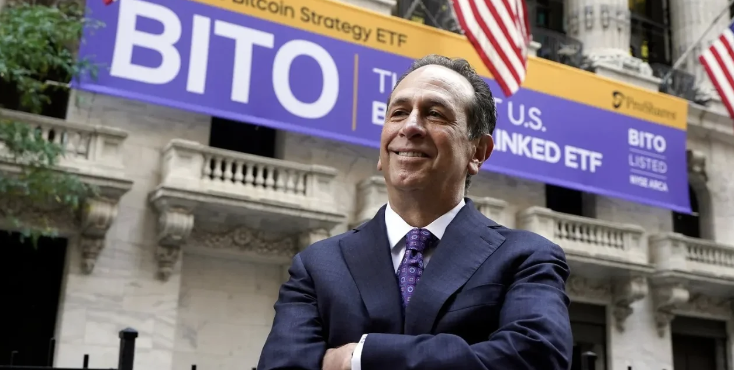
Michael Sapir, CEO of ProShares, photo source: AP
For the 20 months prior to January 2024, investors seeking exposure to a Bitcoin fund traded on U.S. exchanges had only one option: enter the futures market. The U.S. Securities and Exchange Commission (SEC) rejected more than 30 applications for cryptocurrency funds, citing concerns that crypto markets were susceptible to manipulation. These funds simply bought top cryptocurrencies and packaged their holdings into shares listed and traded on major securities exchanges.
Despite being seen as "arbitrary and capricious," the SEC ultimately approved Bitcoin futures ETFs because their prices are determined by regulated commodity exchanges—even though those futures prices are themselves based on Bitcoin’s spot market. Starting with the ProShares Bitcoin Strategy ETF (BITO) in October 2021, 13 futures-based Bitcoin ETFs have since launched. Based in Bethesda, Maryland, ProShares was the first firm to launch a Bitcoin ETF, raising over $1 billion on its debut day—making it the most successful ETF launch in history. Since then, through January 10 of this year—the date the SEC allowed 10 spot ETFs to begin trading—the company has accumulated approximately $2.5 billion in assets.
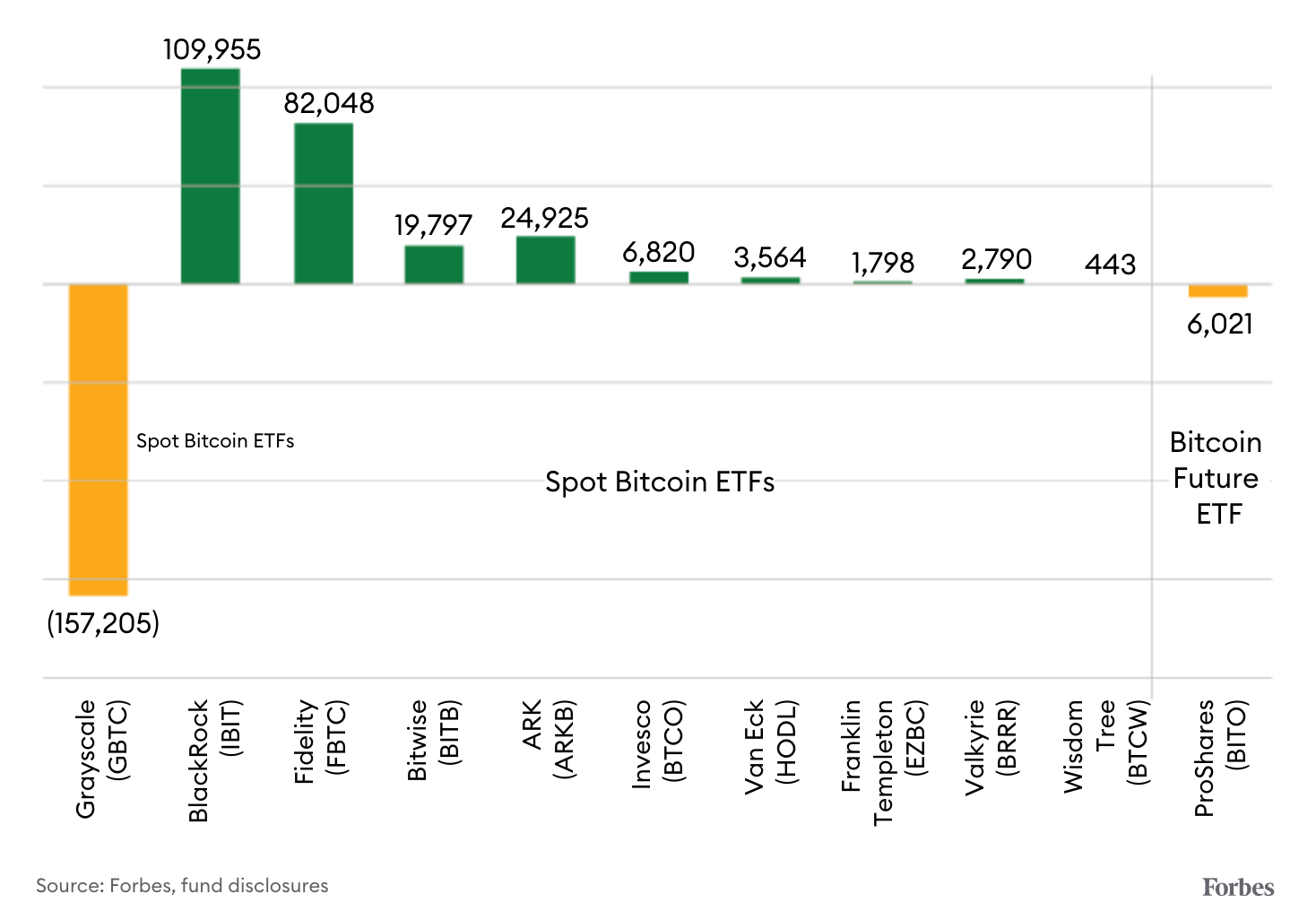
Since launching in January, Bitcoin spot ETFs have amassed $34 billion in assets within just one month—including over $28 billion converted from the closed-end fund GBTC. Suddenly, the outlook for Bitcoin futures ETFs looks less certain. “Investor interest will shift from products offering exposure via futures to those providing direct spot exposure,” said Kyle DaCruz, VanEck’s digital asset product director. “Spot products track Bitcoin’s price more closely.” VanEck isn’t waiting passively for its futures-based Bitcoin fund to fade away. Last month, it shut down its $43 million Bitcoin Strategy Fund (XBTF) futures ETF to focus instead on its new spot fund, the VanEck Bitcoin Trust (HODL), which currently holds $176 million in assets.
In contrast, ProShares is doubling down on futures ETFs. It has no plans to exit its $2 billion Bitcoin Strategy ETF (BITO) or convert it into a spot fund. Instead, it recently filed to launch a series of complementary leveraged futures ETFs, adding leverage to the fund’s indirect Bitcoin investments. ProShares’ BITO charges an expense ratio of 0.95% of fund assets—about three times higher than that of new spot ETF competitors.
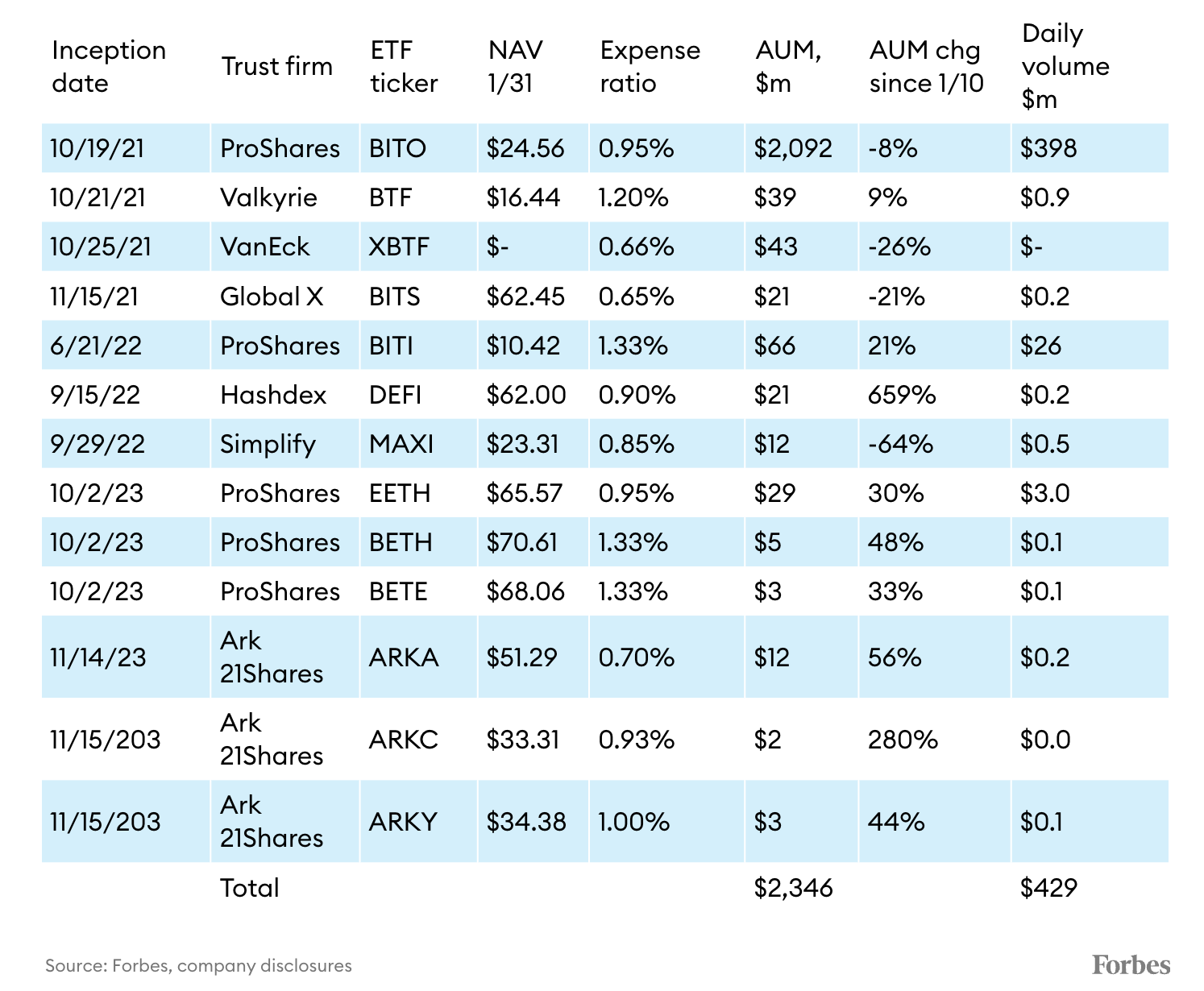
Bitcoin Futures ETFs, Source: Forbes, data as of February 14, 2024
Background
BITO and similar futures-based Bitcoin ETFs buy cash-settled futures contracts on regulated exchanges like the Chicago Mercantile Exchange (CME), packaging them into freely tradable shares on stock markets. These differ from new spot ETFs, whose issuers purchase physical Bitcoin and then offer shares representing partial ownership in a Bitcoin portfolio. Futures ETFs can be more complex and costly because issuers must continually roll into new contracts upon expiration—typically at month-end—and hidden roll costs may erode returns if Bitcoin prices rise.
As shown below, from inception through January 30 of this year, BITO trailed its benchmark Bloomberg Galaxy Bitcoin Index by 8 percentage points. Note that there is a difference between cumulative return and spot price return, as the former includes additional factors such as dividend payments and interest earned on fund cash. Pure spot ETFs have not yet paid dividends.
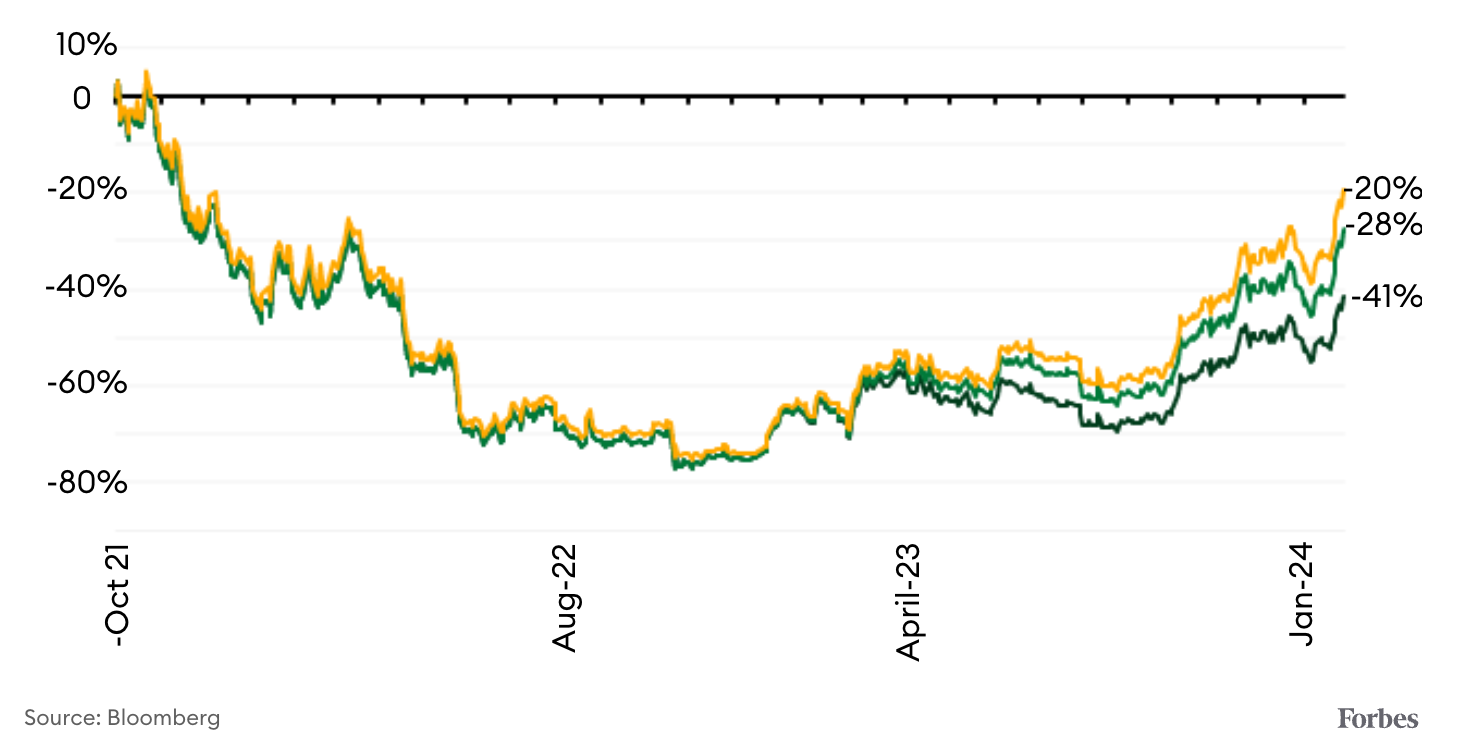
BITO performance relative to BTC index benchmark since inception. Dark green represents BITO price return (excluding dividend reinvestment), light green represents BITO cumulative total return (including dividend reinvestment), yellow represents BTC index return %; Source: Bloomberg
Given these added mechanisms and higher costs, it may surprise some that the SEC initially approved futures ETFs. However, SEC Chair Gary Gensler—who previously led the Commodity Futures Trading Commission, the regulator for futures markets—feels more comfortable with ETFs tracking products traded on regulated exchanges rather than spot products traded largely on unregulated cryptocurrency exchanges.
ProShares’ strongly launched BITO dominates the Bitcoin futures fund space, holding 90% of the market share. From January 10 to February 16, assets under management in BITO declined by $126 million, yet its total assets remain $1.3 billion higher than in mid-October 2023, when institutional investors, bullish on Bitcoin amid expectations of SEC approval for spot ETFs, began buying into futures ETFs.
The exact reason for BITO’s significant outflows since January 11 is difficult to pinpoint, but much of it may stem from short-term traders taking profits. Cathie Wood’s Ark Invest converted its BITO holdings into shares of its own spot ETF, the Ark 21Shares Bitcoin ETF, realizing gains of about $93 million.
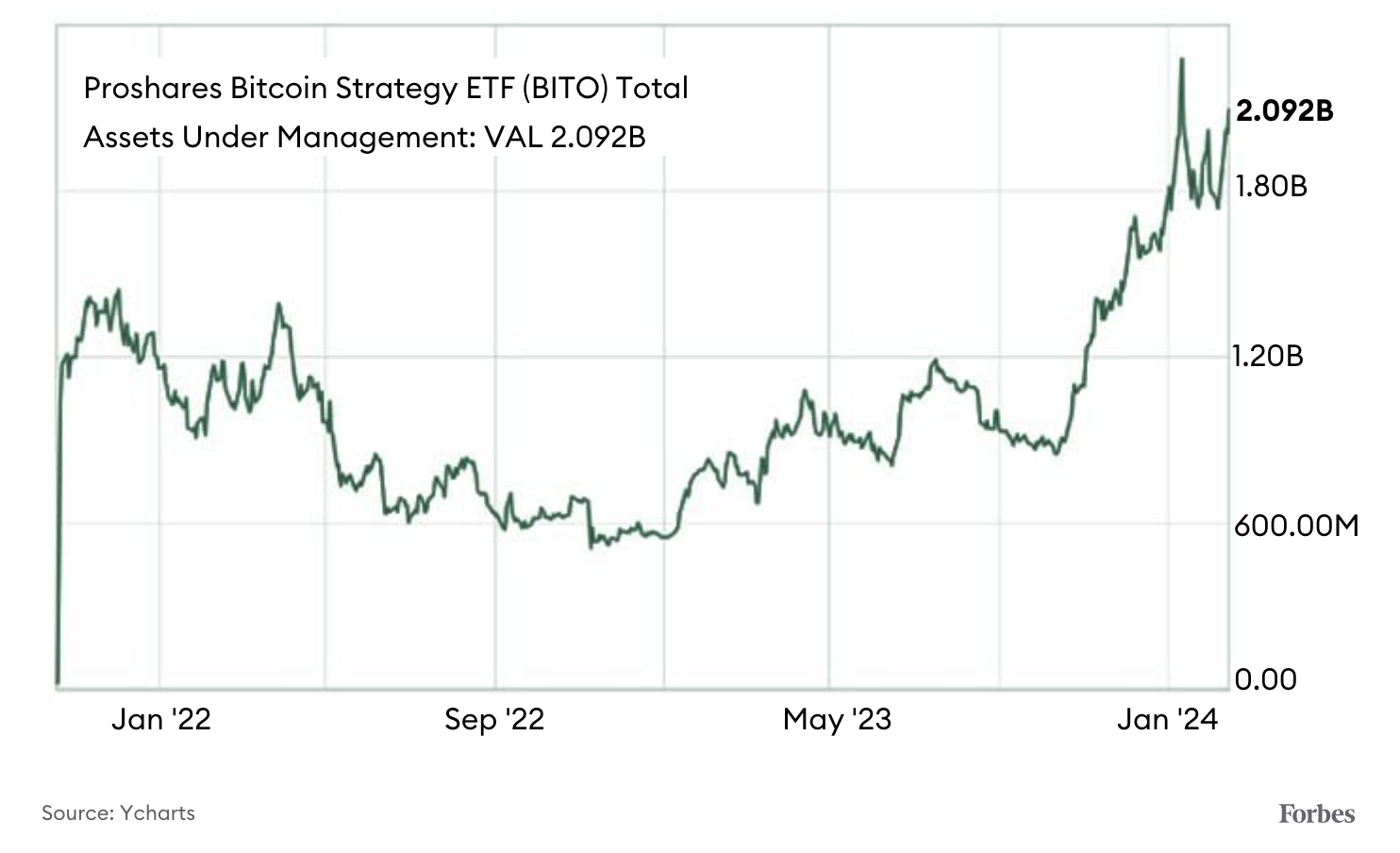
BITO ETF assets under management since October 2021, Source: Ycharts
Key Statistics
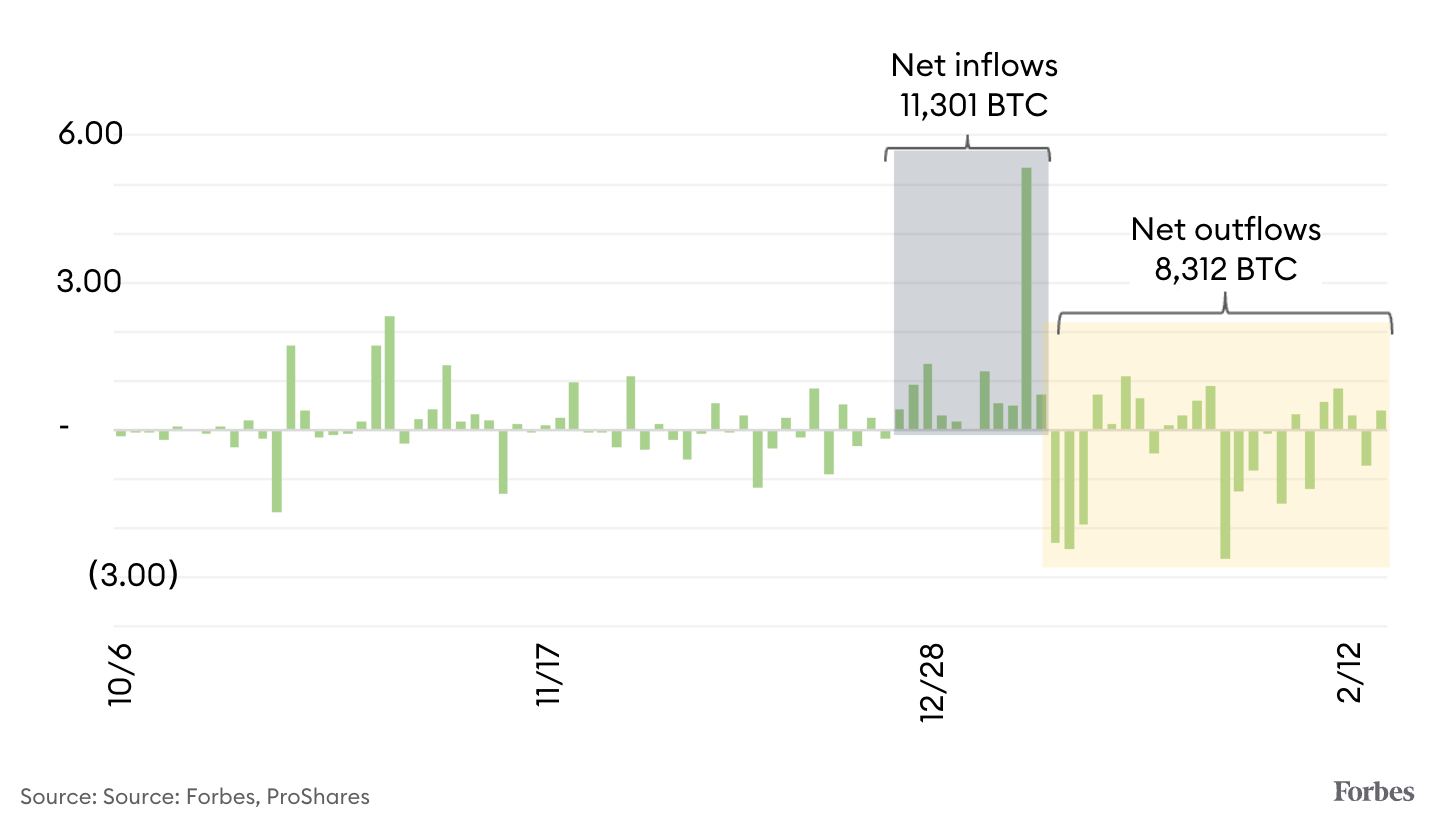
BITO Bitcoin-equivalent holdings, Source: Forbes, ProShares
Bitcoin inflows (outflows) from January 11, 2024 to February 14, 2024, Source: Forbes
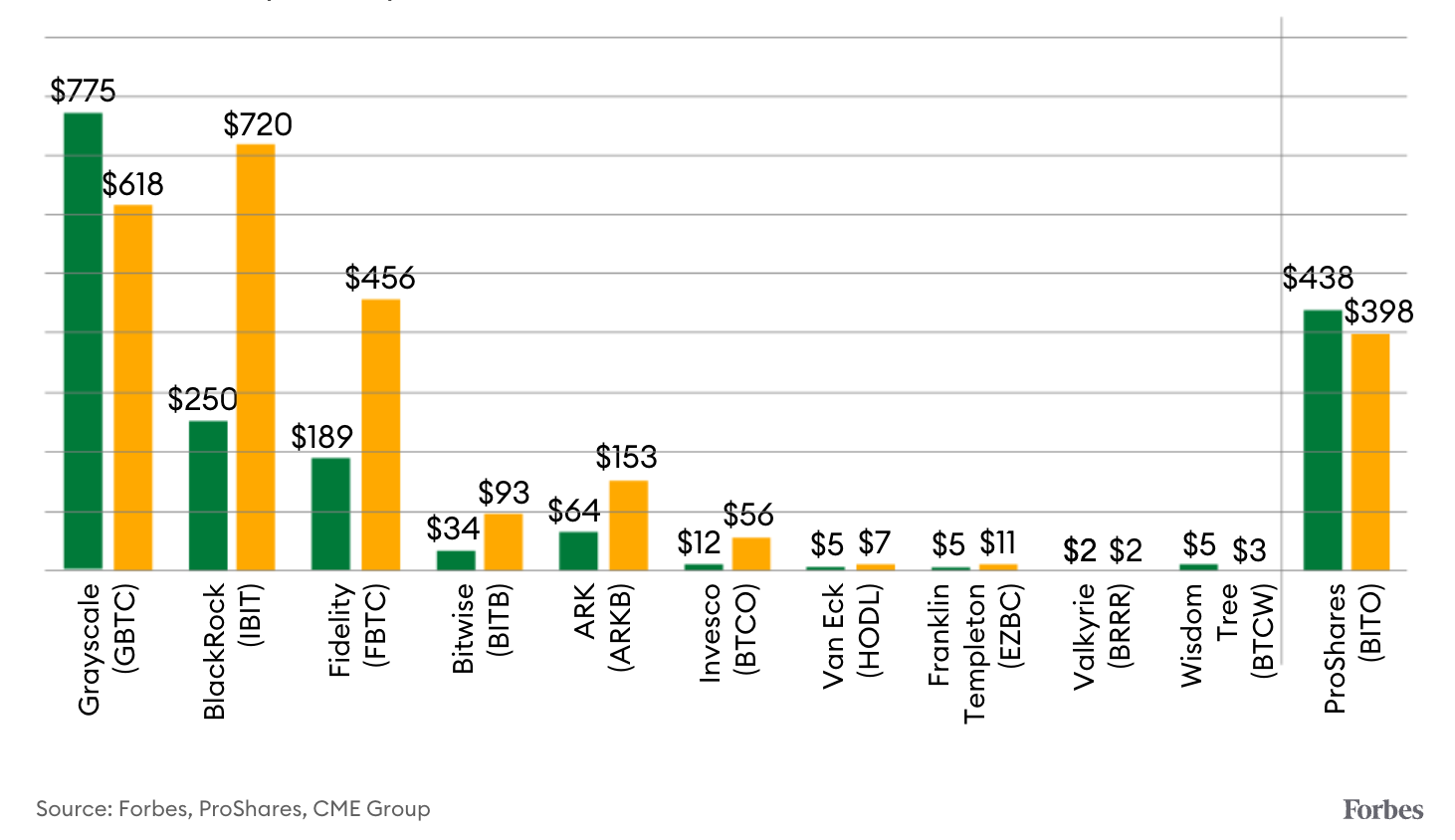
Trading volume comparison. Green represents average trading volume over the past 24 trading days, in millions of dollars; yellow represents activity from the most recent day, in millions of dollars. Source: Forbes, ProShares, CME
Outlook and Implications
ProShares’ BITO enjoys a steady revenue stream, with an expense ratio of 0.95% on roughly $2 billion in assets—generating around $19 million annually. If ProShares were to switch to a spot ETF, it would likely need to cut its fee by two-thirds (though its costs would also decrease) to remain competitive. BITO is just one of over 40 exchange-traded products offered by ProShares, which manages a total of $64 billion in assets. The company appears to be following a strategy similar to that of Bitcoin Trust (GBTC), which charged a 2% fee as a closed-end fund and only reduced it to 1.5% upon conversion to an ETF. In contrast, most new spot ETF competitors charge fees around 0.26%. ProShares’ public statements mirror those of Grayscale CEO Michael Sonnenshein, who has justified GBTC’s high fees by emphasizing experience, operational efficiency, liquidity, and tight bid-ask spreads.
“We believe BITO’s continued success stems from many investors wanting Bitcoin exposure through a fund invested in orderly, efficient, and highly regulated markets, custodied by one of the world’s largest banks—JPMorgan Chase,” said Michael Sapir, CEO of ProShares.
Compared to spot ETF rivals, BITO’s higher expense ratio may never trigger massive redemptions. Inertia has long been a powerful force in investment management. “About 75% to 80% of AUM is invested in ETFs that have been around for more than 15 years,” said Hector McNeil, co-founder of hanETF. “They’re so deeply embedded in financial platforms and systems that they just keep collecting money.”
Another factor that might keep investors in ProShares’ higher-cost fund is taxes—particularly capital gains taxes owed by some BITO holders who have large unrealized profits.
But what about new capital? Are there reasons for investors to allocate to futures ETFs instead of spot Bitcoin ETFs? That’s a harder argument to make. Futures-based commodity ETFs do make more sense for certain assets than others. For example, crude oil is difficult to store. “The issue is, when you hold the spot, you need to store it in big tanks,” McNeil said. “There’s a cost associated with storing physical commodities.” However, he noted, spot gold ETFs don’t face the same challenge. “Gold is easy to obtain because it’s highly valuable, compact, and fits well in vaults… and there’s a liquid spot market.” Given that Bitcoin is marketed as a form of digital gold and is far easier to store, the gold analogy becomes even more relevant.
In falling crypto markets, futures-based funds could outperform Bitcoin. While BITO may struggle to keep up with spot prices during periods of futures premium, the reverse could benefit BITO in bear markets, when longer-dated futures contracts trade at higher prices and roll costs become cheaper. “Futures ETFs are a more complex product, so less suitable for most people,” said Ophelia Snyder, co-founder and president of 21.co. “It’s a tactical strategy product, not a buy-and-hold product.”
What’s Next for ProShares
While the ProShares Bitcoin Strategy ETF remains the company’s flagship cryptocurrency fund, the asset manager recently filed to launch five additional ETFs that will use swap agreements—a new form of Bitcoin exposure. These funds will also reference North American spot ETFs but won’t directly hold cryptocurrency positions, aiming to deliver leveraged daily returns based on the Bloomberg Galaxy Bitcoin Index:
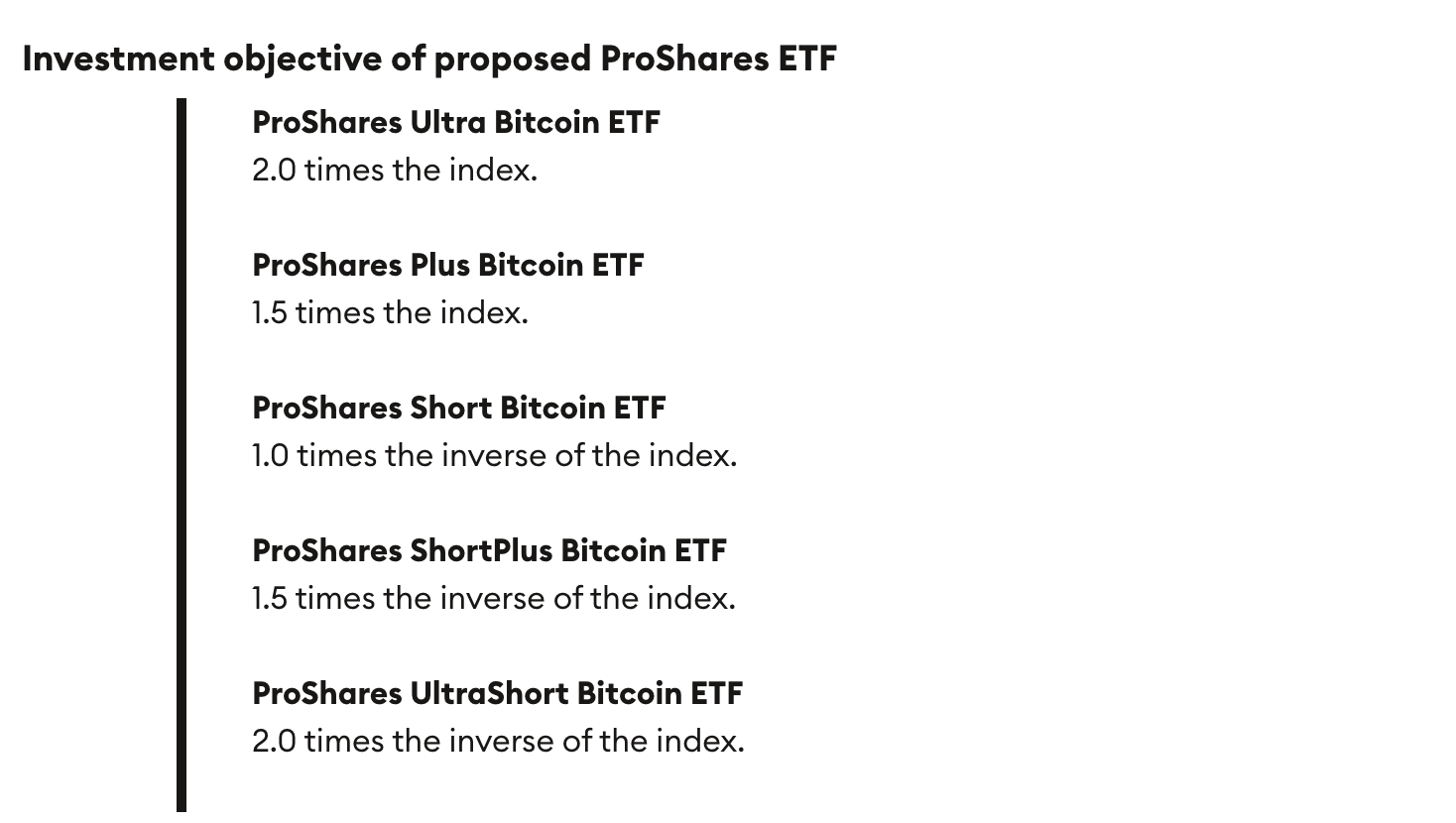
Source: SEC, ProShares filings
ProShares is targeting traders seeking financial leverage—a key differentiator from spot ETFs, which cannot use leverage to amplify returns. These higher-risk funds have not yet been approved for trading, but given that the SEC has already approved other products offering directional bets and leverage on Bitcoin prices, they are likely to be permitted.
ProShares’ second-largest cryptocurrency futures ETF, the ProShares Short Bitcoin Strategy ETF (BITI)—with about $58 million in assets—targets inverse 1x returns to Bitcoin prices, differing in that it primarily sells Bitcoin futures contracts to achieve its investment objective.
Despite higher product costs, ProShares’ dominance in the Bitcoin futures ETF space has cemented its position among seasoned cryptocurrency traders. ProShares is building a leveraged product ecosystem designed to attract institutional investors seeking amplified returns or risk hedging. It faces competition from similar offerings by other issuers, including Hashdex, GlobalX, and Ark21 Shares—assuming they remain active.
Join TechFlow official community to stay tuned
Telegram:https://t.me/TechFlowDaily
X (Twitter):https://x.com/TechFlowPost
X (Twitter) EN:https://x.com/BlockFlow_News
 Forbes