The Ethereum Rollups (STARKNET) battle ends, a new narrative on DA awaits
TechFlow Selected TechFlow Selected
The Ethereum Rollups (STARKNET) battle ends, a new narrative on DA awaits
DA is a long-term competition.
 Navigating Web3 tides with focused insights
Author: Zuo Ye
Abstract
-
Everything is modularizing—Ethereum self-modularizes, while Bitcoin gets modularized.
-
After rollups issue tokens, the narrative halts; narrative economics shifts to the DA layer/blockchain.
-
Orthodoxy and universality become banners, but in reality, fees and token issuance are what truly matter.
With StarkNet's airdrop marking the end of Ethereum rollup competition, it’s time to turn attention to data availability (DA). In my view, the term "data availability" (DA) is an incomplete expression—it lacks clear subject and predicate, merely describing the importance of transmitting transaction data beyond the execution layer. Moreover, DA mechanisms touch on fundamental blockchain operating principles, which I previously detailed in my article on runes using Bitcoin as an example.
Ethereum’s Narrative Falters, DA Takes Over Midway
Modularization is the prerequisite for DA. Ethereum's horizontal modularization involves sharding, while vertical modularization refers to layering—rollups handle transactions, and the mainnet handles DA and consensus. The surge in interest around DA indicates that the concept of layering has become widely accepted. Furthermore, the rollup wars are over; what remains now are just incremental improvements.
Mainnet upgrade plans have turned into daily or annual updates with limited impact on overall market confidence. Under these circumstances, narrative momentum cannot originate from either the topmost rollup layer or the foundational mainnet. Instead, DA—which connects both layers—becomes the optimal candidate.
Let us first clarify the full meaning of DA. Narrowly defined, data availability refers to how light nodes (e.g., wallets) can efficiently verify data held by full nodes. This rests on two assumptions:
-
Assumption 1: Light nodes do not download, or cannot download, complete full node data—especially when prioritizing user experience;
-
Assumption 2: Full-node data may be falsified, and without access control, malicious nodes could exist under either PoS or PoW.
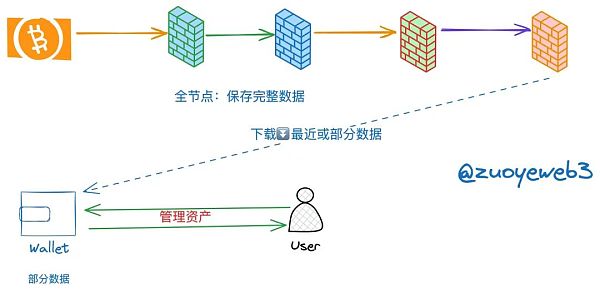
DA stems from real-world demand
On monolithic chains like Bitcoin, this isn’t a major issue because block headers contain rich verifiable information, and PoW ensures that 51% attacks remain largely theoretical. However, on modularized chains, the problem becomes complex—execution, settlement, consensus, and DA occur across different layers, sometimes even on separate blockchains.
It should be noted that according to Vitalik, data availability ≠ data retrieval ≠ data storage. Rather, DA means publishing data without tampering. Post-publication storage and retrieval fall outside DA’s core focus. The distinction lies in:
-
Data publication: On Ethereum, light nodes can directly prove transaction validity even without possessing all data.
-
Data recovery: For Ethereum, leveraging Ethereum itself for DA eliminates security concerns, so “publication” suffices. But projects like Celestia must demonstrate that data stored with them is equivalent to being secured by Ethereum, thus requiring retrieval or recovery mechanisms.
From Vitalik’s perspective, once data is published on the Ethereum mainnet, the process is complete—the subsequent storage and retrieval need not be overly worrying. This makes sense: as the second-largest cryptocurrency after Bitcoin, Ethereum’s security doesn’t require technical jargon to validate.
However! Exceptions exist. If transaction and consensus data do not fully circulate within Ethereum’s ecosystem, then considerations around data publication, retrieval, and even recovery must be carefully addressed—this is precisely where Celestia and Near DA must prove their value.
DA Relativity: Everything Can Be Modularized
Modularization is the direct catalyst behind the rise of the DA narrative. Ethereum has actively chosen to transform itself into a modular public chain, currently existing in a hybrid transitional architecture. Bitcoin, meanwhile, can be used as a modular Layer 1—seen in early experiments like OmniLayer and current BTC L2s.
The definition of modularization here is my own: any outsourcing or being outsourced of a monolithic chain’s functions counts as modularization, differing from Ethereum’s official terminology.
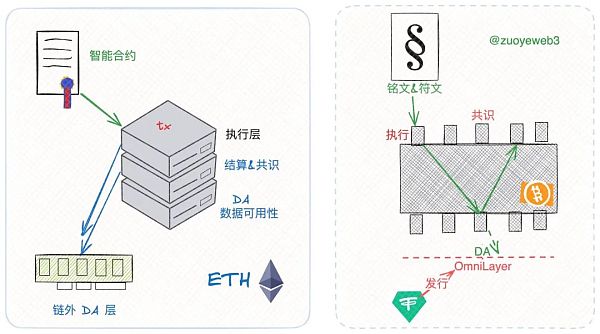
Any public chain can be modularized
Alternatively, consider this: historically, blockchains also had issues involving light nodes, partial nodes, and users verifying full nodes—but these weren’t large-scale market demands. Only in modularized architectures, where separation between layers creates challenges in state synchronization, data storage, publication, and recovery, does this become a critical issue. After all, no one wants to see a second rollback like The DAO incident.
First, understand modularization—the earliest practical example was the Lightning Network. Like DePIN, modularization exemplifies “practice preceding theory.” Outsourcing parts of blockchain functionality allows us to view the Lightning Network as a delayed-settlement accounting system.
Another example is USDT originally issued on Bitcoin’s OmniLayer, ultimately publishing data onto Bitcoin. This shows UTXO-based blockchains can also be modularized.
Account-model blockchains like Ethereum allow easier modularization. Near DA and Celestia follow similar logic. Since everything can be decoupled and Ethereum lacks Bitcoin’s extreme sacredness, treating Bitcoin as a data publication target or assisting Ethereum with data processing becomes entirely reasonable.
Without modularization, DA concepts might still exist—but they would never attract such intense attention.
Ethereum Rollup Wars End, BTC L2 Emerges
With modularization comes leadership. Before DA gained prominence, rollups won the scaling battle—even spreading influence toward BTC L2s. From a more radical viewpoint, modularization represents the ultimate scalability solution: whenever there's demand for improved security, scalability, or decentralization, components can be extracted from the mainnet, built independently, then reconnected.
Yet this raises an interesting question: despite Bitcoin lacking widespread scaling solutions, BTC L2 projects are booming. For instance, B² Network uses fraud proofs to feed data back to the Bitcoin mainnet—an approach treating Bitcoin as a DA layer. Meanwhile, alternative L1s aggressively enter the DA space. Why should Ethereum dominate DA? Are kings and generals born of noble blood? Orthodoxy must be overthrown and trampled upon—Near DA says so, and intends to act accordingly.
In a way, Ethereum improves upon Bitcoin, differing in four key aspects: PoW → PoS, UTXO → account model, monolithic → modular, scripts → smart contracts. Their intersection point is modularization—convergent evolution in scaling approaches. The difference lies in Bitcoin being passively modularized, with increasing numbers of L2s treating Bitcoin as a DA, settlement, or consensus layer.
Thus, we must acknowledge: “modularized Ethereum first created market demand for DA from rollups, which in turn ignited interest in DA layers.” The implicit premise is that rollups are no longer central actors—at least not those on Ethereum.
We can distinguish at least two categories: Ethereum-centric DA solutions like Ethereum itself, EigenLayer, Celestia, and Near DA; versus Bitcoin-based systems that effectively use BTC as DA, such as the Lightning Network, OmniLayer, and B² Network.
The crucial difference is this: for Ethereum, both Ethereum-native and EigenLayer approaches remain centered on ETH and the Ethereum network, ultimately empowering ETH. This stems from rollup economic design—rollups must pay a “toll fee” to leverage Ethereum’s security based on its ETH-powered PoS network. This toll primarily consists of DA costs: the expense of publishing rollup transaction data onto Ethereum for finalization.
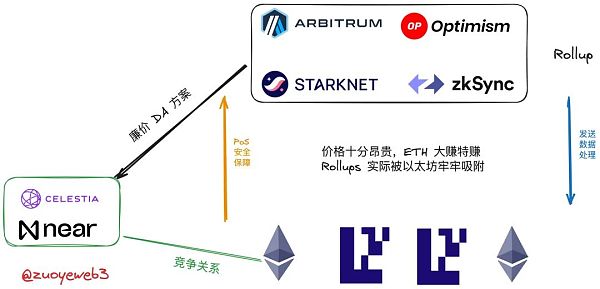
DA Economics
For Bitcoin, things are simpler: no smart contracts, no node censorship—you can write anything into transaction data as long as you pay miner fees. But beware: once written, there's no undo button—no rolling back data or slashing nodes. BTC L2s must resolve transaction conflicts independently.
Mouth Full of Ideals, Mind Full of Business
Vitalik initiated a debate over definitions and classifications of L2s and rollups, distinguishing between rollups, validiums, and sovereign rollups—mainly based on choices regarding DA solutions. Even centuries after the Middle Ages, familiar excommunication tactics persist.
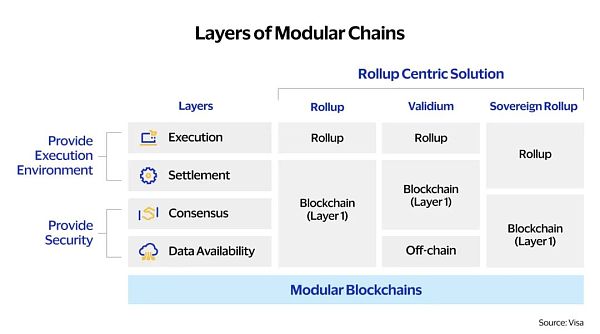
Visa's summary of rollup differences
We only need to remember that the data availability issue isn't purely about technical schemes or definitional debates—it centers on ETH’s cost-benefit dynamics in the PoS era. This is a real-money issue; technical disputes are merely surface-level phenomena. Hence, only a brief introduction is needed.
Narrowly speaking, data availability is about “how light clients verify full node data,” logically derived from papers by Vitalik and Celestia’s founder:
-
Full nodes may potentially lie—i.e., provide incorrect data;
-
Among full nodes, at least one must be honest and retain complete/correct data;
-
Light nodes must be able to “separate truth from falsehood,” promptly correcting fake data—for example, multiple light nodes cross-verifying sampled data.
The crux lies in the proof mechanism. Take Celestia: fraud proofs are central to DA operation, enabling timely correction of errors. Verifying fraud proofs is faster than generating them, allowing light clients to quickly validate without disrupting user experience.
Delving deeper into fraud proofs: recall that this closely resembles optimistic verification in OP-style rollups—initially assume validity, then address potential issues later.
Logic behind fraud proofs:
-
At least one honest node exists among full nodes;
-
Broadcasting mechanisms function normally, with latency below network effectiveness thresholds;
-
A sufficient number of light nodes exist to collectively reconstruct full data or equivalent proofs;
Under this logic, we conclude: light-node security and effectiveness are equivalent to those of full nodes.
If there’s an OP path, naturally there’s a ZK counterpart. Indeed, both Ethereum and EigenLayer follow the “validity proof” route—generating and distributing validity proofs upfront. However, producing such proofs consumes substantial computational resources.
To summarize: Celestia and Near DA represent off-chain + fraud-proof (OP-like) + low-cost + native-token DA solutions; Ethereum and EigenLayer represent on-chain + validity-proof (ZK-like) + higher-cost + ETH-centric DA solutions.
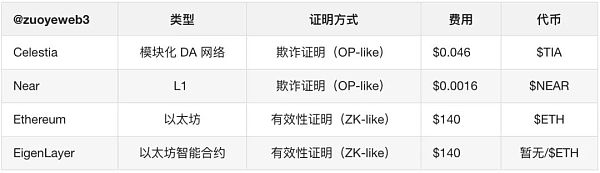
Comparison of various DA solutions
Two clarifications: DA solutions built entirely atop EigenLayer may not be as expensive as direct Ethereum usage, and EigenLayer may eventually issue a token. Nevertheless, ETH’s central role will remain unchanged.
Second, DA cost estimates referenced from Near’s calculations at year-end shouldn’t be seen as fixed or real-time prices. While Ethereum upgrades continue to reduce fees, the overall competitive landscape won’t shift significantly.
From rollups’ perspectives, profitability comes down to open-source collaboration and cost-cutting. Transaction fees and token issuance are their profit sources—absolutely non-negotiable. The only viable path to increased earnings is reducing costs. Continuing to use Ethereum offers ample security but at high expense—herein lies Celestia’s opportunity.
EigenLayer centers on ETH; Celestia centers on TIA. From Vitalik’s standpoint, this resembles a vampire attack—leveraging Ethereum’s existing ecosystem to ultimately empower a competing native token.
Orthodoxy and Universality: A Discussion on Bitcoin and Ethereum
In my opinion, fragmented Ethereum lacks orthodoxy, yet on-chain DA layers still offer the highest security—true for both Bitcoin and Ethereum. Orthodoxy can also be interpreted as compatibility with Ethereum or the degree to which scaling solutions depend on the Bitcoin mainnet.
Universality requires deeper analysis of each DA solution’s design philosophy. Some DA solutions are inherently specialized L2s or L1s—even BTC L2s, EVM-compatible L1s like Near, and EigenLayer prioritize EVM compatibility as a key development direction. Thus, EVM compatibility serves as a synonym for interoperability.
Celestia is unique in introducing off-chain computation, theoretically enabling compatibility with any virtual machine (VM), including EVM. Actively expanding its ecosystem, cross-chain dApp integration is part of its roadmap.
Of course, Bitcoin and Ethereum differ fundamentally in their modularization and DA strategies—doing otherwise would just be for fun.
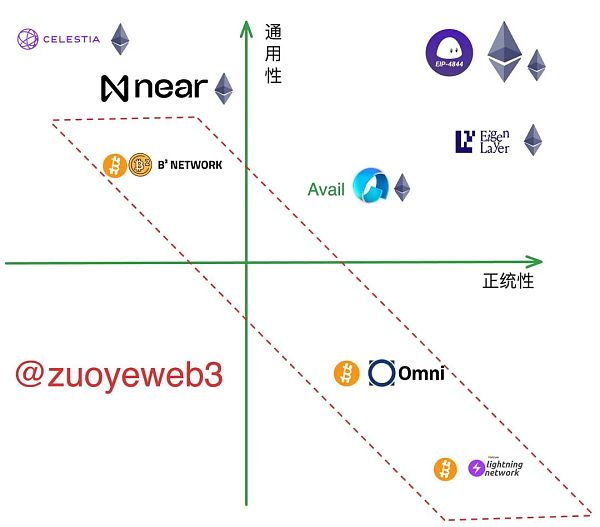
Comparison of DA solutions
Bitcoin as DA
Strictly speaking, Bitcoin is forcibly treated as a DA layer. Whether inscriptions, runes, or BTC L2s—they all emphasize the importance of storing data on Bitcoin.
Within this context, Lightning Network and B² Network represent two extremes. The Lightning Network fully relies on the Bitcoin mainnet for settlement, issues no native token, and requires BTC staking during operations. As discussed in my BTC L2 article, it functions merely as a payment channel, lacking support for smart contracts—high orthodoxy, extremely poor EVM compatibility/universality, a historical artifact.
By contrast, OmniLayer marks progress—using Bitcoin as a data publication layer. Although nodes still need to download full data and lack efficient proof mechanisms, and although it doesn’t support complex operations, this explains why USDT abandoned OmniLayer in favor of RGB. It hardly qualifies as a true Bitcoin-as-DA solution—but given its ancient origins, comparing it strictly isn’t fair. We’ll cut the elder some slack.
Side note: RGB++ and CKB are exploring new models for BTC L2s. I’ll publish a dedicated piece later to systematically review recent BTC L2 advancements—just leaving a placeholder for now.
Next, take B² Network as an example of how “new-era” BTC L2s deliberately treat Bitcoin as a DA layer. Unlike Lightning Network and OmniLayer’s unconscious usage, B² Network intentionally combines data rollbacks from the rollup layer with fraud proof mechanisms—mirroring Celestia’s overall approach.
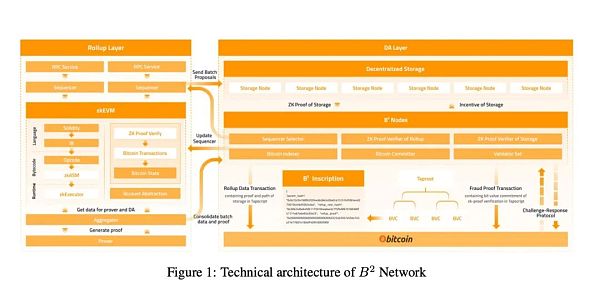
B² Network technical architecture
Architecturally, B² Network partially separates Bitcoin’s DA role—Bitcoin mainly serves as a settlement layer, while additional incentives for B² nodes cover decentralized storage costs required by the B² DA layer.
B² Network’s EVM compatibility need not be heavily scrutinized, but it will likely issue its own token. Additionally, minimizing interaction costs with the Bitcoin mainnet must be considered, given Bitcoin’s inherently high usage expenses.
Overall, Bitcoin’s DA transformation remains in early stages. Real demand will only emerge once inscriptions, runes, and BTC L2s achieve widespread utility. Yet implementation paths will largely follow Ethereum’s precedents, albeit constrained by scripting language limitations and storage costs.
Ethereum DA: Containing Celestia
DA’s current fame owes much to Celestia. Ironically, Vitalik co-authored a 2018 paper with Celestia’s founder Mustafa titled *“Fraud and Data Availability Proofs: Maximising Light Client Security and Scaling Blockchains with Dishonest Majorities,”* laying the theoretical foundation for DA mechanisms and implementations.
Celestia’s fraud proof mechanism, light client designs, and assumptions about minimal honest full nodes were all outlined therein. Later, Mustafa launched LazyLedger—the precursor to Celestia.
Unexpectedly, upon Celestia’s market launch, Vitalik resisted it—primarily due to economic disagreements, already explained earlier.
Unsurprisingly, Celestia holds little orthodoxy—it’s an external DA layer outside Ethereum. Rollups choosing Celestia as their DA layer get stripped of legitimacy. Yet drawn by low costs, growing numbers of diverse projects flock to it.
Celestia’s operation isn’t complicated—the core lies in light nodes efficiently verifying full-node data via DAS (Data Availability Sampling).
Celestia’s affordability stems from moving computation off-chain—enabling fast DA layer performance and compatibility with any programming language or VM. High developer-friendliness fuels rapid ecosystem growth.
Currently, various rollup frameworks, RaaS platforms, rollup development kits, settlement layers, bridges, and wallets can build seamlessly atop Celestia.
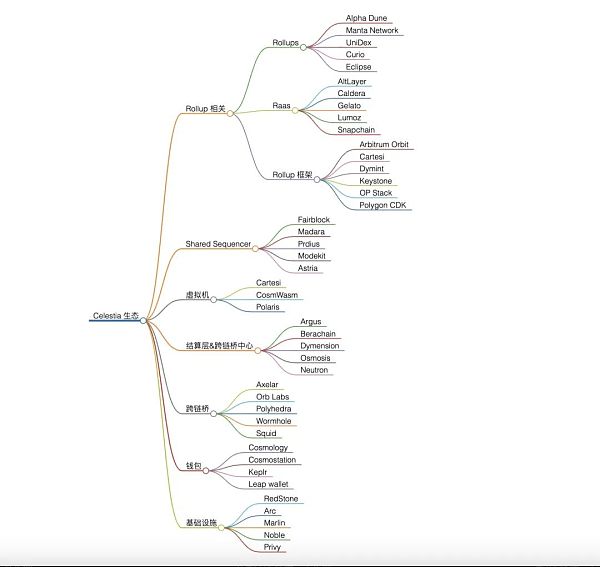
Celestia ecosystem
Facing this foreign incursion, Ethereum emphasizes its own ability to serve as a DA layer, asserting that ongoing upgrades will gradually lower fees. However, due to architectural constraints, engaging in price wars with Celestia or Near is unwise. Thus, EigenLayer is strategically positioned on the front lines of defense.
Unlike Celestia, EigenLayer is essentially a suite of smart contracts on Ethereum—making it technically part of Ethereum itself, yet also functioning as an abstract virtual chain. This duality enables it to preserve ETH centrality while extending into various dimensions: DA, sequencers, bridges, and L2 interoperability—all implementable via EigenLayer. Eigen DA is one such application.
Simply put, EigenLayer’s so-called liquid restaking is a matryoshka doll version of Lido. If ETH can earn staking rewards while being convertible into stETH for daily use, then stETH can undergo further restaking—its derivative tokens serving both as yield receipts and functional currencies.
After transitioning to PoS, the amount of staked ETH directly impacts network health and security. Currently, about 30 million ETH (worth ~$100 billion) are staked—second only to Bitcoin in attack cost.
Since staking secures Ethereum, LSD/LRT theoretically allows infinite nesting—amplifying yield from staked tokens. Based on a $100 billion base, tenfold amplification reaches $1 trillion—well within Ethereum’s valuation capacity.
The specific architecture of Eigen DA matters less than whether EigenLayer’s economic model proves sustainable. Even if EigenLayer fails, relying directly on the Ethereum mainnet remains perfectly viable.
Due to space constraints, in-depth analyses of EigenLayer/ETH/EIP-4844 ETH, Near DA, and Avail are omitted. Just remember—they all aim to provide validity proofs in environments lacking full-node data access.
Conclusion: DA Is a Long-Term Battle
1. Ethereum’s DA Market Will See Sustained Competition Among Existing Players
The Ethereum DA market is already active. Celestia has launched its token TIA; EigenLayer, though ETH-centric, may eventually issue a token—rare in today’s climate. Let’s wait and see.
While new DA solutions may emerge, Ethereum’s DA landscape has largely been claimed—few surprises remain.
2. Bitcoin’s DA Transformation Remains in Growth Phase—Awaiting BTC L2 Winners
In my assessment, Bitcoin becoming a DA layer akin to Ethereum is unlikely. Lack of smart contracts aside, the primary obstacle is prohibitively high costs—even with hundreds or thousands of times data compression, it’s still too expensive. If Ethereum isn’t suitable for data storage, Bitcoin certainly isn’t.
Join TechFlow official community to stay tuned
Telegram:https://t.me/TechFlowDaily
X (Twitter):https://x.com/TechFlowPost
X (Twitter) EN:https://x.com/BlockFlow_News
 @zuoyeweb3