In-depth Analysis of the Telegram Bot Sector (Part 2): The On-chain Brokerage Panorama
TechFlow Selected TechFlow Selected
In-depth Analysis of the Telegram Bot Sector (Part 2): The On-chain Brokerage Panorama
This article delves into Telegram Bot projects, examines the current development status of Telegram trading bots, and forecasts their future trends.
 Navigating Web3 tides with focused insights
Author: @ChingChaLong02
In the first part of our Telegram sector analysis report, we provided a comprehensive overview of the entire Telegram Bot ecosystem. This chapter will delve deeper into specific projects to better understand the current state of Telegram trading bots and forecast their future trends. Given Banana Gun's dominant position in the sector (by total trading volume), we aim to use a valuation model to assess the project’s actual market capitalization and token price.
At the same time, considering Solana's recent strong performance, we will also explore BonkBot—a rising project that has attracted numerous traders to participate in the meme coin trading frenzy on the Solana platform—and offer broader outlooks for the entire Solana-based Telegram trading bot landscape.
Additionally, with the recent surge in Bitcoin inscriptions, Telegram bots dedicated to trading BRC-20 tokens have emerged. This article also aims to examine their business models and development trajectories.
1. Unibot

Since its token launch, Unibot's price surged from a low of $3.13 in May to a high of $200.45 in August—an almost 100x increase. Within just two months of launch, it generated over $6 million in revenue.
This remarkable financial performance and rapid token appreciation significantly boosted interest in the Telegram bot space, sparking widespread hype around Telegram-based trading tools.
Users can interact with Unibot via chat-like interfaces to easily issue on-chain trading commands, enabling various trading activities on Uniswap, including token swaps, copy trading, limit orders, and private transactions.
Moreover, Unibot offers real-time alerts for newly launched Ethereum tokens, allowing users to quickly add and snipe new listings.
1.1 Historical Event Timeline

The Unibot team initiated a token buyback program early on to maintain market liquidity stability. However, during the July Unibot V2 migration, they removed the token burn mechanism after discovering it hindered liquidity growth. As a new strategy, the team reissued previously burned tokens and paired them with ETH, adding the Unibot/ETH pool to Uniswap V2 to enhance liquidity depth.
Later that month, Unibot launched UnibotX, an order-book-style trading platform supporting a wide range of tokens not listed on major exchanges, thereby expanding trading liquidity.
Despite later facing a bear market for Telegram bots and a sharp decline in token price, the project successfully capitalized on the Friend.tech craze in September by launching its keys trading feature.
By January 2024, Unibot rode the wave of Solana meme coins and successfully expanded onto the Solana network, capturing substantial trading volume.
1.2 Economic Model
On May 17, 2023, the project conducted a fair launch, issuing a total of one million tokens—all fully circulating from day one.
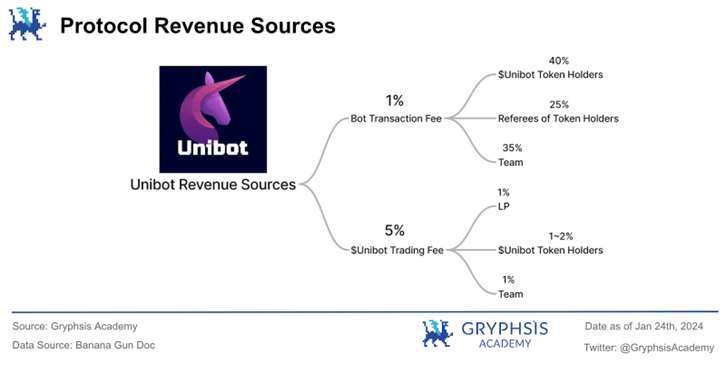
Currently, Unibot generates revenue through two main channels: bot trading fees and transaction taxes on its native UNIBOT token.
The former involves charging a 1% fee on each trade, with 40% distributed to token holders. The latter refers to a 5% tax on all UNIBOT trades, where 1% of the trading volume is allocated to token holders—provided their balance exceeds 50 UNIBOT to qualify for rewards.
1.3 Future Outlook
(1) Overreliance on Token Transaction Taxes
Current data shows that approximately 80% of Unibot’s revenue comes from token transaction taxes. The design requires users to pay a 5% tax when trading $UNIBOT, resulting in an effective 10% cost across buy and sell transactions—making this the primary revenue source. However, this highlights a potential issue: the fees collected from bot services may be insufficient to sustain core operations.
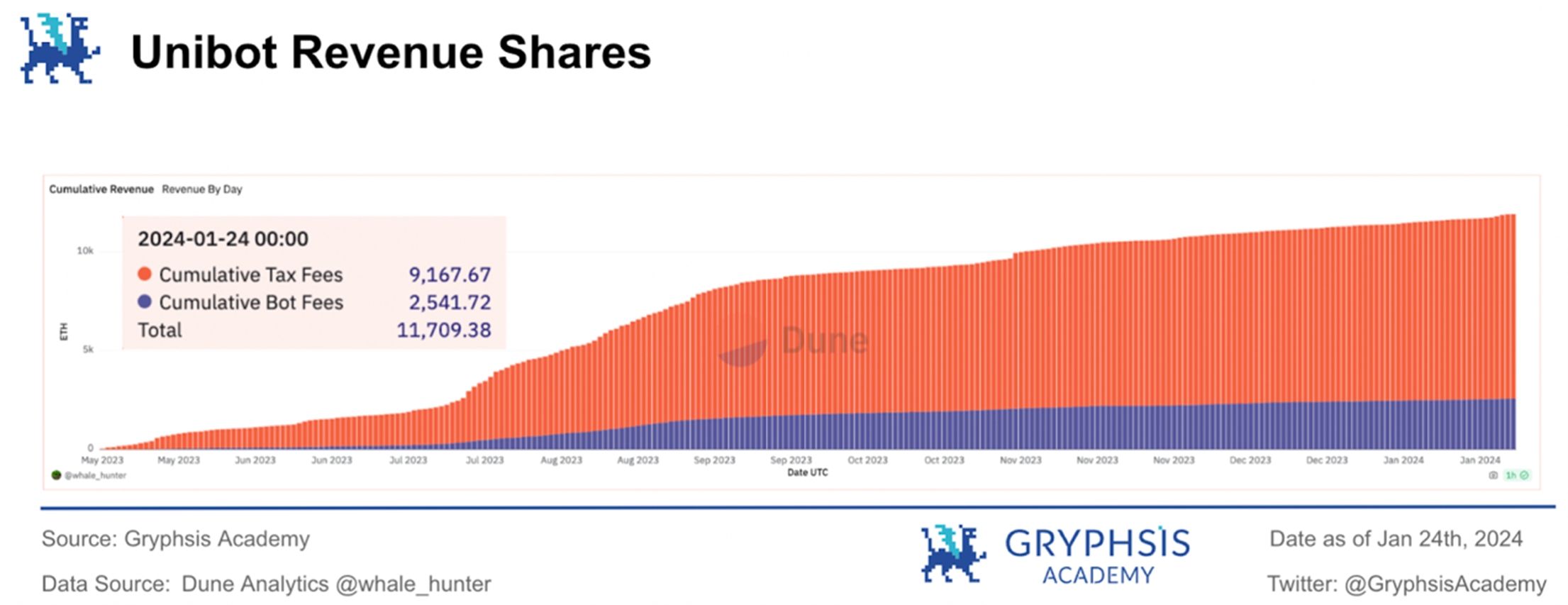
Take Banana Gun as an example—the project has already achieved stable revenue from bot services surpassing tax income, leading it to adopt a 0% token tax model. In the long run, Unibot faces the challenge of capturing more value through bot fees, which should be its core business. Relying heavily on token transaction taxes undermines long-term sustainability.
(2) Unibot on Solana
Unibot recently announced the launch of a similar Telegram Bot on the Solana network. Leveraging its status as an established project, it offers several standout features:
Built-in ETH-SOL cross-chain bridge: Effectively merges Unibot’s original Ethereum functionality with its Solana version, becoming the first dual-chain supported bot project.
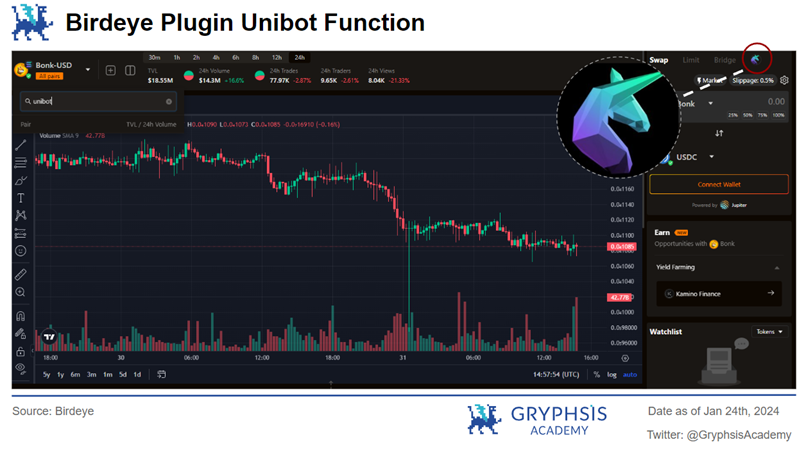
Integration with Birdeye, a trading data aggregator: Enables seamless support for all projects listed on Birdeye. This is, in my view, an ultimate user experience enhancement and a key turning point for Unibot’s success in the Solana market.
1.4 Protocol Performance
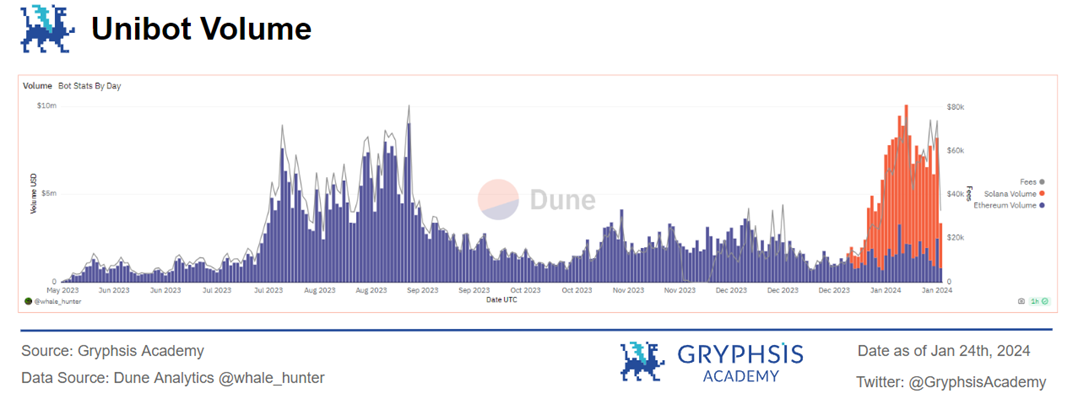
Trading volume on Solana surpassed Ethereum within a week—tripling its volume—and shows promising long-term potential.
2. Banana Gun
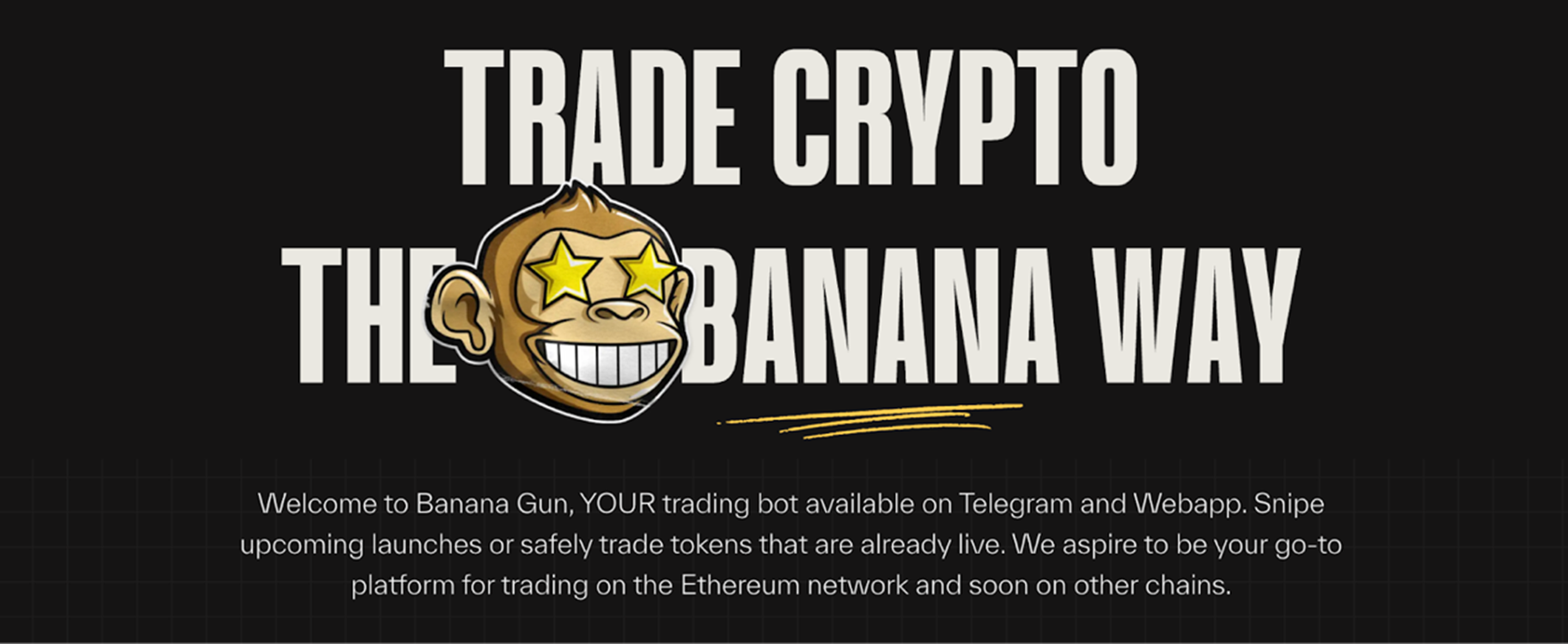
Banana Gun is one of the most popular Telegram trading bots available. It provides two main services: trading and sniping. The trading function allows users to securely purchase tokens already listed on the Ethereum blockchain, while the sniping feature enables users to be among the first buyers when new tokens are launched. Originally supporting only Ethereum, Banana Gun has recently expanded to Solana. Below are detailed explanations of its key features:
First Bundle or Fail (FoF):
Aims to execute purchases at the very first block (block 0). Requires at least 10 wallets to participate effectively. Not applicable to MEV or Deadblock launches.
FoF Backup:
If FoF fails to trigger during MEV or Deadblock launches, the backup function executes the purchase in the next available block using backup miner tips.
Slippage:
Allows price fluctuations between 0–99% in uncapped launches. Setting slippage to 100 is equivalent to “infinite” slippage.
Degen Mode:
When enabled, users can buy into honeypot traps to deter zombie accounts. If activated, the bot ignores safety tax settings and allows purchases even if tokens cannot be sold afterward.
MaxTx or Revert:
Limits purchases to a maximum spend amount. If a token’s max transaction exceeds this threshold, the trade reverts.
MinToken:
Sets a minimum token quantity or percentage for purchases. If the maximum spend cannot meet this minimum, the trade fails.
Anti-Rug Mechanism:
Attempts to sell tokens before potential scams when taxes exceed safe thresholds or fraud indicators appear.
Transfer on Blacklist:
If a user’s wallet is blacklisted, this feature transfers tokens to a pre-designated “transfer wallet.”
Pre-Approve:
Automatically approves tokens after sniping to enable faster selling.
Snipe Settings:
Allows adjustment of current snipe settings without affecting other pending or future snipes.
2.1 Historical Event Timeline
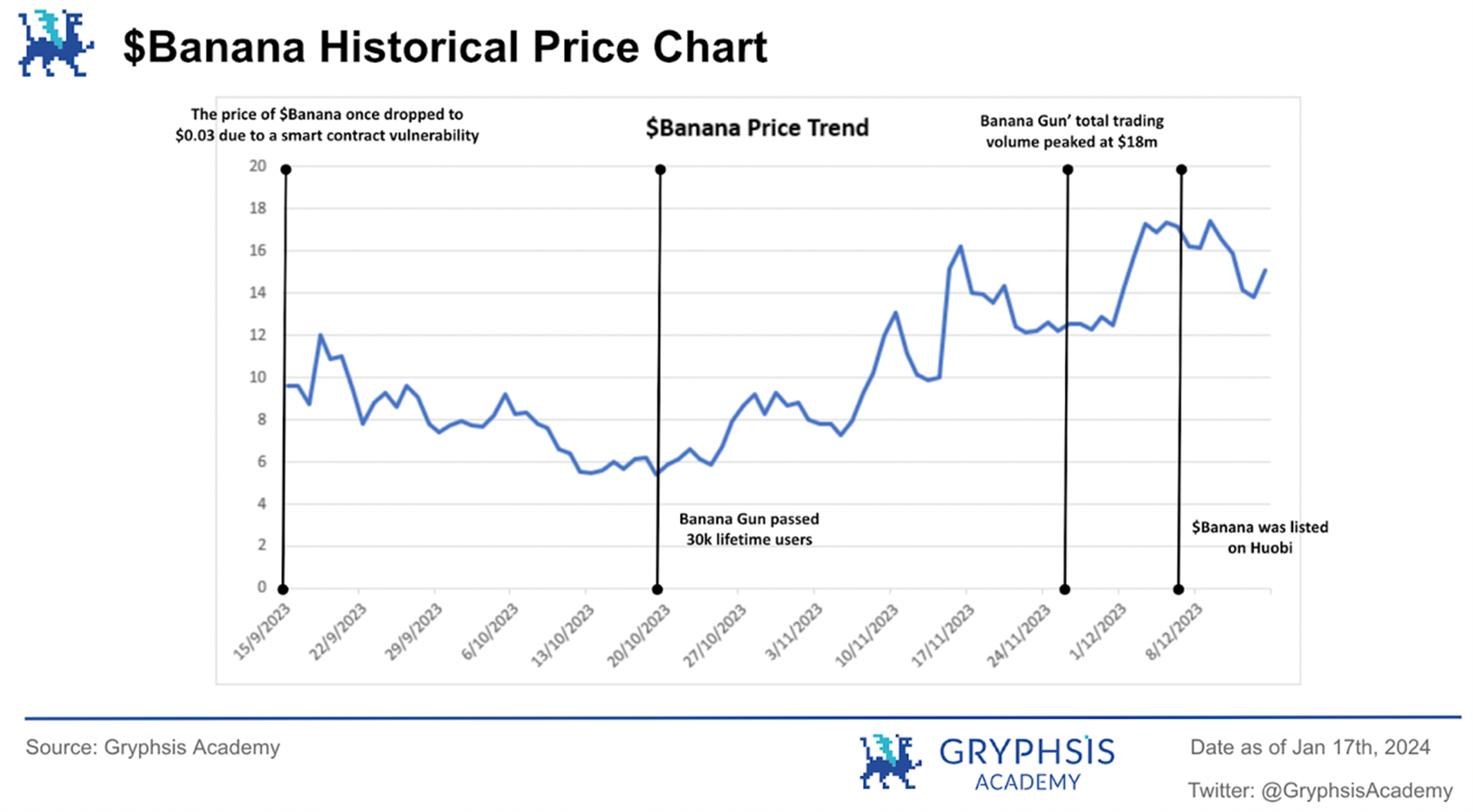
Smart Contract Vulnerability Caused Price Drop (September 11, 2023):
Hours after airdropping, a smart contract bug mistakenly allowed users to sell assets while retaining taxed tokens in their wallets. The $BANANA price plummeted severely to $0.03.
User Milestone Achieved (October 20, 2023):
As Banana Gun reached the significant milestone of 30,000 permanent users, its price began a sustained upward trend.
Peak Trading Volume (November 27, 2023):
The price continued rising, reaching a daily trading volume peak of $18 million on November 27, demonstrating high project activity.
Listed on Centralized Exchange (December 5, 2023):
$BANANA was listed on Huobi.
2.2 Token Distribution

The initial token price was $0.65—approximately a 20x increase from today’s level.
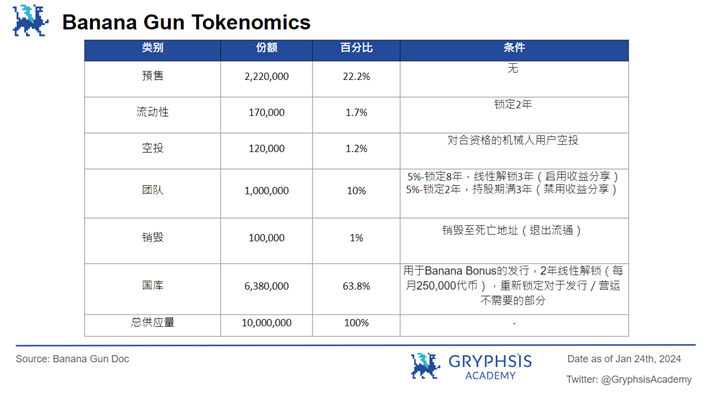

Team allocations will unlock in two phases: the first starting in 2025, lasting three years, accounting for 5% of the initial supply; the second beginning in 2031, also lasting three years, representing another 5% of the initial supply.
2.3 Protocol Revenue Sources / Token Utility
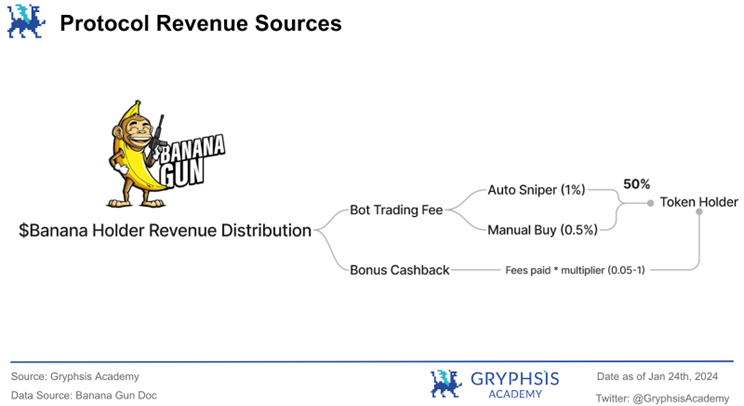
Bot Trading Fees:
Fees are charged for using Banana Gun’s bot trading services:
(1) Manual buys incur a 0.5% fee;
(2) Automatic snipes incur a 1% fee.
Of all collected bot fees, 50% is distributed to token holders—providing passive income and incentivizing bot usage.
Cashback Rewards:
Users who trade via the bot are eligible for additional cashback rewards.
Cashback amount is calculated as: Fee Paid × Multiplier, where multiplier ranges from 0.05 to 1. This means cashback can reach up to 100% of fees paid, depending on the randomly assigned multiplier.
0% Token Tax Model:
Banana Gun recently announced a major shift in its fee structure, moving to a 0% token tax model. This decision stems from multiple factors. Initially, during bear markets when profitable bot activity was lower, the project relied on token taxes for revenue. As market conditions improved and bot-generated revenue stabilized above tax income, the team reassessed its approach.
However, given that past buybacks were primarily funded by token taxes, the team has paused such buyback activities. Going forward, $BANANA holders will play a more critical role, directly participating in decisions about whether to continue deflationary strategies.
On the other hand, removing the token tax is seen as a strategic move to enhance project appeal and efficiency. Advantages of this new model include increased trading volume due to zero transaction costs, reduced slippage for traders, easier integration with centralized exchanges, and broader token exposure. This wider visibility is expected to attract more users to the bot, creating a virtuous cycle of growth and engagement.
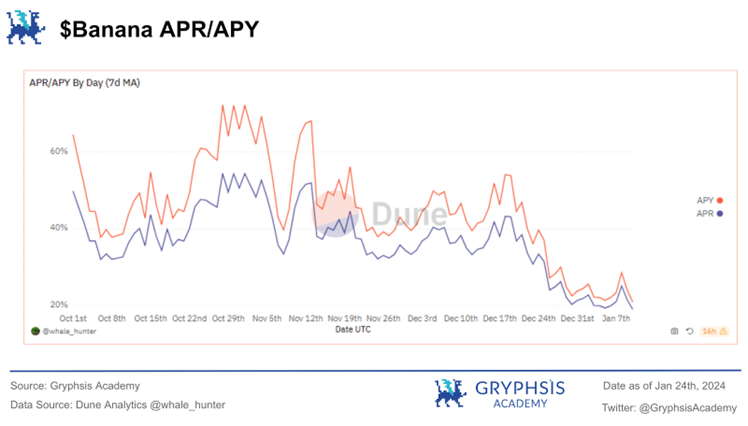
After announcing this change, the annualized yield for $BANANA holders dropped to 21%, roughly one-third of the previous 72% peak. Nevertheless, a 21% annualized yield remains attractive for token holders. Eliminating the token tax is expected to boost bot trading volume, thereby increasing fee revenue from bot operations.
This strategy is anticipated to deliver stable and substantial long-term returns, balancing short-term yield reduction with the prospect of sustained, healthy gains driven by increased bot activity and broader token adoption.
2.4 On-Chain Data
Through in-depth analysis of $BANANA’s on-chain data, we gain insights into token distribution and liquidity movements—critical aspects for assessing overall token health.
On-chain data reveals holder distribution, transaction frequency, and liquidity trends—key metrics for evaluating any cryptocurrency’s health.
These insights allow us to more accurately gauge market adoption, holder diversity, and liquidity stability, providing robust data support for investment decisions.
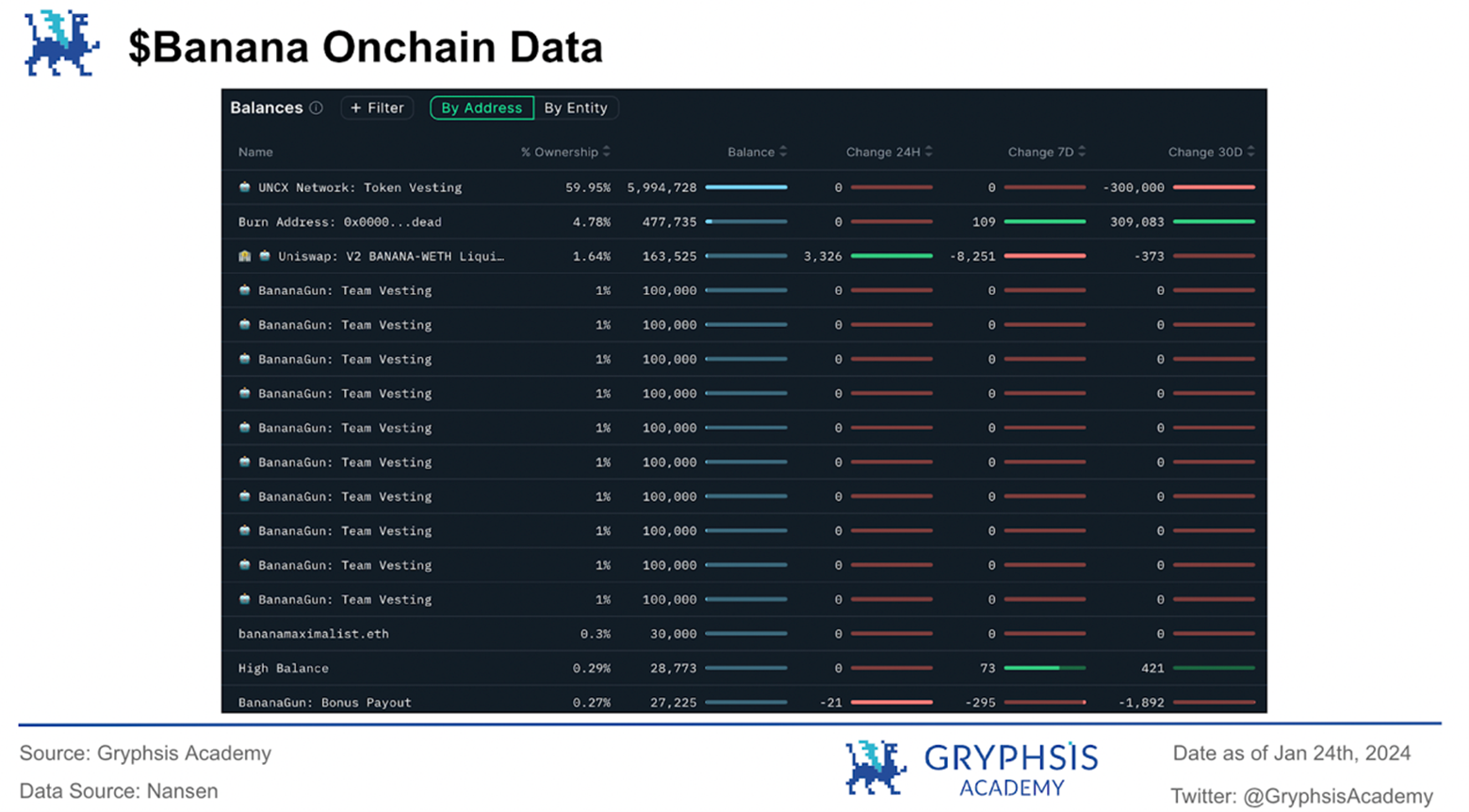
Beyond the top ten addresses, data confirms what the tokenomics suggest: nearly 60% of tokens are locked in UNCX Network, and 10% of team tokens are also locked. Despite over 70% of liquidity still being unvested, linear unlocking schedules must be monitored closely going forward.
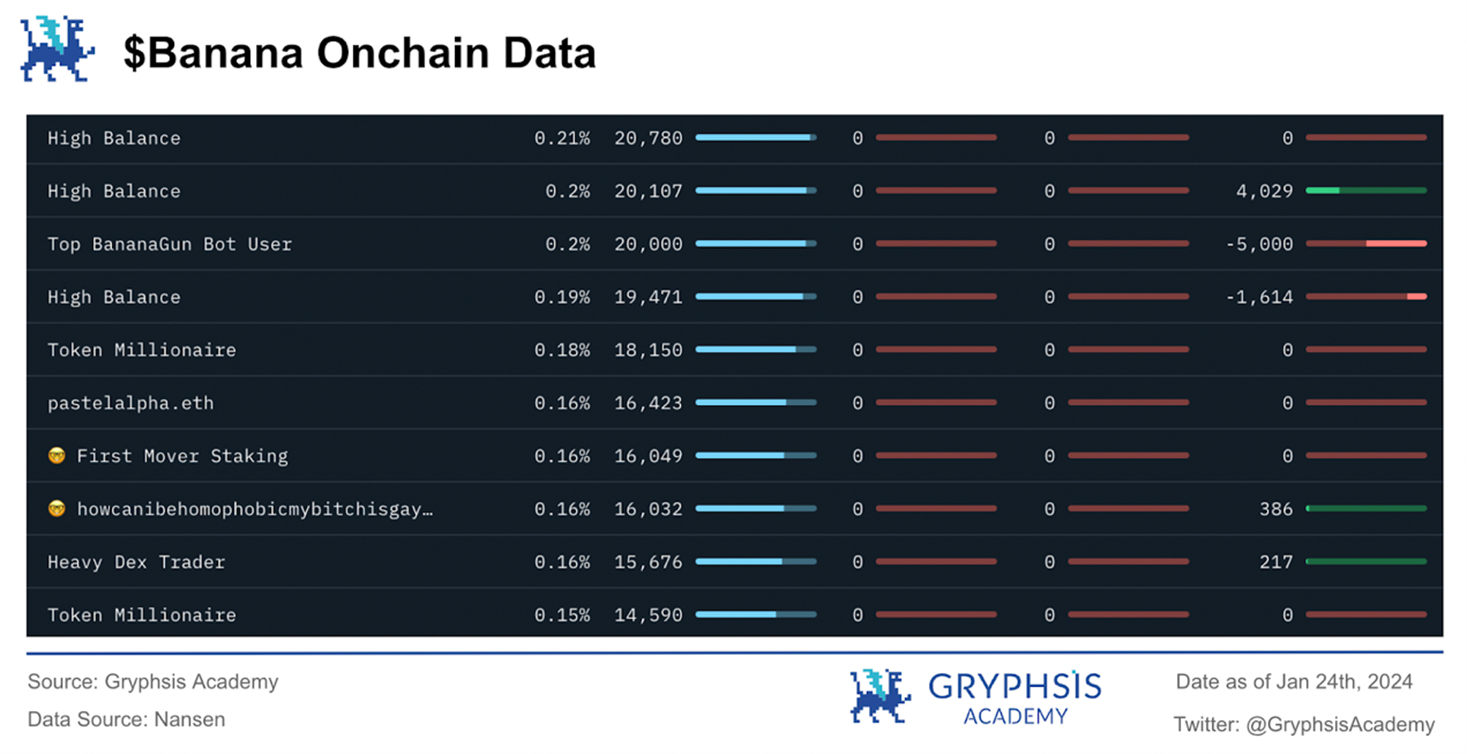
The chart above shows $BANANA’s token distribution. Even the top ten holders individually own less than 1%—indicating no excessive centralization or malicious manipulation.
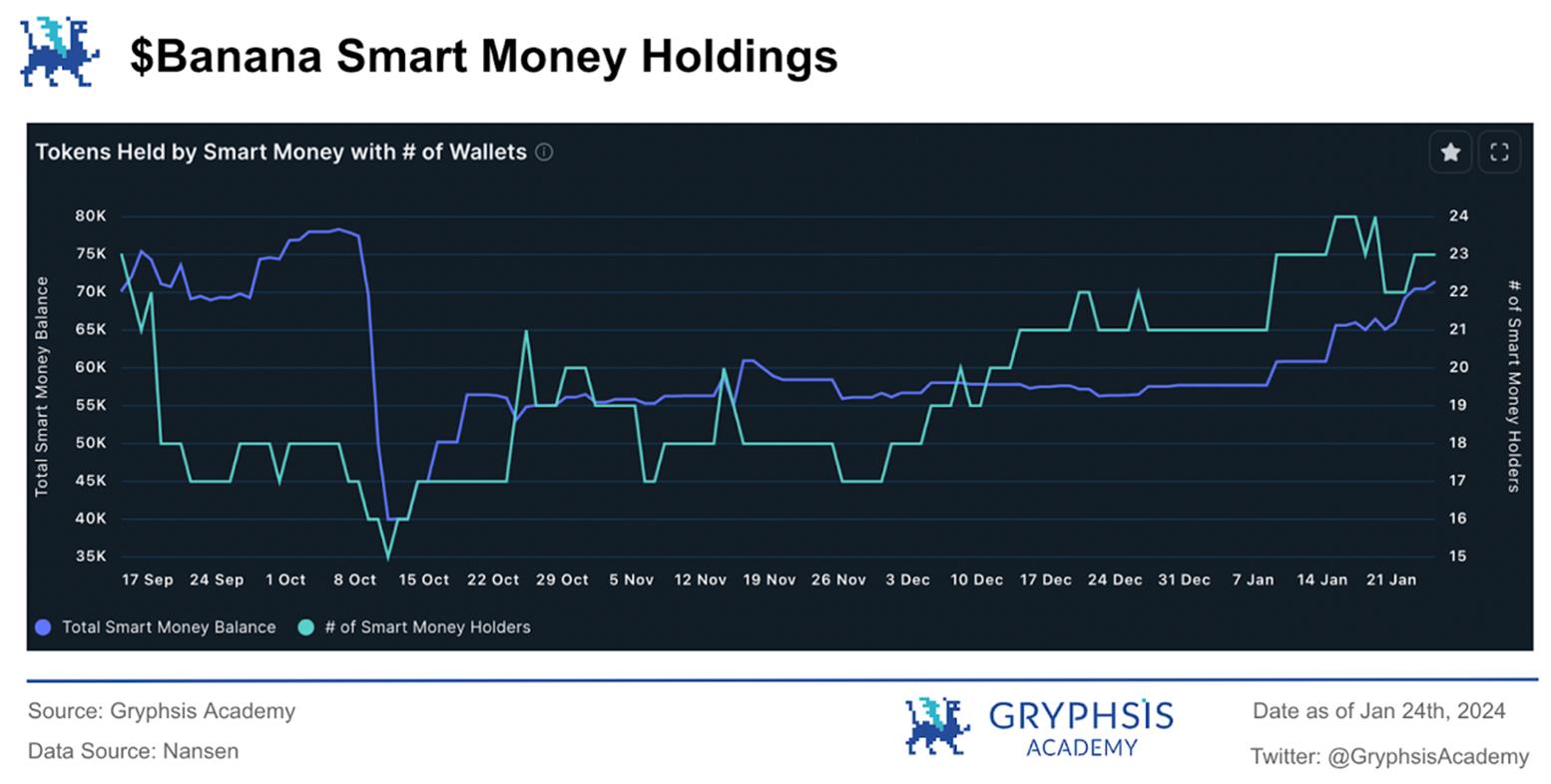
Since December, the number of “smart money” addresses has steadily increased, raising total holdings from 56,143 to 71,327.
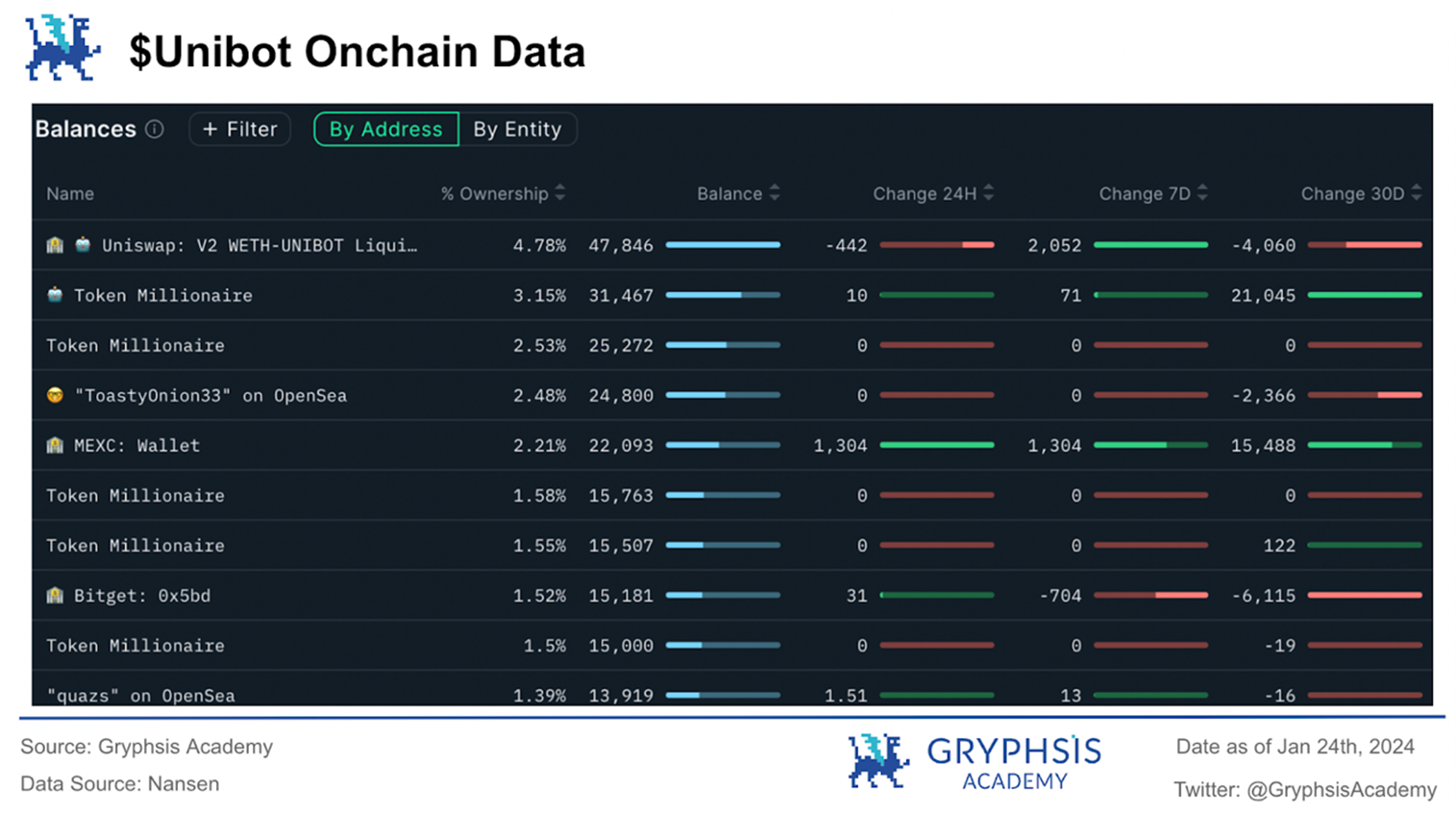
In contrast, the top ten $UNIBOT holders collectively hold nearly 20%.
In summary, $BANANA demonstrates a relatively decentralized and healthy token distribution, with growing “smart money” accumulation despite a portion of tokens remaining locked.
2.5 Comparable Analysis
To more accurately estimate $BANANA’s fair value, we employed a comparable analysis, selecting blockchain projects similar in scale and nature. Key valuation metrics include Price-to-Sales (P/S) and Price-to-Earnings (P/E) ratios.
Selected peers fall into two categories: similar trading bot projects like Unibot and Maestro Bot; and decentralized exchange protocols including Uniswap, Sushiswap, and Pancakeswap.
Notably, since trading bots are essentially Uniswap clones, comparing them with DEXs enhances analytical reliability. This comparison enables a more accurate assessment of $BANANA’s market value and investment potential.
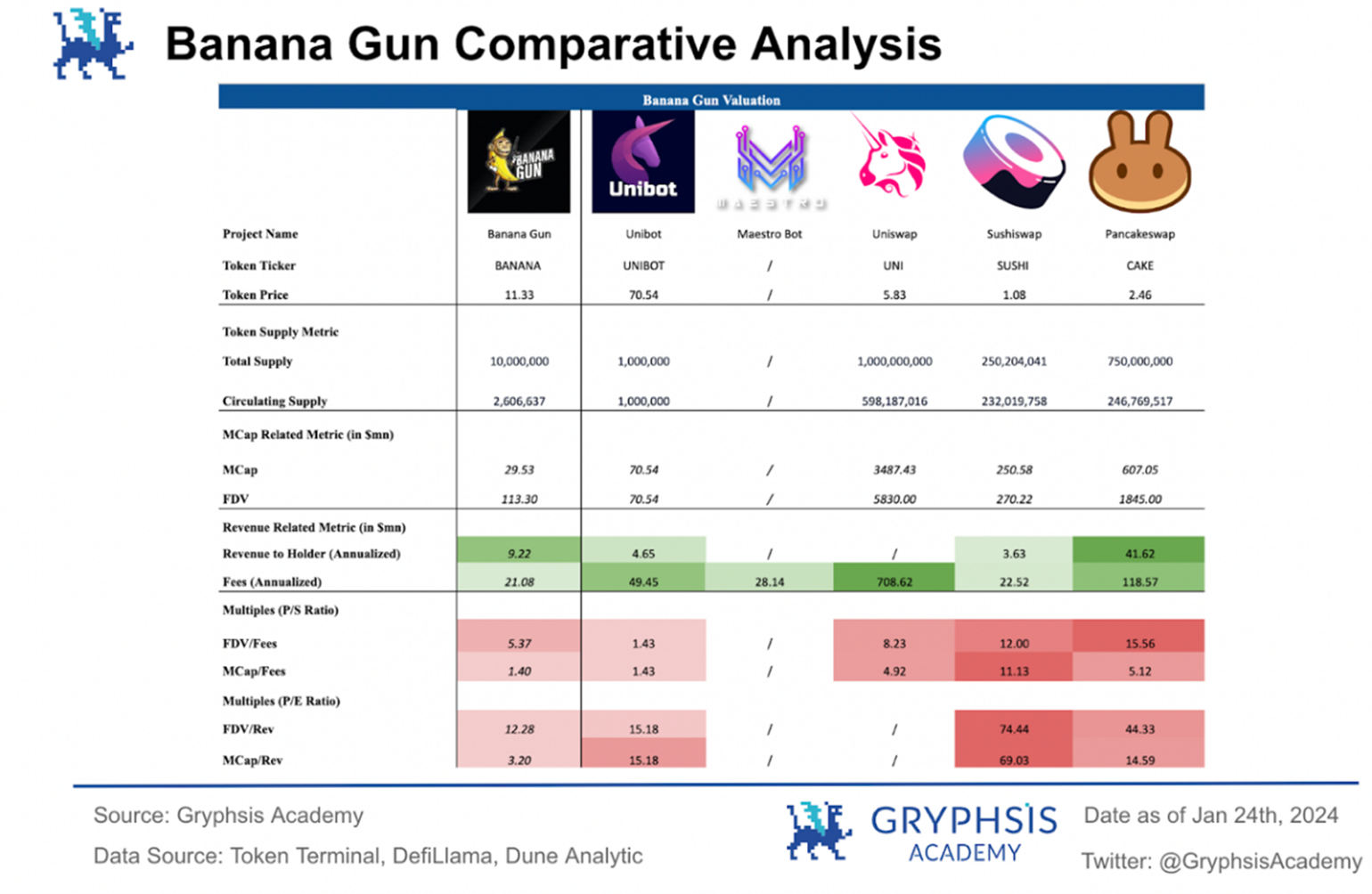
The analysis above compares valuations based on P/E and P/S ratios. Since the three trading bot projects have operated for less than a year, their fees and revenues have been annualized for comparability.
In this context, Banana Gun achieved an annualized total revenue of $21.08 million, showcasing exceptional revenue generation. Notably, due to its mechanism allocating a relatively high share of revenue to token holders, annualized earnings for holders reached $9.22 million—outperforming peers like Unibot and Sushiswap.
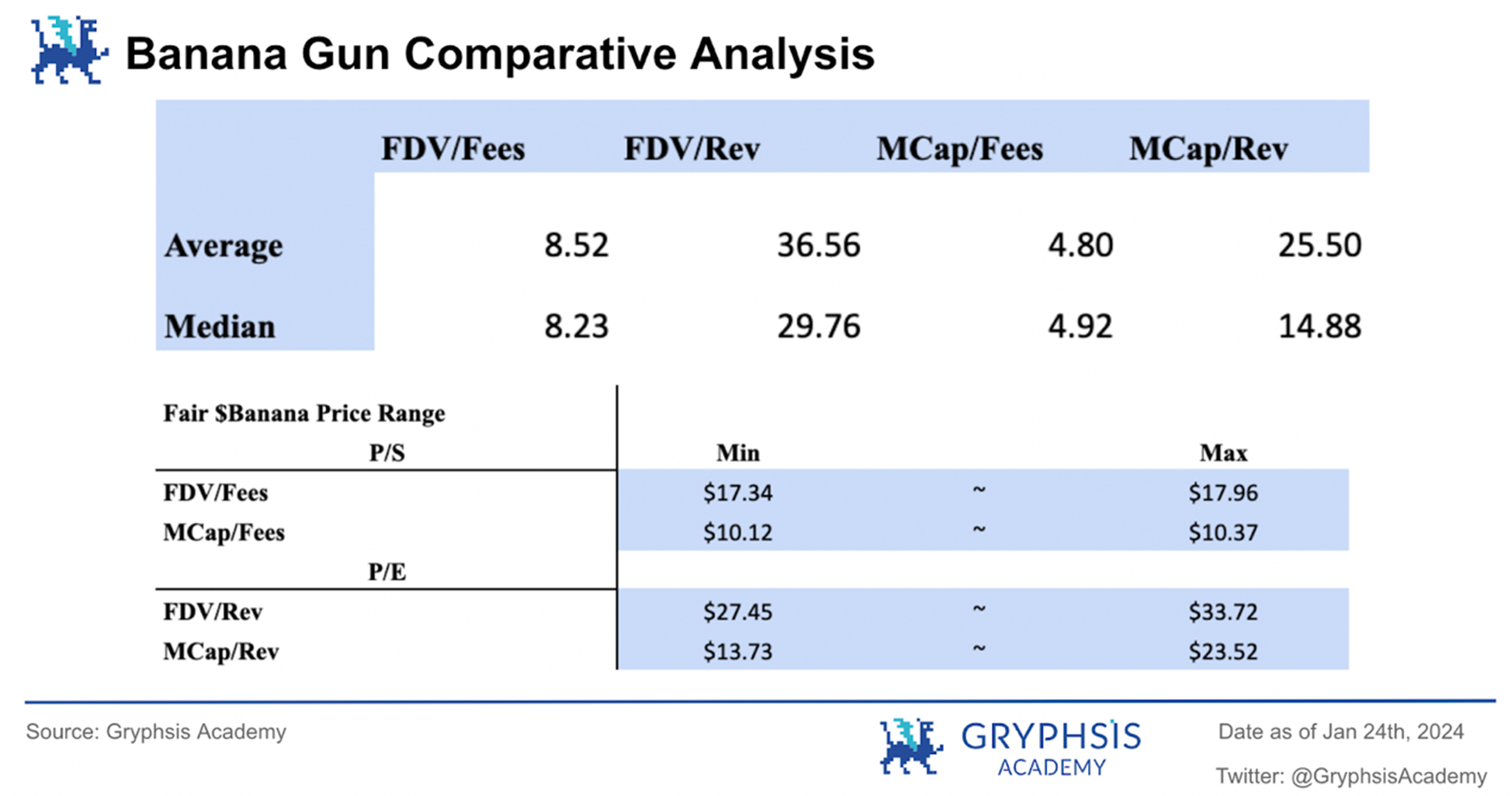
Furthermore, from a P/E perspective, Banana Gun’s ratio is lower than the average of similar protocols, suggesting potential market undervaluation.
Based on P/S analysis, $BANANA’s potential price range is estimated at $10.12 to $10.37. According to P/E analysis, the implied price range is $13.73 to $23.52.
2.6 Future Outlook
(1) Launch on Solana

Source: Banana Gun Twitter
Banana Gun has launched its Telegram bot on Solana, following Unibot’s footsteps. Unlike Unibot’s ETH/SOL cross-chain service, Banana Gun uses $SOL as rewards for $BANANA holders on Solana. Users can connect a Solana-compatible wallet to claim these rewards.
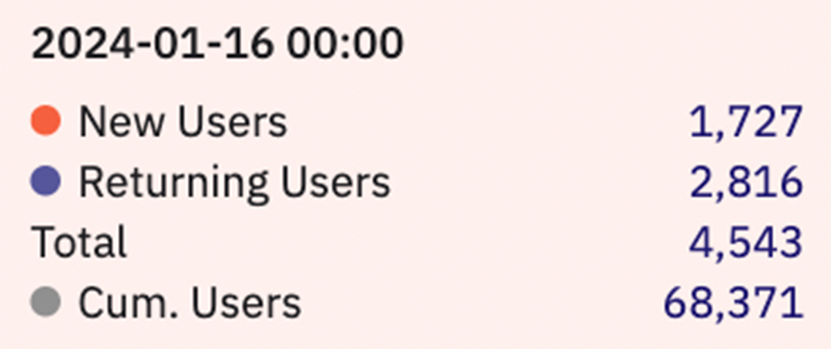
Source: Dune Analytics @whale_hunter
Data shows strong user response—one week post-launch, nearly 1,700 new users joined, pushing total users above 4,000. This success stems from a key marketing tactic: users earn 50% of trading fees by referring new users on the Solana chain during the first two weeks.
For instance, if the bot earned $400K in fees during the first week—with $300K from referrals—Banana Gun would redistribute $150K in SOL to referrers. This is an effective early-user acquisition strategy, clearly reflected in the data.

Given Unibot’s price surge after launching on Solana, it is reasonable to expect $BANANA’s value to follow an upward trajectory.
Moreover, offering significant yield boosts to $BANANA holders during the initial two weeks is undoubtedly an attractive incentive. This strategy is likely to catalyze positive price momentum in the short term, boosting market interest and investment enthusiasm.
Through this mechanism, $BANANA’s trading activity could significantly increase, enhancing market liquidity. Such yield incentives may also attract new traders, further elevating $BANANA’s market value.
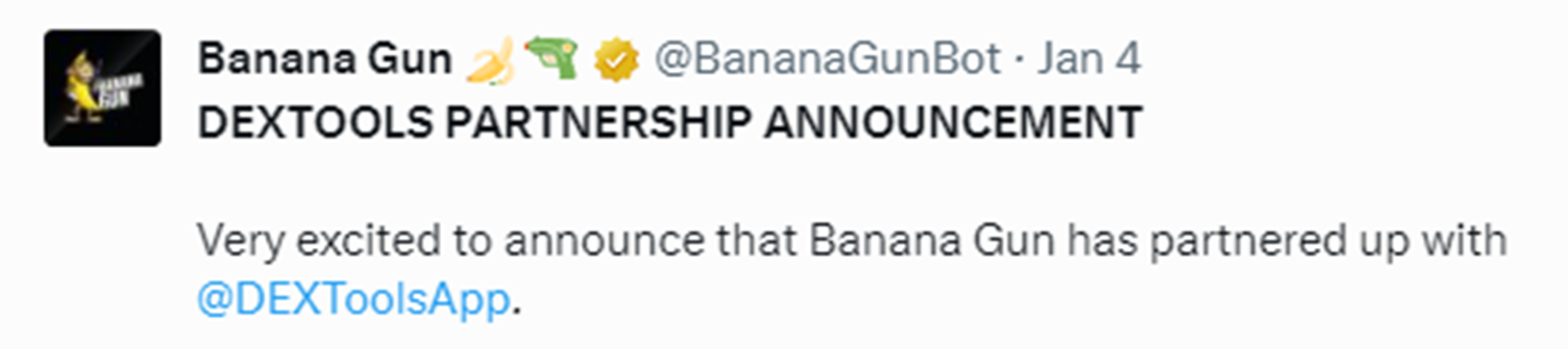
(2) Partnership with DEXTools
Source: Banana Gun Twitter
Banana Gun’s partnership with DEXTools is a major development. Known for lowering trading barriers for the public, DEXTools has now chosen Banana Gun as its partner—a bullish signal for several reasons:
-
Increased Exposure and User Base: Collaboration with DEXTools, which has a large user base, significantly boosts Banana Gun’s visibility. This could attract more users into its ecosystem, potentially increasing both token holder and active trader counts.
-
Higher Trading Volume: Direct integration of Banana Gun’s trading functions into the DEXTools platform enables users to trade and place limit orders seamlessly. This convenience is expected to drive higher trading volumes, enhancing token liquidity and market activity.
-
Strengthened Market Position: The partnership reinforces Banana Gun’s reputation as a credible and technologically advanced trading option. Being selected by a well-known platform like DEXTools underscores the quality and reliability of Banana Gun’s technology and security features.
-
Price Appreciation Potential: Increased usage, higher trading volume, and enhanced visibility could lead to price appreciation for Banana Gun’s token. As more traders and investors discover and engage with Banana Gun via DEXTools, demand for the token may rise.
3. BONKBot
BONKbot is a Solana-based Telegram trading bot that enables users to trade in the simplest and fastest way possible. The project uses $BONK as its token, originally launched in December 2022 as a free airdrop to the Solana community.
Since then, $BONK’s adoption has grown exponentially, spanning DeFi, gaming, payments, and more. As an official partner of the $BONK community, BONKbot offers users a suite of features:
Minimum Holding Value:
Allows users to set a minimum portfolio value threshold—tokens below this value are hidden. Particularly useful when you don’t want to sell certain tokens, even if they’re underwater (“bag holding”). Click to edit.
Auto-Buy:
Immediately executes a buy upon pasting a token address, eliminating confirmation steps.
Button Configuration:
Users can customize buy/sell buttons on the dashboard. Simply click each button to edit.
Slippage Settings:
Customizable slippage for buy and sell orders. Slippage refers to the difference between intended and executed prices—proper configuration helps control trading costs. Click to edit.
MEV Protection:
BONKbot partners with Jito Labs to provide advanced MEV protection, defaulting to accelerated transactions and front-running defense. Two modes are available:
-
Turbo Mode: Transactions are routed through Jito for maximum speed and front-run protection. If standard transmission is faster, MEV protection won’t activate.
-
Secure Mode: Guarantees transaction protection under all circumstances—even if it means slower execution. Users can increase bribes to speed up transactions.
When enabling MEV protection, users can select either mode and set transaction priority: Medium, High, or Very High. Advanced users also have the option to customize transaction priority for finer control.
3.1 Historical Event Timeline
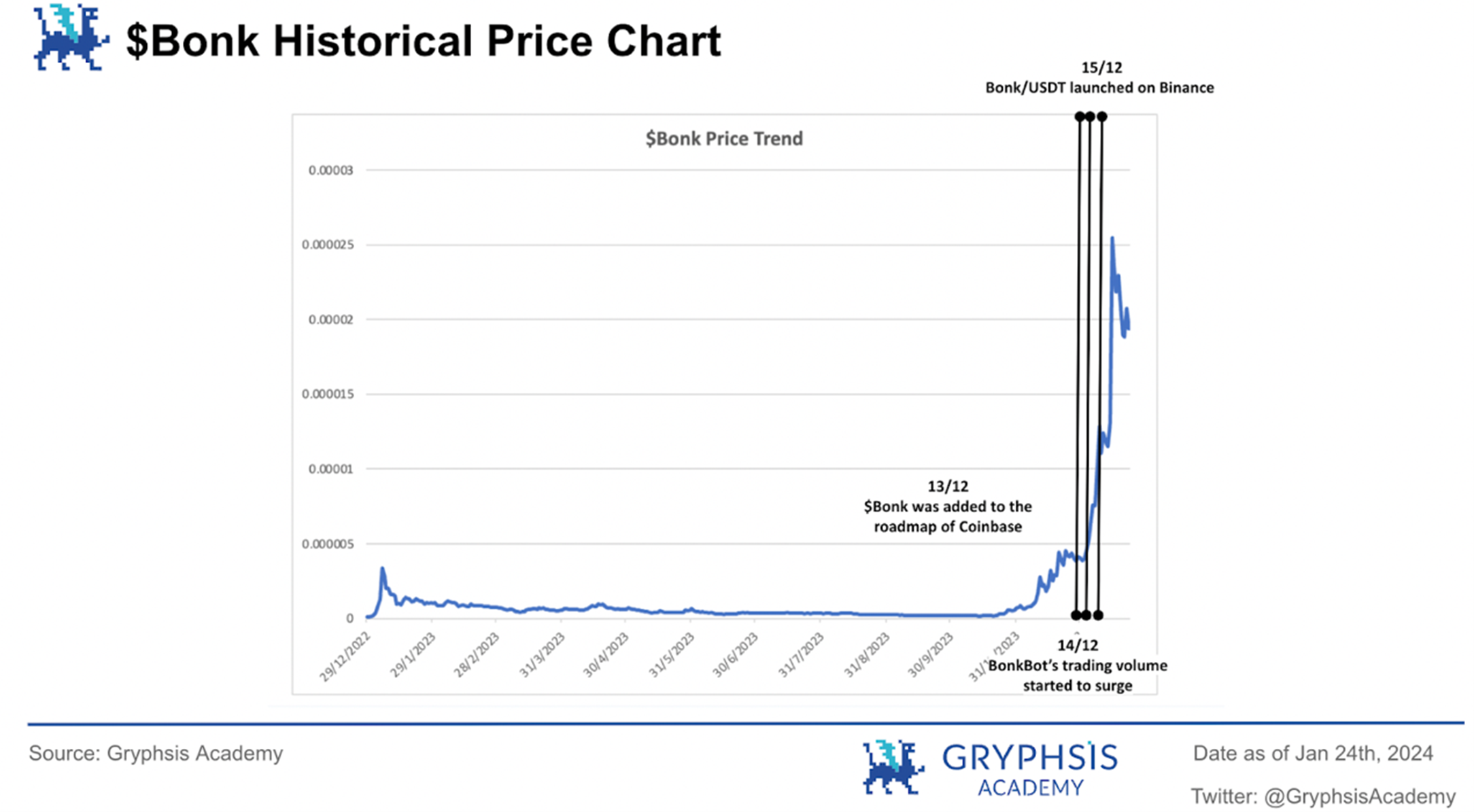
$Bonk was initially airdropped as a meme coin to Solana community members, then gradually adopted by multiple projects. However, its significant price surge mainly stemmed from recognition and listing by centralized exchanges. When major platforms like Coinbase and Binance acknowledged and listed it, Bonk’s ecosystem saw massive growth and broader adoption.
Take BONKBot as an example—it uses $Bonk as its primary platform token and implements a buyback-and-burn mechanism funded by trading fees. This not only strengthens $Bonk’s utility but also supports its intrinsic value. In this way, trading activity supports BONKBot’s operations while indirectly promoting a healthy economic cycle for $Bonk.
3.2 Economic Model
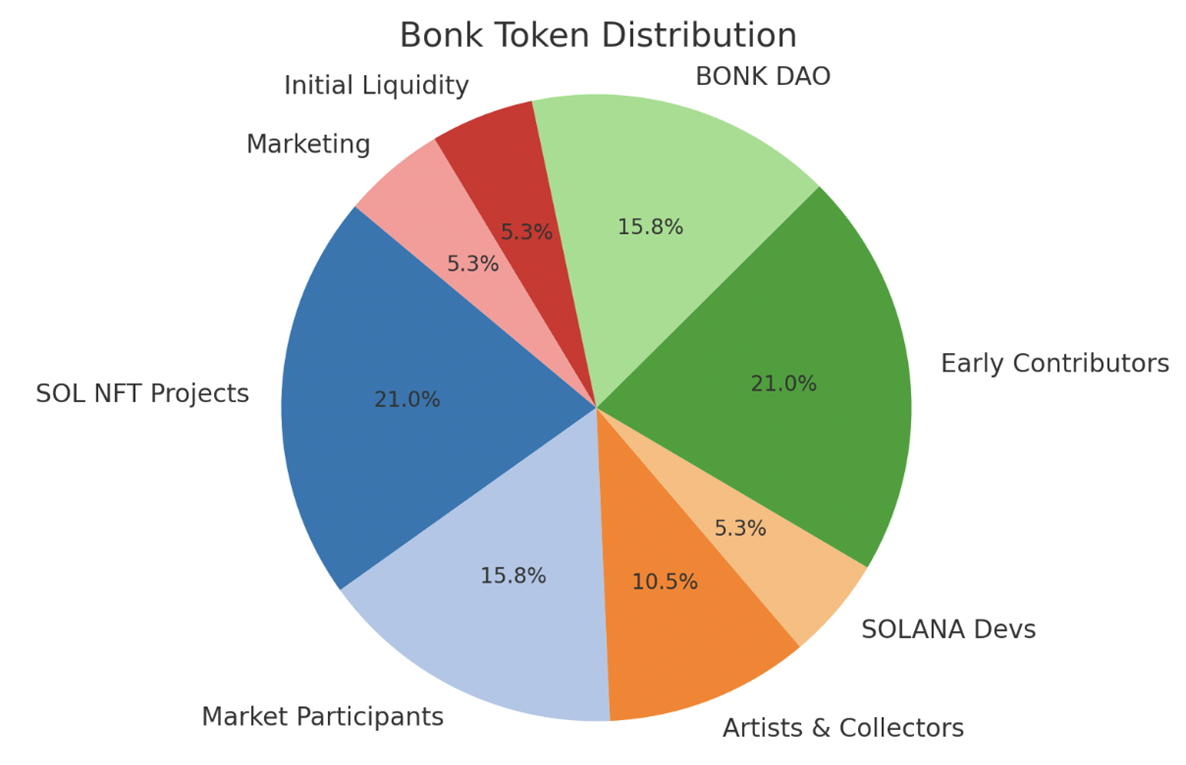
Source: Bonk Whitepaper
Above is the $Bonk token distribution. As a project giving back to $Bonk, BONKBot allocates 1% of trading fees to the following purposes:
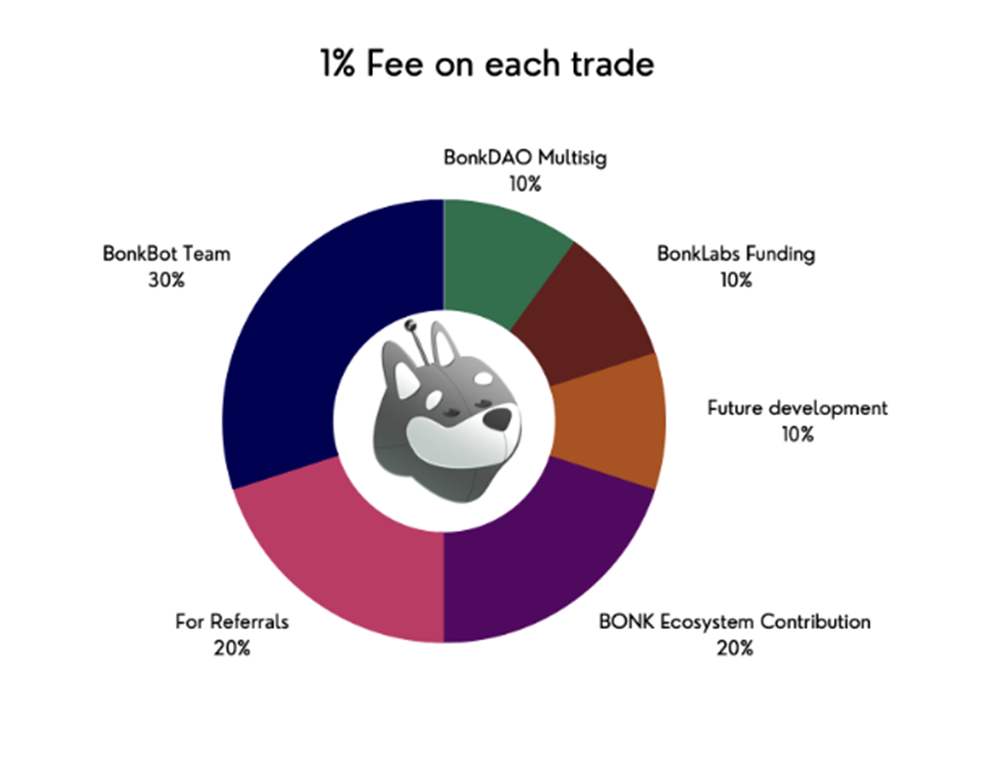
Source: BONKbot Documentation
-
30% to the BONKbot team
-
20% for referral rewards
-
10% immediately burns $BONK
-
10% supports the Bonk community
-
10% covers infrastructure and future development costs
-
10% goes to the BonkDAO multisig wallet
-
10% funds BonkLabs
3.3 Protocol Performance

Protocol trading volume and revenue surged alongside the BONKBot-driven meme coin hype, peaking at $750K in daily revenue—though it has since cooled down.
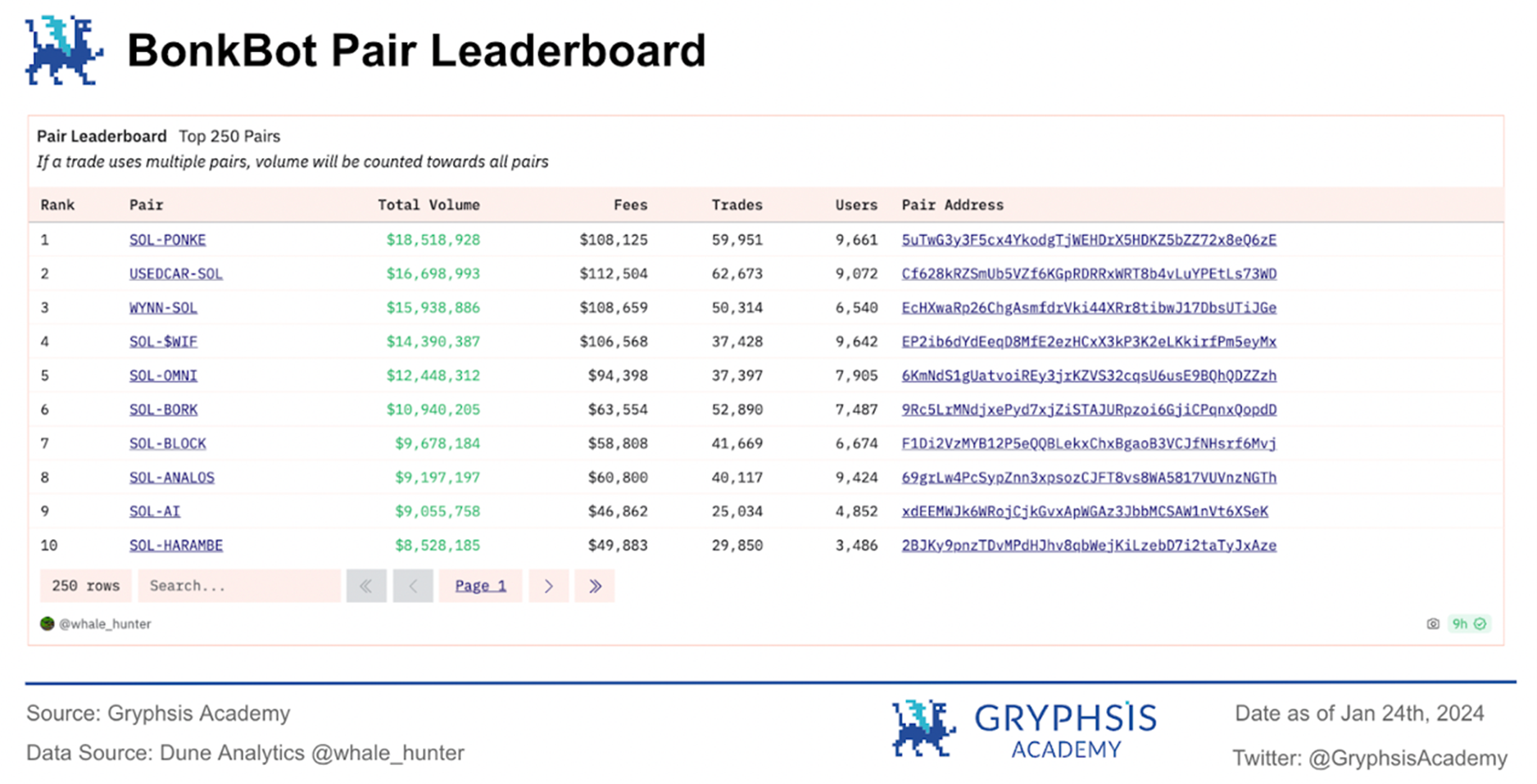
Top trading pairs on BONKBot include SOL/PONKE, SOL/USEDCAR, SOL/OMNI, SOL/$WIF, and SOL/BORK—all meme coins.
3.4 Future Outlook
(1) Meme Coin Craze in the Solana Ecosystem
The thriving meme coin culture within the Solana ecosystem can largely be attributed to Solana founder Anatoly Yakovenko’s influence and style.
A pivotal moment symbolizing Solana’s embrace of meme coins occurred when Yakovenko appeared at the Solana Breakpoint event dressed as the “Dumb Dragon,” sending a friendly nod to the meme coin community. This gesture highlighted Solana’s welcoming attitude toward meme coins, fostering an environment where they could flourish.
Following this, $Silly emerged as one of Solana’s leading meme coins, evolving alongside $Bonk into a core aspect of Solana community culture. As long as this culture persists, tools like BONKBot—which facilitate quick and easy access to tokens—will remain highly valuable.
This is especially true for speculative traders drawn to the high-risk, high-reward nature of meme coin trading. The Solana market continues to see new meme coins like $WIZ and PONKE emerge, making BONKBot’s utility perfectly aligned with the speculative and dynamic nature of the Solana meme coin market.
(2) Driving Raydium, Solana’s DEX
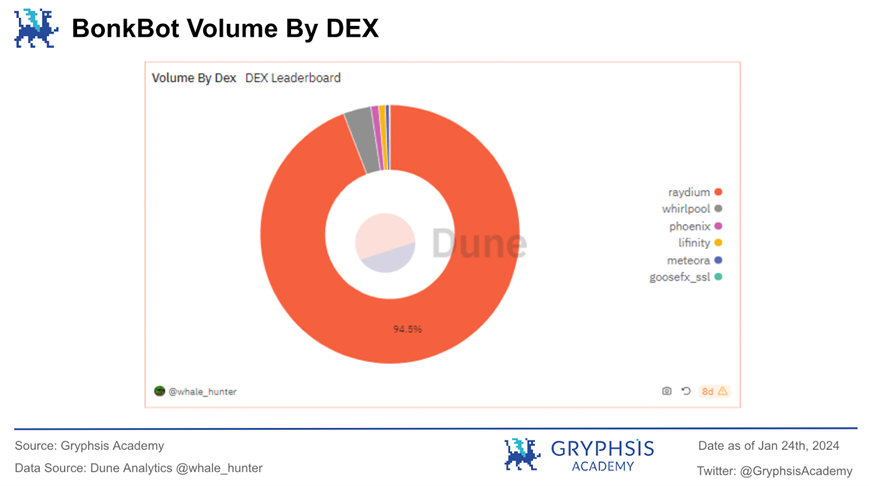
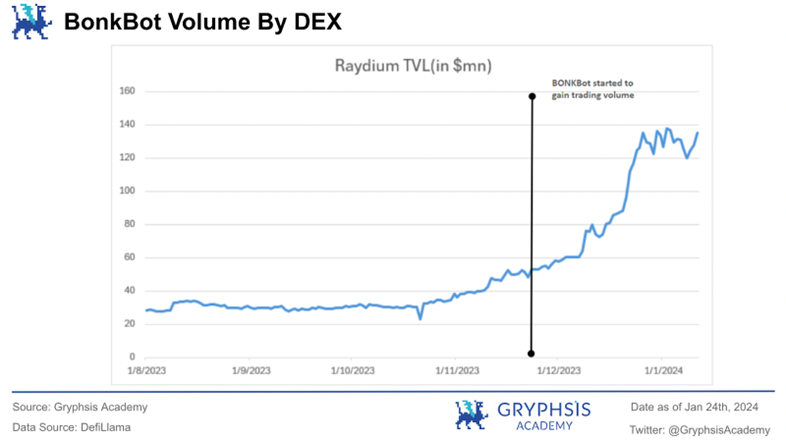
BONKBot has become a key catalyst for Raydium, evident from the fact that approximately 95% of BONKBot trades are executed via Raydium’s Swap function.
This correlation is further reinforced by data showing Raydium’s TVL increasing visibly alongside BONKBot’s rising trading volume—highlighting BONKBot’s central role in driving Raydium’s activity.
Moreover, any major updates to Raydium—such as new trading pair additions—will directly benefit BONKBot’s development and usability. These enhancements on Raydium could expand BONKBot’s trading capabilities and efficiency, further strengthening its importance within the ecosystem.
The symbiotic relationship between BONKBot and Raydium suggests that growth in one will promote development in the other, creating a mutually beneficial dynamic that supports both parties’ growth and vitality within the Solana ecosystem.
4. SolTradingBot
Join TechFlow official community to stay tuned Telegram:https://t.me/TechFlowDaily X (Twitter):https://x.com/TechFlowPost X (Twitter) EN:https://x.com/BlockFlow_News
 @gryphsisacademy