Who's Taking a Bite Out of Ethereum's "Cheese"? Opportunities Behind This Key Narrative in 2024
TechFlow Selected TechFlow Selected
Who's Taking a Bite Out of Ethereum's "Cheese"? Opportunities Behind This Key Narrative in 2024
The battle over DA's "legitimacy" will also become a central narrative in 2024, potentially giving rise to a new "Ethereum killer."
 Navigating Web3 tides with focused insights
Author: Terry
"Legitimacy"—a term that on the surface contradicts the spirit of Web3—has recently begun appearing more frequently in public discourse.
In particular, a major debate has erupted within the crypto community over the legitimacy of Ethereum's data availability (DA), involving prominent projects such as EigenLayer and Celestia. Even Ethereum co-founder Vitalik Buterin has been actively weighing in. So what exactly is DA, and what does this debate over its “legitimacy” really mean?
What Is DA?
DA stands for data availability, a critical component of today’s modular blockchain architecture.
Unlike monolithic blockchains, modular blockchains split a network into distinct functional layers—execution, data availability (DA), consensus, and settlement:
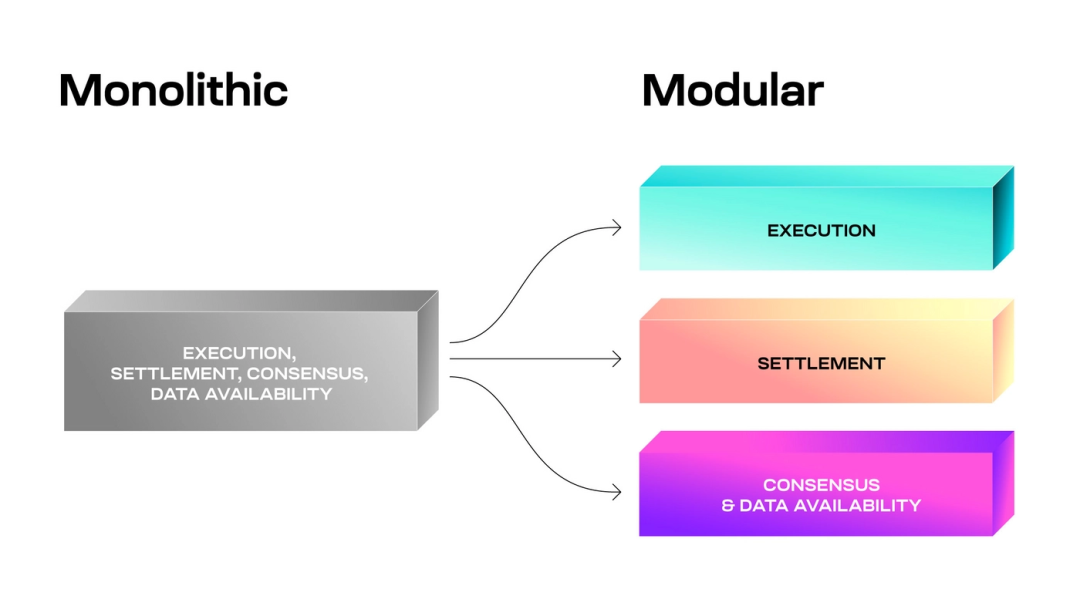
Comparison between monolithic and modular blockchains, image source: network
-
Execution: The layer responsible for processing transactions and updating state;
-
Data Availability (DA Layer): Stores data required to verify transaction validity;
-
Consensus: Determines the ordering and finality of transactions within blocks—that is, which transactions from the mempool are included in which order and in which block;
-
Settlement: Verifies Rollup L2 state data and processes fraud proofs or validity proofs.
With the intensifying L2 race and the ongoing evolution of the modular narrative, projects focused solely on execution like Rollups, or those specializing in data availability like Celestia, have proliferated.
In the modular paradigm, the core function of data availability (DA) is to ensure that on-chain data is accessible to all participants in the network, enabling cost reduction and blockchain scalability.
What are the benefits?
First, greater specialization. Take the separation of data availability and execution: in a modular architecture, one set of nodes can handle DA while another (or multiple other sets) handles execution, each focusing on their designated role. In this context, dedicated DA layers can achieve higher throughput, improve interoperability, and reduce costs.
Theoretically, every node in a blockchain network must download all transaction data to verify its availability—an extremely inefficient and costly process, yet it remains how most blockchains operate today and represents a key bottleneck to scalability, as the volume of data requiring verification increases linearly with block size.
Second, significantly improved scalability, allowing each blockchain to function like a Lego brick. Developers can combine specialized modular chains to build more scalable systems. Rollup-as-a-service providers like Caldera, AltLayer, and Conduit have made deploying new L2s increasingly simple.
In short, taking Ethereum’s modular approach as an example, the L1 acts as the settlement and data availability layer, while various L2 solutions like Rollups serve as the execution layer, enabling scaling.
This aligns with Ethereum’s roadmap toward a modular blockchain stack. Once complete, users will be able to leverage L2 solutions while still benefiting from the security of Ethereum’s base layer.
The Great DA "Legitimacy" Debate
Why have Vitalik and the broader community recently sparked a major discussion about DA? What lies at the heart of this debate?
Simply put, apart from Ethereum itself—which directly posts state data and proofs onto Ethereum L1—new alternative DA solutions have emerged, including Celestia, EigenLayer, and Avail.
As Celestia evolved, its advantages in scalability, sovereignty, flexibility, and shared security began challenging Ethereum’s dominance in the DA space, attracting general-purpose Rollup L2s such as Manta and ZkFair to adopt Celestia instead.
The most direct shockwave came when Manta Pacific migrated its data availability layer from Ethereum to Celestia—the so-called “broken window effect”—becoming the first L2 built on Celestia and triggering widespread discussion and concern within the Ethereum community.
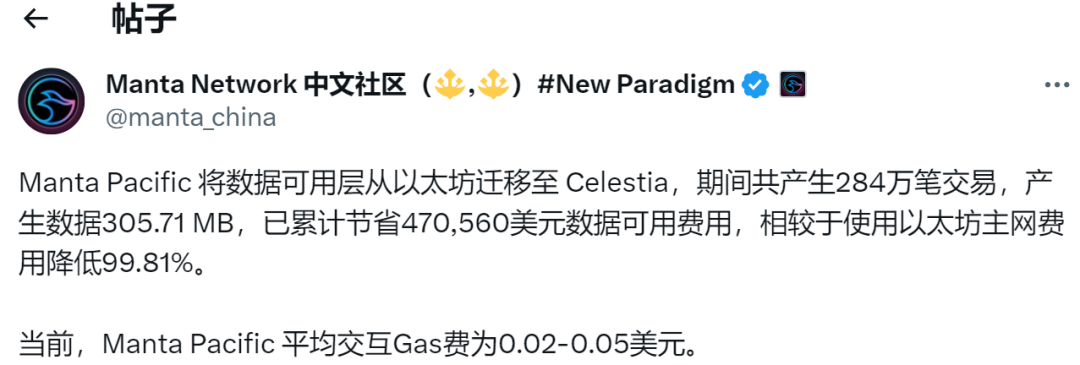
For Manta Pacific, the motivation was clearly cost reduction in data availability—official figures show that after migrating DA to Celestia, fees dropped by 99.81% compared to using Ethereum mainnet, an exponential decline.
Of course, third-party DA solutions like Celestia inherently sacrifice some degree of security compared to Rollups that rely directly on Ethereum for DA. But for these L2s, choosing a DA provider involves trade-offs between cost and security—and cost often dominates the decision-making.
As a result, new projects like Aleo, Dymension, and ZKFair are turning to Celestia and similar DA alternatives to cut costs. Even Polygon shifted to NEAR, openly claiming it is “8,000 times cheaper than Ethereum.”
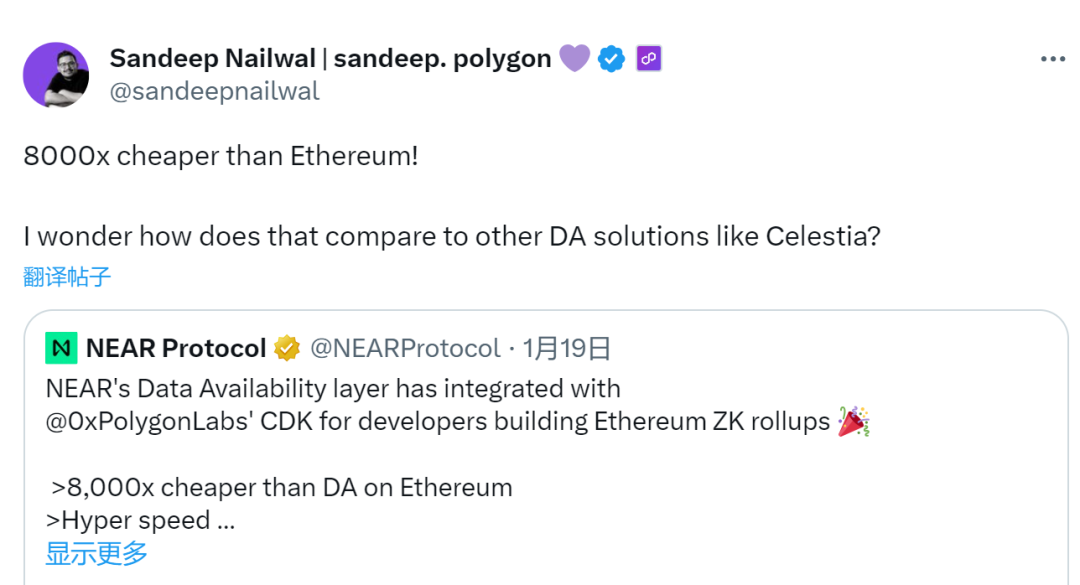
Translation: 8,000 times cheaper than Ethereum!
I wonder how this compares to other DA solutions like Celestia?
It is foreseeable that as long as the cost advantage persists, more and more L2s will integrate new DA solutions like Celestia—posing a significant challenge to Ethereum and intensifying the struggle between the Ethereum community and the Celestia team over the definition of Ethereum L2 legitimacy.
In essence, the DA 'legitimacy' debate centers on whether general-purpose Rollup L2s should replace Ethereum with modular blockchain DA solutions like Celestia or Avail.
The Underlying Evolution of the DA Landscape
Overall, the rise of diverse DA solutions like Celestia has indeed weakened Ethereum’s competitive edge in the DA space to some extent.
More specifically, the challenge to Ethereum’s “legitimacy” isn’t limited to Celestia alone. If we broadly categorize the current DA landscape (excluding centralized options), it falls roughly into four categories:
-
Ethereum blob / Danksharding;
-
Standalone decentralized DA like Celestia;
-
EigenDA/MantleDA (DA leveraging ETH restaking);
-
Newcomers like NEAR;
Celestia needs little introduction—it’s widely seen by many in the community as an essential solution delivering massive economic benefits by reducing L2 gas fees.
Indeed, Ethereum-based projects such as Manta, ZKFair, Arbitrum Orbit, general-purpose L2 Eclipse, decentralized API data service Pocket Network, and modular blockchain network Movement Labs are already using Celestia.
Once network effects take hold, Celestia could continuously erode Ethereum’s fee revenue, emerging as a dominant specialized DA player and capturing significant valuation upside—at Ethereum’s expense.
On the other hand, EigenDA leverages Ethereum’s existing infrastructure and extends Ethereum’s security consensus via restaking—thus reinforcing rather than undermining Ethereum’s DA “legitimacy,” strengthening Ethereum’s own DA capabilities.
NEAR is also an emerging contender. Beyond Polygon’s adoption, Arbitrum Orbit has integrated Near DA, enabling developers to launch customizable Rollups based on Arbitrum’s technology.
Overall, the surging market price of TIA reflects how the DA sector is increasingly entering the mainstream spotlight amid the evolving L1 and L2 landscape.
From this perspective, the battle over DA “legitimacy” will likely become a central narrative in 2024, potentially giving rise to a new generation of “Ethereum killers.” Whether any new projects will emerge as dominant players remains to be seen—let’s wait and see.
Join TechFlow official community to stay tuned
Telegram:https://t.me/TechFlowDaily
X (Twitter):https://x.com/TechFlowPost
X (Twitter) EN:https://x.com/BlockFlow_News
 白话区块链
白话区块链