









Apple Vision Pro is in short supply, leading to the rise of resellers and counterfeit versions
TechFlow Selected TechFlow Selected
Apple Vision Pro is in short supply, leading to the rise of resellers and counterfeit versions
When Huaqiangbei arrives, all problems are solved.
 Navigating Web3 tides with focused insights
By Mu Mu
After Apple Vision Pro opened pre-orders in the U.S., the first batch sold out in less than ten minutes, with delivery dates now pushed to March this year. As the product has not yet been launched in China but there is still demand among domestic early adopters, a market for proxy purchasing services has emerged.
When Vision Pro began pre-orders on January 19, the official price for the 1TB model was $3,899 (approximately 27,660 RMB), while proxy buyers were charging nearly 90,000 RMB—without guaranteeing first-batch availability or fast shipping back to China.
In recent days, although proxy prices have dropped, the 256GB model, priced at $3,499 (about 24,823 RMB) on Apple’s website, still costs between 33,000 and 40,000 RMB through proxy channels. With additional shipping fees and taxes, the total cost of importing a Vision Pro from the U.S. via proxy buyers could be 2,000 to 5,000 RMB higher than the quoted proxy price.
With authentic Vision Pros hard to obtain, some counterfeit versions have started appearing. In Shenzhen’s Huaqiangbei electronics market, a device called “AppleCore” closely resembles the Vision Pro and sells for only 1,600 RMB. Unsurprisingly, its quality and user experience are nowhere near Apple’s vision of a “spatial computer.” When we asked local vendors about fake Vision Pro models, one responded: "You're the first person to ask me about this."
Vision Pro Proxy Prices Drop After Initial Surge
The Vision Pro, which Apple claims will "herald the era of spatial computing," officially launched in North America on January 19, starting at $3,499 (around 24,823 RMB) for the 256GB version. The U.S. website showed sold-out inventory just 18 minutes after launch; within two hours, delivery estimates had slipped to March.
Supply chain reports indicate that Apple's production volume for the Vision Pro isn't high. In mid-2023, Apple reportedly cut initial orders from one million units down to 400,000. According to TrendForce, Vision Pro shipments may reach between 500,000 and 600,000 units in 2024.
With limited supply, Vision Pro is already in short supply across the U.S. For users based in China who want to purchase it internationally, official channels present significant barriers.
To pre-order the Vision Pro, customers need a U.S. Apple ID, an American phone number, a compatible payment card, and a valid U.S. shipping address—requirements that most Chinese tech enthusiasts can't easily meet. Those who can often end up becoming resellers themselves.
On e-commerce platforms such as JD.com, Taobao, and Xianyu, numerous sellers offer proxy purchasing services for Vision Pro, with prices ranging from 30,000 to 90,000 RMB. One JD International seller listed the device at 89,800 RMB, requiring a deposit of 38,999 RMB.
Recently, proxy prices have declined slightly, but the 256GB model generally still costs between 33,000 and 40,000 RMB. This may reflect relatively modest interest among mainstream consumers so far.
A private reseller on Xianyu told Metaverse Daily: "We lowered our price to 33,000 RMB after research—it's already quite low. Since the adjustment, more people have been asking. But while inquiries increased, few actually paid deposits. I personally ordered only two units, planning to bring them back in person to save on taxes and duties." He added that no one had paid a deposit yet.
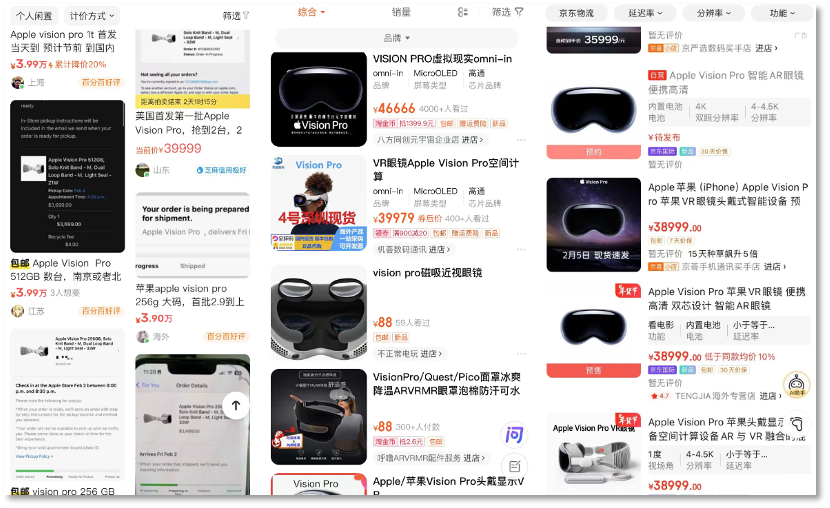
High-premium proxy sellers for VisionPro appear on e-commerce platforms
On other platforms, sales volumes for proxy sellers remain low, typically just dozens of units. Limited stock and high prices deter average consumers. A 3C enthusiast named Nico (a pseudonym) told Metaverse Daily: "I’d be willing to pay for the new computing experience offered by Vision Pro, but I wouldn’t buy it from the U.S. Setting aside the cost, using a U.S.-region product in China is inconvenient and compromises the experience. It's better to wait for the mainland China version."
Indeed, Chinese users who purchase the U.S. version regardless of cost face several usability issues. First, Vision Pro currently supports only English for language and input methods. Second, due to copyright and licensing restrictions, certain apps may not function properly outside the U.S. Correspondingly, accessing the Vision Pro App Store requires logging in with a U.S. region Apple ID.
Additionally, Vision Pro currently only supports prescription lenses certified by Zeiss, and buyers must ensure their eyeglass prescription comes from a licensed provider in the U.S.—a requirement that creates potential complications for future after-sales service.
Domestic Counterfeits Emerge But Find No Market
With genuine Vision Pros hard to get, netizens joked: "Once Huaqiangbei gets involved, all problems are solved."
In fact, last year saw the emergence of a knockoff headset called Apple Core, selling for just 1,600 RMB—only a fraction of the authentic product's price.
On January 5, Bilibili content creator "Xiaochen Charges Forward" published a review video of this counterfeit Vision Pro. Externally, the Apple Core bears a strong resemblance to the real thing—but includes an additional controller made of visibly cheap plastic. While the Vision Pro features 12 cameras, the Apple Core has only two.
According to the reviewer’s footage, upon startup, instead of Apple’s iconic logo, users see a large “Android” sign, followed by a floating 3D text reading “Vision SE.” Once inside the interface, the UI largely mimics the design of Vision OS shown in Apple’s June 2023 promotional video, though settings resemble those of an iPad.
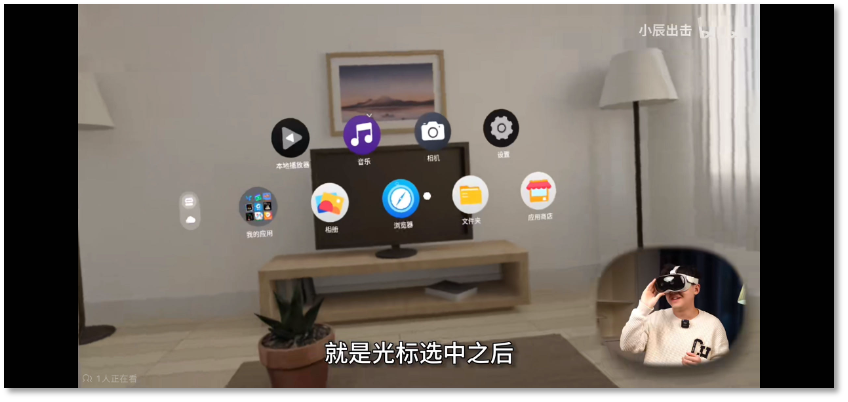
Footage from content creator "Xiaochen Charges Forward" testing the counterfeit Vision Pro
In Neal Stephenson’s novel, the virtual city develops along a 100-meter-wide avenue, where electronic billboards stretch across dimly lit blocks. People enter this highly advanced, free-flowing metropolis through VR glasses, buying virtual land and building structures. The protagonist Hiro lives in a cramped warehouse shared with others in the real world, but in the virtual city known as the “Metaverse,” he owns a beautiful mansion.
As for actual performance, the counterfeit version naturally cannot compare to the genuine Vision Pro. Furthermore, its app ecosystem is extremely limited, offering only a few simple games and videos, with poor image quality and laggy performance—not to mention any integration with Apple’s applications.
So how is the market responding to these affordable knockoffs?
When Metaverse Daily asked several Huaqiangbei stall owners about counterfeit Vision Pros, the responses were strikingly consistent: “No stock—we don’t have a domestic market.” One vendor said: “You’re the first person to ask.”
Beyond smartphones, Huaqiangbei’s popular counterfeit products mainly include headphones and smartwatches. Although used less frequently than phones or computers, buyers still prioritize user experience when opting for fakes—expecting savings without sacrificing functionality. Given that authentic XR headsets haven’t yet become mainstream consumer electronics, it’s no surprise that counterfeits are underwhelming.
Nico, the 3C enthusiast, believes XR headsets heavily depend on user experience. Even leading devices like PICO and Meta Quest aren’t perfect yet—“For example, motion sickness remains unsolved. Knockoffs stand no chance. And they still cost over a thousand yuan. If someone really wants to try VR, buying a secondhand PICO Neo3 would be a much better deal.”
Content creator “Xiaochen Charges Forward” suggested in his review that the Huaqiangbei counterfeit Vision Pro isn’t aimed at regular consumers: “It might target shopping malls or VR experience centers—basically serving as offline demo units for VR exhibitions.”
Whether they’re 3C enthusiasts or ordinary users, anyone interested in this “spatial computer” would be wiser to wait for the official China version of Vision Pro. Apple has not yet announced a specific release date for Vision Pro in China. Some analysts predict Apple may launch Vision Pro in markets outside the U.S. before WWDC 2024, which typically takes place every June.
Join TechFlow official community to stay tuned
Telegram:https://t.me/TechFlowDaily
X (Twitter):https://x.com/TechFlowPost
X (Twitter) EN:https://x.com/BlockFlow_News









