Upcoming Ethereum Upgrade: An Underestimated Factor for ETH Price?
TechFlow Selected TechFlow Selected
Upcoming Ethereum Upgrade: An Underestimated Factor for ETH Price?
The Dencun upgrade is about one month away from finalization, and according to research data, Ethereum is likely to experience a rebound surge.
 Navigating Web3 tides with focused insights
Written by: Mary Liu, BitpushNews
The impact of Ethereum's governance decisions on its price has been underestimated.
A recent study by three academics—Cesare Fracassi and Moazzam Khoja from the University of Texas at Austin, and Fabian Schär from the University of Basel—sheds light on this relationship, particularly regarding EIPs (Ethereum Improvement Proposals).
An Ethereum Improvement Proposal is a design document proposing new features or changes to the Ethereum blockchain, serving as a guide for community consensus. The research paper by Cesare Fracassi et al. focuses on Ethereum’s decision-making process and reveals an interesting trend: in the period leading up to final discussions on core EIPs, Ethereum’s price rose approximately 18%, outperforming Bitcoin by 12%.
The paper has not yet undergone academic peer review. The study also examines centralization within Ethereum's governance, finding that developers and influencers hold significant sway over the EIP process.
Ethereum’s next major upgrade is Dencun, expected to reduce transaction costs on Layer 2, potentially launching by the end of February. Ethereum developers will test Dencun on the Sepolia and Holesky testnets on January 30 and February 7, respectively.
Historical Data
The study analyzed Ethereum’s price trends during the final discussion and approval phases of successful core EIPs, using hourly price data from May 2016 to November 2023.
One of the most significant findings was that Ethereum’s price increased by 18% in the weeks leading up to the last AllCoreDevs call before a major EIP.
AllCoreDevs calls are regular meetings where Ethereum’s core developers discuss EIPs and make key decisions.
The price surge is seen as reflecting shifting investor expectations about the likelihood of a proposal being approved and its potential impact on the token’s value.
To ensure analytical accuracy, researchers focused on specific 80-day periods, evenly split before and after these calls.
The study found that Ethereum’s price began rising roughly 30 days before key discussions.
A clear pattern also emerged when comparing Ether to Bitcoin.
In the 25 days prior to the approval of a core EIP, Ether typically outperformed Bitcoin by around 12%, indicating that ETH prices tend to rise significantly in anticipation of major changes to the Ethereum network.
This growth is particularly notable given the centralized nature of governance, where a small group holds substantial influence over critical decisions.
For example, each client implementation—an average of 10 validators responsible for running different software versions of the Ethereum protocol—accounts for 80% of all software changes.
When compared to the S&P 500 index, Ethereum’s price movements do not always align with stock market trends, suggesting that factors influencing Ethereum differ from those driving traditional markets.
For market participants—from retail investors to institutional traders—these insights could offer potentially valuable perspectives on how governance-related events may serve as key indicators in investment strategies.
For the Ethereum community and developers, the data underscores how their decisions impact not only the network’s technical trajectory but also its financial ecosystem.
With the Dencun upgrade about a month away from finalization, historical data suggests Ethereum could be poised for a rebound.
Could ETH fall below $1,000?
Crypto trader and analyst Benjamin Cowen, however, suggests ETH might decline further, possibly falling below $1,000, attributing the potential drop to factors tied to the asset’s historical patterns.
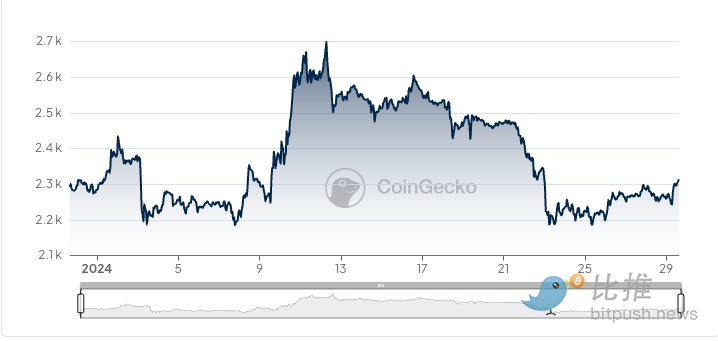
In recent weeks, investors and traders have closely watched Ethereum’s price following the U.S. approval of spot Bitcoin exchange-traded funds (ETFs). After the ETF approval, Ethereum hit a year-to-date high of $2,720, but quickly pulled back into consolidation.
Analyst Benjamin Cowen notes that historically, from a technical perspective, Ethereum tends to “test” its major cycle lows about twice before entering a new bullish phase. Cowen specifically points to 2015, 2016, and 2020, noting that the 2022 low has not yet been retested.
According to the trader, in the coming months, Ethereum will first show signs of weakness in its Bitcoin-denominated price (ETH/BTC), followed by a pullback in ETH/USD.
He stated: "So at some point, I think Ethereum will fully test that low, dropping below $1,000. However, historical data also shows it won’t test that low until after the ETH/BTC collapse. The data also suggests the ETH/BTC collapse likely occurs after January, since January is typically a strong month for Ethereum."
At the time of writing, Ethereum’s price stands at $2,310, down 14% from its year-to-date high of $2,700 on January 12.
Join TechFlow official community to stay tuned
Telegram:https://t.me/TechFlowDaily
X (Twitter):https://x.com/TechFlowPost
X (Twitter) EN:https://x.com/BlockFlow_News
 比推 BitpushNews