









TVL Exceeds $30 Million in 4 Days: What's Innovative About Vector Reserve?
TechFlow Selected TechFlow Selected
TVL Exceeds $30 Million in 4 Days: What's Innovative About Vector Reserve?
A new protocol combining the LPD and LRT concepts amidst rising interest in the restaking sector.
 Navigating Web3 tides with focused insights
Text: Meteor, ChainCatcher
Editing: Marco, ChainCatcher
If 2023 was the year of LSTs (Liquid Staking Tokens) dominating DeFi, then 2024 is shaping up to be the year of LRTs (Liquid Restaking Tokens). With Ethereum's upcoming Cancun upgrade on the horizon, interest in Ethereum staking and restaking has reignited. This momentum has given rise to numerous new protocols and concepts built around LRTs. Among them, the new project Vector Reserve combines two trending ideas—LPD and LRT/LST.
Regarding LPD (Liquidity Providing/Position Derivatives), during the peak popularity of the LSDfi sector, some projects introduced the concept of LPDfi—Liquidity Derivatives Finance—and several LPDfi-based projects have emerged, such as Logarithm Finance, Limitless, Entangle, and Good Entry.
LPD products aim to address impermanent loss issues faced by active liquidity providers (LPs) in Uniswap V3-like DeFi protocols, maximizing LP returns.
"Multiple Benefits from One Fish": The Layered Advancement of LST, LRT, and LPD
LST stands for Liquid Staking Token (e.g., Rocket Pool’s rETH, Coinbase’s cbETH), allowing users who stake ETH to receive tradable liquid tokens representing both their staked value and staking rewards.
LRT stands for Liquid Restaking Token (e.g., Retake Finance’s rstETH, Renzo’s ezETH, Ether.fi’s eETH), representing the next step in enhancing returns from LSTs. Leveraging mechanisms provided by EigenLayer, LRTs allow holders of ETH and LSTs to restake their assets and earn additional rewards.
LPD stands for Liquidity Position Derivatives—a new asset class designed to capture the full market value of LST/LRT markets in a low-risk, diversified manner, thereby offering higher yields.
Compared to the restaking returns offered by LRTs, LPDs go further by leveraging EigenLayer’s Superfluid Staking mechanism to further increase staking yields (from both restaking rewards and Superfluid Staking rewards). Superfluid Staking is part of EigenLayer’s design, enabling users to stake LP tokens—an idea that has drawn significant attention since its introduction.
"The Superfluid Staking concept was first proposed by Osmosis and launched in March 2022. Osmosis’ Superfluid Staking allows users to stake LP tokens from OSMO pools, securing the network while earning extra rewards. Subsequently, EigenLayer also introduced its own Superfluid Staking functionality, enabling users to stake LP tokens from liquidity pools involving ETH or ETH derivatives, thereby increasing yield potential from trading fees for LP token holders."
Introduction to Vector Reserve
Vector Reserve is a DeFi project combining restaking and liquidity derivatives. At its core, Vector Reserve leverages LSTs and LRTs to create diversified LPDs within traditional ETH/LST or ETH/LRT liquidity pools, further boosting yields through Superfluid Staking.
In simple terms, vETH’s key innovation lies in allowing LP tokens—not just single underlying tokens—to be staked. By utilizing Superfluid Staking, Vector stakes LP tokens back into EigenLayer to generate additional returns, making vETH’s yield significantly higher than simply staking on a standalone LST platform or via LRT restaking.
Innovative vETH and VEC
The Vector Reserve ecosystem features two tokens: vETH (a staked LP token) and VEC (the native governance token).
vETH: Vector Reserve’s LPD
vETH (Vector ETH) is an ERC-20 token pegged to ETH, minted by depositing ETH paired with LSTs/LRTs into a liquidity pool. It represents a tokenized asset denominated in ETH, reflecting LP exposure relative to LSTs and LRTs, and serves as a sustainable, risk-managed, high-yield asset for DeFi participants. vETH provides liquidity in the form of LSTs and contributes to the liquidity of the VEC token. This dual utility makes vETH a multifunctional and valuable asset—offering a sustainable income stream and supporting the governance token VEC as a reserve asset.
vETH is also a yield aggregator, drawing returns from multiple sources:
-
LST and LRT yields: vETH holders benefit from the returns generated by Vector Reserve’s LP positions and associated LSTs/LRTs.
-
Trading fees and emissions: Participation in LPs across multiple chains and DEXs enables vETH to accumulate trading fees and emission rewards, enhancing its yield potential.
-
Staking: By leveraging EigenLayer’s Superfluid Staking, vETH enables restaking of ETH-based LP tokens.

Advantages of vETH over current DeFi LST/LRT offerings include:
-
Higher yield opportunities: LPDs offer returns exceeding those from holding underlying assets alone;
-
Diversification: Unlike single-point investments, LPDs provide exposure across multiple platforms and protocols, spreading risk;
-
Flexibility and liquidity: LPDs maintain the liquidity of underlying assets while adding utility and yield potential, offering investors stability and flexibility.
-
Market correlation: LPDs like vETH remain closely correlated with their underlying ETH-denominated assets, providing deep liquidity, stability, and higher yields.
VEC: Governance Token of Vector Reserve
VEC is the cornerstone of the Vector Reserve ecosystem, serving multiple roles in value accrual, incentives, utility, and governance. VEC works synergistically with vETH to create a sustainable circular economy. VEC incentivizes vETH minting, which in turn strengthens VEC’s reserve backing and value.
The VEC token is designed to appreciate over time through a sustainable tokenomics model incorporating real revenue generation from vETH and strategic treasury management:
-
Revenue sharing: A portion of the revenues and fees generated by vETH will be directly used to support VEC’s value, creating a self-sustaining economic loop.
-
Treasury management: Vector Reserve employs an ETH-based treasury strategy to ensure long-term economic stability of the VEC token.
Considering balanced and controlled VEC supply, long-term value stability, and the goal of increasing protocol deposits, VEC will:
-
Be issued at a discount to promote growth: VEC tokens can be minted at a discount, encouraging expansion while preserving value;
-
Control inflation: Manage the supply of VEC and VEC bonds to prevent excessive inflation.
Like other DeFi protocols, VEC holders have governance rights, enabling participation in key future decisions for the Vector Reserve protocol. Token holders can propose changes and vote, ensuring development aligns with community interests. Transparent governance fosters a strong community culture among VEC holders.
Vector Reserve Tokenomics
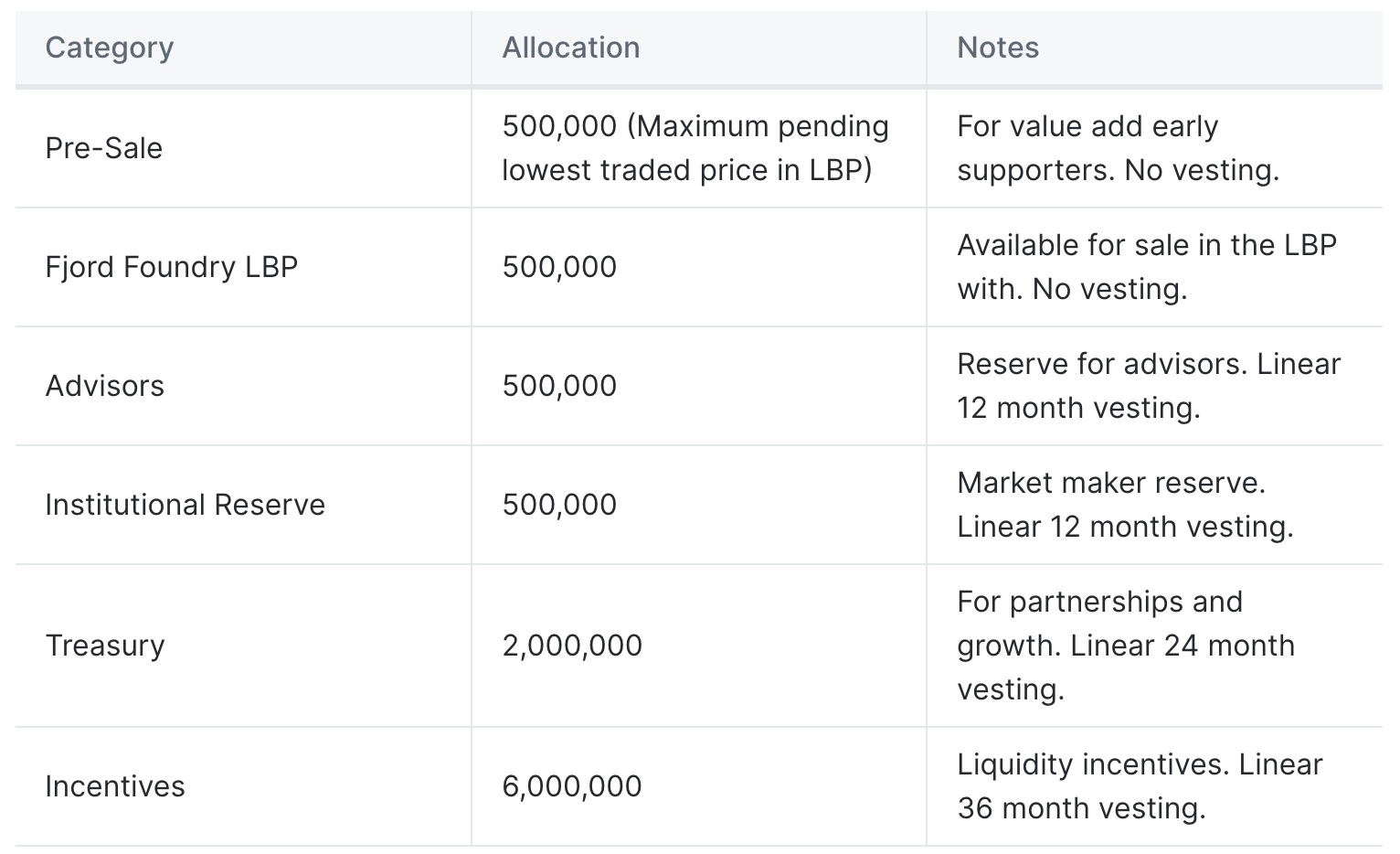
Currently, the initial supply of Vector Reserve’s native token VEC is set at 10,000,000.
-
Presale: 500,000 tokens allocated to early supporters, no vesting period (raised 180 ETH, presale now concluded);
-
Fjord Foundry LBP: 500,000 tokens available for sale via LBP, no vesting period;
-
Advisors: 500,000 tokens, linear unlock over 12 months;
-
Reserve: 500,000 tokens for market-making purposes, linear unlock over 12 months;
-
Treasury: 2,000,000 tokens for partnerships and ecosystem growth, linear unlock over 2 years;
-
Incentives: 6,000,000 tokens for liquidity incentives, linear unlock over 3 years.
Conclusion
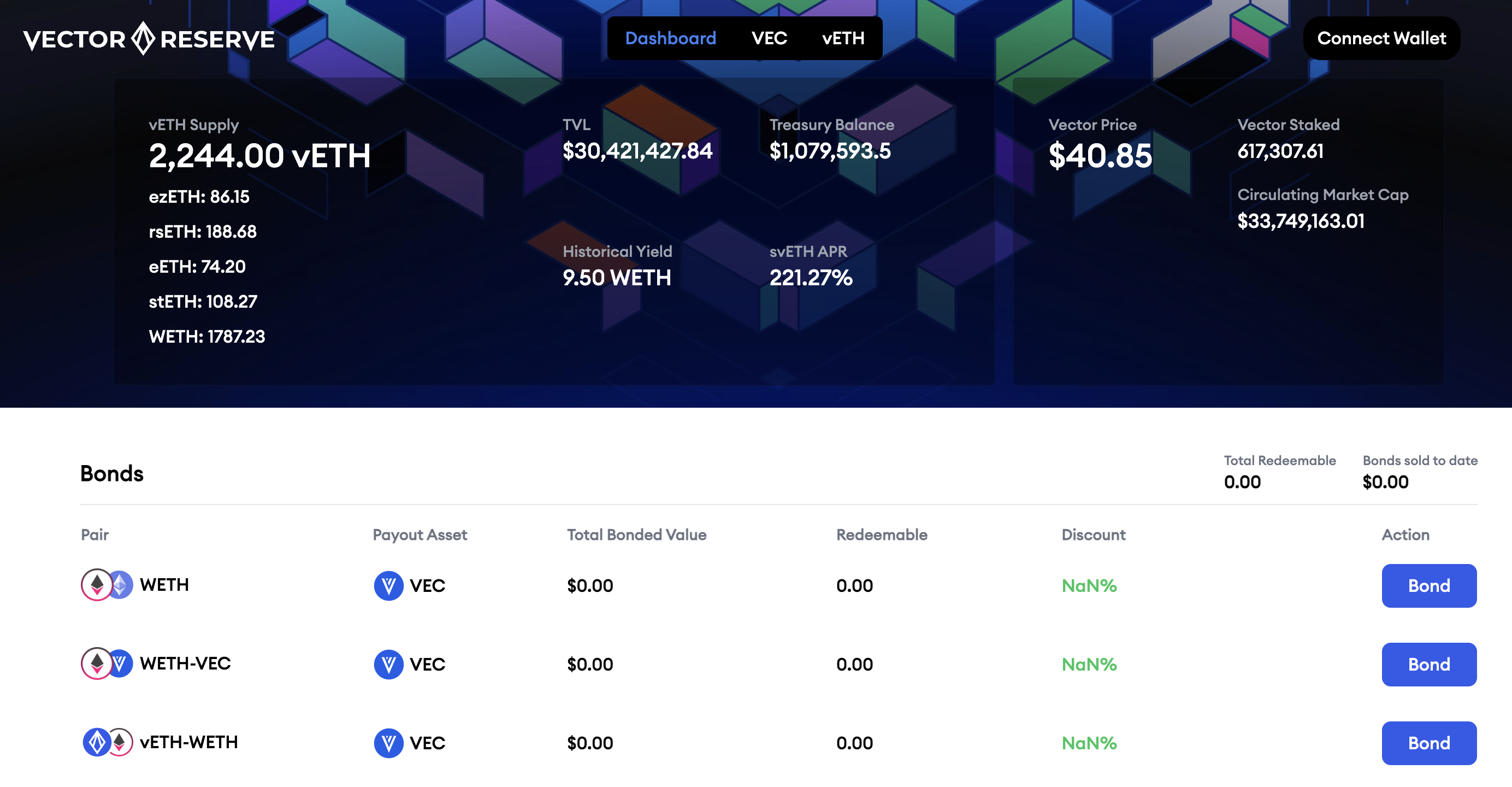
At the time of writing, Vector Reserve’s website shows the protocol has received 2,244 ETH in deposits (worth approximately $5.15 million), with a total value locked (TVL) exceeding $30.42 million. The VEC token is priced at around $40. All treasury assets are publicly visible and transparent.
So far, having accumulated over $30 million in TVL in nearly four days since launch, Vector Reserve’s metrics have already surpassed those of ether.fi, one of the most popular liquid staking protocols in 2023.
Join TechFlow official community to stay tuned
Telegram:https://t.me/TechFlowDaily
X (Twitter):https://x.com/TechFlowPost
X (Twitter) EN:https://x.com/BlockFlow_News
 ChainCatcher 链捕手








