What enabled Solana, once surrounded by adversity, to stage a remarkable comeback?
TechFlow Selected TechFlow Selected
What enabled Solana, once surrounded by adversity, to stage a remarkable comeback?
Solana has endured hardship and made a comeback.
 Navigating Web3 tides with focused insights
Written by: SAURABH, JOEL JOHN, SIDDHARTH
Translated by: HuoHuo
In 2022, as SBF and the FTX platform gained massive attention, Solana became one of the hottest public blockchains in the crypto industry. However, the subsequent collapse of FTX nearly brought down Solana’s entire ecosystem.
SOL's price plummeted from $236 to $13 within weeks. Investment firms advised startups not to build on Solana but instead to develop on Ethereum Virtual Machine (EVM)-compatible chains. Soon after, several prominent projects migrated from Solana to other blockchains. Yet, a year later—shown in the chart below—Solana rebounded and outperformed its peers.
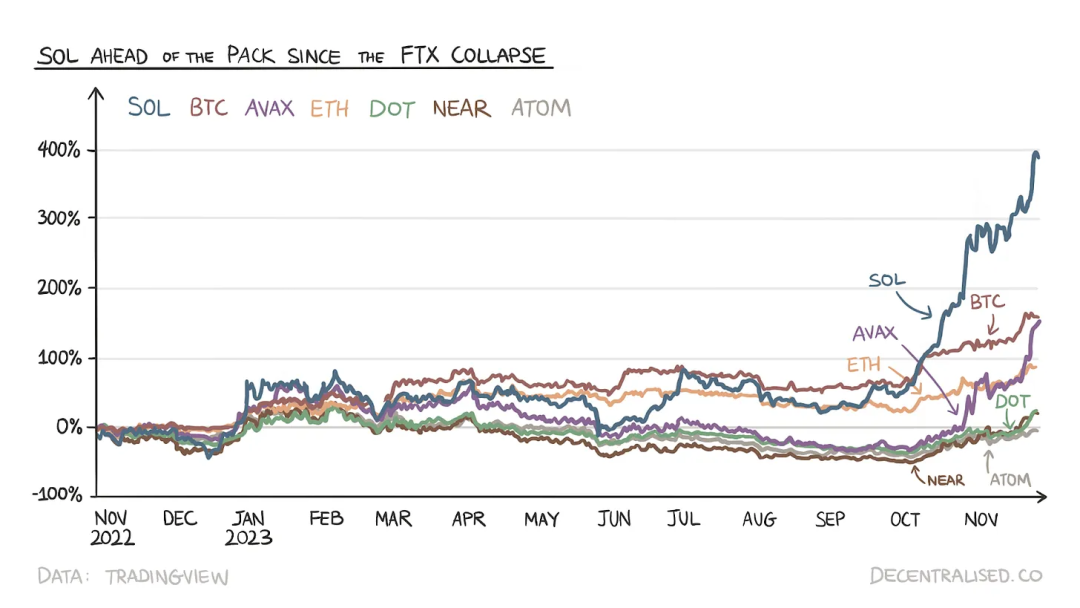
Top token price performance from late 2022 to 2023
People love comeback stories, and today we explore how Solana recovered from its bear market lows in 2023, and what design differences have made it a top-tier blockchain.
Client Diversity
Solana's founder Anatoly and team members come from strong backgrounds in traditional mobile communications. They worked for over a decade at Qualcomm as engineers, witnessing firsthand Moore’s Law—the doubling of hardware capacity every two years. Unlike Bitcoin and Ethereum, Solana does not restrict node hardware requirements in its architecture.
Bitcoin and Ethereum are relatively mature networks with greater client diversity. But why is client diversity so important? Think about it: in a decentralized network, you want all functions to be relatively decentralized. If more than 66% of the network runs a single client, and that client issues faulty updates or synchronizes blocks in the wrong order, it could disrupt the blockchain’s functionality. There may arise consensus issues over which block gets approved first. Both Ethereum and Bitcoin have actively optimized client diversity in the past.
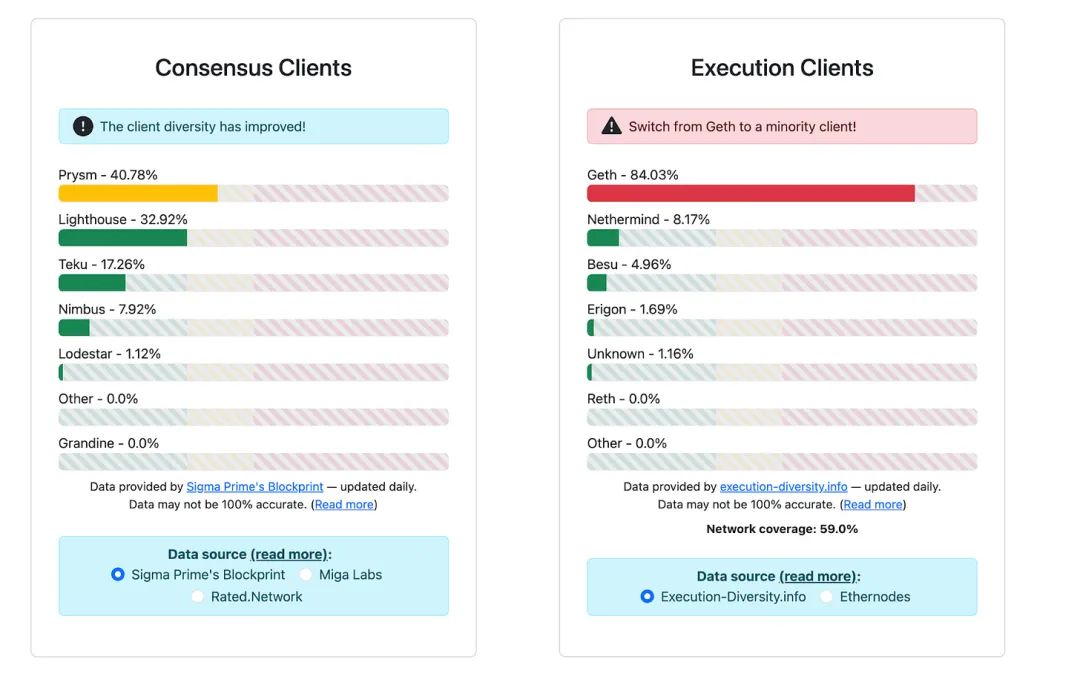
Consensus clients and execution clients, source: https://clientdiversity.org/methodology/
Solana experienced three major network outages and several performance degradations in 2022, and another outage in 2023. These downtimes were primarily caused by consensus issues. Although low transaction fees benefit users, they also make spam attacks and denial-of-service (DDoS) attacks easier to execute.
When a block is proposed, validators receive packets (within the block), independently verify their correctness, and confirm validity among each other to reach consensus. However, when validators lag in processing these packets, consensus messages can be lost.
Firedancer has created a messaging framework that bypasses certain bottlenecks, reducing network latency. Since Firedancer is built from scratch by a different team, it likely won’t carry the same bugs as the Solana Labs client. Thus, identical errors won't affect both clients simultaneously. Ideally, validators will run one primary and one secondary client, with the secondary serving as a backup.
A chain with a robust DeFi ecosystem needs to guarantee 100% uptime, so Solana requires stronger client infrastructure. The main reasons for Solana network halts have been lack of congestion control and network processing delays. Several network upgrades have improved validator handling of transaction floods, enabling better congestion management.
Solana acknowledges that client diversity is a work in progress. Like Ethereum and Bitcoin before it, such improvements take time. One sign of progress is the percentage of staked assets running through the Jito-Solana client. While the Jito Solana client doesn’t help redundancy yet, it shows that validators are willing to run alternative clients when available.
With more clients like Firedancer and Sig coming online, we should see reduced reliance on the Solana Labs client in the future. The ideal distribution per individual client is around 33%. So there’s still work to do.
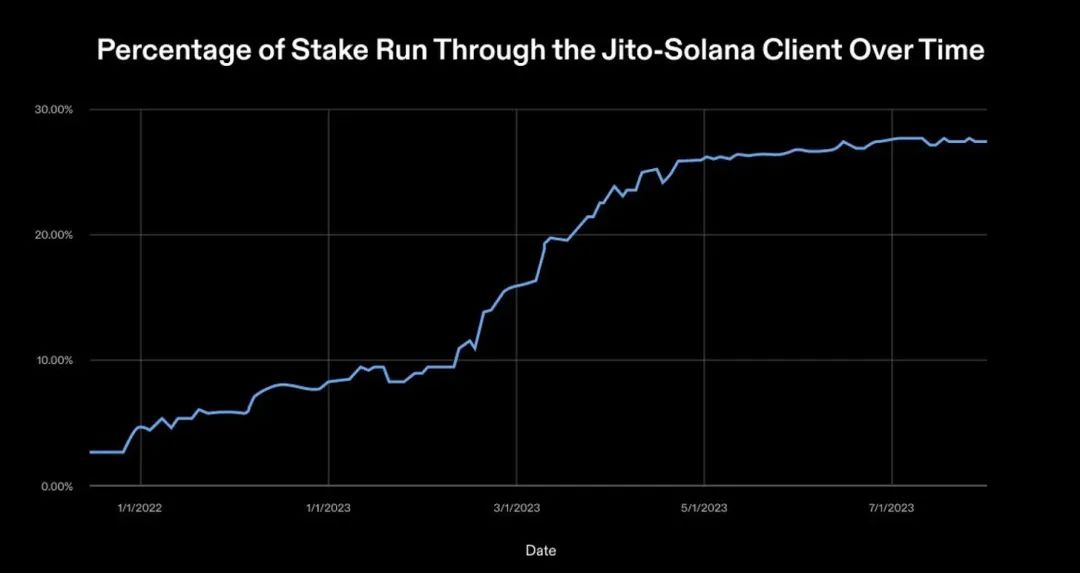
Percentage of staked SOL running via Jito-Solana client over time
Fee Model
A healthy fee market is a key factor for a thriving blockchain, as demonstrated by chains like Bitcoin and Ethereum. In 2024, Bitcoin’s block reward will halve from 6.25 BTC to 3.125 BTC per block. Assuming block producers require the same incentives, either the price must double, or fee revenue must compensate for the reduced issuance to maintain current incentive levels. Thanks to inscriptions, increased fees bring hope for higher payouts to block producers and enhanced Bitcoin security funding.
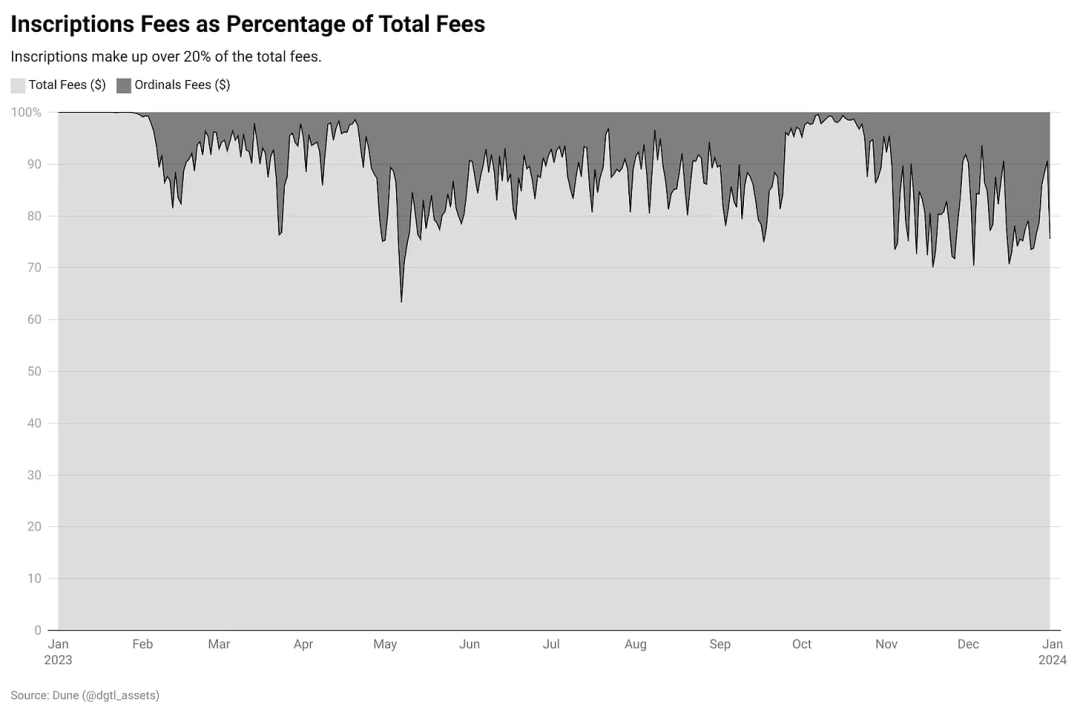
Inscription minting fees account for about 20%
Through EIP-1559, Ethereum changed its monetary policy by introducing a burn mechanism to keep ETH inflation under control. Monetary systems and dynamic fee markets play a vital role in stabilizing chains and aligning stakeholder incentives—something other chains also aspire to achieve.
Solana did not initially prioritize transaction fees—each transaction was fixed at 5000 Lamports (on Solana, Lamport is the smallest unit, similar to wei in Ethereum or satoshis in Bitcoin). Solflare was the first wallet to implement priority fees on Solana in January 2023. Fees are crucial for several reasons:
1) Defense against spam attacks
2) Validator compensation
3) Improved economic stability of the protocol. As fees increase, inflation can be reduced.
Like Ethereum’s EIP-1559, Solana burns 50% of fees, while the remaining 50% go to validators. This standard was set in 2021 and remains unchanged.
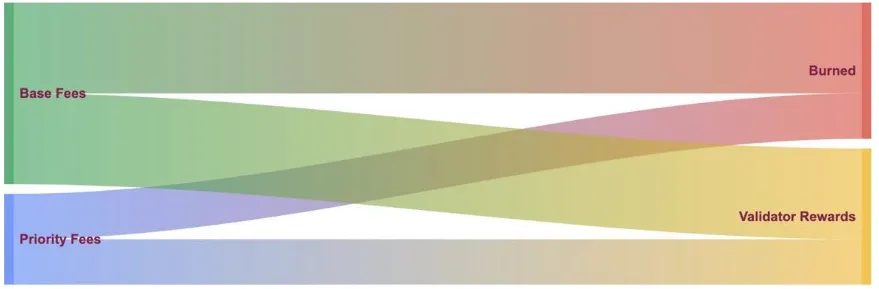
Base fees burned, priority fees go to validators. Source: Umbra Research
On Ethereum, transactions wait in the mempool before entering a block, and validators select those offering the highest gas fees for inclusion. The global mempool is formed as different validators propagate their local mempools to each other. This is where maximum extractable value (MEV) emerges.
Since the mempool is visible to validators and MEV searchers, searchers can identify profitable front-running and back-running opportunities. Searchers are often bots scanning for MEV. For example, if someone buys $1 million worth of Token A, a searcher might buy A just before that transaction executes and immediately sell afterward.
Unlike Ethereum, Solana is multithreaded and can execute transactions in parallel. When signed transactions arrive at the leader, the leader validates them and randomly assigns them to threads. Only when assigned across different local threads does sorting occur based on priority fees (i.e., higher-fee transactions get prioritized).
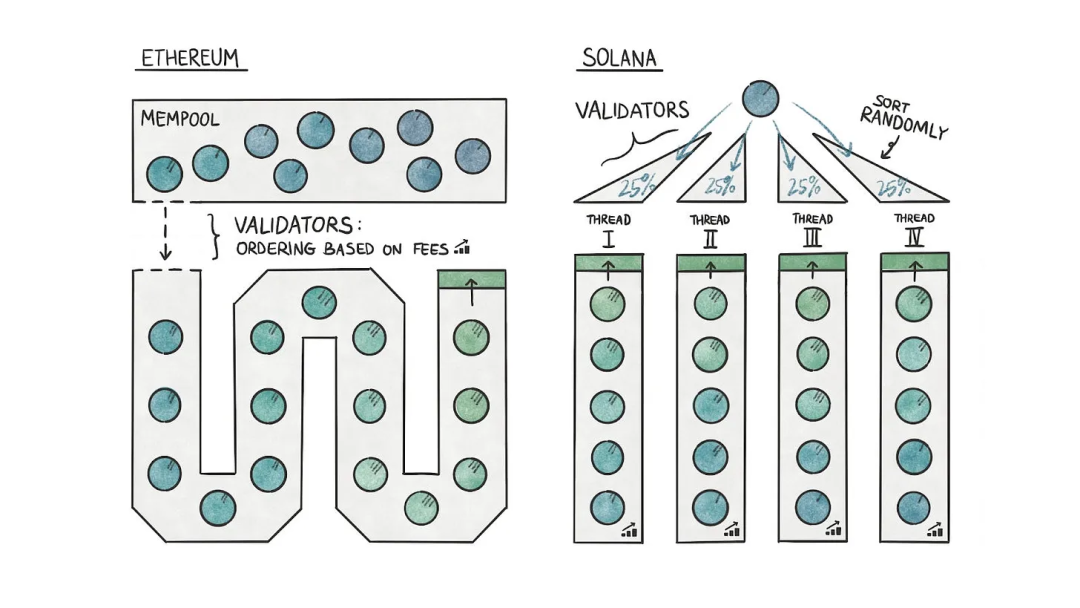
Different transaction flows on Ethereum and Solana
Solana originally had no priority fees. Now, wallets like Solflare allow users to pay priority fees. Priority fees create a native or isolated fee market on Solana. Unlike Ethereum, Solana transactions must specify which part of the state they intend to read from or write to.
Solana validators know beforehand which state segments a transaction involves; Ethereum validators only discover this during computation. Solana transactions require specific information that helps determine which parts of the state are becoming hotspots. The total compute units (CU) used by any hotspot are capped at 25% (one of Solana’s four cores used for multithreaded execution). This prevents excessive updates to a single account within a block.
A hotspot refers to a specific smart contract or account experiencing sudden high traffic. On EVM networks, heavy demand from a single app (like CryptoKitties) can cause overall network gas prices to spike. On Solana, individual dApps (such as Tensor or Jupiter) are limited to using no more than 25% of CUs per block.
That means transactions interacting with any given contract cannot consume more than 25% of a block—or 12 million CUs. All transactions exceeding this limit must wait for the next block. Therefore, even if usage of an individual application surges dramatically, the rest of the network doesn’t start paying higher fees. Only transactions interacting with that app will see increased costs. This is what a localized fee market looks like.
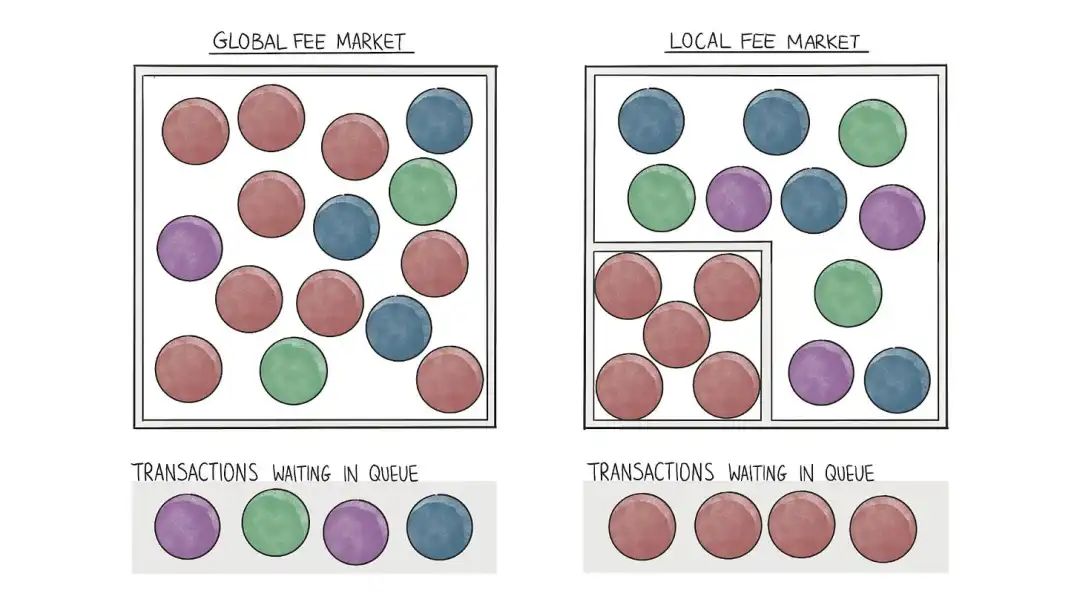
Even if gas wars happen in one app, others remain unaffected
What happens if there are 4 or more hotspots? In such cases, Solana begins to resemble Ethereum. Competing hotspots may engage in gas wars, and transactions with higher fees gain entry. A localized fee market appears to be an elegant solution to general fee spikes.
How does it work in practice? Solana’s fee market design still faces some challenges:
First, currently all transactions generate the same base fee regardless of whether it’s a token transfer, swap, or flash loan. This clearly isn’t optimal. Fees should scale according to consumed compute resources (CUs), though this is already under consideration. CUs represent block space, so higher-paying transactions should secure more space.
Second, since there is no mempool, validators only sort transactions by fee after assigning them to different threads, meaning higher-fee transactions aren’t always successful. This leads to the next issue.
Third, Solana lacks a mempool like Ethereum’s, so higher priority fees don’t guarantee inclusion in a block. Therefore, MEV searchers’ best strategy is to flood the network with multiple transactions and hope one gets picked up. On Solana, due to low transaction costs, this tactic is relatively easy to execute.
Community Sentiment
Steve Ballmer once said: “.NET succeeded because of developers, developers, developers.” When building new ecosystems, this remains the only meaningful metric. A strong developer network builds applications, which create use cases, ultimately converting into real users. Whether mobile, desktop, cloud, or blockchain—developers are the path to relevance.
So I’m curious about how many developers are active in the Solana ecosystem. That said, it’s important to note that much of Solana’s ecosystem was severely damaged initially due to FTX’s collapse.
In a 2022 article, Packy sarcastically noted that SBF was one of the figures who made Solana an interesting ecosystem. When FTX collapsed, the ecosystem lost one of its biggest supporters. New tokens stopped listing, VCs halted investments, and development talent likely migrated elsewhere in search of funding.
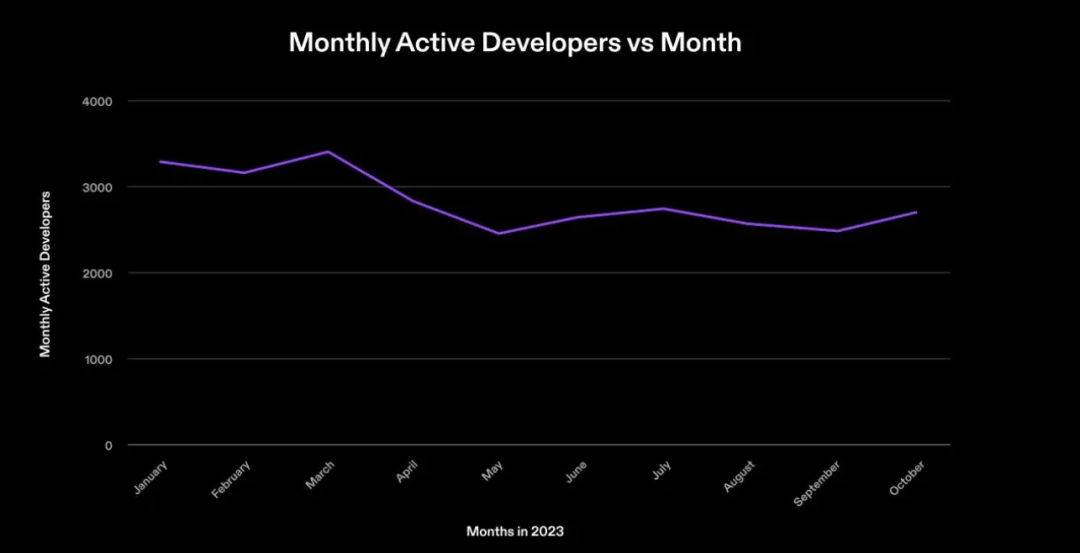
Monthly active developers on Solana in 2023
According to recent Solana data, approximately 3,000 developers contributed to Solana over the past year. This number includes only those contributing to public repositories, excluding private GitHub repos. Considering the recent surge in SOL’s price, more developers may shift toward this ecosystem. As users flock to Solana (driven by rising prices), this number could grow significantly.
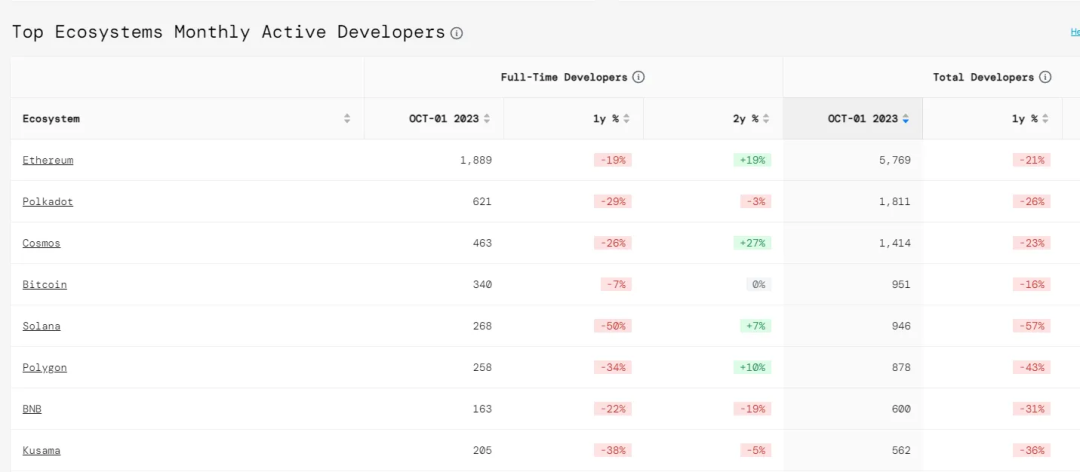
Comparison of developer count changes across major blockchains from January to October over the last three years, source: https://www.developerreport.com/
Comparing this figure with Electric Capital’s Developer Report—which states over 19,000 developers were active in blockchain ecosystems in October 2023—Solana accounts for roughly 15% of the total developer base.
Compared to traditional Web2 ecosystems, Solana offers developers lower costs and faster transactions, resulting in a better user experience. As consumer onboarding toolkits around Solana continue evolving, more developers will build on it.
To build a sustainable ecosystem, ensuring developers benefit is critical. Solana provides resources to serious builders through its foundation, community hackathons, and platforms like Superteam Earn. Teams have raised nearly $600 million from ecosystem hackathons. Additionally, through targeted airdrops to developers, Solana unleashed a wave of new talent able to build without fundraising pressure.
In 2022, Bonk allocated 5% of its airdrop to developers. Another 20% went to existing NFT projects in the ecosystem, and 10% to artists and collectors. This 35% is now worth $450 million. Developers who held onto their tokens may have earned around $500,000 during Bonk’s December rally—equivalent to a pre-seed round raise.
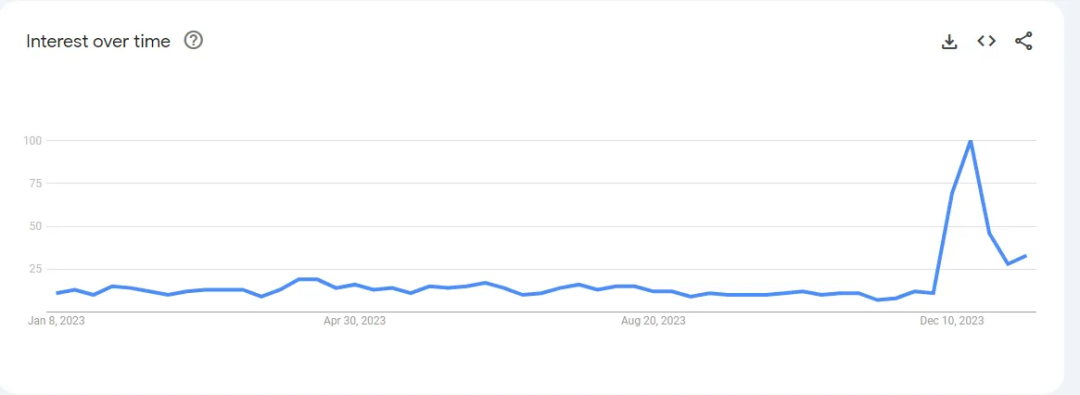
Google Trends for Saga Phone searches
The recent shift in sentiment toward Solana can be quantitatively verified through Saga phone sales. Despite being rated the “worst phone of 2023,” buyers discovered the phone could essentially pay for itself as Bonk’s price rose. Phone owners qualified for Bonk airdrops, turning the device into a free crypto-native phone. Due to limited supply—similar to Bored Ape NFTs or other collectibles—traders realized arbitrage opportunities and potential future airdrop value, rushing to buy. Demand peaked, with unopened Saga phones reselling on Solana for over $5,000.
This phenomenon indicates a shift in sentiment around the Solana ecosystem. Bonk is an example of a meme asset, with similar variants like WIF. However, relying solely on meme assets may not sustain ecosystem growth. In reality, consumer demand for using products on Solana—such as earning points and potential airdrops—is the primary driver of sentiment change. Two recent examples are Pyth and Jito.
Pyth Network provides oracle services and increases Solana liquidity by airdropping tokens to users. Jito airdropped part of its supply to users who staked SOL via Jito’s validator client and used LSTs in DeFi activities. These airdrops particularly benefited smaller users, delivering tangible value.
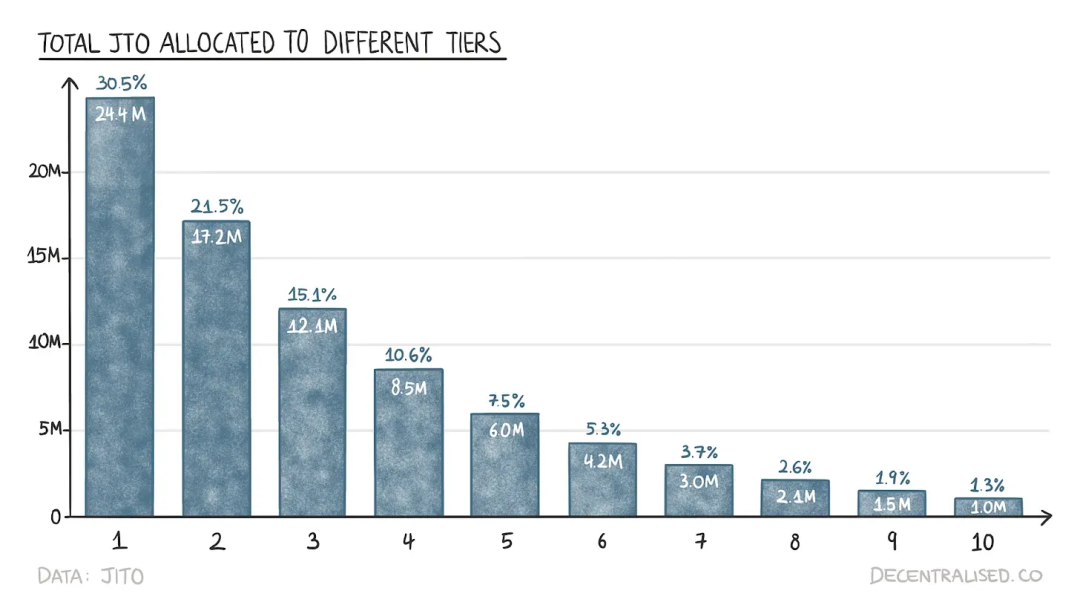
Total JTO distributed across tiers
Interestingly, Jito’s airdrop采用了 a tiered model, where JTO amounts decrease progressively from Tier 1 to Tier 10, meaning lower-tier users received higher point value per unit.
Jupiter, a DEX on Solana, disclosed its airdrop plan prior to Jito. Although people anticipated Jito would launch a token, the scale of the airdrop was underestimated—possibly explaining why it wasn’t widely exploited.
Now everyone’s focused on Solana, trying to participate in the next JTO airdrop. Projects like Tensor, Kamino, Marginfi, Zeta, Meteora, Parcl, and others have announced point programs, planning to convert points into their respective tokens. Some argue these point systems aren’t ideal, while others counter that they serve as loyalty points and more transparent token distribution mechanisms, unlocking behaviors that enhance product value.
For instance, Marginfi awards one point daily to stakers but four points to borrowers. This makes sense—the protocol needs borrowers. Nevertheless, detecting Sybil activity has become extremely challenging, though projects like Marginfi and Zeta employ detection methods. For example, if a wallet matches money laundering patterns on Zeta, its points are reset to zero.
These examples attracted massive user engagement. In our view, ecosystem building involves two balancing forces. On one hand, you need to cultivate culture and passion—meme assets, points, and airdrops address this. On the other, you need well-designed products to spark curiosity and retain users. Hence, although various aspects of Solana can be further explored, greater focus should be placed on the products developers built over the past year.
Ecosystem
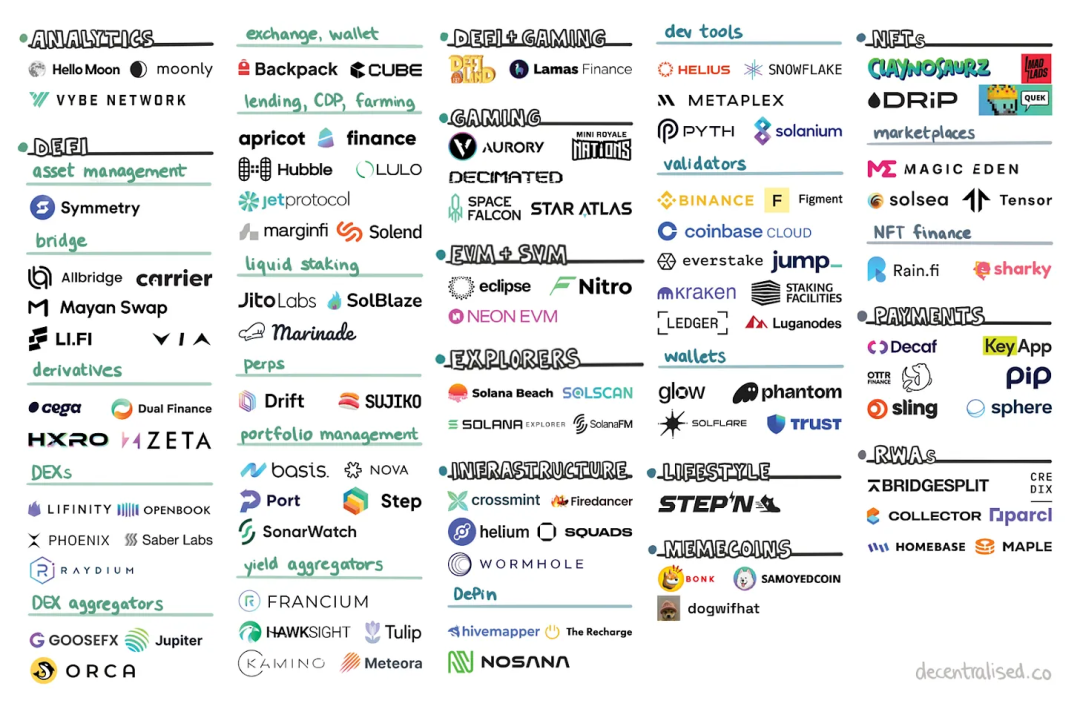
Solana's on-chain ecosystem map (incomplete)
The evolution of internet products has always accompanied improvements in bandwidth. The same applies to Web3—Solana marks a moment where high throughput and low transaction costs make consumer-grade applications feasible. Just as platforms in the Web2 era absorbed server costs, on Solana, compressed NFTs allow developers to send a million NFTs for a few hundred dollars.
Currently, most content on Solana extends broader crypto trends, seen as “X, cheaper and faster.” But building entirely new applications requires overcoming inherent user behaviors—a resource-intensive task most startups are unwilling to undertake.
Yet, what excites me about Solana is its potential to reshape today’s internet landscape. I’ll elaborate on how at the end of this article, but for now, let’s examine Solana’s current state.
1) Trading Platforms
Given Solana’s ties with FTX, the early ecosystem centered heavily on DeFi. Mercurial began as Solana’s stablecoin swap platform, akin to Curve on Ethereum. After FTX’s collapse, hackers stole over $400 million in tokens from FTX, including around $800,000 worth of Mercurial’s governance token MER. This led developers to sever ties with Alameda Research. As part of revitalization, Mercurial was abandoned, giving rise to two new protocols: Jupiter and Meteora, serving as yield aggregators and DEX aggregators respectively.
Solana’s low fees enable users to trade at higher frequencies—easily observable in the numbers. Three charts illustrate differences between Ethereum and Solana in trading activity. In terms of trading volume and total value locked (TVL), Ethereum shows superior metrics.
Note that Ethereum has a five-year head start and hosts a healthy DeFi ecosystem where multiple base tokens are worth billions. Thus, the following metrics have limitations. Conclusions should be drawn by examining all three charts together rather than individually.
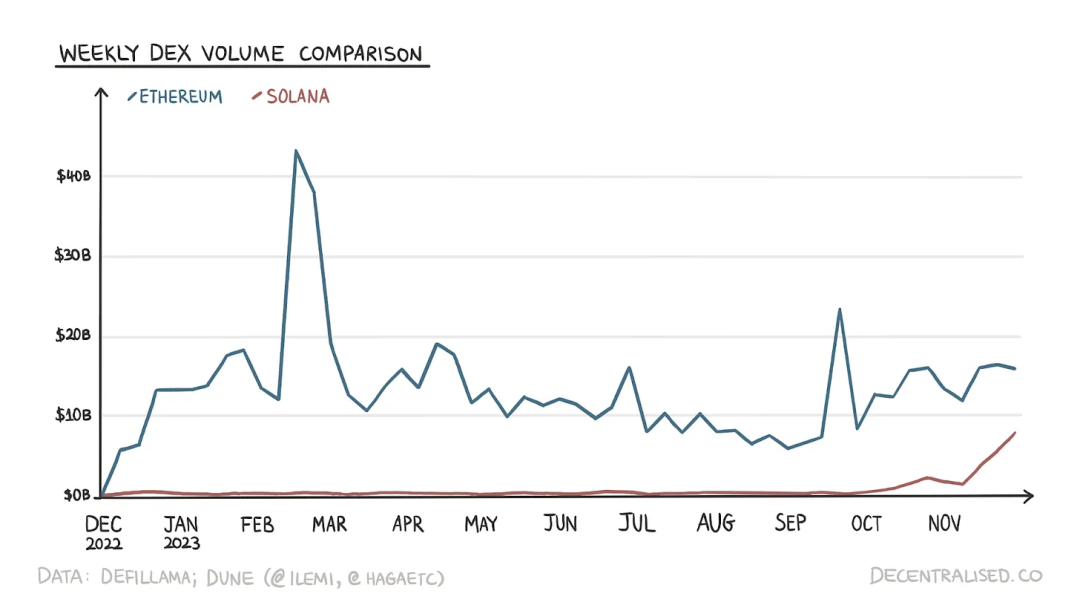
Weekly comparison of Ethereum and Solana trading volume
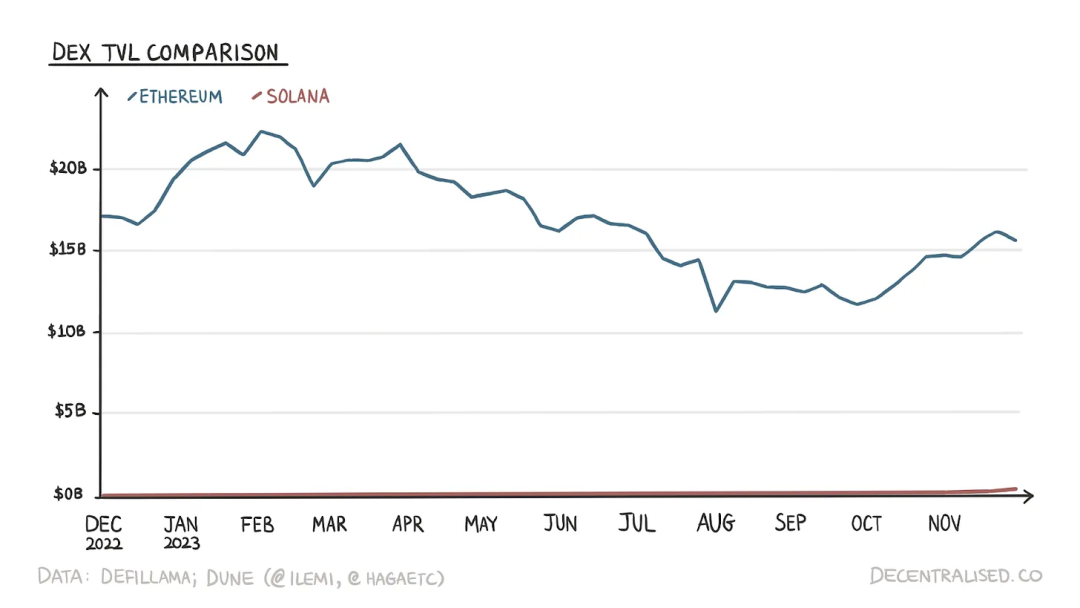
TVL comparison between Ethereum and Solana
However, the gap in TVL between the two chains is far larger than in trading volume. At some point, TVL becomes less relevant. A higher ratio of trading volume to TVL indicates better capital efficiency. Recently, Solana has clearly outperformed Ethereum in this regard.
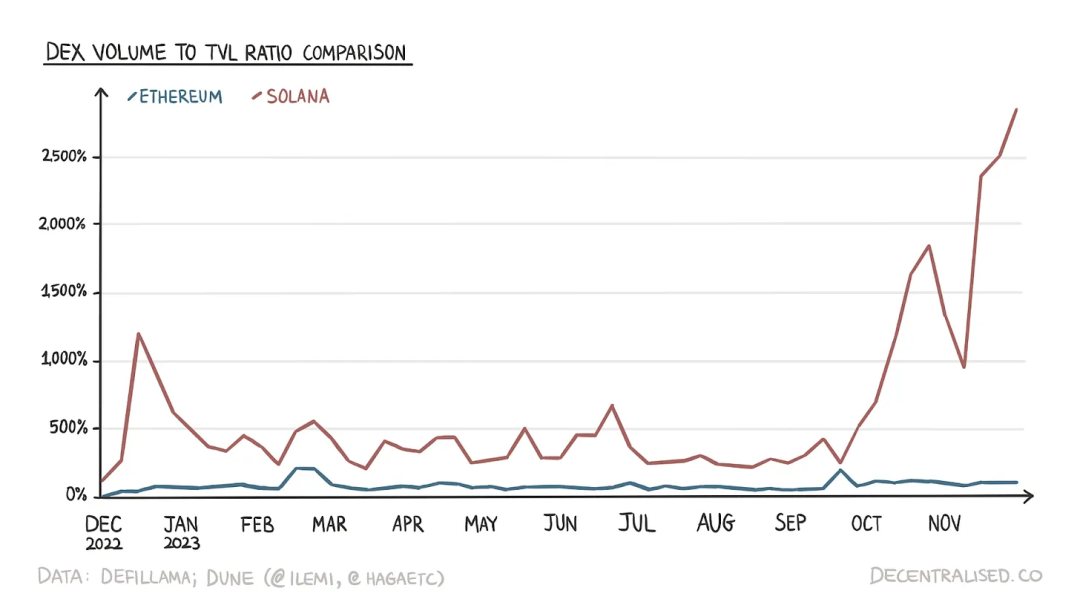
Trading volume to TVL ratio: Ethereum vs. Solana
One reason for the recent volume surge is users seeking airdrops. Jupiter announced its airdrop plan, reserving 50% of tokens for the community across four phases, with Phase 1 potentially launching in early 2024.
While airdrops may drive Solana’s activity, it’s important to recognize certain designs are impossible on Ethereum. For example, orderbook-based designs are infeasible at Ethereum’s base layer. Protocols like dYdX and Aevo have therefore branched off to their own chains.
Solana’s combination of speed and low fees enables market makers to conduct high-frequency trading on-chain, without resorting to centralized exchanges (CEX) or waiting for high-performance Layer 2 solutions.
Today, many CEXs barely interact with chains. Sometimes, when chain integration is difficult, they simply list tokens but disable deposits or withdrawals. Still, CEXs have advantages—market makers (MMs) still prefer CEXs as primary venues, not just for lower fees, but for guaranteed performance.
As the saying goes, liquidity begets liquidity. Traders flock to platforms with the most market makers, as large positions can be entered and exited relatively easily.
2) Lending & Yield Aggregators
On-chain lending markets allow participants to earn yield on assets. They also enable investors to switch between assets without triggering taxable events. Marginfi is Solana’s largest lending protocol, holding over $350 million in deposits and $80 million in loans.
Prior to FTX’s collapse, Solend was Solana’s dominant lending protocol. In November 2021, its total value locked approached nearly $1 billion. In November 2022, as FTX neared bankruptcy, Solana ecosystem token prices crashed, leading to liquidations across DeFi positions. Solend’s TVL dropped from over $350 million to around $25 million in just one week.
As of December 26, 2023, TVL stood slightly above $200 million, still below pre-FTX-collapse levels. Solend’s decline created an opportunity for a new protocol to attract funds. Given Solend already has a token, attracting and retaining users based solely on interest rates isn’t enough.
Marginfi seized this opportunity by announcing “points,” meaning depositors and borrowers would receive future airdrops in addition to interest. Marginfi launched its points program in the first week of July 2023. From October 15 onward, its TVL grew from ~$30 million to ~$485 million in just two months—an over 10x increase.
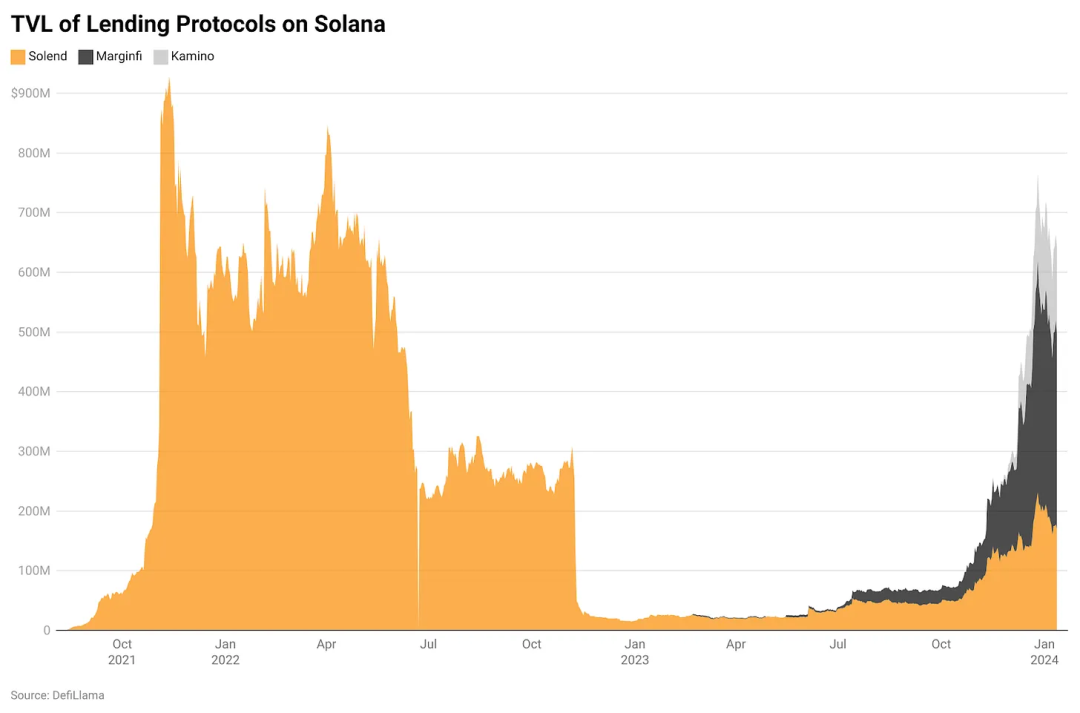
Total TVL of lending protocols on Solana
Kamino is Solana’s second-largest lending platform, and its incentive mechanism shows rapid growth. After announcing upcoming points on December 3, its TVL increased eightfold within three weeks, reaching ~$245 million.
3) Liquid Staking
Staking is a core component of proof-of-stake (PoS) chains. It allows stakers to earn rewards from protocol inflation and fees while securing the network. Liquid staking is critical infrastructure—staking should have low barriers, not exclude users due to high costs.
Liquid staking allows investors to stake any amount without deep technical knowledge or running node software. Although Solana validators have required staking SOL from day one, Ethereum only transitioned to PoS last year, yet leads in liquid staking adoption. Over 383 million SOL are staked, about 90% of circulating supply.
Of this, a staggering 362 million—or about 95%—are natively staked, meaning locked without utilizing any staking derivatives. This implies users staking via native SOL miss opportunities to use liquid tokens in DeFi. By staking SOL through protocols like Marinade or Jito, users receive mSOL or JitoSOL in return, usable across DeFi apps. As staking derivatives evolve, users are expected to gradually adopt them, avoiding opportunity costs.
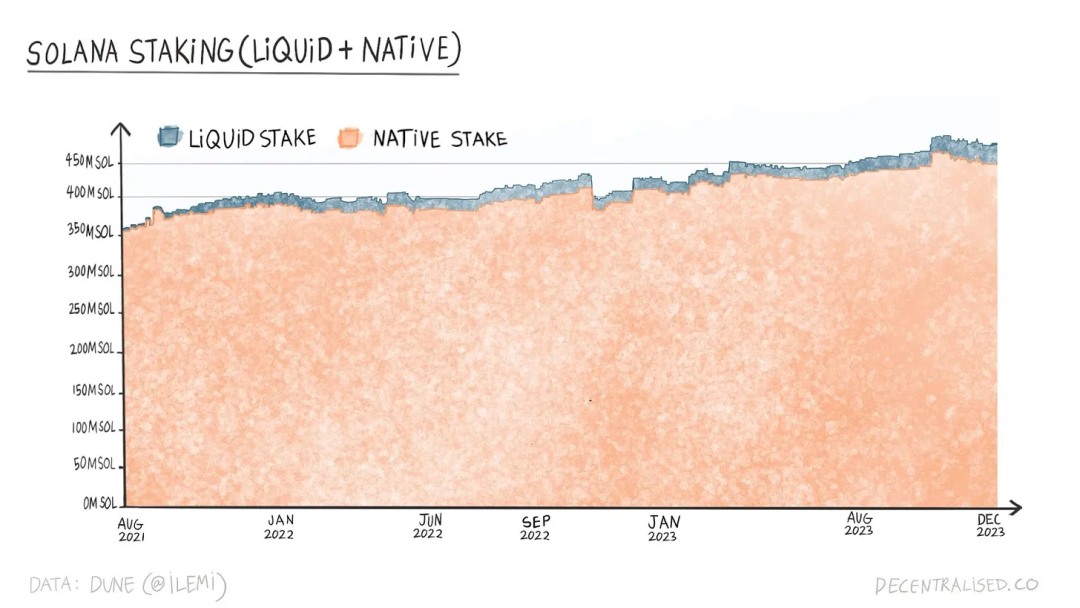
SOL staking (liquid vs passive)
The liquid staking market represents only about 20 million SOL. Currently, 24% of circulating ETH is staked, but approximately 68% (31% via LSTs and 37% via platforms) is staked through liquid staking platforms and CEXs. If 31% of SOL were similarly staked via various LSTs, Solana’s LST market could be estimated at around 115 million SOL or ~$11 billion.
Marinade was the first Solana liquid staking protocol, born after placing third in a 2021 Solana hackathon. It launched on mainnet in August 2021. The solution, similar to Lido, is simple and practical. When users stake SOL through Marinade’s pool, they receive Marinade SOL (mSOL), usable in Solana DeFi applications.
mSOL accumulates rewards from the Marinade staking pool and adjusts relative to SOL every epoch (~2 days). When users opt for liquid staking, they pay a fee to the pool. Liquid staking exposes users to smart contract risks associated with the staking protocol.
Marinade also offers users a native staking option for SOL. When chosen, users don’t receive mSOL. Instead, they use native Solana functionality, with Marinade acting merely as an interface. Users remain the sole party able to withdraw their SOL at any time.
Users effectively create a Solana staking account, delegating management responsibility to Marinade. The staking account earns rewards at the end of each epoch. Marinade charges no fees, and users face no smart contract risk from Marinade.
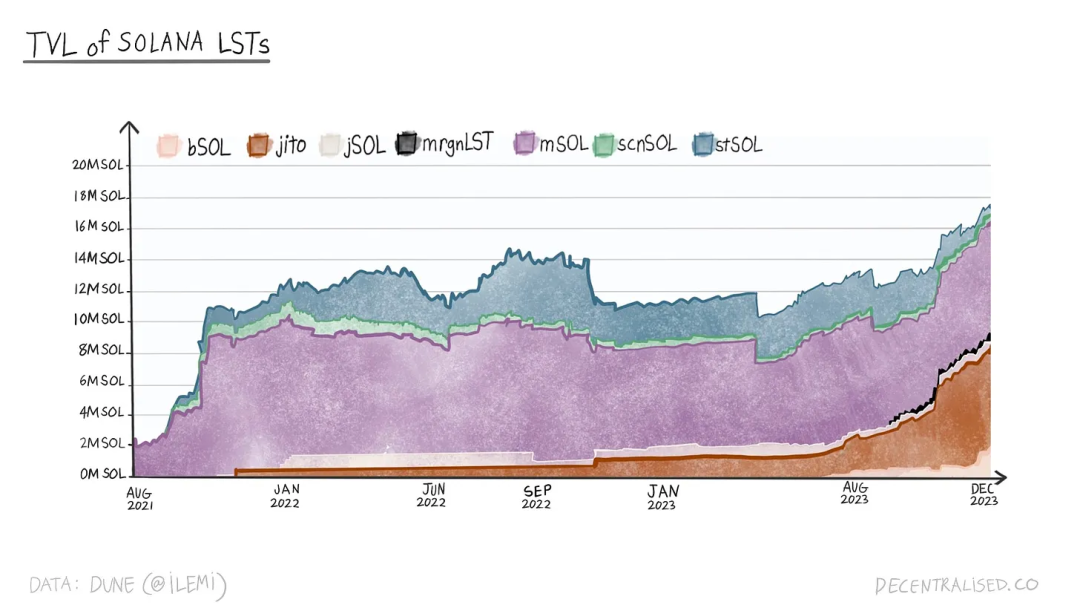
Total TVL of liquid staking on Solana
Marinade and Jito are the two major liquid staking providers on Solana. Marinade has a total value locked of ~7.1 million SOL (~41% market share), while Jito has ~6.4 million SOL (~38%). Similar to mSOL, Jito issues JitoSOL to users who lock SOL in its staking contract. In addition to validator rewards, Jito passes MEV rewards to JitoSOL holders.
Liquid staking tokens are convenient for users but come with drawbacks. One major issue is liquidity risk. For example, mSOL depegged on December 12 when a trader dumped a large amount, causing the price to drop from 1.16 to 1.02. For a supposedly pegged token, this could be quite damaging. Although arbitrageurs restored the peg, the event highlighted the need to improve liquidity for liquid staking tokens.
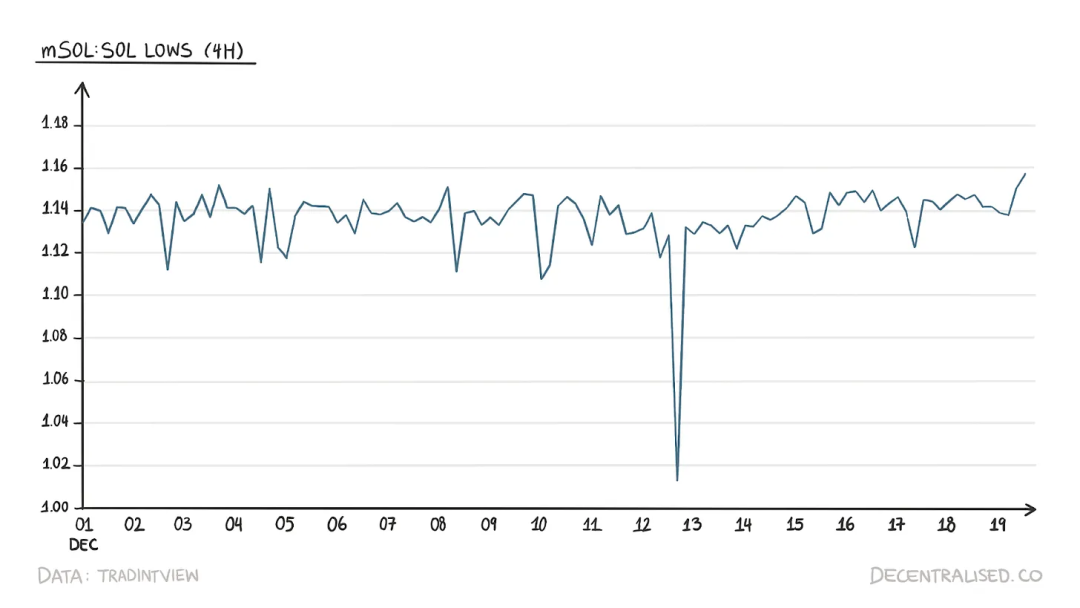
mSOL depegged on December 12
Currently, there are over 10 liquid staking tokens on Solana. As more emerge, low liquidity issues may worsen. To address this, Sanctum proposed a solution. Sanctum Infinity is a multi-LST pool allowing swaps between all LSTs in the pool. It acts as an aggregation layer for Solana’s liquid staking tokens. The solution is expected to launch in Q1 2024.
4) NFT Ecosystem
Solana’s NFT ecosystem has grown rapidly over the past year. Initially, there was a lack of compelling content, and flagship projects like DeGods and yOOts chose to migrate to other chains. While Magic Eden remained Solana’s leading NFT marketplace, it hedged by going multi-chain. Top-tier NFT collections are crucial for community identity, so this gap needed filling.
New collections like Claynosaurz and Mad Lads filled this void and built strong community belonging by choosing to stay on Solana. Both projects share a common trait—they are means to an end, not ends in themselves.
Mad Lads is a collection created by former FTX engineers aiming to replace FTX with a platform called Backpack. This exchange aims to fill the void left by FTX, while being more compliant, transparent, and aligned with DeFi principles. Mad Lads developed a Solana wallet using executable NFTs (xNFTs), blurring the line between apps and NFTs.
Unlike traditional NFTs stored on servers, xNFTs can execute code. xNFTs allow users to interact within the Backpack wallet with apps like Jito Staking, Birdeye, Orca, and Marginfi.
Magic Eden was initially the dominant NFT marketplace on Solana. It expanded support to Ethereum in August 2022 and eventually added other chains like Polygon and Bitcoin (Inscriptions). As Magic Eden expanded to other chains, Tensor doubled down on Solana, adding advanced features such as TradingView integration and market-maker orders. Beyond these, Tensor introduced a points program similar to Blur, rewarding traders with Tensor governance tokens.
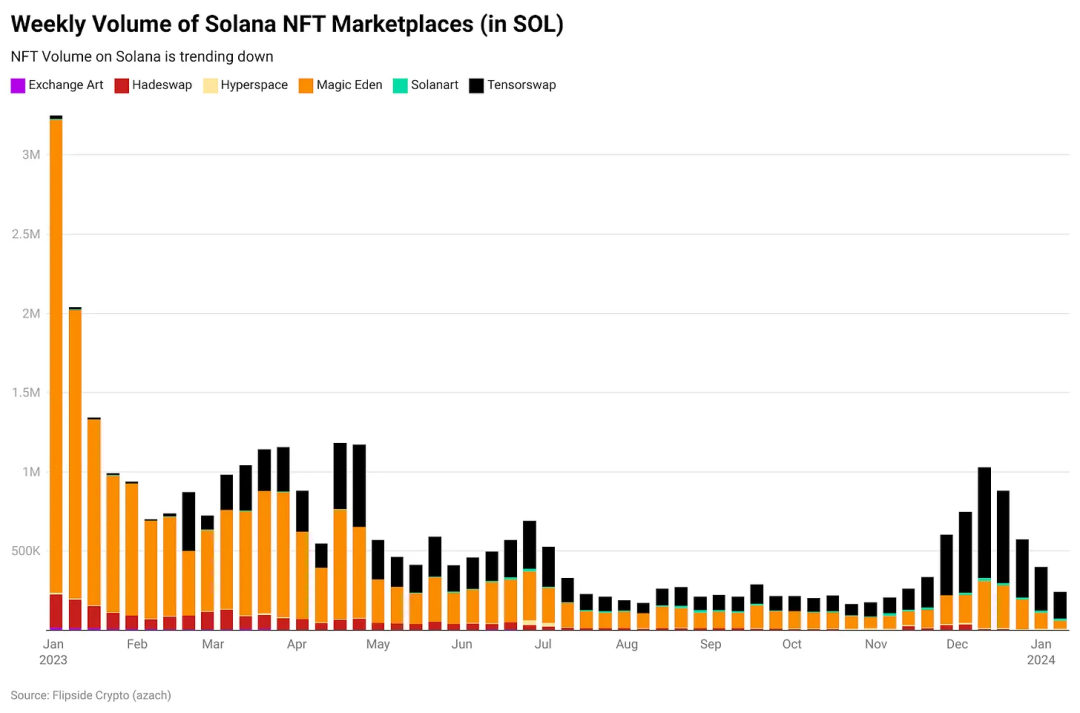
Weekly NFT trading volume on Solana marketplaces
5) Infrastructure
I’ve used Solana for over two years and have personally experienced infrastructure changes. In 2022, Solana halted block production over ten times, but only once in 2023. While failures are undesirable, they’re common for new chains experimenting with cutting-edge tech. Even established L2s like Arbitrum suffer outages during traffic spikes.
Multiple factors have improved infrastructure—from fee market operations and client diversity to RPC nodes. Companies like Helius Labs and Triton are helping app developers by providing:
-
RPC nodes and webhooks for interacting with the Solana network. Outsourcing this lets developers focus on core problems.
-
Enhanced APIs that save developers time retrieving data such as transaction history, NFT data, and token metadata.
Another infrastructure advancement is state compression, where Solana uses Merkle trees and stores only partial data, drastically reducing storage costs. NFTs were among the first applications of state compression. Helius Labs and Triton provide essential RPC infrastructure and indexing services, while wallets like Phantom and Solflare offer user-friendly interfaces.
Minting 1 million NFTs costs about $247 on Solana, ~$98,000 on Polygon, and ~$65 million on Ethereum. DRiP is an NFT platform that sends 3 million NFTs weekly to users instead of ads. Using state compression, DRiP achieves the same effect for about $250.
Some projects are improving Solana’s interoperability with other chains, combining the best of Solana and other ecosystems. Eclipse uses Solana’s SVM for computation while settling on Ethereum. Conversely, Neon is building an EVM on Solana capable of parallel processing. Nitro is building a Cosmos L2.
5) DePIN
DePIN stands for Decentralized Physical Infrastructure Networks. The idea of leveraging decentralized infrastructure with token incentives has existed for a long time. DePIN blurs the line between consumer and commercial devices. Helium and Hivemapper are examples of DePIN on Solana.
Helium’s original mission was to create a decentralized wireless infrastructure supporting IoT devices. Helium devices act as hotspots—about 50 can provide internet coverage for a city. Anyone can host a Helium hotspot.
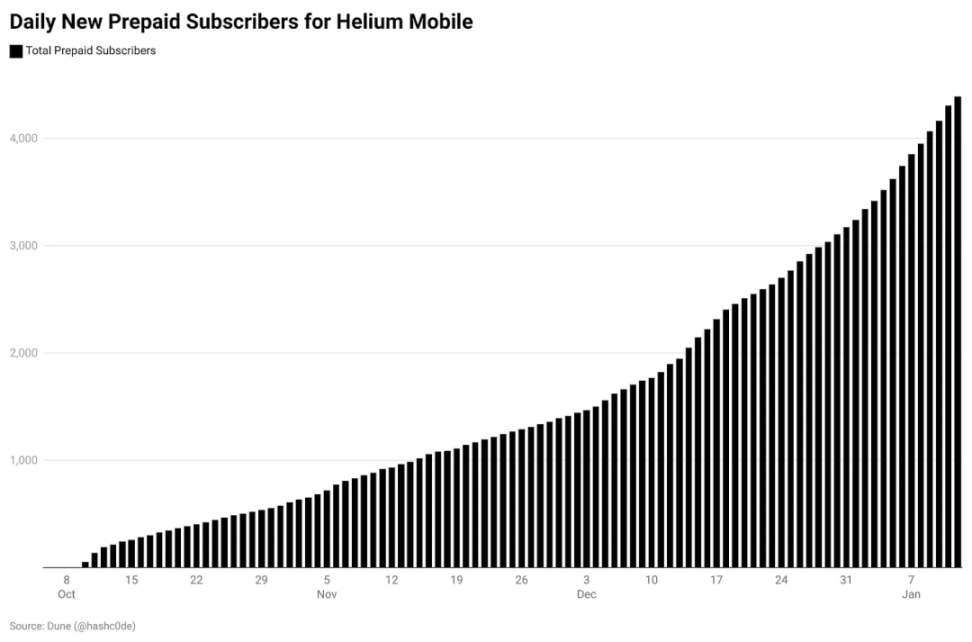
Daily prepaid user additions for Helium Mobile
Before migrating to Solana in April 2023, Helium operated its own blockchain with over a million hotspots. To support growth and scalability, Helium outsourced infrastructure tasks to Solana, reducing costs and enhancing scalability.
Hivemapper is another DePIN application built on Solana. It incentivizes participants with HONEY tokens to install dashcams and map roads. To date, Hivemapper has mapped 100 million kilometers of roads, 6.6 million of which are unique.
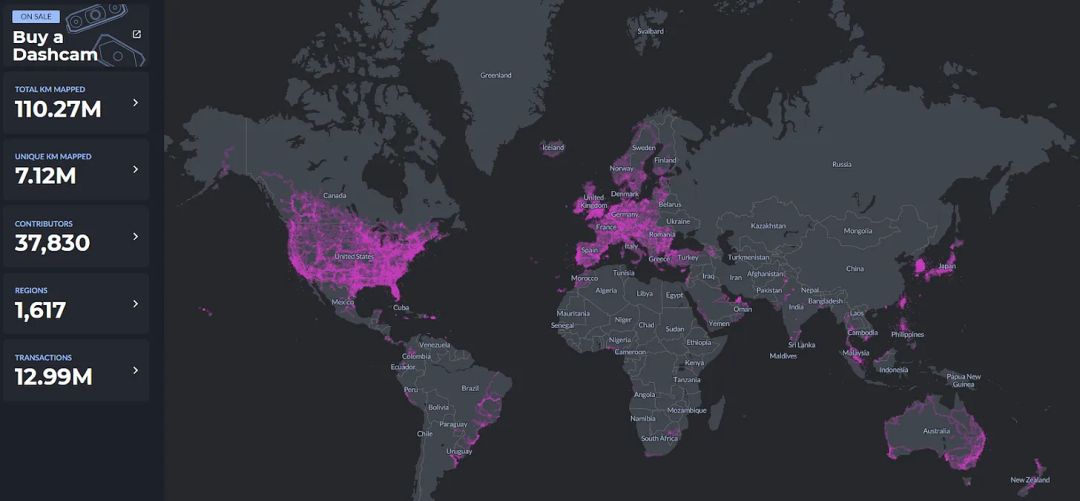
Source: Hivemapper
Hivemapper leverages Web3 infrastructure by incentivizing ordinary people to install dashcams and begin mapping. This model enables services like Uber and Zomato to use Hivemapper similarly to Google Maps—with fewer permissions required.
Conclusion
Technology adoption accelerates when the cost of interaction drops sharply. We’ve lived this—cheap Nokia phones replaced landlines in the early 2000s, shifting people to mobile. Moore’s Law and Android enabled global internet access via mobile devices. In my view, Solana’s characteristics are perfectly suited to attract mainstream users.
You can ignore the rest of this article and simply try receiving $1 in Solana’s Phantom wallet to understand what I mean. I remember my first experience—the speed and feel were closest to what I saw using PayPal in the early 2010s. Solana’s unit economics allow developers to cover on-chain user interaction costs without creating holes in their balance sheets. Solana’s unit economics make it possible to build consumer-scale applications beyond today’s crypto-native user base.
This doesn’t mean products like MarginFi or Jupiter are irrelevant. They are critical infrastructure. Yet, attracting the first wave of users requires meeting their needs. Replacing existing financial infrastructure is a tough but worthwhile goal. But looking ahead ten years, unless the Facebooks or Substacks of our generation are built on blockchain, we’ll struggle to gain relevance beyond a shrinking group of speculators.
Blockchains are financial infrastructure. In their current form, we overemphasize user trading rather than backend value exchange. What forms of invisible value exchange (unknown to users) can Solana’s blockchain enable? These answers lie beyond the scope of this article.
Like most price surges, focusing too much on price rather than the core mission (Build) causes networks to lose long-term advantage. Therefore, Solana must slow its race against EVM peers and pivot toward consumers. It needs a new cohort of venture capitalists willing to invest alongside founders who previously built in Web2, targeting consumer crypto apps. While the market stubbornly fights for shares of 10 million active on-chain users, this alternative approach could put Solana on a completely different trajectory.
In a competitive market, Solana finds itself in a relatively strong position. Whether this translates into meaningful moats and sustained momentum remains unclear. But for now, a few things are evident: the SVM approach holds architectural advantages, developers are building cool things in the ecosystem, and the community cares deeply.
None of these happened overnight. Solana endured hardship and made a comeback. But note—its destination remains to be seen.
Join TechFlow official community to stay tuned
Telegram:https://t.me/TechFlowDaily
X (Twitter):https://x.com/TechFlowPost
X (Twitter) EN:https://x.com/BlockFlow_News
 白话区块链
白话区块链