









Is a spot Ethereum ETF inevitable, and will litigation be an unavoidable path?
TechFlow Selected TechFlow Selected
Is a spot Ethereum ETF inevitable, and will litigation be an unavoidable path?
Although the SEC's delayed actions have temporarily prevented U.S. consumers from safely and tax-advantaged access to the second-largest cryptocurrency, the final outcome could ultimately benefit ETH.
 Navigating Web3 tides with focused insights
By Mary Liu, Bitpush News
Unsurprisingly, the U.S. Securities and Exchange Commission (SEC) has not quickly approved spot Ethereum ETFs, with proposals from BlackRock and Grayscale having been successively delayed.
The SEC stated: "The Commission believes it appropriate to designate a longer period within which to take action on the proposed rule change so that there will be sufficient time to consider the proposed rule change and the issues raised."
The agency has specifically expressed concerns about Ethereum's proof-of-stake mechanism and whether "centralization of control or influence by a small number of individuals or entities" could pose unique risks, making such funds vulnerable to fraud and manipulation.
Last week, it used nearly identical language to delay its decision on Fidelity’s Ethereum ETF.
This was the outcome predicted by most market analysts. In a recent report, JPMorgan Chase (JPM) analysts said the likelihood of the SEC approving ETH-based ETFs before May is less than 50%. Bloomberg’s seasoned ETF expert James Seyffart noted that further delays for spot Ethereum ETF proposals could "occasionally continue" over the coming months.
Bitcoin ETFs endured more than a decade of struggle with the SEC before finally launching, as the regulator long refused to budge due to concerns over potential market manipulation. So what exactly must happen for an Ethereum ETF to reach the market?
Will litigation be the inevitable path to approval for a spot Ethereum ETF?
BlackRock, the world's leading ETF issuer and largest asset management firm, was the first to establish exchange surveillance agreements aimed at alleviating manipulation concerns. Eleven ETF issuers have also made significant concessions to regulators—such as opting for cash settlement instead of physical delivery—in seeking approval.
Ultimately, however, it was Grayscale’s courtroom victory that forced SEC Chair Gary Gensler to approve Bitcoin-based financial products. An appellate judge criticized the agency’s prior logic in approving futures-based ETFs while rejecting spot-based ones, and ordered the SEC to reevaluate its listing standards.
So the existence of Ethereum futures ETFs may be a positive sign. However, Gensler stated publicly that the decision to approve Bitcoin ETFs "in no way implies that the Commission is prepared to apply similar standards to listings involving crypto asset securities."
Hester Peirce, known as the "crypto mom" and SEC Commissioner, recently told Coinage that the SEC should not need to go down the litigation path for Ethereum ETFs, as the agency should “apply precedent” when making decisions.

Peirce frequently dissents from her fellow commissioners and speaks publicly in defense of the crypto industry, criticizing the SEC’s enforcement actions against crypto firms and projects.
She pointed out that the specific details and contexts of each ETF application can vary significantly, suggesting that a differentiated approach is needed for each case.
She commented: "There's a lot of work involved in getting exchange-traded products ready for listing, including ensuring disclosures align with how the product actually operates. Having courts tell us our approach was wrong... I think that lesson will certainly be remembered."
Nonetheless, Peirce emphasized: "Congress did not authorize us to tell investors whether a particular investment is suitable for them."
Bitcoin holds a stronger position in this regard, as it is the only crypto asset uniformly classified as a commodity by regulators. Unlike earlier regulatory statements describing Ethereum as "sufficiently decentralized," Gensler has voiced reservations about ETH, particularly following Ethereum’s transition to a staking mechanism.
JPMorgan analyst Nikolaos Panigirtzoglou observed: "The SEC is currently suing cryptocurrency exchanges that provide staking services for proof-of-stake blockchains including Ethereum, which makes approval of a spot Ethereum ETF more challenging—at least until these lawsuits are resolved."
Panigirtzoglou also noted that the SEC did not directly name ETH in its lawsuits against exchanges like Kraken, Coinbase, or Binance over alleged securities law violations, suggesting it may effectively treat the cryptocurrency as a commodity. Moreover, if the SEC were to litigate over an ETH ETF, it might have to confront the Commodity Futures Trading Commission (CFTC), its rival regulator that also claims jurisdiction over ETH.
All of this suggests that the launch of a spot Ethereum ETF is ultimately inevitable, though numerous obstacles remain ahead.
As deadlines approach, expectations grow
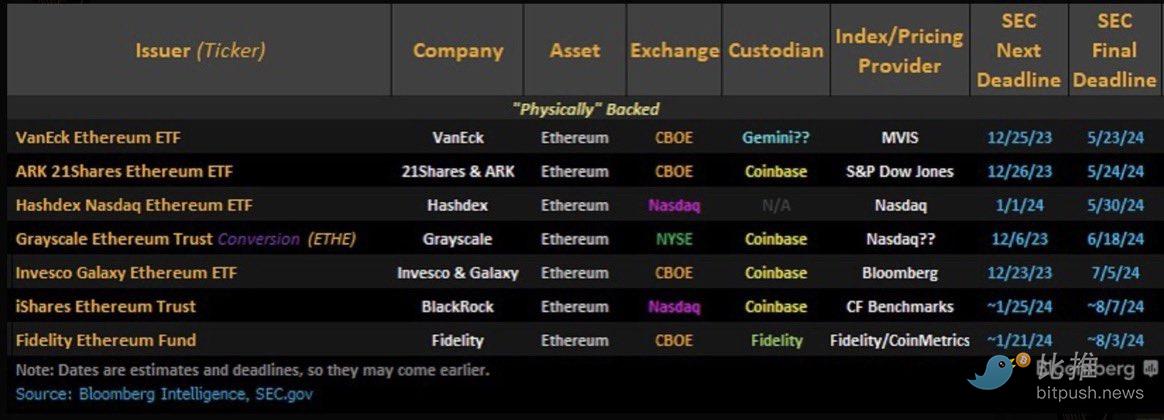
VanEck’s application deadline is May 23, ARK 21Shares’ is May 24, Hashdex’s is May 30, Grayscale’s is June 18, and Invesco’s decision date is July 5. Meanwhile, decisions on Fidelity’s and BlackRock’s applications are expected on August 3 and August 7, respectively.
Although the SEC’s delaying tactics are temporarily preventing U.S. investors from accessing the second-largest cryptocurrency in a secure and tax-efficient manner, the eventual outcome may still prove favorable for ETH.
Join TechFlow official community to stay tuned
Telegram:https://t.me/TechFlowDaily
X (Twitter):https://x.com/TechFlowPost
X (Twitter) EN:https://x.com/BlockFlow_News
 比推 BitpushNews








