A perfectly good Web3 is now all about points
TechFlow Selected TechFlow Selected
A perfectly good Web3 is now all about points
Have you checked in today?
 Navigating Web3 tides with focused insights
Author: Kaori
Editor: Zhang Wen
Recently, apart from Grayscale's aggressive selling of crypto assets causing market downturns and unsettling many esteemed "U.S. stock traders," the Zetachain airdrop results have also left the community feeling disheartened. Yesterday, cryptocurrency wallet Rabby Wallet launched a points system and has already distributed initial points to every EVM address. Seeing this news, one can't help but感慨 that MetaMask might be headed for "oblivion" if it doesn’t release its token soon — and also exclaim: “Not more points again!”
After a winter that was already tough for yield farmers, now not only do we have digital beggars actively online “begging for alms,” but point systems are also following us like shadows. Mass adoption hasn't been achieved, yet the industry is increasingly mimicking Web2 playbooks — today’s crypto is no longer pure.
Points Systems Make Web3 Look More Like Web2
Rabby isn’t the first wallet to introduce a points-based model. In August 2022, Rainbow Wallet launched Rainbow Boost — a system that tags, scores, and incentivizes on-chain address behaviors. Its Raindrop rules were designed as metrics to calculate users’ participation, activity, and contribution within the community. By the end of 2023, Rainbow announced that wallet addresses with transaction history across certain EVM chains would receive retroactive points upon importing into Rainbow, complete with leaderboards. Although the team never stated these points would relate to an airdrop, the parachute icon displayed in the wallet interface inevitably sparked speculation.
Before that, it was Blur — which famously disrupted OpenSea — that made points a central theme. Then came Friend.Tech, the hottest trend of 2023, where buying keys weekly and voting became sacred rituals for every user. “Accumulate points, exchange for airdrops” turned into a universal mantra. After Friend.Tech’s TVL spiraled downward, Blast — the Layer2 project by Blur’s founder — quickly followed with an early access version, offering Blast Points to invited users. Of course, there was also a strong airdrop expectation attached.
Beyond these examples, the Solana ecosystem is particularly fond of points programs. Jito Labs launched a points campaign in September 2023 and issued its token in December of the same year, triggering FOMO across the crypto community. Users rushed to identify other projects in the Solana ecosystem running points campaigns, eager to interact and farm potential airdrops.
At least the aforementioned projects awarded points based on real product interactions. What’s harder to understand are those projects launching check-in campaigns where users earn points without any actual interaction or gas fees — simply watching their balance grow. The frustration? You must check in consecutively; otherwise, your points reset to zero. Still, add the magic phrase “potential airdrop,” and you’ll never lack participants.
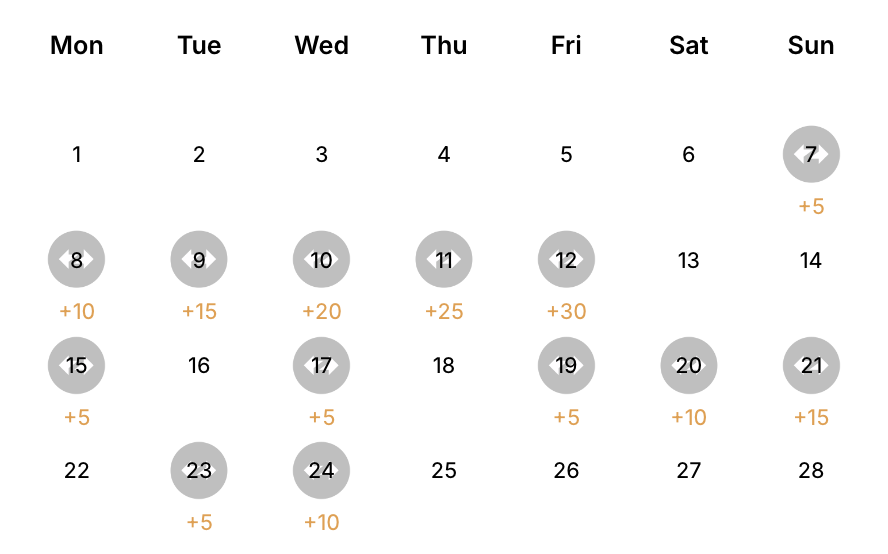
Calendar from a project’s check-in points campaign
Why does this feel increasingly like Web2? In my view, these points systems resemble Meituan’s MiLi (rice grains) or Ele.me’s Chihuo Dou (foodie beans): I place an order, you give me points; I interact, you give me points. At least those foodie beans and rice grains can offset part of my next meal cost. Projects could go even further — imagine using points to pay gas fees. Then it would truly mirror Web2.
Visible Points, Invisible Governance
Some argue that today’s points systems are just like past liquidity mining — deposit assets, and your account balance grows. Back then, balances increased; now, it’s points. Jokes aside, we should still ask why more and more Web3 projects are adopting points systems.
Attention is undeniably the scarcest resource, and Web3 founders clearly recognize this. When a project lacks immediate token issuance plans but still needs to win loyalty, they need ways to keep users engaged. Points are merely a simplified version of the traditional “interact-to-farm-airdrops” model: projects get impressive metrics, while users see rising points and heightened airdrop expectations. But as more projects adopt points systems, user attention inevitably becomes fragmented across multiple platforms.
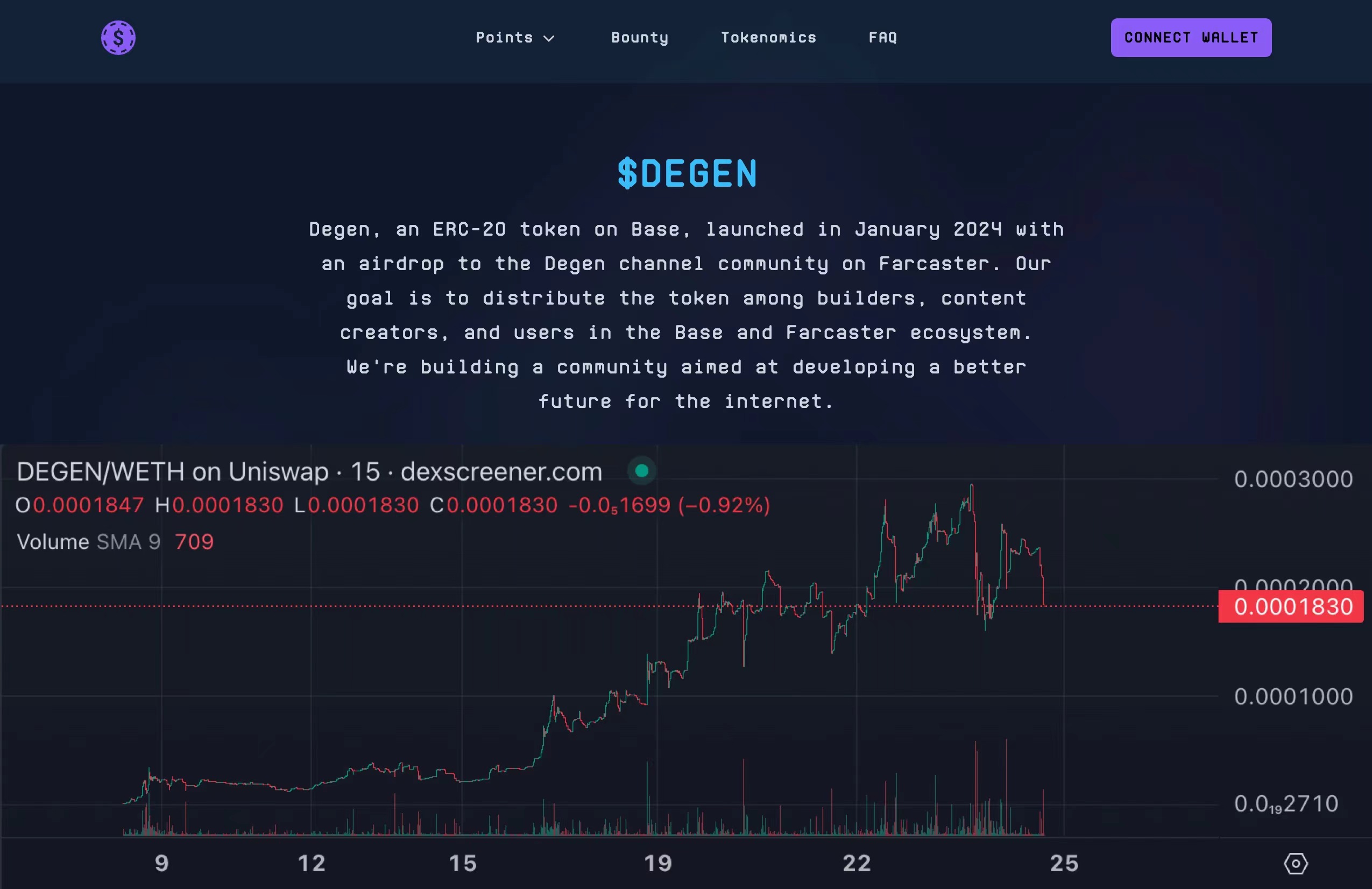
Projects want traffic; users want tokens. Points serve as a fragile bridge between the two. $DEGEN strikes a good balance here — a meme coin airdropped to the Degen channel community on Farcaster. Users earn points by posting in the channel, and those points directly convert into tokens. A second round of airdrops is even planned.
Underlying points systems is a reflection of project governance philosophy. Developers use this tool to boost user retention and engagement. Yet it remains a superficial fix. Users are drawn by airdrops, fundamentally chasing tokens, while projects openly manipulate them through points systems — blatantly ignoring the elephant in the room.
What users may resent today isn’t endless points systems per se, but rather the ambiguous-yet-calculated value assigned to those points. Li Jin, a member of Variant Fund, once wrote about how to build better Web3 points systems, noting that “maintaining ambiguity in point value offers greater flexibility.” This allows projects to freely adjust point values to manage costs and test incentives, while keeping user interest alive.
Points are what you see, but invisible is the raw calculation behind them. Yield farmers continue their spring耕耘, but the landlord has already moved to a new field.
Join TechFlow official community to stay tuned
Telegram:https://t.me/TechFlowDaily
X (Twitter):https://x.com/TechFlowPost
X (Twitter) EN:https://x.com/BlockFlow_News
 BlockBeats