








Why Has Celestia Been Resilient? How Will Modular Blockchains Transform the Crypto Market
TechFlow Selected TechFlow Selected
Why Has Celestia Been Resilient? How Will Modular Blockchains Transform the Crypto Market
Short-term, Celestia still holds significant advantages, with its main pain point primarily being the large token unlock scheduled for the end of October 2024.
 Navigating Web3 tides with focused insights
Author: TechFlow Asher Zhang
As Bitcoin broke downward, major crypto assets began to sharply retreat. By comparison, Celestia (token TIA), which had been continuously rising, maintained strong performance despite the market downturn, with only minimal pullback. What exactly supports TIA's resilience? And how will the modular blockchain Celestia reshape the crypto market?
Why TIA Holds Up: A Supply and Demand Perspective
At its core, Celestia’s resistance to price drops stems from active buying pressure and limited selling. Below, we analyze this phenomenon through the lens of token issuance and use cases.
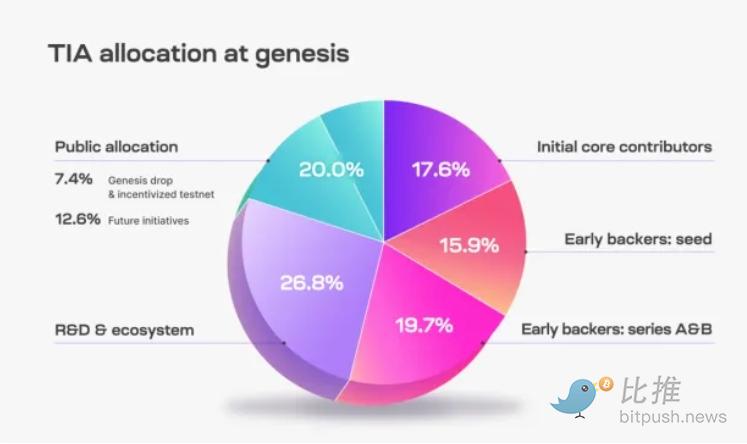
From a token release standpoint, TIA is a newly launched asset in 2023 with a total supply of 1 billion tokens. The first-year inflation rate is 8%, decreasing by 10% annually until it stabilizes at 1.5%. The chart below shows the allocation breakdown of TIA across key ecosystem participants:
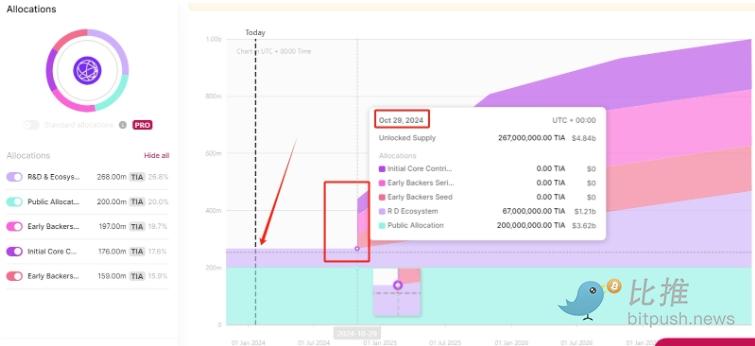
According to data from token.unlocks, the circulating supply of TIA remains very low today. However, a significant unlock is expected by the end of October 2024, which could dramatically increase sell-side pressure and likely trigger a substantial correction in TIA’s price.
On the demand side, TIA has several primary utility scenarios: 1) Rollup developers must pay fees for using Celestia’s data availability (DA) layer in TIA; 2) Similar to Ethereum, rollups built on Celestia will use TIA as gas; 3) Staking; 4) Governance. With the rise of Rollup-as-a-Service (RaaS), developers now have abundant tools to quickly deploy rollups while inheriting base-layer security. Many RaaS protocols now offer Celestia as an underlying option. Notable examples include:
Manta: Manta Network is a modular blockchain designed for ZK applications, founded by a team from prestigious institutions such as Harvard, MIT, and Algorand, and backed by investors including Binance Labs and Polychain Capital.
Dymension: Dymension, a modular settlement layer in the Cosmos ecosystem, launched its Genesis Drop, distributing airdrops to holders of Celestia, Ethereum Layer 2s, Cosmos, Solana, and NFTs. Users could claim up to 70 million DYM tokens (7% of total supply) before 20:00 Beijing time on January 21, 2024, reinforcing TIA’s “pickaxe” narrative.
Saga: Following Dymension, Saga, a scalability protocol in the Cosmos ecosystem, announced eligibility criteria for its genesis airdrop, distributing tokens to the Celestia community, with over 27,000 wallets qualifying.
ZKFair: ZKFair is the first community-owned zkRollup, leveraging Polygon ZK and Celestia DA architecture, with technical support from Lumoz.
Arbitrum Orbit: On October 25, 2023, the Arbitrum Foundation and Celestia Foundation jointly announced the integration of Celestia’s modular data availability network into Arbitrum Orbit and Nitro stacks, giving developers the option to publish data to Arbitrum One, Arbitrum Nova, or Celestia. The feature officially launched on the Arbitrum Sepolia testnet on December 20. Subsequently, multiple protocols on Arbitrum announced plans to integrate Celestia.
Other notable projects include universal L2 Eclipse, decentralized API data service protocol Pocket Network, and modular blockchain network Movement Labs.
From both supply and demand perspectives, TIA’s circulating supply will remain limited in the short term. As more projects adopt it—offering airdrop eligibility—it gains strong “pickaxe” appeal. However, the major risk lies at the end of October 2024, when a large volume of tokens will be unlocked. Concurrently, high-profile projects may conclude their bull-run launches, reducing the attractiveness of TIA as a “pickaxe,” potentially leading to a significant price adjustment. That said, as use cases expand, staking rates are expected to rise, and during a bull market, any pullback might be relatively mild.
Celestia Builds on Cosmos SDK, Expanding Its Reach Beyond Ethereum
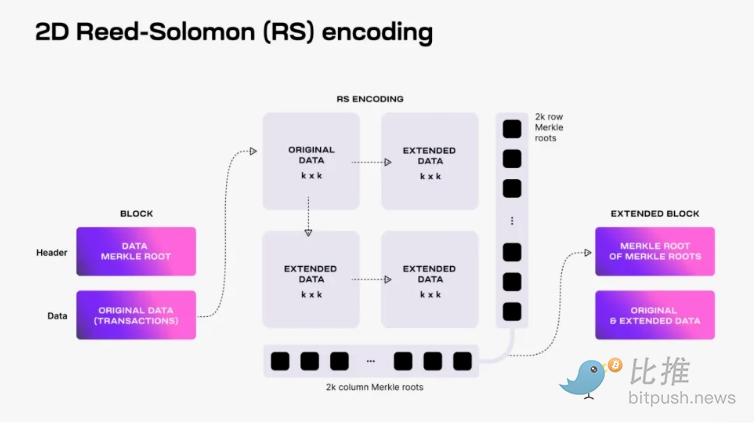
Celestia is a proof-of-stake (PoS) blockchain built on CometBFT and the Cosmos SDK. Its data availability (DA) layer relies on two key technologies: Data Availability Sampling (DAS) and Namespaced Merkle Trees (NMT). DAS allows light nodes to verify data availability without downloading entire blocks. It works by having light nodes randomly sample small portions of block data across multiple rounds. As sampling continues, confidence in data availability increases. Once a predefined confidence level (e.g., 99%) is reached, the data is considered available. NMT enables execution and settlement layers on Celestia to download only transactions relevant to them. Celestia divides block data into multiple namespaces, each corresponding to a specific application like a rollup. This ensures that each application downloads only its own data, improving overall network efficiency.
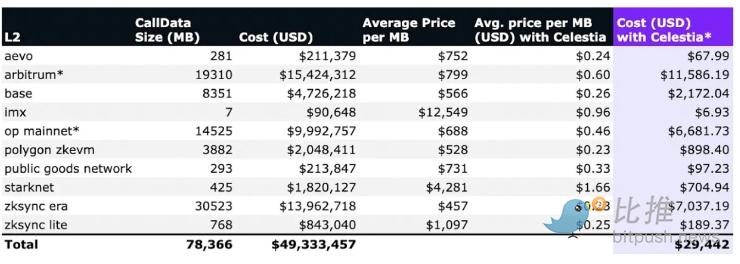
These two core technologies make Celestia highly efficient and cost-effective. In a report titled *The impact of Celestia’s modular DA layer on Ethereum L2s: a first look*, Numia Data compared the costs incurred by various L2s over the past six months when posting calldata to Ethereum versus potential costs if they used Celestia as their DA layer (assuming TIA priced at $12). The magnitude difference clearly illustrates the significant economic benefits that dedicated DA layers like Celestia can bring to L2 gas fees.
As previously mentioned, Ethereum-based projects such as Manta, ZKFair, Arbitrum Orbit, universal L2 Eclipse, Pocket Network, and Movement Labs are already adopting Celestia, and adoption is expected to grow further. The key reason for Celestia’s popularity lies in the unprecedented flexibility and customizability it offers developers, enabling them to build unique products unachievable through monolithic architectures. Unlike top-down decisions about infrastructure stacks, modular, bottom-up approaches empower builders to create their own components, letting the free market determine optimal solutions.
In reality, Celestia’s growth poses a certain threat to Ethereum. Ethereum core developer Justin Drake stated: "There are powerful network effects around shared security for data availability. If rollups stop consuming Ethereum’s DA, it signals Ethereum losing the settlement game to competitors. This would lead to loss of fee revenue, reduced monetary premium, and diminished economic security and bandwidth. I predict it will slowly but surely die."
Future Outlook for TIA
Celestia has two exciting developments underway: Quantum Gravity Bridge (QGB) and Cevmos. QGB will enable Celestia to connect with any EVM-compatible chain beyond its native ecosystem, including Ethereum and Avalanche (AVAX), unlocking new liquidity sources. Cevmos is a Cosmos SDK chain specifically designed for rollup settlement. This EVM-integrated chain allows Ethereum rollups to upload their data to Cevmos, which then forwards it to Celestia, significantly enhancing interoperability between the EVM and Celestia ecosystems. Investing in TIA is essentially a bet on the future adoption of Celestia as the DA and consensus layer by more rollups and applications. Based on current momentum, Celestia maintains a strong advantage in the near term. The main challenge lies at the end of October 2024, when a large number of tokens will unlock, likely triggering a notable price correction.
Join TechFlow official community to stay tuned
Telegram:https://t.me/TechFlowDaily
X (Twitter):https://x.com/TechFlowPost
X (Twitter) EN:https://x.com/BlockFlow_News
 比推 BitpushNews









