








Outlier Ventures: How Should Web3 Projects Design Token Vesting Schemes?
TechFlow Selected TechFlow Selected
Outlier Ventures: How Should Web3 Projects Design Token Vesting Schemes?
Token vesting refers to the amount of tokens released into the market over a certain period of time.
 Navigating Web3 tides with focused insights
Author: Achim Struve
Translation: Luffy, Foresight News
What Is Token Vesting?
Many early Web3 companies start with a great idea to revolutionize the world of decentralized technology. But even the best ideas require some form of funding to get off the ground and build the anticipated flywheel economy. These self-sustaining ecosystems are often built on top of fungible cryptocurrencies, where tokenomics can help drive user adoption, incentivize behaviors, and support the product itself. Therefore, in addition to raising funds on equity terms, raising capital on future tokens is also a common strategy—especially when overall crypto market sentiment is rising.
Token vesting refers to the release of token supply into the market over a certain period. In fundraising, vesting describes the gradual release of allocated tokens to early investors and contributors. Since they play a crucial role during the construction phase of a Web3 startup, they may receive discounted or even “free” tokens, meaning their entry point is lower than that of later investors and market participants. A timed release schedule aligns these privileged entities’ token allocations with the long-term success of the Web3 startup while making it fairer for those who enter later.

Figure 1: Blur Token Vesting Schedule, Source: Token Terminal
Figure 1 shows the $BLUR token vesting schedule. Aside from airdrops, most of the supply will gradually unlock over four years following a six-month lock-up period. These figures are quite common in the current market narrative. During the 2021 bull cycle, typical vesting periods ranged from 12 to 18 months. Moving into the main topic of this article: how should we design the right vesting terms for our early investors and contributors?
Short-Term or Long-Term Vesting?
The above highlights the range of possible vesting schedules observed in the market. These ranges are largely driven by narratives and based on “what others are doing,” rather than what might be “best” for the overall Web3 initiative. When designing a vesting schedule, beyond asking “what’s best,” other factors should also be considered:
Early Investors and Contributors
Recognizing early investors and contributors through vesting means acknowledging and rewarding stakeholders who took risks by supporting the project from its inception. These individuals and entities typically provide the necessary capital and resources for the project’s initial development and growth. They want to receive liquid tokens early but also hope the startup they invested in develops healthily over the long term.
Fairness
Market participants consider vesting conditions when conducting due diligence on Web3 projects. If they perceive the vesting terms as unfair, it could trigger negative sentiment toward the project and hinder future adoption. Fairness means equitable distribution of benefits among all stakeholders. It ensures no party gains a disproportionate advantage or disadvantage due to vesting terms. The goal is to create a level playing field where long-term participants are rewarded for their commitment, while new entrants still have opportunities to participate and benefit. In most cases, this means the lower an investor’s entry point, the longer their vesting period should be.
Maintaining Investability
Token valuation tables and corresponding vesting schedule designs play a significant role in future investability and are in tension with startups’ need for rapid fundraising. Compared to public sales with short vesting periods but higher valuations, lower-priced sales may attract more early capital but reduce future rounds’ investability, as later investors feel disadvantaged relative to the earliest ones.
Ecosystem Sustainability and Stability
Vesting schedule design should account for the need for sustainable ecosystem development. This requires creating a timeline that avoids flooding the market with tokens and causing value dilution, thereby maintaining stability. A well-thought-out vesting schedule can prevent sharp price fluctuations and ensure token issuance aligns with the project’s growth and development stages, thus supporting the ecosystem. A more advanced approach to sustaining sustainability and stability involves adopting adjustable vesting mechanisms.
Timing and Intervals
The timing factor relates to specific intervals at which tokens are released to stakeholders. It is important to align token release milestones with strategic goals and the project’s overall progress. Proper timing helps maintain momentum, signal project maturity, and manage market supply. By setting vesting timelines according to the project roadmap and development phases, participants can be confident that vesting is part of a strategic plan, not just a short-term incentive. Note that actual token releases should not be one-time events but instead occur progressively. When large supplies hit the market immediately, it can cause significant volatility. A better practice is to smooth out releases over time to reduce market manipulation and price swings.
Community Vesting
Community incentives are also often distributed over specific timeframes. Recent vesting designs include individual address-based allocations for market contributors. Efficient use of these community incentives is critical. Every dollar paid out in tokens should generate more than one dollar in protocol value. Often, this is achieved by incentivizing core ecosystem behaviors and product adoption.
These aspects are not exhaustive; there are many different angles to carefully weigh when considering token releases within economic systems. One fundamental pillar is creating appropriate demand to offset token emissions. Imbalances between supply and demand sides can lead to volatility and disruption in the token ecosystem. Strong Web3 startups pay attention to these dynamics and attempt to anticipate various scenarios.
Case Study: Simulating Vesting Schedules
The following case study illustrates how different-length vesting schedules impact token valuation. It was conducted using Outlier Ventures’ open-source Quantitative Token Model (QTM) radCAD under standard settings and moderate adoption assumptions. Figure 2 shows the general structure of QTM, which has evolved since its first release.

Figure 2: Abstract Structure of the Quantitative Token Model
Keep in mind that no model can predict any token valuation accurately, and results should never be taken as financial advice—especially those derived from static and simplified models. However, using QTM allows us to assume a certain adoption scenario and then apply different vesting schedules to test what happens if they change. In the study below, all conditions were kept identical except for varying vesting durations, to understand how vesting length affects token valuation stability.
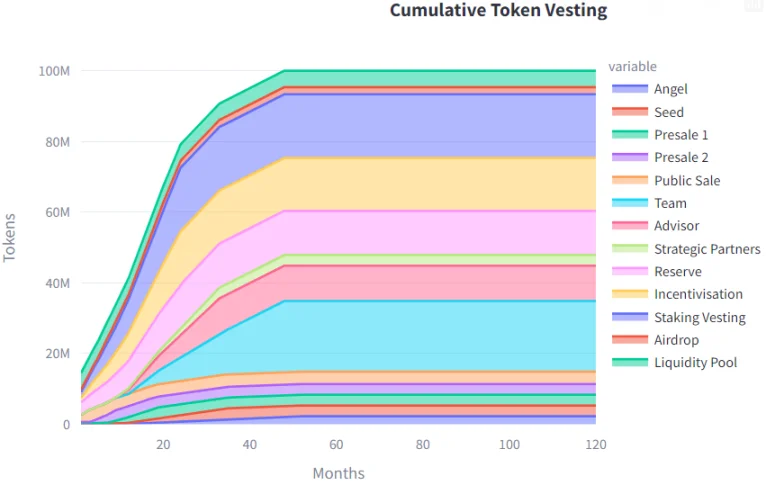
Figure 3: Slow (top) and Fast (bottom) Vesting Schedules in the Quantitative Token Model (QTM) Case Study
Figure 3 depicts the assumed vesting schedules in two test scenarios. The top chart shows slow vesting, the bottom one fast vesting. As seen, many different stakeholders are involved, such as various funding rounds, early investor groups, team members, advisors, partners, reserves, incentive and staking vesting, airdrops, and liquidity pools. These ecosystem participants are common across various protocols. In this case study, no specific product or token utility was defined beyond general staking and transfer utility representing various mechanisms (e.g., store purchases or ecosystem transaction fees). Specific use cases are irrelevant to this study.
In the slow vesting scenario, it takes eight years to fully release all tokens into the economy; in the fast vesting scenario, it takes four years. This includes the time from token launch, including lock-ups, after which most investors will have completed vesting.
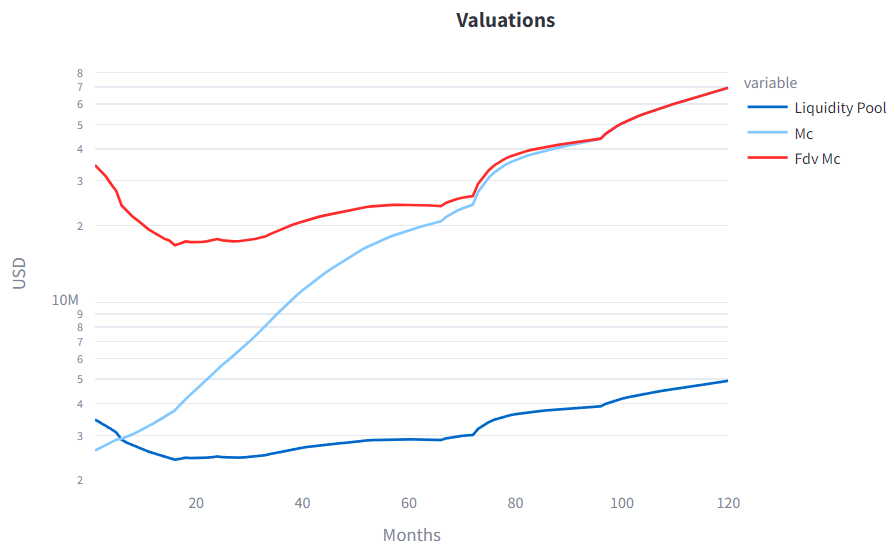
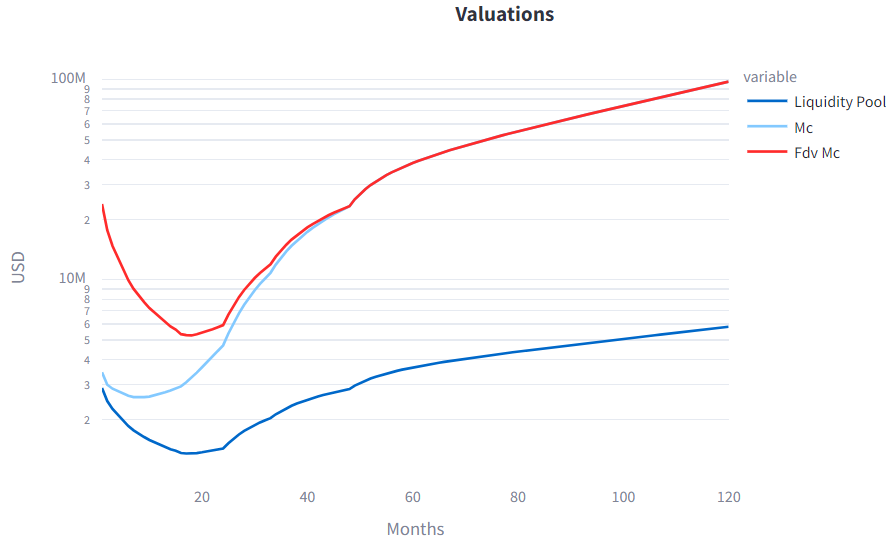
Figure 4: Token Valuation Resulting from Slow (top) and Fast (bottom) Vesting Schedules
Figure 4 shows the token and liquidity pool valuations simulated under the two different vesting plans given in Figure 3. Note that the vertical axis uses a logarithmic scale. In both cases, the fully diluted market cap (FDV MC) at launch is $40 million. Both scenarios show similar curve shapes, with FDV MC declining initially and beginning to rise after some time. Circulating MC only declines in the fast vesting scenario but starts increasing after eight months. A decline in valuation during the first two to three years is commonly observed in many Web3 token launches, caused by large token supplies released into the market while the startup is still in the building phase. Subsequently, assuming successful business modeling, token design, and GTM strategy, valuations may rebound due to increased demand.
An interesting observation is the valuation range in both scenarios. In the slow vesting case, FDV MC drops about 58% from launch levels at month 16 and peaks at a 74% increase by the end of the 10-year simulation. In the fast vesting scenario, FDV MC falls approximately 87% after 18 months but reaches a peak increase of 145% by the end of the simulation. While QTM cannot predict these outcomes absolutely, it provides insight into how changes in initial parameters affect results under the same boundary conditions and base assumptions. Notably, slower vesting leads to smaller deviations from the launch valuation and thus less volatility compared to faster vesting. Slower vesting reduces the depth of valuation drawdowns but potentially limits long-term upside.
Two questions arise here: (1) What is the root cause of this phenomenon? (2) What does this mean for our own vesting schedule design?
-
The reason for the larger valuation drop in the fast vesting scenario is that more token supply enters the economy in a shorter timeframe. When greater supply meets unchanged demand, it leads to sharper valuation declines. At the same time, releasing more supply earlier results in fewer tokens being released later. Assuming equal and sustained healthy growth in Web3 business and token demand in both cases, the reduced late-stage issuance combined with steady demand leads to higher valuations in the later period compared to the slow vesting scenario.
-
Based on the above reasoning, one might conclude that faster vesting benefits long-term token valuation. This holds true in the given simulation context, but in reality, additional factors must be considered—such as community sentiment. Significant token depreciation rarely correlates with positive market perception and may even damage the protocol's reputation long-term, ultimately reducing adoption. Although protocols cannot control market conditions or actual token demand, they can influence controllable elements like vesting schedule design.
Conclusion
The discussion and case study above show that no perfect static vesting schedule exists that accounts for all influencing factors—such as interests of early investors and contributors, market participants, fairness, investability, sustainability, token stability, and proper incentives. Every vesting schedule is a compromise.
The QTM simulations highlight differences between slow and fast vesting schedules regarding token valuation and volatility. We acknowledge this is not an accurate prediction of the future, as the model is static and deterministic. However, it supports the conclusion that slower vesting tends to result in lower volatility compared to faster vesting. Although simulations indicate higher long-term token valuations under fast vesting, substantial early losses for market investors and token holders could harm the protocol’s potential reputation.
Another aspect of vesting schedule design that must not be underestimated is the complexity and difficulty of implementation. In the author’s view, optimal vesting occurs when releases align with actual demand and protocol adoption, benefiting all participants—including early investors. However, this approach requires careful engineering and on-chain execution, which may be challenging for all early-stage, especially smaller, Web3 startups.
For protocols unable to adopt more advanced methods, good practices can still be applied to traditional static vesting schedules to better support tokenomic design:
-
Align vesting schedules with key milestones in the protocol’s growth roadmap.
-
Do not release tokens into the market without utility or underlying demand.
-
Web3 businesses go through three stages: Build, Scale, and Saturation. Most tokens should begin distribution during the scaling phase, not the build phase. Matching lock-up and vesting durations accordingly is key.
-
Clearly communicate to early investors the rationale behind delayed vesting via lock-ups and extended timelines. Ultimately, they benefit from conservative vesting plans, as these allow breathing room for better product adoption and provide more counterparties for realizing profits.
-
There is no perfect vesting schedule. Only when a Web3 business has the capability should additional engineering resources be allocated to advanced vesting designs. Therefore, finding an appropriate balance among the various aspects discussed above is crucial.
Join TechFlow official community to stay tuned
Telegram:https://t.me/TechFlowDaily
X (Twitter):https://x.com/TechFlowPost
X (Twitter) EN:https://x.com/BlockFlow_News
 Outlier Ventures











