









Freechat's $80 million funding shrouded in controversy: Founder once mined 55 bitcoins daily a decade ago, now restricted from high-end consumption
TechFlow Selected TechFlow Selected
Freechat's $80 million funding shrouded in controversy: Founder once mined 55 bitcoins daily a decade ago, now restricted from high-end consumption
Long Yujiang said in an interview that he cannot currently disclose the information of the $80 million investor, as it awaits disclosure by the investor itself.
 Navigating Web3 tides with focused insights
Writing: Meteor, Marco, ChainCatcher
Editing: Marco, ChainCatcher
The announcement of an $80 million funding round did not bring Freechat the expected publicity but instead triggered skepticism among some Web3 industry participants, as Freechat has never disclosed any investor following its two funding rounds, and no investment news has surfaced within the industry.
This "half-hidden" high-profile approach planted seeds of doubt in the industry, leading to immediate accusations of "fake financing" on the same day.
ChainCatcher's investigation reveals that Freechat, which markets itself as an overseas Web3 social platform, was founded by Jack Long (Chinese name: Long Yujiang), a native of Sichuan, China and an early Bitcoin miner. In 2013, Huaxi Metropolis Daily reported on Long’s mining experience, stating he once mined 55 bitcoins in a single day when the price was around 4,000 RMB per bitcoin.
On January 17, when interviewed by ChainCatcher, a Freechat executive still did not directly address questions about investors. "Funding is primarily through equity shares; tokens are only part of it—most have bought Freechat's equity," the executive said, adding, "These are early-stage entrepreneurial investors who followed us into this round."
On January 18, Long Yujiang told ChainCatcher that the seed round was funded jointly by himself and another investor known as "Old Li," and that details of the $80 million financing would be disclosed only when investors choose to reveal themselves.
ChainCatcher found that Long Yujiang established Chengdu Tairui Technology Co., Ltd. ("Chengdu Tairui") in Chengdu in 2017. According to public records, in June 2021, the company was placed on the "dishonest被执行人" list, and Long has been repeatedly issued court-ordered consumption restrictions due to labor arbitration with former employees and litigation with other companies.
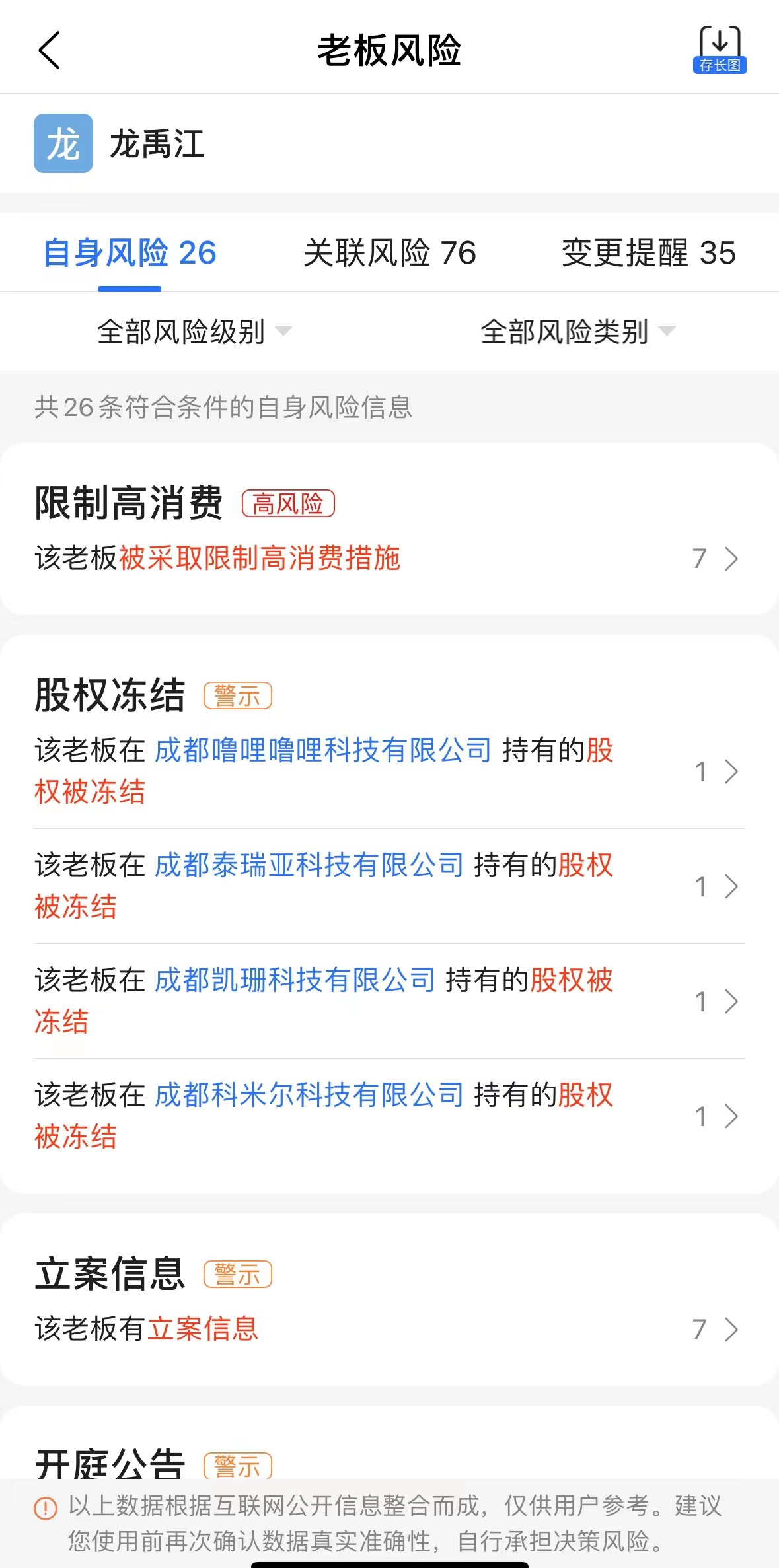
Regarding these debt issues, Long responded: "Chengdu Tairui is currently insolvent and unable to repay its debts."
Who Invested $80 Million?
Previously obscure, Freechat suddenly became one of the most talked-about Web3 companies on January 8 after news broke of a massive investment.
That day, a well-known Chinese venture capital media outlet published an article claiming that blockchain social platform "Freechat" had recently completed an $80 million funding round, achieving an $800 million post-money valuation, though investors were not disclosed.
The article noted that Freechat was founded in 2022 and completed a $2 million seed round in August of that year.
Notably, both of Freechat’s funding announcements were first reported exclusively by this same media outlet, and neither round revealed investor identities.
This report quickly became the primary source for numerous industry publications, spreading rapidly across the sector.
However, the lack of disclosed investors, combined with the project’s previously low profile, led to skepticism. Some media outlets questioned whether this was false information released by the team.
Freechat's official website describes it as a Web3.0 social application using end-to-end encrypted communication to ensure anonymity and privacy for free communication. The company claims to have been founded in 2020 and headquartered in Los Angeles, USA, conducting an IEO on a blockchain exchange in 2023.

In its whitepaper, Freechat outlines business areas including social networking, e-commerce, NFTs, value-added services (such as memberships), advertising, content, payments, DeFi, and gaming.
The app’s mobile interface resembles Feishu, incorporating features similar to TikTok short videos, Xiaohongshu-style图文posts, WeChat-style chat, and Weibo-style posting. Users can enable a “add friend” function requiring payment of a custom amount of FCC tokens to initiate conversations with others.
FCC is the token issued by Freechat, with a total supply of 1 billion. On November 3, 2023, Freechat announced a token burn plan on social media, destroying 100 million tokens, reducing total supply to 900 million.
On December 12, 2023, FCC was listed on BitMart exchange and began trading. As of January 18, it remains listed on only this single exchange.
On January 19, CoinMarketCap data showed FCC priced at $0.04, with a 24-hour trading volume of $751. At this price, the market cap stands at $36 million.
On social platforms, users have questioned the claimed funding amount.
On January 8, a user commented under Freechat’s official Twitter account: "You claim $80 million in funding via token settlement, yet the fully diluted market cap of your token is less than $70 million. Can you disclose your investors?"
Freechat replied: "Not convenient. Relevant institutions will disclose at appropriate times," and added that 10% equity remains, with tokens being only part of the deal.
On January 17, a Freechat executive told ChainCatcher that funding was mainly through equity, with tokens being just a component—"Most bought Freechat equity."
The executive declined to disclose specific investor names, saying: "They are early entrepreneurial investors who followed us in."
On January 18, Long Yujiang, during an interview with ChainCatcher, also refused to reveal investor details, clearly stating they cannot be disclosed—"Institutions will disclose on their own."
At the time of publication, no institution has publicly confirmed participation in Freechat’s funding round.
Long also revealed that the $2 million seed round was funded equally by himself and investor "Old Li," each contributing $1 million.
Founder Subject to Consumption Restrictions, Company Equity Frozen
ChainCatcher’s investigation shows that Long Yujiang founded Chengdu Tairui in 2017. Tianyancha data indicates the company primarily operates in software and information technology services, with registered capital of 1.25 million RMB. It completed a seed round in 2017, raising 1 million RMB from Shenzhen Chuangyuan Mofang Investment Enterprise (Limited Partnership), established in 2015 with 6.1 million RMB registered capital.
Chengdu Tairui’s main product was QAQGame, a game accelerator designed to reduce lag, disconnections, and latency in online games.
Long stated that QAQGame handled game acceleration, in-game items, and traffic services, previously generating tens of millions annually before being shut down due to policy reasons.
Chengdu Tairui began encountering serious issues starting in 2020.
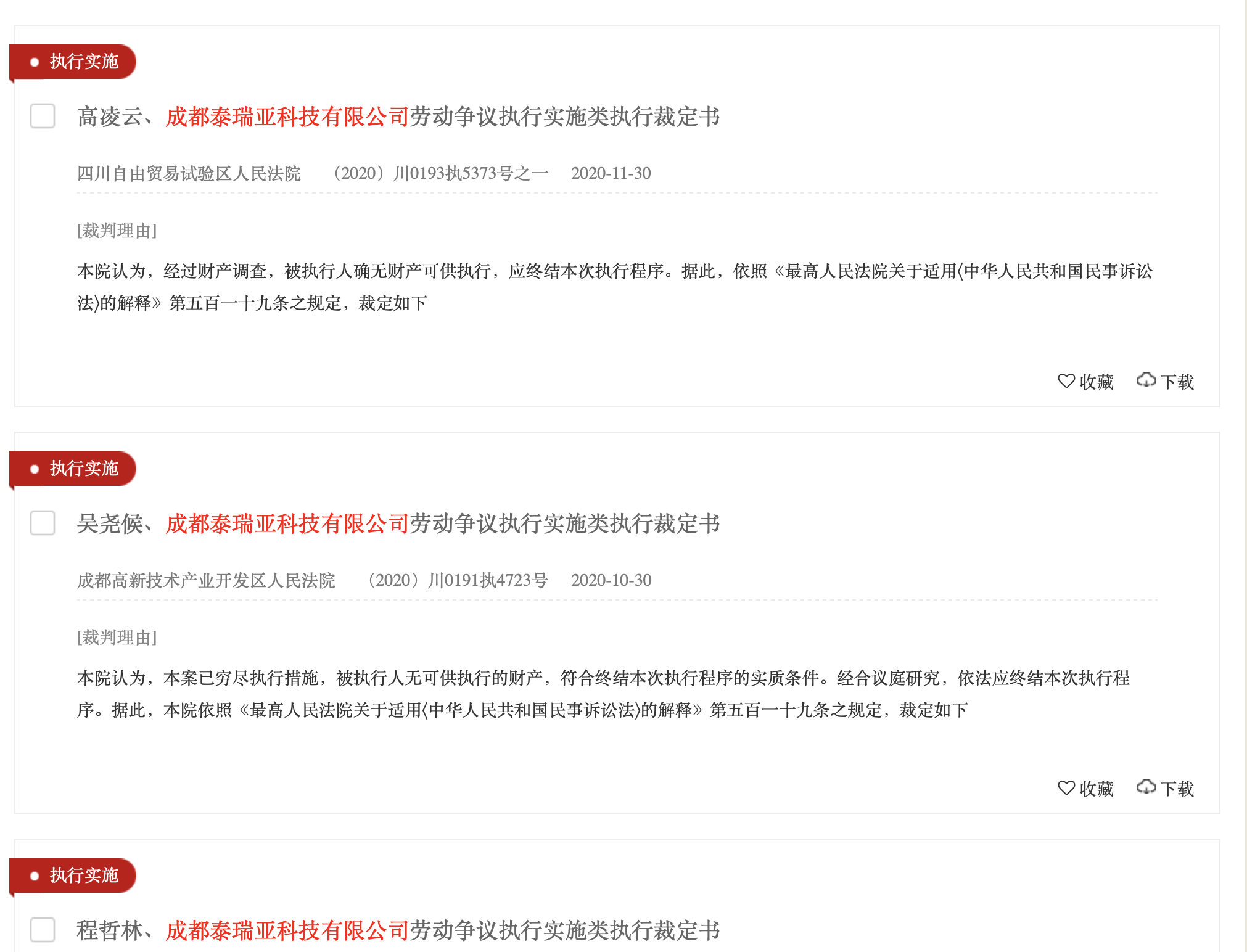
On June 30 and July 15, 2020, Long was issued consumption restriction orders by the Sichuan Pilot Free Trade Zone People's Court for failing to comply with two final labor arbitration rulings.
An enforcement ruling from China Judgments Online shows that in a labor dispute case between Chengdu Tairui and an employee, the court initiated enforcement proceedings on August 12, 2020, for an award of 33,500 RMB.
However, the ruling states that despite checks via online enforcement systems and field investigations, no executable assets were found belonging to Chengdu Tairui, resulting in the court imposing high-consumption restrictions on Long Yujiang.
In 2020, Chengdu Tairui faced multiple similar wage-related labor arbitrations, all indicating the company had no executable assets.
Tianyancha records show that on September 21, 2023, due to a network contract dispute with Alibaba Cloud, Chengdu Tairui failed to fulfill a legal judgment, prompting the Hangzhou Internet Court to issue another consumption restriction order against Long Yujiang.
In March 2023, Long’s equity stake in Chengdu Luliluli Technology Co., Ltd. was frozen by the court. He holds 90% of the company’s shares.
Regarding these disputes, Long responded: "Currently, Tairuiya Company is insolvent and unable to repay debts."
Founder Once Mined 55 Bitcoins a Day a Decade Ago
In the aforementioned funding reports, Jack Long (Long Yujiang) revealed that during the early development phase, the team spent $1.248 million—$16,000 per BTC—to acquire 78 bitcoins as reserves. At today’s Bitcoin price of $44,000, those holdings are now worth $3.432 million, representing nearly $2.2 million in unrealized gains.
Long told ChainCatcher that after he and Old Li invested $2 million, the team used part of the funds to purchase Bitcoin.
Long’s earliest media appearance related to Bitcoin dates back to 2013, when he was featured in Huaxi Metropolis Daily as a Bitcoin miner.
On November 21, 2013, the newspaper published an article titled “Chengdu Bitcoin Miner: 55 Coins Mined in One Day, Worth 240,000 RMB,” spotlighting Long Yujiang.
At the time, Bitcoin surged 74% in a single day, briefly reaching close to 6,000 RMB per coin, drawing mainstream media attention.
The article stated that Long started mining Bitcoin in July 2009, making him one of China’s earliest Bitcoin pioneers. “Long told reporters yesterday he owns 60 mining rigs hosted in a data center, consuming up to 9,000 RMB worth of electricity daily, with astonishing output—recently earning several million RMB worth of Bitcoin per month.”
In the report, Long claimed to operate 60 mining machines with a total computing power of 300 TH/s, averaging 69.2175 bitcoins mined daily over the years, with current daily output at 55 bitcoins.
Long said at the time: "Mining still has about three to four more good years, so I’m mining while also selling mining equipment."
In that decade-old report, Long also mentioned several key figures in China’s early Bitcoin scene, including Li Xiaolai, Zhang Nange (“Pumpkin Zhang”), founder of Jia Nan Yun Zhi, and “Fried Cat” (Kao Mao).
Long said in the article he primarily operated in international Bitcoin circles, where people knew him as “Mr. Long.”
On January 18, Long told ChainCatcher his mining farm was shut down in 2015 due to “too low output efficiency.”
Long said he withdrew from the crypto space in 2017 for personal reasons and only returned at the end of 2022. He now focuses solely on Freechat’s product development and provides resources, leaving operations to his former core team.
Join TechFlow official community to stay tuned
Telegram:https://t.me/TechFlowDaily
X (Twitter):https://x.com/TechFlowPost
X (Twitter) EN:https://x.com/BlockFlow_News
 ChainCatcher 链捕手








