
Removing Rollup Training Wheels: How Can L2s Embark on the Decentralized Path?
TechFlow Selected TechFlow Selected
Removing Rollup Training Wheels: How Can L2s Embark on the Decentralized Path?
Economic decentralization and community co-governance might be the winning key to the L2 decentralization journey.
 Navigating Web3 tides with focused insights
Author: NingNing
Recently, the Metis community passed MIP-4, making it the first Layer 2 (L2) to initiate testing of a decentralized sequencer. This marks the beginning of Metis' special initiative to remove the "training wheels" from Rollups.
The concept of Rollup training wheels originates from Vitalik. In November 2022, Vitalik posted on the Ethereum community forum discussing milestones in the development of Rollup L2s. He proposed three key milestones:
Stage 0: Full Training Wheels Phase
Rollup L2s at Stage 0 are permitted to use centralized sequencers that bundle and submit all L2 state data to L1 (Ethereum mainnet), while deploying a set of verification smart contracts on L1 (e.g., Optimism Gateway deployed by Optimism on Ethereum) to ensure data availability and allow users permissionless asset transfers.
Stage 1: Limited Training Wheels Phase
For Rollup L2s at Stage 1, OP-Rollups must deploy fraud proofs on L1, while ZK-Rollups must deploy validity proofs on L1.
A multi-sig "Security Council" with authority to override incorrect outputs from fraud or validity proofs is required.
Upgrade mechanisms are allowed but must include a time lock with at least a 7-day delay.
Stage 2: No Training Wheels Phase
Two independent and mutually redundant fraud proof contracts or validity proof contracts are mandatory. In case of state data conflicts, the "Security Council" intervenes as needed.
Upgrade mechanisms are allowed but must include a time lock with at least a 30-day delay.
After publishing this post, Vitalik expressed strong optimism about these three milestones, expecting that after the Cancun upgrade, L2s would reach at least Stage 1.
However, due to the separation of the Cancun upgrade from the Shanghai upgrade into an independent major upgrade, along with repeated deployment delays, all existing Rollup L2s remain stuck at Stage 0.
There are two main reasons for this stagnation:
1. The smart contract architecture required to implement fraud proofs is highly complex and consumes substantial on-chain computation and verification resources, resulting in very high operational costs. Meanwhile, the probability of actual fraud challenges occurring is extremely low—so far, there has not been a single instance of state conflict across numerous OP-Rollup L2s.
Investing significant resources for such low-probability events is economically unjustifiable. Even if economic concerns were set aside purely for enhanced security, most L2 development teams prefer to wait until the Cancun upgrade significantly reduces L2 operating costs before proceeding with deployment.
2. Some L2s benefit directly from remaining in Stage 0. Leveraging L2 farming trends and centralized sequencers, they generate monthly MEV revenue exceeding tens of millions of dollars from users. As such, they lack motivation to advance toward Stage 1 or Stage 2.
Faced with this sluggish progress and continued complacency in Stage 0, both market and user patience is wearing thin.
Criticism of L2s has grown louder recently, focusing on delayed fraud proof testnet rollouts, sequencer centralization, and endless mission-driven extraction of user gas fees via MEV.
In response to these criticisms, some L2s invoke Ethereum Maxi ideology as a shield, arguing that establishing a decentralized sequencer with independent or semi-independent consensus represents decoupling from Ethereum.
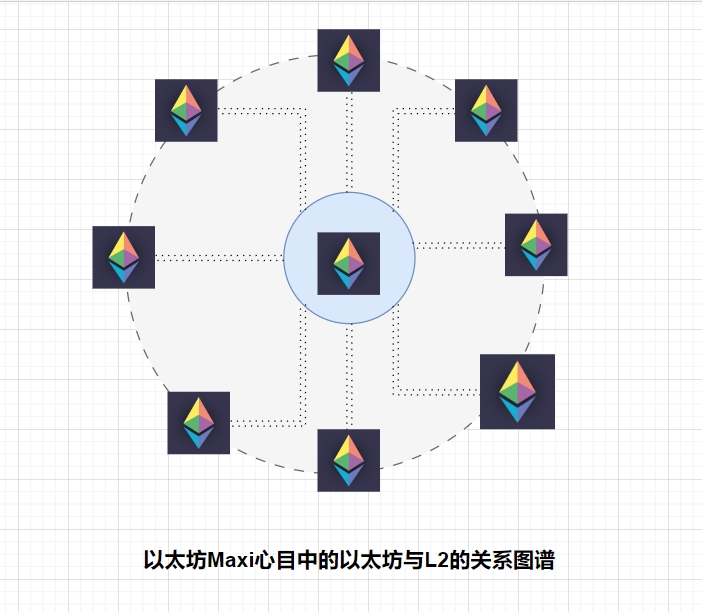
Other L2s view the relationship between L2 and Ethereum as fractal. A decentralized sequencer, to some extent, represents a fractal extension of Ethereum’s PoS consensus mechanism down to the L2 layer.
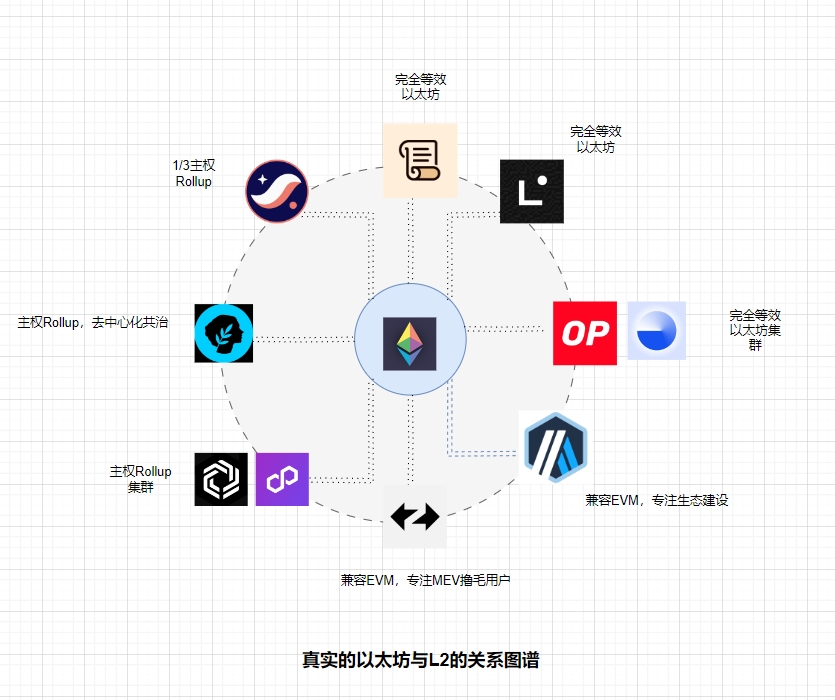
L2s holding this perspective include Starknet and Metis. Starknet, aiming for balance, chose to have one-third of gas fees paid in its native token STRK—making it effectively a “1/3 sovereign Rollup.” Metis, often dubbed “Vitalik’s mom’s L2,” takes a firmer stance on sovereign Rollup architecture and decisively launched decentralized sequencer testing this month.
Centralized versus decentralized sequencers—this is a critical decision facing every L2.
Setting aside Ethereum orthodoxy for now, let's examine the methodological approaches behind L2 construction.
Currently, two distinct schools of thought are emerging in L2 design. One prioritizes Ethereum orthodoxy and developer supremacy, relying on fraud proofs or validity proofs to achieve minimal trust and decentralization. The other emphasizes community sovereignty and user empowerment, advocating decentralized sequencers combined with sovereign Rollup architectures to realize true L2 decentralization.
We do not intend to take sides in this debate, but simply highlight a fundamental truth: Web3 protocols are not Web2 products. Building a Web3 protocol resembles constructing a living ecosystem rather than manufacturing an industrial product.
This is why the Metis community emphasizes principles of diversity, inclusivity, and shared ownership—and why Metis continues pushing forward with sequencer decentralization despite skepticism from certain Ethereum Maxi circles.
Decentralizing economic rights and enabling community co-governance may well be the key to unlocking true L2 decentralization.
Finally, as Bitcoin ecosystems and modular blockchains rise to challenge Ethereum for defining the future paradigm of Web3, the Ethereum ecosystem must resist e/acc impulses and listen more attentively than ever to voices from its communities.
Join TechFlow official community to stay tuned
Telegram:https://t.me/TechFlowDaily
X (Twitter):https://x.com/TechFlowPost
X (Twitter) EN:https://x.com/BlockFlow_News
 @0xNing0x