








On its launch day, hit twice, take a quick look at LENX, the full-chain Bitcoin liquidity protocol from a three-time entrepreneur
TechFlow Selected TechFlow Selected
On its launch day, hit twice, take a quick look at LENX, the full-chain Bitcoin liquidity protocol from a three-time entrepreneur
LENX, a three-time entrepreneur known for being "exceptionally skilled in DeFi protocol design," was sandwiched twice on the first day of the token launch, resulting in a total loss of 230 ETH.
 Navigating Web3 tides with focused insights
Author: Frank, Foresight News
A seasoned Web3 startup team that has undergone three transformations and left its mark across the NFT and DeFi sectors recently launched its third project—LENX Finance, an omnichain Bitcoin liquidity protocol built entirely on ZetaChain. It aims to bring Bitcoin liquidity into Ethereum and L2 DeFi ecosystems through deep integration with Frax.
However, in a twist of irony, the LENX team, which previously claimed confidently to be "very skilled in DeFi protocol design and token incentives," made a critical error this week while providing initial liquidity for the XD token on SushiSwap. This mistake allowed two MEV bots to profit 230 ETH via arbitrage, sparking widespread community criticism.
So what exactly is LENX’s omnichain Bitcoin product? How closely is it tied to Frax? What is the team’s three-time entrepreneurial journey? And how did they lose $600,000 on day one due to being sandwiched twice?
LENX: An Omnichain Bitcoin Liquidity Protocol
LENX Finance is an omnichain Bitcoin liquidity protocol built on ZetaChain. By integrating Frax Finance's Borrow AMM (BAMM) and ZetaChain’s cross-chain interoperability protocol CCIP, it features built-in lending capabilities:
Users can deposit native Bitcoin as collateral to borrow other omnichain assets on ZetaChain, or supply any omnichain asset to earn interest from the protocol.
Currently, LENX’s DeFi matrix consists of four core products designed to integrate BTC liquidity directly into DeFi through functional combinations:
-
xBTC: A BTC-pegged stablecoin, i.e., a “wrapped” Bitcoin, enabling seamless cross-chain transfers and redemption of native BTC;
-
LENXSwap (Omnichain BTC Swap): Enables swapping between native BTC and other crypto assets, and liquidity provision, on any chain;
-
Permissionless BAMM Gauge based on XD: The XD token is LENX’s governance token. BAMM is Frax Finance’s mechanism for building oracle-free lending platforms with spot liquidity. This feature leverages Frax Finance’s BAMM to enable loans, non-custodial lending, and collateralized assets to enter the omnichain economy;
Additionally, LENX plans to launch BXD, a new USD-pegged stablecoin in its V2 version, which will be minted using native Bitcoin as collateral. This functionality is currently under development.
In simple terms, LENXSwap and BXD can be analogized to Uniswap and Maker respectively, while xBTC is essentially similar to wrapped Bitcoin products like WBTC or tBTC.
xBTC: The Core of the DeFi Product Matrix
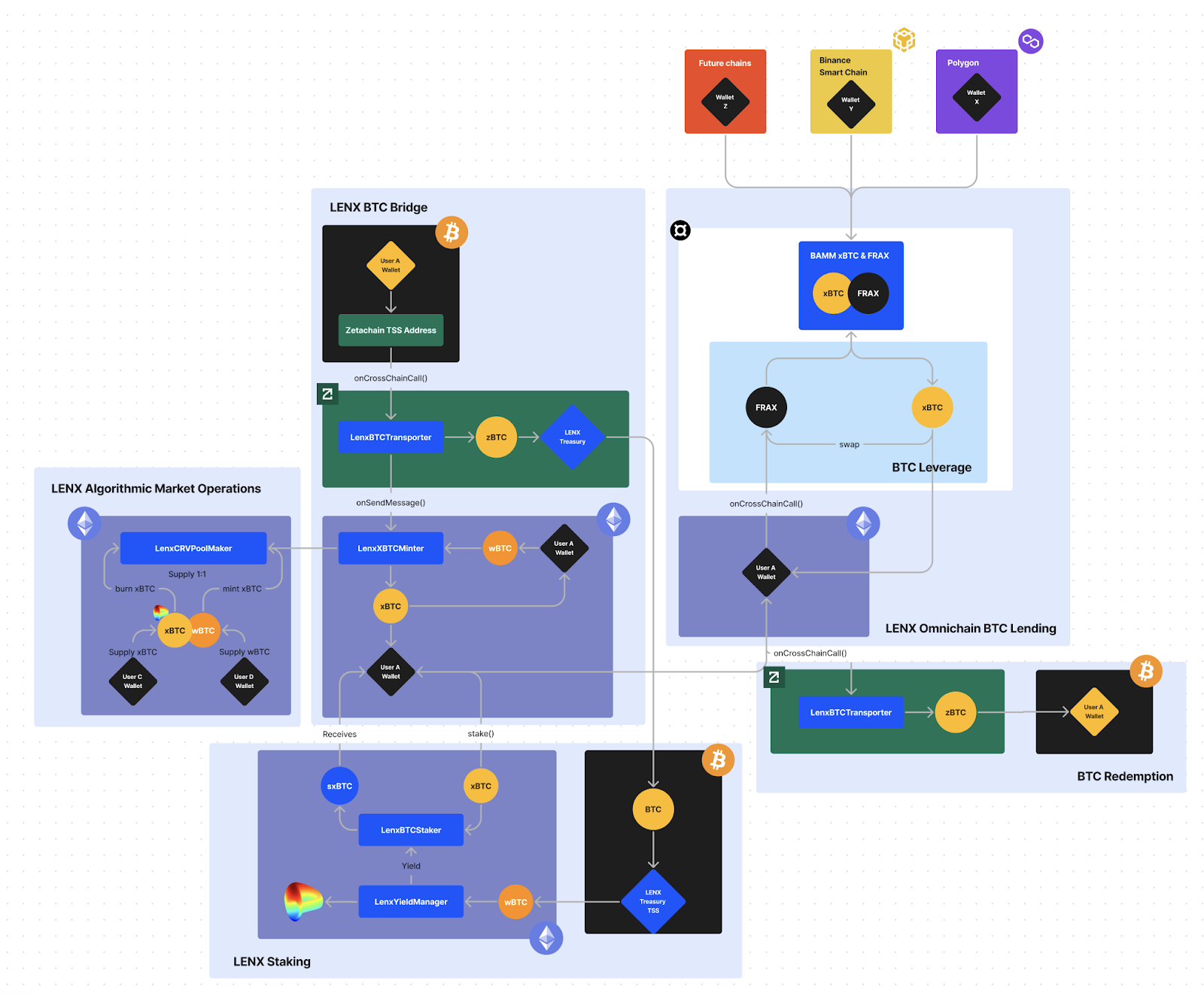
Among these, xBTC is the core of the entire ecosystem. Since ZetaChain enables the creation of omnichain smart contracts capable of reading and relaying messages from external chains, LENX uses ZetaChain as the custodian for its Bitcoin and has created the ZRC-20 token standard to mint and burn native assets across chains, thereby unlocking omnichain Bitcoin liquidity.
When users mint xBTC, their Bitcoin transactions follow standards set by LENX and ZetaChain, requiring at least two outputs: the first directed to a TSS (Threshold Signature Scheme) Bitcoin address for security, and the second serving as a memo output.
The memo uses the Bitcoin script command (OP_RETURN) to include less than 80 bytes of data, conveying recipient addresses or additional instructions for interaction with smart contracts on zEVM.
Once data input is set, BTC is sent to the Bitcoin TSS address along with a memo indicating the deposit, such as "deposit to vitalik.eth".
ZetaChain nodes then observe this transaction and credit an equivalent amount of zBTC to the designated address on ZetaChain’s omnichain smart contract, deducting applicable fees. Subsequently, LENXBTCMinter mints xBTC and transfers it to the user’s address.
Throughout this process, since native BTC remains securely held by the TSS address, users can always reclaim native BTC by burning the corresponding amount of xBTC, triggering LENX to release the BTC back.
Integrating Fraxchain as the Liquidity Layer
LENX Finance also has deep integration plans for the yet-to-be-deployed Fraxchain and BAMM—Foresight News previously reported that Sam Kazemian, founder of Frax, revealed in the official Telegram group that the Fraxchain testnet, Frax Finance’s Ethereum L2 network, aims to launch in January 2024, with early builders receiving maximum block space incentives.
LENX Finance’s main plan is to create two BAMM liquidity pools on the upcoming Fraxchain: a WBTC/xBTC pool and a FRAX/xBTC pool.
By adding these two liquidity pools and participating in gauge voting, LENX expects to earn rewards. According to official disclosures, LENX plans to support these liquidity pools and liquidity on Curve using Frax’s AMO model.
The AMO operations will allow LENX to increase the relative TVL size in these pools and collect FXS rewards, which will be locked into veFXS and further used to vote for the corresponding liquidity pools.
The XD token will be used to bribe these pools in exchange for FXS, aiming to create a flywheel effect—boosting market liquidity while incentivizing new users to purchase xBTC for staking purposes.
From this perspective, LENX is essentially expanding the use of xBTC on Ethereum and Fraxchain, leveraging Frax as a liquidity layer to bring Bitcoin liquidity into Ethereum and L2 DeFi ecosystems.
From RenaissanceDAO to Perlin, Then to LENX
Interestingly, LENX Finance proactively disclosed on its official Twitter account the team’s developmental journey, sharing its evolution through multiple pivots.
The LENX team was originally known as RenaissanceDAO, a fragmented NFT marketplace inspired by OlympusDAO, which completed a $250,000 seed round investment led by Frax Finance on February 28, 2022.
That $250,000 investment was specifically for the then-RenaissanceDAO token ART (now the LENX token XD). ART was intended to represent ownership in a DAO-owned NFT index:
ART would be issued to raise funds to build a treasury, which would then be used to purchase NFTs voted on by the community. ART tokens would thus serve as ownership certificates—similar to stocks—for the DAO-owned NFT index.
Unfortunately, the project ultimately failed. The team then migrated to the Neo chain and established Perlin Finance through funding, but according to the team, “the project faced critical security issues because smart contracts had to be written in C#.”
Finally, the team launched the current LENX Finance, stating, “We’ve never tried to hide it—we’re actually proud of it. The team is very skilled in DeFi protocol design and token incentives.”
$600,000 Lost on Day One?
This week, LENX Finance completed a Liquidity Bootstrapping Auction (LBA) on the community platform Fjord Foundry, raising $10.22 million for the XD token.
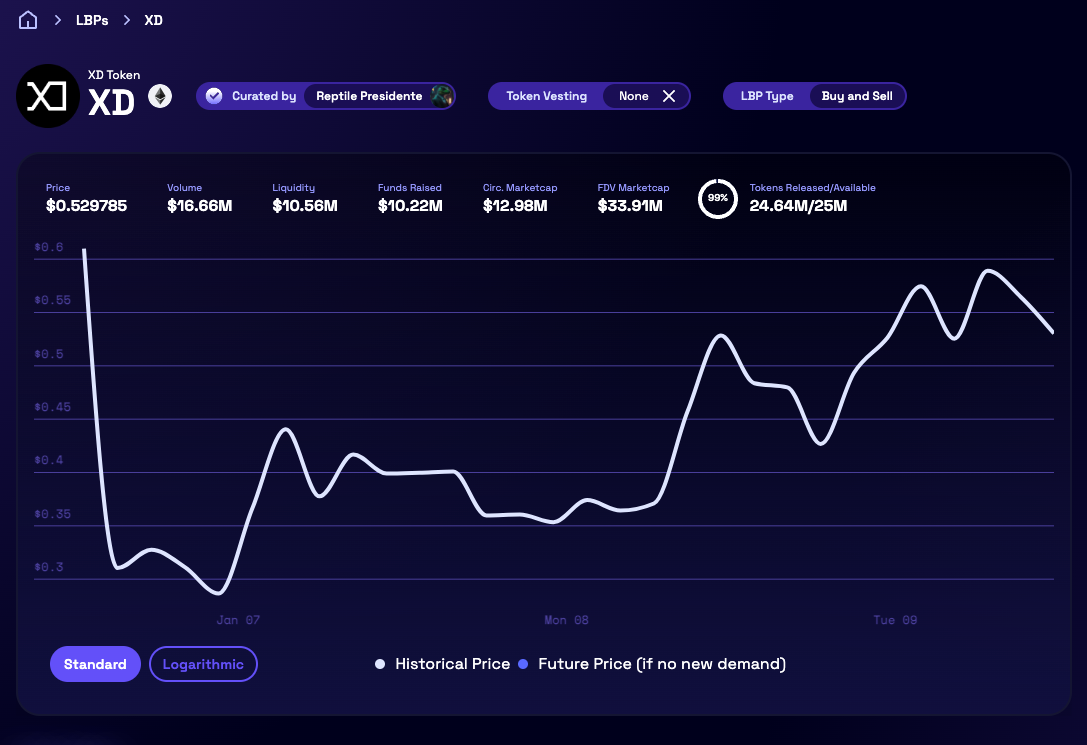
Ironically, the team that claims to be “very skilled in DeFi protocol design and token incentives” made a critical operational error when injecting initial liquidity for the token on SushiSwap after fundraising—allowing two MEV bots to profit 230 ETH ($600,000) through arbitrage:
-
MEV bot c0ffeebabe.eth profited 74 ETH;
-
Another MEV bot c0ffeebabe.eth profited 74 ETH;
Initially, the team added 7.5 million XD and 777 ETH to the SushiSwap v3 LP at an issuance price of approximately $0.50. Less than 30 minutes later, the team removed half of the LP liquidity—380 ETH and 1.7 million XD—apparently intending to add this portion to Uniswap V3.
However, since users had already created XD/ETH positions on Uniswap V3, the team couldn’t add liquidity at their desired ratio. Instead, they chose to add 1.8 million XD as single-sided liquidity on top of the existing LP, severely skewing the liquidity pool.
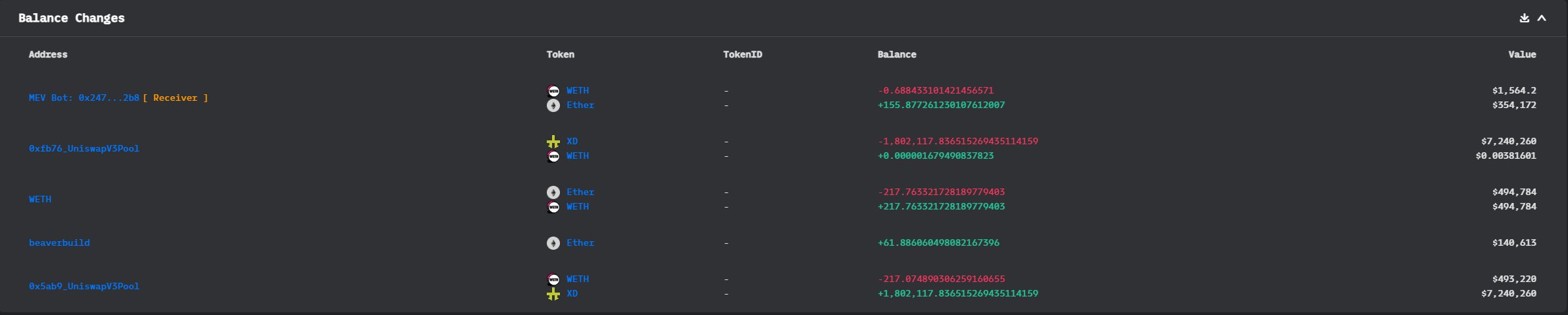
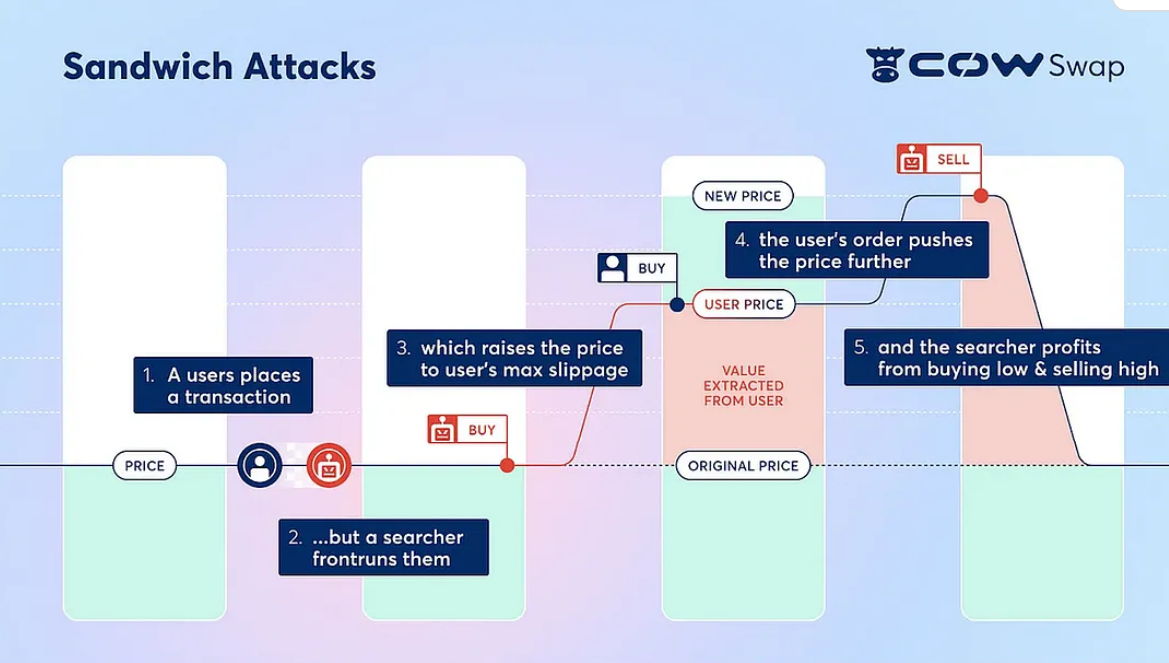
This opened the door for MEV bots. As reviewed by crypto KOL 0xBoboShanti, consider just one bot’s actions—an MEV bot executed a sandwich attack within the same block, exploiting slippage and price impact to sell at a higher price and profit:
-
First, it obtained 217 ETH via flashswap from the Uniswap V3 pool;
-
Then exchanged 0.0000017 ETH for 1.8 million XD on SushiSwap V3;
-
Sent the 1.8 million XD to Uniswap V3 to repay the flashswap;
-
Sent 61 ETH to the Builder address;
Ultimately, the MEV bot netted 217 ETH - 61 ETH = 156 ETH.
Shortly afterward, the team again abnormally added 176 ETH and 100,000 XD to the Uniswap V3 pool, allowing another MEV bot to reap hundreds of thousands of dollars in profit.
At the time of writing, LENX has released a post-event analysis and deployed a risk management tool that interacts directly with Flashbots RPC endpoints. Users can submit transaction hashes to check how much XD they lost during routing and will receive compensation from the team’s allocation.
Join TechFlow official community to stay tuned
Telegram:https://t.me/TechFlowDaily
X (Twitter):https://x.com/TechFlowPost
X (Twitter) EN:https://x.com/BlockFlow_News
 Foresight News








