








Who Holds the Power Over ETF Approvals? What Are the SEC's Five Commissioners' Stances on Crypto?
TechFlow Selected TechFlow Selected
Who Holds the Power Over ETF Approvals? What Are the SEC's Five Commissioners' Stances on Crypto?
SEC's "Gorosei": Can They Usher in the Golden Age of ETFs?
 Navigating Web3 tides with focused insights
Author: Azuma
As the January 10 "final judgment day" for Bitcoin spot ETFs draws near, speculation over whether they will be approved or rejected is growing increasingly intense.
Last night, all major ETF applicants except Hashdex submitted updated versions of their S-1 (or S-3) filings. The SEC will now review these documents along with the previously submitted 19b-4 forms, culminating in a vote to decide whether to approve Bitcoin spot ETF applications.
According to FOX reporter Eleanor Terrett, the five current SEC commissioners—Chair Gary Gensler, and commissioners Hester Peirce, Caroline Crenshaw, Mark Uyeda, and Jaime Lizárraga—will cast the decisive votes on the fate of these ETFs.
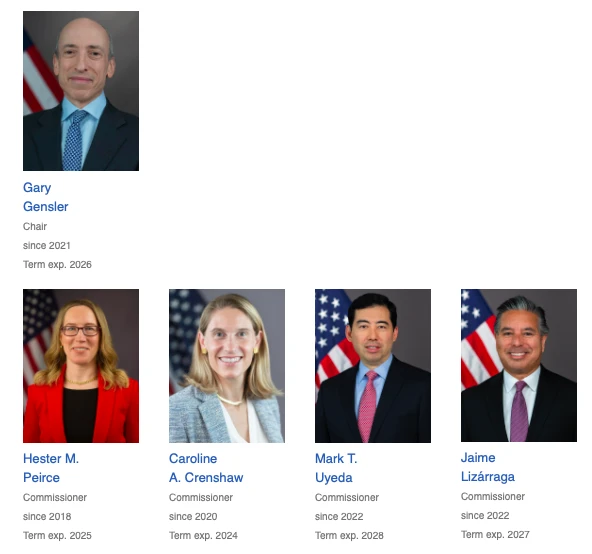
What are the stances of these five individuals toward crypto and Bitcoin spot ETFs? And how might they vote in this crucial decision? By examining their past statements, we attempt to uncover some clues.
Voter One: Chair Gary Gensler
"Industry enemy," "human black swan"... As SEC Chair, Gary Gensler likely holds the most influence in this vote and may well be the most disliked regulator within the crypto industry.
Gensler was once viewed as an ally due to his academic work on crypto, but in recent years, his leadership in numerous lawsuits against crypto companies and projects has marked a complete 180-degree shift in his stance.
Last night, Gensler issued another warning about crypto risks, emphasizing that individuals offering crypto investment products or services may be violating applicable laws, including federal securities laws; investors participating in crypto asset securities should understand they may lose critical information and other important protections; investing in crypto assets also involves extremely high risk and often severe volatility; many major platforms and crypto assets have already experienced bankruptcy and/or devaluation; continued investment requires full recognition of significant risks.
In summary, based on his past words and actions, Gensler is more likely to vote against approval... However, some argue that given the SEC's extensive efforts over recent months to engage with ETF applicants, Gensler might make an unexpected decision.
Voter Two: Commissioner Hester Peirce
In contrast to Gensler, Commissioner Hester Peirce has long been the most crypto-friendly figure within the regulatory sphere, affectionately nicknamed the "Crypto Mom" by the industry.
Peirce has consistently opposed using litigation instead of regulation, arguing that the SEC should proactively develop a regulatory framework for crypto.
Regarding ETFs, Peirce may be even more aggressive than you think—she has stated that spot Bitcoin ETFs should have been approved five years ago, bluntly adding: "I’ve always been puzzled by the logic behind the SEC’s failure to approve spot Bitcoin ETFs."
You can confidently expect Peirce to vote yes.
Voter Three: Caroline Crenshaw
Compared to Gensler and Peirce, Caroline Crenshaw's work appears less focused on the crypto industry. Yet from her limited public comments, Crenshaw seems to hold a generally skeptical or even negative view toward crypto.
In November 2021, Crenshaw emphasized the need for DeFi regulation, stating that while DeFi could bring certain benefits, it would also pose dangers without protective regulatory frameworks.
In January 2023, Crenshaw joined Gensler at a Twitter Space event hosted by the U.S. Army, where she described crypto as "notorious for scams" and advised those considering investments to "carefully, carefully consider" what percentage of their portfolio they allocate to digital assets.
Conservatively speaking, Crenshaw is more likely to cast a vote against approval.
Voter Four: Mark Uyeda
Like Peirce, Mark Uyeda maintains a friendly stance toward crypto. The two have jointly opposed certain SEC enforcement actions against industry projects.
In March 2023, after the SEC rejected VanEck’s Bitcoin spot ETF application, Uyeda joined Peirce in issuing a dissenting statement, accusing the SEC of applying a "double standard" in reviewing ETP applications, which has delayed the approval of spot Bitcoin ETFs.
Based on this, Uyeda is highly likely to vote in favor.
Voter Five: Jaime Lizárraga
Among the five commissioners, Jaime Lizárraga appears to be the one most distant from the crypto industry. When Cointelegraph reported on Lizárraga’s appointment in 2022, it noted: "Lizárraga has essentially never made any public statements regarding crypto or blockchain."
Since taking office, Lizárraga has not expressed any clear position on crypto.
Lizárraga’s voting intention remains unpredictable at this stage.
Summary
As shown above, the current five SEC commissioners hold significantly different views on crypto. Given the clearly supportive positions of Peirce and Uyeda, approval of the ETFs remains quite plausible.
However, it must be emphasized that the above analysis is based solely on historical statements by the five commissioners and does not fully represent their comprehensive judgment, nor does it account for potential shifts in their views over time.
Who really holds the power over the ETF’s fate? What are the five SEC commissioners’ stances on crypto? Let’s end with the prediction of Bloomberg ETF analyst Eric Balchunas. Balchunas believes that since Gensler has invested substantial effort—even using his vacation time—to assist applicants in revising their filings, he may ultimately vote in favor. Combined with the two certain votes (Peirce and Uyeda), the ETF could pass with a 3-vote majority.
So what will the final outcome be? Let’s wait out these last two days and prepare to receive our fate.
Join TechFlow official community to stay tuned
Telegram:https://t.me/TechFlowDaily
X (Twitter):https://x.com/TechFlowPost
X (Twitter) EN:https://x.com/BlockFlow_News
 Odaily








