
What Caused Bitcoin's 10% Plunge: Matrixport Report? Excessive Leverage?
TechFlow Selected TechFlow Selected
What Caused Bitcoin's 10% Plunge: Matrixport Report? Excessive Leverage?
Regardless of whether the Matrixport report was to blame for the market flash crash, the crypto market's belief in the approval of bitcoin spot ETFs does not appear to have wavered.
 Navigating Web3 tides with focused insights
By Krisztian Sandor, CoinDesk
Translation: Felix, PANews
Bitcoin briefly plunged nearly 10% last night, coinciding with the release of a bearish report from Matrixport predicting that the U.S. SEC will reject all spot Bitcoin ETF applications this month.
An analyst at K33 Research said in an interview that the pullback was more likely a "typical deleveraging" caused by an overheated market rather than driven by individual opinions.
The sharp drop in Bitcoin yesterday served as a warning to investors about the asset's downside volatility. Observers—including Reflexivity Research founder—quickly pointed to a research report forecasting rejection of the highly anticipated spot Bitcoin ETFs in the U.S., and even comments from CNBC host Jim Cramer, as potential triggers. However, some analysts suggested the market correction may have stemmed from excessive optimism fueled by sustained price gains.
Market data shows Bitcoin fell rapidly from around $45,000 to $40,800 within hours—roughly the same time Singapore-based digital asset firm Matrixport released its report (authored by Markus Thielen) forecasting that the U.S. SEC would reject all spot Bitcoin ETF applications, reversing its January 2 prediction that approval was imminent and prices could rebound to $50,000.
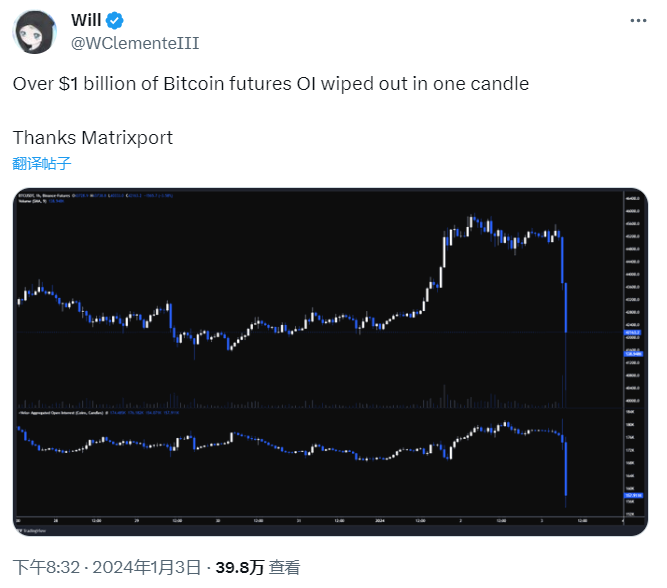
Jihan Wu, co-founder of Matrixport, stated that the company’s analysts operate independently from management, and that SEC approval of a spot Bitcoin ETF is inevitable. He added that it is unlikely the report alone triggered the market crash, noting recent weakness in crypto-related stocks might signal shaky momentum for crypto assets.
In a tweet early Thursday, Wu said: “It’s unrealistic to believe that one report from Matrixport could trigger a trillion-dollar market crash. We’ve also seen unexpected declines in crypto stocks over the past few trading sessions while Bitcoin prices remained stable. These events seemed minor and received little attention before Markus Thielen published his report.”
Wu further responded on X earlier today, stating that Matrixport’s report should not be blamed for the market plunge, and emphasized that quickly adjusting views should be seen as a capability and strength.
However, some analysts have rejected the views expressed in the Matrixport report, saying there is no evidence regulators will reject the applications and that approval remains more likely.
Bitcoin’s sharp drop came just a day after CNBC host and former hedge fund manager Jim Cramer made positive remarks about Bitcoin—remarkable given he was bearish on Bitcoin’s outlook in October 2023. While unlikely, observers retrospectively suggested his comments “caused” the price decline, citing Cramer’s well-known reputation as a contrary indicator. (For example, since his bearish statement last October, Bitcoin has risen approximately 60%.)
What Caused Bitcoin’s Drop?
Vetle Lunde, senior analyst at K33 Research, said the market was overheated and excessively leveraged, making it highly vulnerable to downward pressure.
“Leverage was extremely high ahead of the market crash, with most traders positioned long—the annualized funding rate for perpetual contracts reached as high as 66%, and futures premiums spiked to 50% annualized—clear evidence of an overheated market,” Lunde said in an interview. “This made the market highly susceptible to downside volatility.”
The Matrixport report provided a catalyst for unwinding overly leveraged long positions, triggering a cascade of liquidations that amplified the downturn. According to CoinGlass data, nearly $560 million in leveraged derivatives long positions (bets on higher prices using borrowed funds) were liquidated—the highest level in at least three months.
“This was a classic long liquidation event,” said Vetle Lunde.
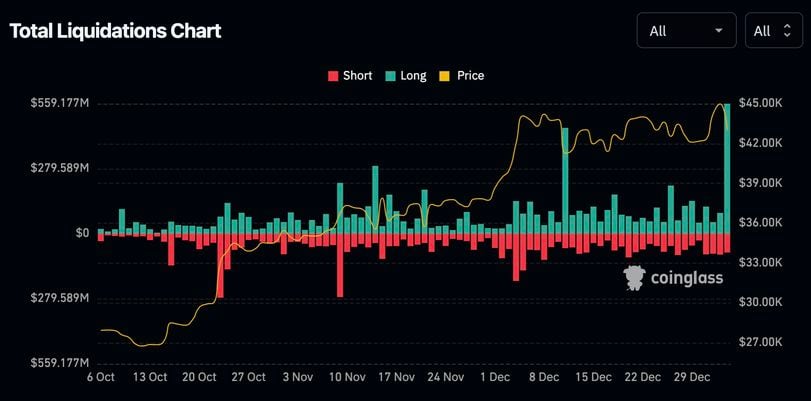
Surge in crypto derivative liquidations intensified price declines (CoinGlass)
Digital asset research firm CryptoQuant also attributed the drop to abnormally high funding rates in the Bitcoin futures market, increased selling pressure from Bitcoin miners, and high profit margins among short-term holders.
CryptoQuant analysts said last week that approval of a spot Bitcoin ETF could become a “sell-the-news” event, potentially pushing Bitcoin down to $32,000.
Is Approval of a Spot Bitcoin ETF Still Possible?
Joel Kruger, strategist at LMAX, said in an email that the prevailing market consensus is that approval of a Bitcoin ETF in the U.S. is “not if, but when.”
K33’s Lunde echoed similar sentiments, stating, “Given Grayscale’s legal victory in court, along with repeated discussions between the SEC and issuers leading to continuous updates to S-1 filings and demands for cash creation/redemption mechanisms, the likelihood of SEC rejection is very low.”
Join TechFlow official community to stay tuned
Telegram:https://t.me/TechFlowDaily
X (Twitter):https://x.com/TechFlowPost
X (Twitter) EN:https://x.com/BlockFlow_News
 CoinDesk