Will the BRC-20 indexing upgrade controversy lead to a "fork"?
TechFlow Selected TechFlow Selected
Will the BRC-20 indexing upgrade controversy lead to a "fork"?
Behind the BRC-20 indexing upgrade controversy: choosing between a conservative path focused on stability and security, or a risky innovative offensive approach.
 Navigating Web3 tides with focused insights
By Youyou, ChainCatcher
Recently, BRC20 has been embroiled in a "fork" controversy. Unisat's insistence on following the Ordinals upgrade has drawn opposition and criticism from BRC20 founder Domo, exposing a power struggle over control of the BRC20 protocol.
Currently, the total market capitalization of BRC20 tokens is approaching $10 billion, making it the most popular and widely embraced product within the Bitcoin ecosystem. Every move related to BRC20 captures the attention of crypto users. Behind this controversy lies a pivotal decision: whether BRC20 and the Ordinals protocol will develop in sync or gradually diverge.
Why is the debate over whether BRC20 should upgrade receiving so much attention? Could it lead to a "fork"?
Unisat’s Commitment to Ordinals Jubilee Upgrade Sparks Power Struggle and Fork Controversy in BRC20
An announcement by Unisat regarding adherence to the Ordinals upgrade has triggered turmoil among BRC20 indexers, escalating into a battle for control behind the BRC20 protocol.
On January 2, Bitcoin inscription infrastructure provider UniSat announced it would follow the Ordinals Jubilee upgrade, ensuring that BRC20 continues to operate on top of Ordinals without splitting into an isolated protocol. Additionally, it plans to release a whitepaper on January 31.
UniSat claimed this was the best gift it could offer since launching BRC20 in February 2023—for BRC20, Ordinals, Bitcoin, and the community at large.
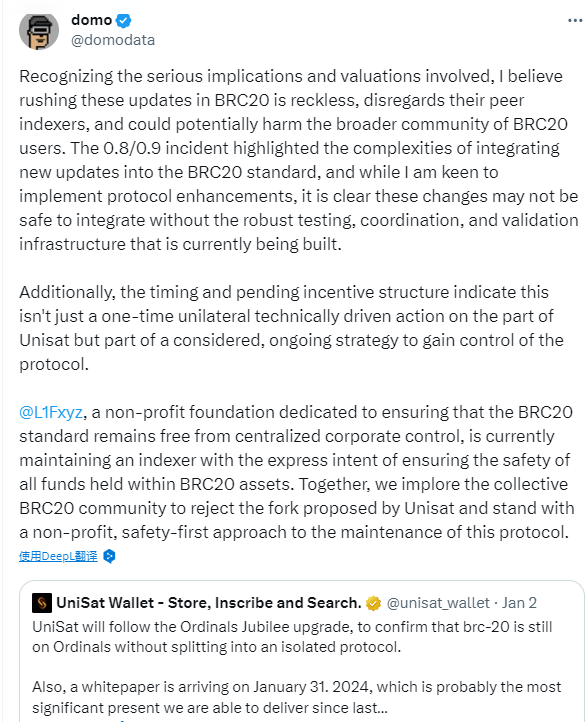
However, this statement was met with strong opposition and criticism from BRC20 founder Domo, who argued that Unisat Wallet’s actions could create conflicts in the BRC-20 accounting standard—amounting to a "fork" of BRC20 and an attempt to seize control of the BRC20 protocol. He urged community members to reject Unisat’s proposed upgrade.
In response to Unisat's push for adopting the Ordinals Jubilee upgrade, Domo stated that such updates were being rolled out without sufficient consideration of their consequences. He called these BRC20 changes reckless, accusing Unisat of ignoring other indexing projects and potentially harming the broader interests of BRC20 users. According to Domo, this isn’t merely a one-off technical initiative but rather a well-planned strategy aimed at capturing control of the protocol.
Domo further explained that the recent Ordinals 0.8/0.9 upgrade events highlighted the complexity of integrating new updates into the BRC20 standard. While he shares the desire for protocol improvements, he emphasized that without robust testing, coordination, and validation infrastructure currently under development, such changes could be unsafe.
Domo added that L1Fxyz—a nonprofit foundation dedicated to safeguarding the BRC20 standard from centralized corporate control—is now maintaining an indexer specifically designed to ensure the security of all funds within BRC20 assets. Together, they appeal to the entire BRC20 community to reject Unisat’s proposed fork and support a nonprofit, security-first approach to protocol maintenance.
As the creator of BRC20, Domo’s remarks quickly ignited discussions across the crypto space, turning Unisat’s stance on the Ordinals upgrade into a full-blown power struggle over a potential BRC20 fork.
Why Don’t BRC20 Indexers Update Alongside the Ordinals Upgrade?
Given that BRC20 is built upon the Ordinals protocol, why does Unisat’s insistence on following the Ordinals upgrade spark such intense debate? Why is this referred to as the “BRC20 indexer war,” and what does it have to do with BRC20 indexers?
To understand this, we must first examine how BRC20 tokens work. BRC20 is an experimental token standard created by Domo in March 2023 based on the Ordinal protocol for issuing fungible tokens. Ordinals (or "ord") is a system that assigns unique numbers to individual satoshis—the smallest units of Bitcoin—for tracking purposes.
Thus, BRC20 is a meta-protocol built atop Ordinals, which itself runs on Bitcoin. However, since BRC20 lacks smart contract functionality, it currently relies on centralized indexers to maintain account balances and track transaction data related to BRC20.
An indexer, in essence, is a database that reads and records all BRC20 transactions—such as identifying which inscription first deployed a new token name, tracking wallet balances after minting, and monitoring associated transaction addresses.
In simple terms, while Bitcoin serves as the ultimate “data layer,” BRC20 tokens are inscribed onto individual sats via the Ordinals protocol and then tracked through indexer databases that record transaction history and balance changes of BRC20 tokens issued under Ordinals.
Since Ordinals is a nascent protocol, Casey Rodarmor and other developers continue to iterate and release new versions regularly—multiple upgrades were released last year alone. The recent Ordinals Jubilee update introduced version v0.13.0, primarily fixing vulnerabilities linked to cursed inscriptions. Different versions of Ordinals may use varying methods to bind and track inscriptions, which can result in inconsistencies or errors in BRC20 indexer databases, leading to incorrect balance reports.
In October last year, users discovered sequencing issues with BRC20 tokens, with different exchanges running incompatible versions—raising concerns about double-spending risks and potential asset losses. Users were advised not to trade BRC20 tokens during this period. Unisat later identified the root cause: discrepancies in BRC20 index results due to different versions of the Ord software.
Additionally, some found that inscriptions #35321413 and #35329860 could be indexed by the v0.9.0 version of the Ordinals protocol but not by v0.7.0 or v0.8.0. Because different markets adopted different versions of the Ordinals protocol, certain inscriptions could not be properly indexed on some platforms, resulting in actual shifts in inscription numbering.
To preserve indexing stability, starting from block height 816,000 on November 9, the BRC20 indexing standard was “frozen” at Ord v0.9. All BRC20 indexers in the market must remain synchronized with Ordinals v0.9.0 and no longer update alongside future Ordinals protocol upgrades.
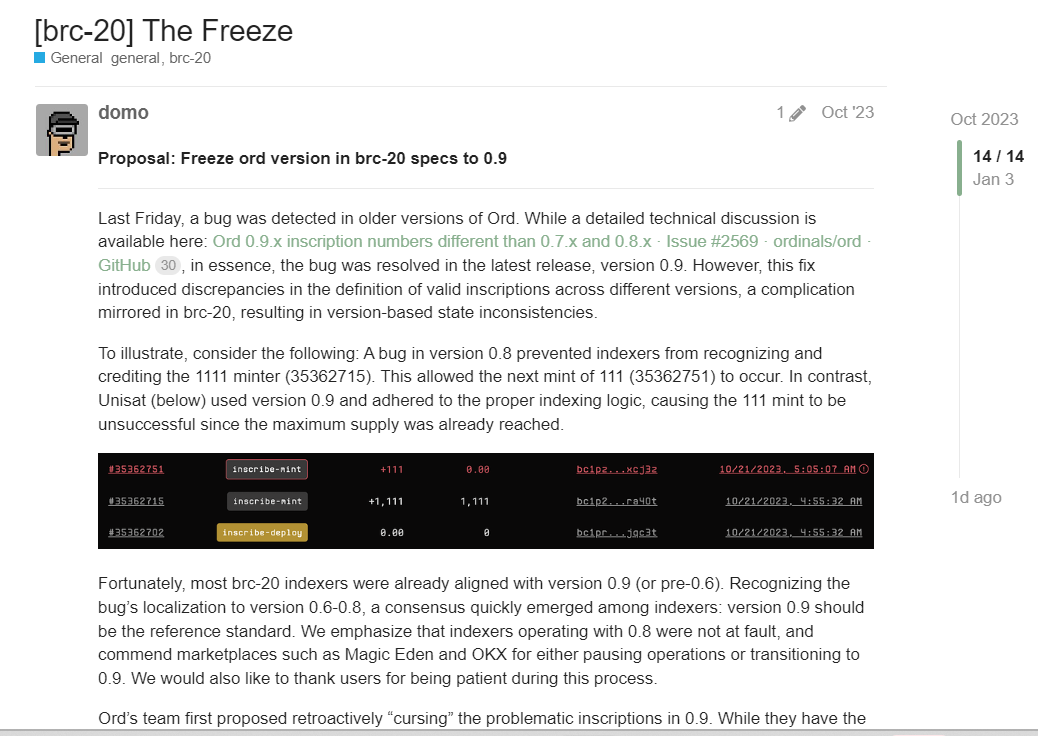
This rule was implemented because BRC20 has grown into a massive protocol in terms of TVL, user base, infrastructure, wallets, and market scale. With a total market cap exceeding $10 billion, hundreds of thousands of issued tokens, and widespread listing support from CEXs, the number of BRC20 holders is enormous. Ensuring the safety and stability of BRC20 assets has become the top priority. Any innovation-induced loss of user funds could severely damage the BRC20 ecosystem.
Now, Unisat’s decision to follow the Ordinals Jubilee upgrade risks creating two conflicting indexing standards for BRC20 on Bitcoin—one for those upgrading their indexing systems and another for those staying on the old version. This divergence in accounting rules could result in inconsistent balances across platforms or mismatched account records, fragmenting the BRC20 market along different Ord version lines.
Of course, the BRC20 indexing standard isn't meant to stay frozen indefinitely at v0.9.0. If the Ordinals protocol evolves to a more stable new version in the future, the standard would likely change accordingly—similar to how Bitcoin and Ethereum node clients update with network upgrades. Domo previously mentioned on the L1F forum the possibility of gradually adopting Ordinals upgrades using a maintenance mode, meaning freeze first, upgrade later.
Could the Indexer Upgrade Dispute Trigger a BRC20 Fork?
Currently, within the crypto community, there are three main perspectives on whether BRC20 indexers should follow Ordinals upgrades: coexistence, freeze, and upgrade.
The coexistence camp advocates allowing both frozen and upgraded indexers to exist simultaneously—but this could lead to community fragmentation and confusion over BRC20 asset balances. The freeze approach maintains all indexers on Ord v0.9, effectively isolating BRC20 from the broader Ordinals ecosystem. The upgrade path calls for all BRC20 indexers to uniformly adopt the latest Ord version, though short-term instability during transition is expected. A compromise where the freeze faction eventually joins the upgrade side might also occur, albeit with temporary instability.
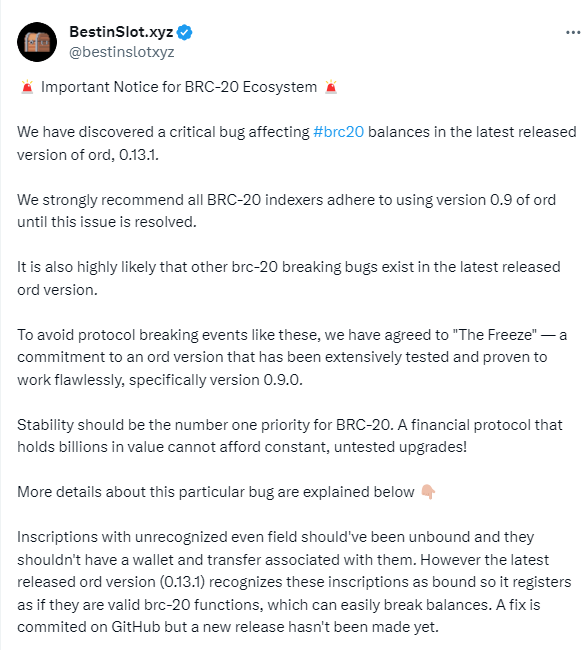
Members of L1F, led by Domo, prefer delaying the upgrade, warning that rushing into it could introduce further bugs. After Domo publicly opposed Unisat’s upgrade, BestinSlot—one of L1F’s representatives and an ordinal aggregator—recently posted that a critical bug affecting BRC20 balance accuracy had been found in Ordinals v0.13.1. They strongly recommend that BRC20 indexers stick with v0.9.0 to maintain protocol stability. The post also warned that other undiscovered bugs impacting BRC20 may still exist in v0.13.1, emphasizing that stability must come first—given the multi-billion-dollar value locked in BRC20, untested and continuous upgrades cannot be tolerated.
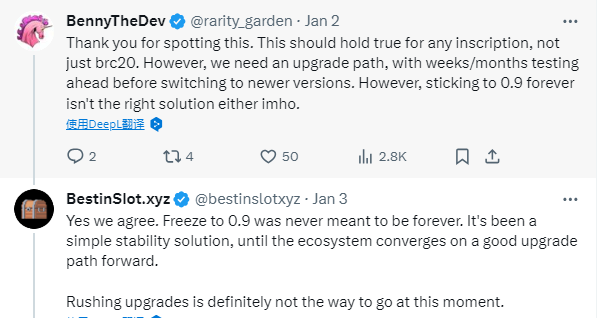
However, the founder of decentralized indexing protocol Trac argues that permanently sticking to v0.9.0 is not the right solution. Instead, a clear upgrade path is needed—one that includes weeks or even months of testing before switching to any new version.
BestinSlot responded that freezing at v0.9 doesn't mean forever—it’s always been intended as a temporary stabilization measure until the ecosystem establishes a safe upgrade pathway. For now, rushing into an upgrade is absolutely not the right choice.
Unisat, the leading advocate of the upgrade camp, wants to push the BRC20 protocol forward. In an interview with Decrypt, Unisat stated that the Jubilee upgrade holds significant importance for both Ordinals and BRC20. For Ordinals, it fixes long-standing historical issues; for BRC20, although the upgrade process might introduce new problems, these can be resolved through subsequent patches. In the long run, the benefits of the Jubilee upgrade outweigh the transitional risks for the entire ecosystem.
Unisat further explained that the initial agreement to freeze at v0.9 was understood as a temporary measure. But if this freeze evolves into a permanent detachment from the Ordinals protocol, it threatens future compatibility. Therefore, Unisat chose to take proactive action instead of remaining permanently disconnected. Despite the risk of fragmentation, Unisat hopes to keep pace with Ordinals’ development so that BRC20 can seamlessly interact with other protocols on the same platform.
Regarding the upgrade, Unisat’s founder said they postponed other ongoing tasks to ensure smooth execution. “Personally, I canceled all meetings this week to fully focus on the upgrade,” he stated.
Commenting on this controversy, user @lilyanna_btc noted that either a split or a prolonged freeze would create major flaws in the BRC20 protocol—such as high costs and inconsistent inscription numbering—opening the door for competing optimized protocols like CBRC20. Moreover, with rising competition from Atomicals and other emerging Bitcoin-layer protocols, BRC20—the most successful product built on Ordinals—faces increasing pressure. Neither a fork nor a forced indefinite freeze represents an ideal outcome.
Some users also pointed out that details about how the upcoming Jubilee upgrade affects BRC-20 indexing have not been clearly communicated. If regulatory changes impact indexing, the BRC20 protocol should be transparent and adhere to established rules. Currently, there’s a lack of official explanation—only abrupt decisions about upgrading, without inclusive discussion.
Clearly, both Ordinals and BRC20 are still evolving technologies, far from mature, with various bugs and issues requiring constant refinement.
Today, BRC20 stands at a crossroads. Whichever direction it ultimately chooses will have profound implications for its future.
Join TechFlow official community to stay tuned
Telegram:https://t.me/TechFlowDaily
X (Twitter):https://x.com/TechFlowPost
X (Twitter) EN:https://x.com/BlockFlow_News
 ChainCatcher 链捕手