
The Four Most Profitable Crypto-Related Concepts of 2023: Did You Hold On?
TechFlow Selected TechFlow Selected
The Four Most Profitable Crypto-Related Concepts of 2023: Did You Hold On?
Positive developments emerge one after another, sending crypto stock trading into a frenzy.
 Navigating Web3 tides with focused insights
By Mary Liu, Bitpush News
For crypto bulls, the winning bet in 2023 has been cryptocurrency- and blockchain-related stocks.
While Bitcoin has risen over 150% year-to-date, stocks closely tied to the crypto market have performed even better. Marathon Digital, Coinbase, MicroStrategy, and Grayscale Bitcoin Trust (GBTC) have all surged more than 300% in 2023. Among them, Bitcoin miner Marathon Digital is up nearly eightfold since the beginning of the year.
According to data from FactSet, these four crypto-linked stocks rank among the top eight best-performing U.S. listed companies with a market capitalization of at least $5 billion, with Marathon leading the pack.
Regulatory uncertainty has eased, and expectations of Federal Reserve rate cuts have made risk assets more attractive. In November 2022, cryptocurrency exchange FTX collapsed, triggering a cascade of hedge fund failures, bankruptcies among crypto lenders, and severe losses for miners. FTX founder Sam Bankman-Fried was arrested on fraud charges. Last month, a New York jury found SBF guilty on seven criminal counts, potentially facing life in prison. Weeks later, Binance founder Changpeng Zhao pleaded guilty and stepped down as CEO of the company.
The upcoming Bitcoin halving and the prospect of spot Bitcoin ETF approvals have further boosted prices. Galaxy Digital CEO Michael Novogratz said last week during a CNBC "Squawk Box" interview: "With so many tailwinds, crypto stocks are entering a frenzy."
Marathon’s “Phoenix-like Rebirth”
This time last year, Marathon's business was on shaky ground. Hit by plunging Bitcoin prices, power outages at its Montana facility, and financial exposure to the now-bankrupt miner Compute North, the company reported nearly $400 million in quarterly losses, with sales of just $28.4 million.

Fred Thiel, CEO of Marathon Digital, said in an interview last week: "It was an extremely difficult period. Bitcoin mining is a capital-intensive business because running supercomputers requires significant energy costs."
Thiel said the company managed to raise equity and was fortunate to have no debt beyond convertible notes.
Conditions improved dramatically in 2023. Last month, Marathon reported a third-quarter net profit of $64.1 million, with revenue jumping to $97.8 million compared to the same period last year. The company is now in expansion mode—last week it announced the acquisition of its first two wholly owned Bitcoin mining facilities, one in Texas and one in Nebraska, for $178.6 million. These purchases increased Marathon’s mining portfolio by 56%, bringing its total capacity to 910 megawatts.
"Through vertical integration, we capture profits that would otherwise go to third parties and operate our sites exactly how we want," Thiel said. "Much of the technology we’ve been developing focuses on efficiency improvements—something often overlooked in high-end markets where high prices drive high margins."
Thiel aims to ensure the company maintains strong cash flow if Bitcoin prices fall again. He also believes the company will eventually diversify its revenue streams through innovations such as converting methane into sellable electricity.
"One of our goals by 2028 is to reduce the share of revenue from Bitcoin mining to 50%," Thiel said.
Coinbase’s “Multiple Revenue Streams”
Outside the mining sector, the top-performing U.S. crypto stock this year has been Coinbase, which is up 450% year-to-date.
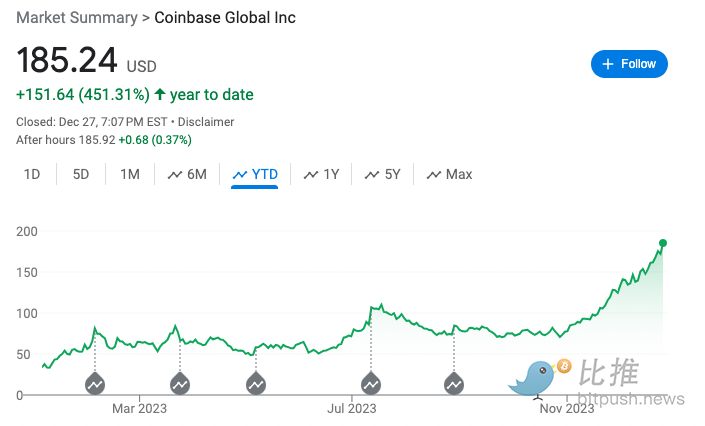
As the only publicly traded crypto exchange in the U.S., Coinbase has long been the go-to platform for buying and trading cryptocurrencies in the American market. But according to a late-November report from research firm Kaiko, Coinbase has also gained market share during non-U.S. trading hours amid regulatory troubles faced by Binance, the world’s largest exchange.
Coinbase’s revenue and stock price remain far below their peaks during the 2021 crypto bull run. However, after aggressive cost-cutting measures initiated last year and continued into early 2023, its business has stabilized.
Coinbase also offers investors services beyond crypto trading. In the third quarter, Bitcoin accounted for only 37% of Coinbase’s trading revenue, Ethereum for 18%, and other crypto assets for 46%. Additionally, interest income and stablecoin revenue (earned through USDC reserves) more than doubled in the most recent quarter to $212 million, driven by rising interest rates.
Currently, trading revenue accounts for less than half of Coinbase’s net revenue, down from 96% at the time of its 2021 IPO.
Coinbase CEO Brian Armstrong said: "We made a major effort post-IPO to begin diversifying our revenue. Now we have multiple income streams—some performing well in high-rate environments, others better in low-rate conditions—meaning our revenue is becoming more predictable."
Grayscale Bitcoin Trust
The Grayscale Bitcoin Trust (GBTC) has risen 330% this year. Launched in 2015 as an over-the-counter product, GBTC became the first publicly traded Bitcoin fund in the U.S., offering investors a passive way to gain Bitcoin exposure. A key challenge for investors in the past was that GBTC was a closed-end fund, making it less liquid than an ETF.
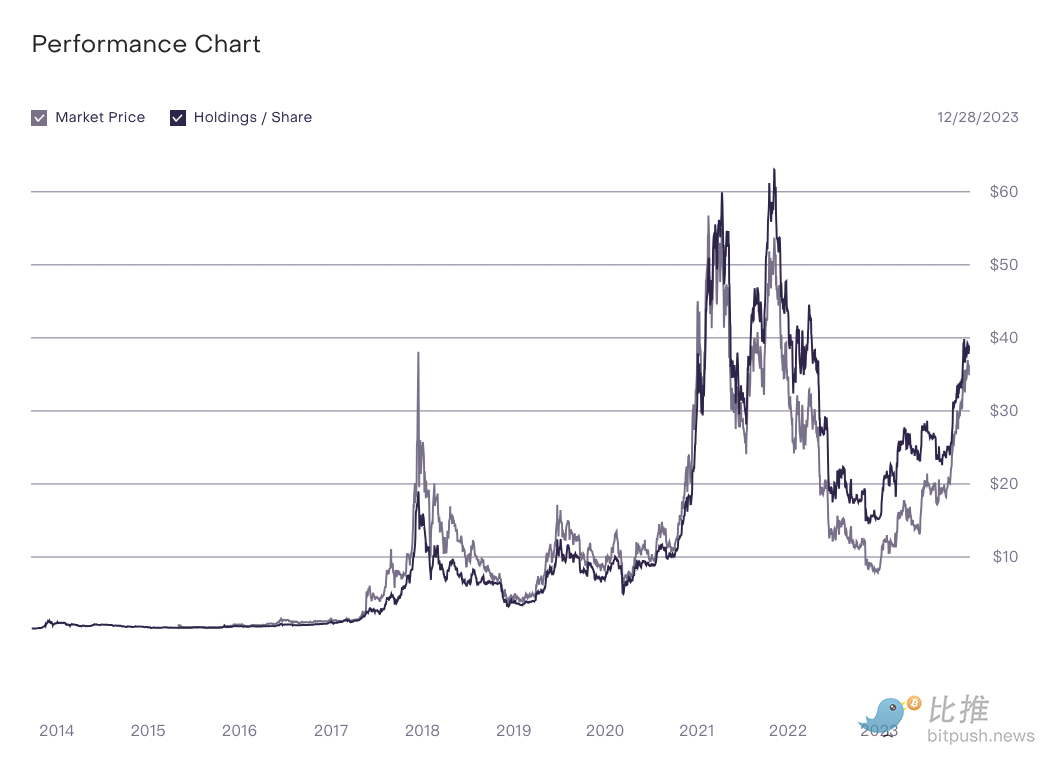
During last year’s bear market, GBTC traded at a discount of nearly 50% to its net asset value (NAV), meaning its market value was about half the value of the Bitcoin it held. As of December 22, that discount had narrowed to 5.6%, the lowest level since early 2021. The fund currently holds around $26.6 billion worth of Bitcoin, with a market capitalization of $24.7 billion.
Beyond this year’s Bitcoin rally, GBTC has also been buoyed by expectations that it will receive SEC approval to convert into an ETF next year. This transition would allow it to trade on traditional securities exchanges and benefit from liquidity mechanisms, aligning its market value more closely with its NAV.
Grayscale CEO Michael Sonnenshein said last week on CNBC’s "Squawk Box": "When my team won in court, I think it undoubtedly sparked investor optimism about GBTC and its prospects of listing as a spot Bitcoin ETF. As we head into the new year, I know the investment community is watching this very closely."
MicroStrategy, the Bitcoin “Whale”
Many investors have chosen MicroStrategy as a proxy for holding Bitcoin.
Founded in 1989 as a business intelligence software company, MicroStrategy’s stock has surged 360% this year, reaching an $8.3 billion market cap.
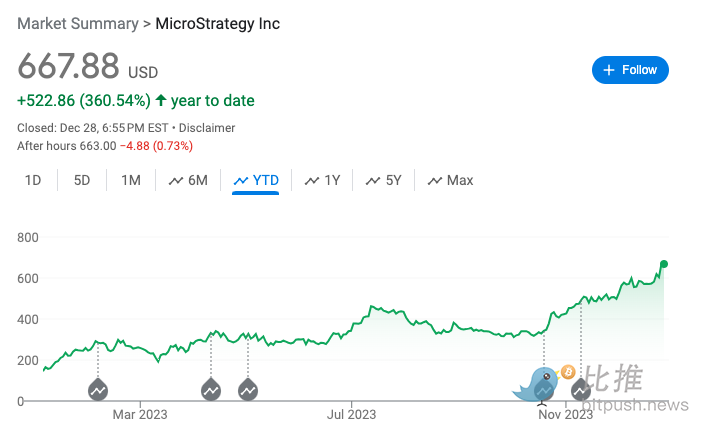
As of the end of November, the company held 174,530 bitcoins, worth approximately $7.4 billion. On Wednesday, the company disclosed in a regulatory filing that between November 30 and December 26, it added another 14,620 bitcoins for $615.7 million, bringing its total holdings to 189,150 bitcoins.
In mid-December, BTIG analysts raised their price target for MicroStrategy from $560 to $690, citing improving sentiment and the approaching Bitcoin halving.
Phong Le, who was promoted from CFO to CEO last year, said during a Q4 2020 earnings call that MicroStrategy’s Bitcoin investments allowed the company to “tap into broader enthusiasm across the cryptocurrency market,” adding, “We’ve seen significant growth, and our Bitcoin investment has brought unexpected benefits in enhancing the company’s image.”
Galaxy Digital CEO Mike Novogratz expects Bitcoin to break its all-time high next year, stating optimistically: "Overall, we’re still in a bull market."
Join TechFlow official community to stay tuned
Telegram:https://t.me/TechFlowDaily
X (Twitter):https://x.com/TechFlowPost
X (Twitter) EN:https://x.com/BlockFlow_News
 比推 BitpushNews