One-year gain of 80%, is Ethereum really underperforming?
TechFlow Selected TechFlow Selected
One-year gain of 80%, is Ethereum really underperforming?
Ethereum's outlook remains bright.
 Navigating Web3 tides with focused insights
Author: Zach Pandl, Grayscale
Translation: Chief Villager of Xiangyashan, Carbon Value Chain
Ethereum delivered strong returns in 2023. However, its performance lagged behind Bitcoin and some other smart contract platform tokens. We believe this reflects Bitcoin-specific tailwinds this year, along with a slow recovery in Ethereum’s on-chain activity.
Despite underperforming Bitcoin, Ethereum has outperformed traditional asset classes both in absolute and risk-adjusted terms this year. The continued growth of Ethereum’s Layer 2 ecosystem could attract new users and support ETH valuations in 2024.
Few would call an 82% gain “underwhelming,” but that’s exactly how Ethereum’s token ETH performed in 2023. As the second-largest crypto asset, Ethereum generated solid returns this year (with relatively low price volatility), yet it clearly trailed Bitcoin, which is on track to rise around 162%. The ETH/BTC price ratio declined throughout the year, reaching its lowest level since mid-2021 (see Figure 1).
The ETH/BTC price ratio trended downward in 2023
First, several Bitcoin-specific positive developments emerged this year, including progress toward spot Bitcoin ETFs and instability among U.S. regional banks, highlighting Bitcoin’s role as an alternative digital monetary system. These developments appear to have driven inflows into Bitcoin-focused cryptocurrency investment products throughout the year—possibly contributing to Bitcoin’s higher price returns. For example, Grayscale Research estimates that Bitcoin-focused crypto exchange-traded products (ETPs)—including futures-based products in the U.S. and spot-based products overseas—attracted approximately $2 billion in net inflows in 2023. In contrast, Ether ETPs saw total net inflows of just $24 million over the same period (see Figure 2).
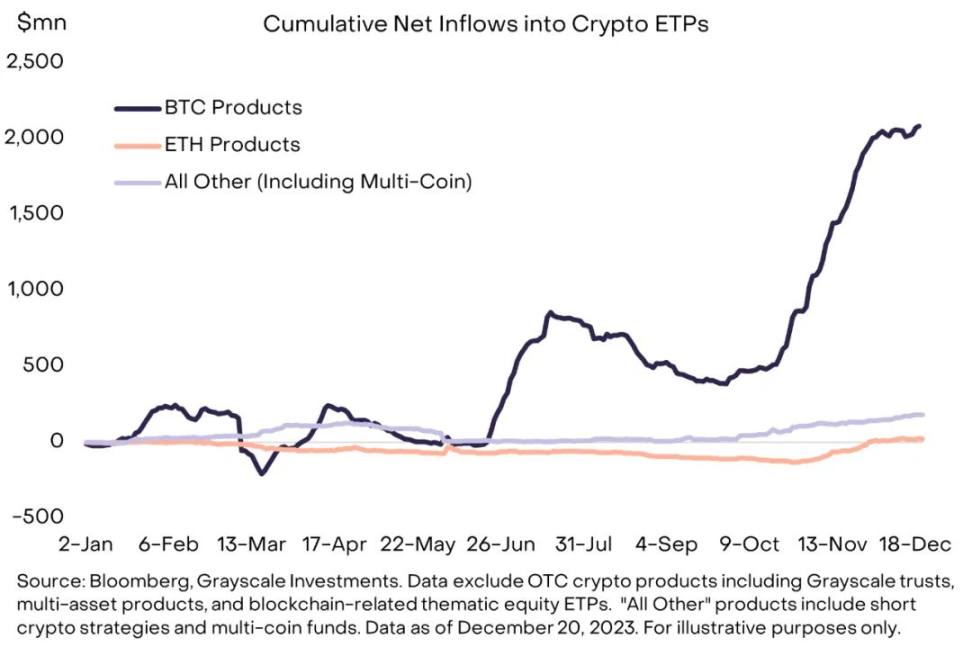 Bitcoin-specific tailwinds appear to have driven larger ETP inflows
Second, most smart contract platform tokens underperformed Bitcoin this year, with ETH broadly tracking Bitcoin’s performance. As shown in Figure 3, the FTSE Grayscale Smart Contract Platforms Cryptocurrency Index rose about 94% in 2023, only slightly ahead of ETH. Ether outperformed its peers over the 12 months through October, but other tokens have recently caught up (notable outperformers include AVAX and SOL). On a full-year basis, ETH ranked near the middle among the 40 smart contract platform cryptocurrencies.
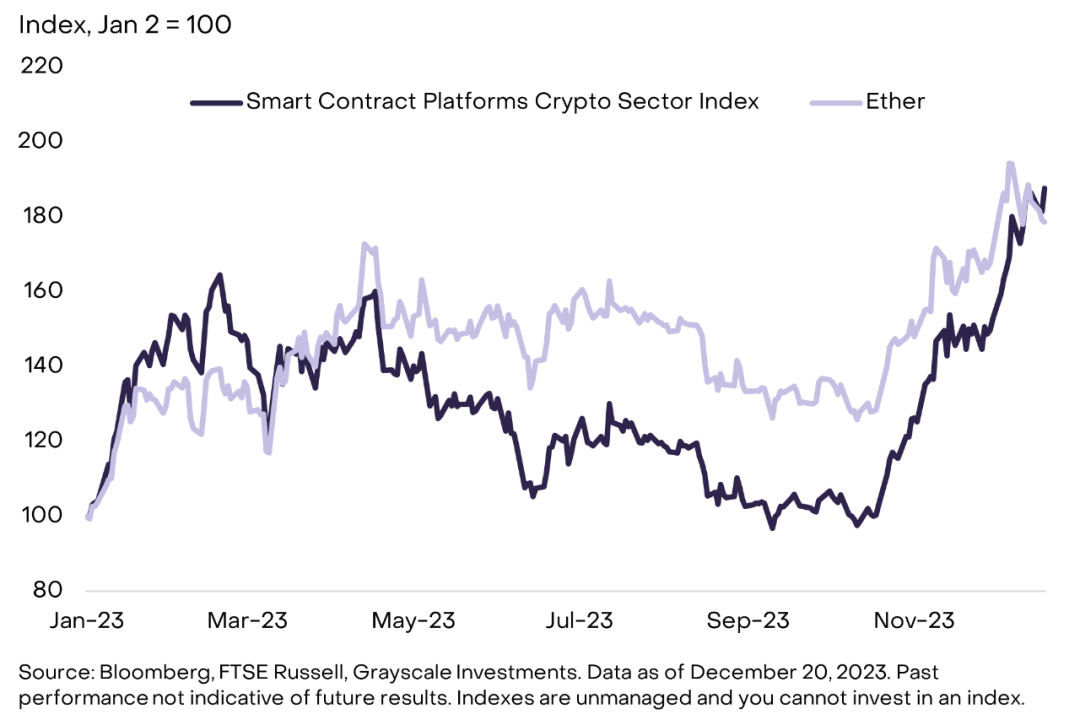 ETH performance aligned with the broader smart contract platform sector
Third, core network on-chain activity (in certain categories) on Ethereum has recovered more slowly compared to other chains. For instance, Solana’s NFT trading volume has grown faster since the start of the quarter (~15x) than Ethereum’s (~2x). While Grayscale Research remains constructive on Ethereum’s NFT ecosystem, Solana and Bitcoin have recently captured market share in this area of on-chain activity.
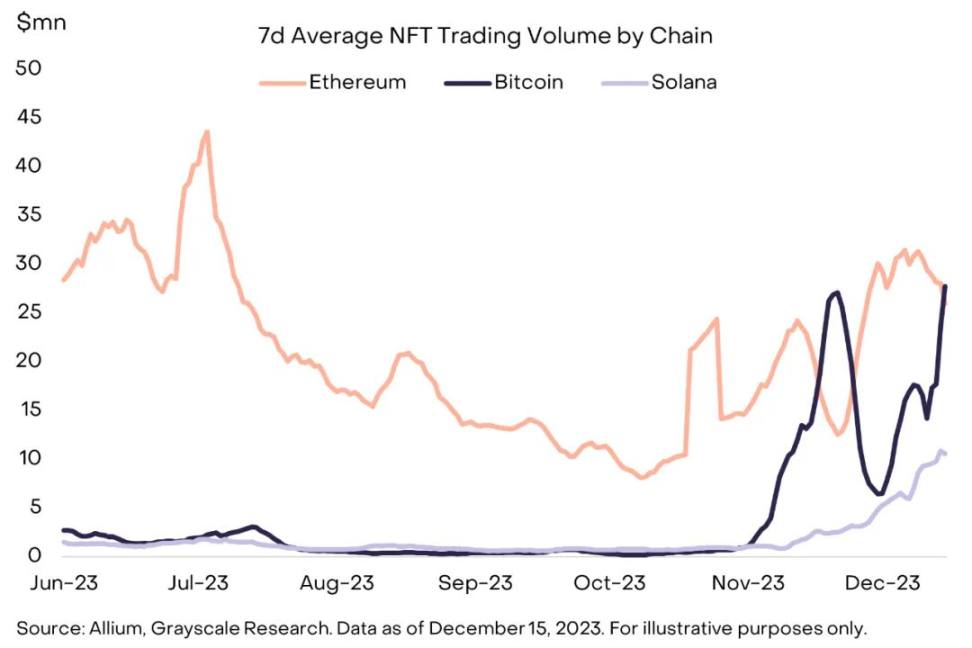 Rising NFT activity on Bitcoin and Solana
More broadly, although ETH underperformed Bitcoin and certain other crypto assets this year, it significantly outperformed traditional asset classes in both absolute and risk-adjusted terms (see Figure 5). Therefore, while ETH prices rose “only” 82% this year, we view its rebound as evidence of a broadening crypto recovery.
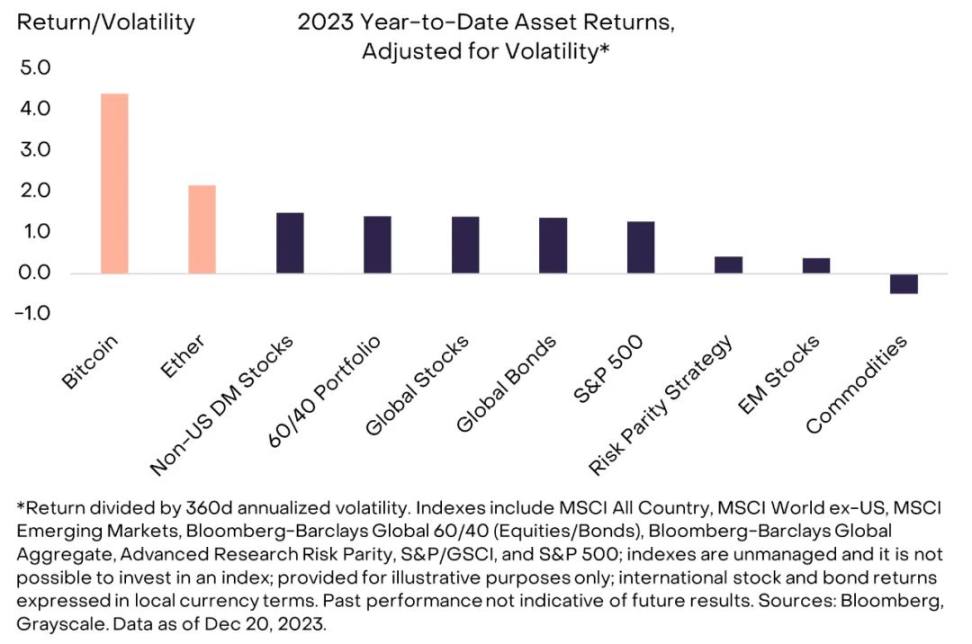 ETH’s risk-adjusted returns outperformed traditional asset classes
Despite the spotlight on other blockchains in 2023, Ethereum’s outlook remains bright. Most importantly, Ethereum has historically benefited from the deepest network effects in the industry, hosting the largest number of decentralized applications (DApps), developers, and generating the highest revenue. Ethereum is pursuing a “modular” development approach, where a Layer 2 ecosystem will be built atop the Layer 1 foundation, enabling scalable transaction throughput. This effort is ongoing, but next year’s EIP-4844 upgrade will mark a significant step forward by reducing the cost of posting transactions on Ethereum for Layer 2 scaling solutions by 10–100 times. This will help lower costs for users on Ethereum’s Layer 2 networks.
If Ethereum can attract new users to its expanding Layer 2 ecosystem, it could return to center stage in 2024. Among the five Grayscale cryptocurrency sectors, competition within the smart contract platform segment may be the fiercest.
Low-cost “monolithic” chains like Solana can offer compelling experiences for new users, especially when paired with well-designed wallets and other ecosystem applications. In contrast, Ethereum’s “modular” architecture may be harder to navigate, as users need to actively bridge assets between the mainnet and its L2s.
However, these networks are still in early stages of development, and it remains to be seen which blockchain design will achieve the best product-market fit and deliver the greatest long-term value to its native token. Once end users primarily interact with applications—and blockchain infrastructure operates seamlessly in the background—the current user experience challenges facing Ethereum should become less relevant, while Ethereum’s other strengths, such as credible decentralization, may attract developers and ultimately support token valuation. For investors uncertain about how competition among smart contract platforms will unfold, diversified exposure to this cryptocurrency sector may be worth considering.
Join TechFlow official community to stay tuned
Telegram:https://t.me/TechFlowDaily
X (Twitter):https://x.com/TechFlowPost
X (Twitter) EN:https://x.com/BlockFlow_News