Is AI-assisted market timing a pseudoscience? We spoke with an AI strategy fund manager.
TechFlow Selected TechFlow Selected
Is AI-assisted market timing a pseudoscience? We spoke with an AI strategy fund manager.
"You think price movements are merely the result of market supply and demand, but AI can see something in higher dimensions."
 Navigating Web3 tides with focused insights
Compilation: Peng SUN, Foresight News
"Successfully exited at the top in early 2022, successfully bought the bottom by year-end, and confidently predicted Bitcoin would rise above $40,000 when it was still below $20,000." As someone who constantly fails to guess market movements—a mere gambling dog in the cryptocurrency market—I can't help but feel envious reading about such track records.
But in reality, these calls weren’t made by humans. They were decisions generated by artificial intelligence based on data analysis.
Like many others entering the Web3 industry, Xin Liu, AI Strategy Fund Manager at Everest Link Capital, became deeply fascinated after first hearing the story of Bitcoin. However, her expertise lies more in market research.
Just as AlphaGo defeated human Go champions, AI executes trading strategies without emotion through massive data analysis and learning, uncovering subtle clues in price charts that humans might miss. As Xin Liu puts it:
"You see price movements as a battle between buying and selling forces, but AI perceives something from a higher dimension."
Foresight News: What are the backgrounds of your current team members? When did you start trading cryptocurrencies, and why did you choose crypto as an investment target?
Xin Liu: I joined the blockchain industry in 2016 and began developing the "Night Navigating Star" AI deep learning model that same year—now seven years ago. The model has primarily been applied to cryptocurrency and stock markets, surviving multiple bull and bear cycles and numerous extreme black swan events.
In 2016, cryptocurrencies—or Bitcoin specifically—were still excluded from mainstream finance. Coming from an asset management background, I was looking for alternative assets during portfolio allocation to reduce overall risk. It was at IC Coffee in Zhangjiang High-Tech Park’s subway station where I first heard a detailed introduction to Bitcoin, and I immediately resonated with the concepts of decentralization and incentive mechanisms.
Why did someone like me, raised in traditional finance, embrace decentralization so quickly? Because I once had a unique experience while working at Reuters, conducting macroeconomic research. There, I single-handedly built China’s first decentralized community composed of fixed-income traders. This gave me firsthand insight into the immense power of decentralization and the importance of incentives.
So on August 14, 2017, I published a research article on Wall Street Insights analyzing how allocating just 5% of a portfolio to Bitcoin could positively impact overall performance. Later, Andrew Ang, Chief Investment Strategist at BlackRock, echoed this view in his 2022 paper “Asset Allocation with Crypto: Application of Preferences for Positive Skewness.”
Foresight News: What criteria do you use when selecting specific trading assets?
Xin Liu: In fact, I'm very open-minded about sector selection. The greatest feature of this market is its rapid innovation, which also gives it tremendous vitality. Being "open" means minimizing preconceived biases and embracing innovations under conditions of high win rate and safety margin. Generally speaking, whenever a certain asset—whether from the "classical school" or the "meme coin crowd"—gains significant consensus, I’ll study it. If many people support something, love it, regardless of whether it looks like ballet or folk dance, there must be some profound human need it fulfills. Existence implies reasonableness.
Additionally, it must have a sustainable and scalable incentive mechanism. I place great emphasis on incentives—and the simpler and clearer they are in igniting individual desire, the more I value them. You'll notice successful projects, whether public blockchains or ecosystem applications, share this trait: collective participation fuels collective success. Especially in the Web3 world, you need mechanisms that ignite every individual's inner fire.
This explains my strong compatibility. But how can we afford to explore such a wide range of high-risk innovative assets? Because AI deep learning enables precise control over price trends, significantly improving both the win rate and safety margin when embracing innovation. For example, we're currently developing new strategies using AI deep learning models to identify opportunities in inscriptions and meme coins. Although inscriptions are now booming, practitioners face real challenges: 1) risk of minted inscription projects failing; 2) high gas fees during minting; 3) risk of getting buried if mint fails; 4) competition from automated minting studios. So which promising inscription projects should we mint? And if we miss the mint, at what price should we enter for higher success probability? These are exactly the questions our AI deep learning models are solving. The same logic applies to meme coins.
Foresight News: Can you elaborate on your AI-based deep learning trading strategy? What parameters does the model consider? Which indicators do you reference? What is the underlying logic behind calculating trade directions?
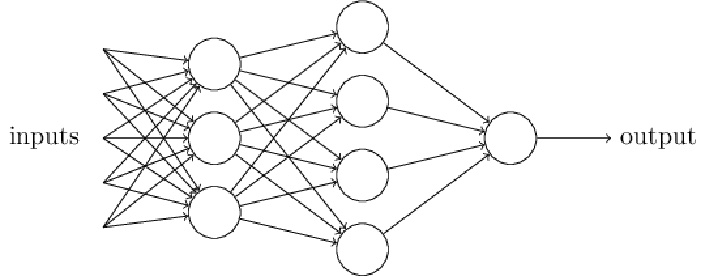
Xin Liu: Simply put, AI deep learning mimics the way human neurons think. The image shows a basic model: the input layer represents incoming data, the output layer represents final predictions, and the layers in between are called hidden layers—extremely complex and sophisticated. Unlike traditional methods requiring manually defined features, AI deep learning automatically learns and extracts features directly from raw data. Common domains include price trends, volume changes, and market sentiment. Thanks to nonlinearity and adaptability, combined with computing power for processing large-scale data, AI-simulated neural systems can surpass human cognition in understanding fundamental patterns.
As for specific parameter designs, due to commercial confidentiality, I cannot disclose too much detail.
Foresight News: Price movements of financial products are essentially determined by supply and demand dynamics. How can such theoretically chaotic events be predictable? Is forecasting future price movements akin to pseudoscience? What scientific basis supports this?
Xin Liu: I read a paper titled *Observing Schrödinger's Cat with Artificial Intelligence: Emergent Classicality from Information Bottleneck*. It uses AI to analyze the famous Schrödinger's cat thought experiment. To summarize briefly: gods, humans, and lower beings fundamentally differ in their ability to process information. That’s actually the perfect answer to your two questions.
For instance, when you say price fluctuations result from market supply-demand battles, that perspective makes prediction seem impossible—this reflects ordinary human causal perception, right? But another possibility exists: viewing this battle from a higher-dimensional information-processing level reveals a different picture. In fact, from the AI deep learning perspective, back in May I already saw Bitcoin rising above $40,000, and later events emerged to catalyze that outcome. At the time, I didn’t know precisely which events would drive it—but I knew corresponding catalysts would inevitably appear. Do you see the difference in causality here? Because AI processes information far beyond human capacity, it sees things invisible to most people, creating seemingly 'mystical' prophecies.
Foresight News: During our conversation, you mentioned the previously observed 'four-year bull-bear cycle' tied to Bitcoin halvings may fail this round. Why do you believe this?
Xin Liu: Let me clarify—I mean that past and present Bitcoin has followed halving cycles, making bull and bear markets highly regular and thus easier for ordinary investors to predict: bull markets around halving events, followed by two years of bear markets. But soon after the fourth halving ends, a large proportion of Bitcoins will enter circulation while remaining mineable supply becomes extremely scarce. By common sense, the larger circulating portion will dominate the smaller mineable fraction. Therefore, future bull and bear cycles will become much more complex—not as clearly rhythmic as today. After this halving cycle concludes, what logic will people use to judge long-term market trends? I believe AI deep learning will become a crucial tool for identifying long-cycle bull and bear phases.
Foresight News: With increasing participants in the crypto market, price movements are becoming more complex. This year’s trends no longer follow simple cyclical patterns. In increasingly complicated future scenarios, how can AI deep learning assist in market forecasting? Compared to conventional theories used to predict market direction, what concrete advantages does AI offer?
Xin Liu: You're right—the market is growing more complex. Cyclical trends may still exist, but they’re no longer straightforward. Anyone who experienced the March 2020 Bitcoin rally knows this well. Combined with the upcoming post-halving phase, judging bull and bear markets will become significantly harder. AI’s advantage lies in its powerful data-processing capabilities, enabling it to detect trends invisible to ordinary observers from higher dimensions. For example, do you know when we first identified the bottom of this bull run? We first proposed a bottom around $16,000 in August 2022, and reiterated this signal four times—in August, September, and November of that year. But anyone who lived through that period knows the sentiment near $16,000 was extremely pessimistic—even major institutions were forecasting drops to $11,000. Yet our internal model showed no downside below $16,000. Similarly, in October and November this year, our AI flagged Estée Lauder and U.S.-based retailer Dollar General. At the time, both stocks were suffering from negative earnings reports and widespread pessimism. Then in December, Goldman Sachs included both on its 2024 “Top Buy” list—we spotted them two months earlier. In short, we live by Buffett’s principle: ‘Be fearful when others are greedy, and greedy when others are fearful.’
Foresight News: Some in the market argue that trading and investing are fundamentally different. Trading, to some extent, ignores fundamentals and focuses solely on technical signals to predict short-term price movements, whereas investing leans toward long-term thinking, focusing on industries, sectors, and project development. What are your thoughts on trading versus investing?
Xin Liu: I don’t see trading and investing as contradictory—at least not for us. Our medium-to-long-term trading strategies align closely with investment principles. If you're referring to high-frequency trading or arbitrage strategies, then yes, those differ significantly.
Both investing and trading are essential survival skills in the market. The perception that they conflict arises because it's difficult for individuals to master both simultaneously. But with AI assistance, we’ve achieved integration of both capabilities. This suggests AI will dramatically enhance individual productivity in the future.
It’s well known that crypto assets carry high risks: First, many projects go public extremely early—sometimes just with a whitepaper—exposing investors to project failure risks. Second, innovation and iteration in the crypto world move incredibly fast, meaning long-term thinking must accommodate rapid change. Third, even within strong sectors, token prices can swing wildly. As asset managers responsible for generating returns for LPs, we must balance long-term vision with tactical flexibility to deliver consistent, stable gains. So rather than debating whether to pursue investing or trading, the best path forward is combining both.
Foresight News: What is your general outlook for the cryptocurrency market over the next few years?
Xin Liu: Let me share four key predictions:
1. Bitcoin’s price trajectory will become more complex
After the fourth halving concludes, long-term Bitcoin market patterns won’t remain as predictable as they are today. Halvings have acted like anchor points shaping major market trends. Once that stabilizing force fades, new factors—previously unseen by most crypto participants—will take center stage. Put simply, this cycle may represent the last easy opportunity for average investors to profit. Beyond this point, only those with deep, sophisticated research capabilities will thrive.
2. Cryptocurrency investing will grow more decentralized—super individuals empowered by AI will either replace or coexist with institutions
The world is moving toward disintermediation. In crypto especially, information asymmetry continues to shrink. Investors are maturing, forming independent judgments and increasingly unwilling to absorb VC dumps. Whether institutional or individual, investing ultimately depends on superior insight and judgment. In the AI era, individual productivity will be massively amplified—one person may accomplish what previously required an entire firm. Thus, credibility in the future will hinge not on organizational form, but on consistently accurate investment insights and outcomes—regardless of whether they come from institutions or individuals.
3. Divergence between major coins and small-cap tokens
With the Binance case settling, regulators are accelerating demands for centralized exchange compliance. For many emerging small-cap projects, compliance costs will be prohibitively high, as will potential litigation expenses. This increases risks for project founders and squeezes small-cap survival space on centralized exchanges. On average, small caps will receive less traffic, while major coins attract more. We won’t see another 2017-like scenario where all altcoins surge indiscriminately. Instead, capital will rotate cyclically among select small-cap plays.
4. Explosive growth of decentralized exchanges and wallets
The allure of the crypto industry lies in offering every newcomer—regardless of entry timing—a stage and voice, provided they possess sharp insight. No need to inherit legacy interests. This gives crypto absolute appeal to young people worldwide, sustained by constant innovation. If innovative small-cap projects get squeezed out of centralized exchanges, they’ll naturally migrate elsewhere—and decentralized exchanges and wallets are the ideal destination.
Join TechFlow official community to stay tuned
Telegram:https://t.me/TechFlowDaily
X (Twitter):https://x.com/TechFlowPost
X (Twitter) EN:https://x.com/BlockFlow_News
 Foresight News